

Quick Summary: The best architectural outsourcing companies in 2026 combine technical expertise with reliable project delivery across CAD drafting, BIM modeling, 3D visualization, and full architectural design services. This comprehensive guide profiles ten leading agencies that serve architecture firms, construction companies, and real estate developers worldwide, highlighting their specializations, service offerings, and what makes each stand out in the competitive outsourcing landscape.
Finding the right architectural outsourcing partner can transform how architecture firms handle workload peaks, access specialized skills, and manage project timelines. The challenge? Sorting through hundreds of companies that all claim to offer top-tier services.
This guide cuts through the noise. The ten companies featured here have proven track records, specialized expertise, and the infrastructure to deliver quality work consistently. No fluff, no generic lists scraped from directories—just agencies that architectural professionals actually use and recommend.
The architectural outsourcing landscape has matured significantly. What started as basic CAD drafting services has evolved into comprehensive partnerships that span everything from conceptual design to construction documentation and virtual reality walkthroughs.
What Makes an Architectural Outsourcing Company Worth Considering
Before diving into the company profiles, it helps to understand what separates exceptional outsourcing partners from mediocre ones.
Technical proficiency matters, obviously. But so does communication reliability, cultural fit, time zone compatibility, and experience with the specific project types relevant to your practice.
The best architectural outsourcing companies demonstrate several key characteristics:
- Software expertise across platforms: Proficiency in AutoCAD, Revit, ArchiCAD, SketchUp, Rhino, and rendering engines like V-Ray, Lumion, or Enscape
- Quality control systems: Multi-layer review processes that catch errors before deliverables reach clients
- Scalability: Ability to handle sudden workload increases without sacrificing quality or missing deadlines
- Communication infrastructure: Responsive project managers, clear workflows, and reliable collaboration tools
- Industry specialization: Deep experience in residential, commercial, hospitality, healthcare, or other specific building types
- Portfolio transparency: Willingness to share detailed case studies and client references
Geographic location influences service delivery more than some companies admit. Teams in Eastern Europe often balance cost-effectiveness with strong technical education systems. Latin American firms provide time zone overlap with North American clients. Asian outsourcing hubs bring massive scalability but sometimes require more structured communication protocols.
None of these factors alone determines whether a partnership will succeed. The right fit depends on project requirements, firm culture, and specific workflow needs.
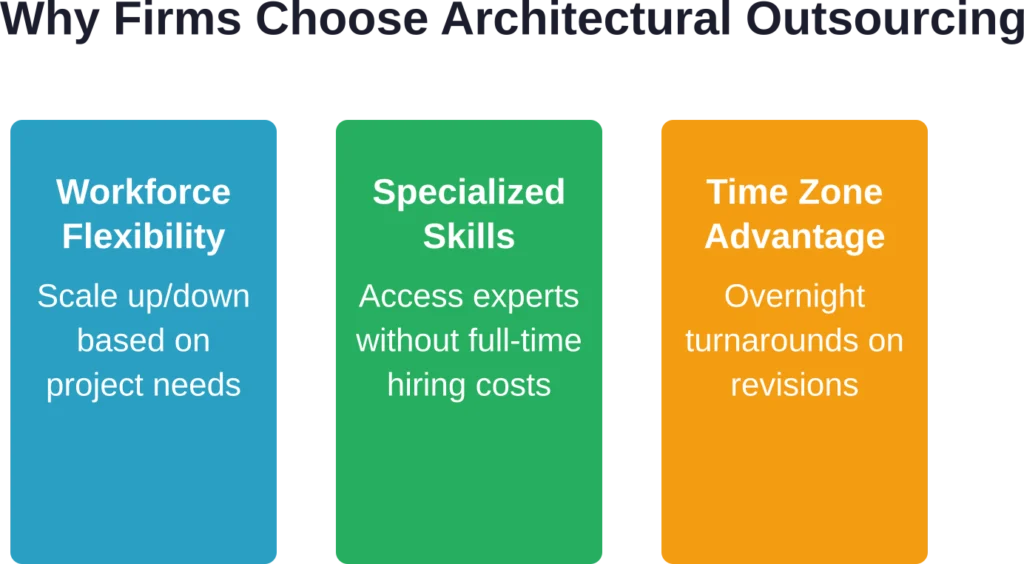
Why Architectural Firms Choose to Outsource
The decision to outsource architectural work stems from practical business realities, not just cost considerations.
Architecture practices face unpredictable workload fluctuations. Landing a large commercial project can overwhelm in-house teams for months, while quieter periods leave staff underutilized. Hiring permanent employees for peak demand creates unsustainable overhead during slower months.
Outsourcing provides workforce flexibility. Firms can scale capacity up or down based on actual project needs rather than maintaining fixed teams sized for worst-case scenarios.
Specialized skills represent another driver. Creating photorealistic renderings, developing detailed MEP coordination models, or producing construction documentation for unfamiliar building types often requires expertise that doesn’t justify a full-time hire.
Time zone advantages matter more than firms initially expect. Partnering with teams several hours ahead enables overnight turnarounds on documentation revisions or rendering iterations—essentially extending the productive workday.
The architectural outsourcing market has matured considerably. Early adopters often encountered quality control problems, communication breakdowns, and disappointing deliverables. Modern outsourcing companies have professionalized substantially, implementing quality systems and communication protocols that rival many domestic firms.
That said, outsourcing introduces complexity. Managing remote teams requires clear standards, detailed briefings, and sometimes more upfront effort than delegating to someone sitting three desks away. The payoff comes through consistent, predictable capacity that doesn’t require office space, benefits administration, or long-term employment commitments.
The Top 11 Architectural Outsourcing Companies in 2026
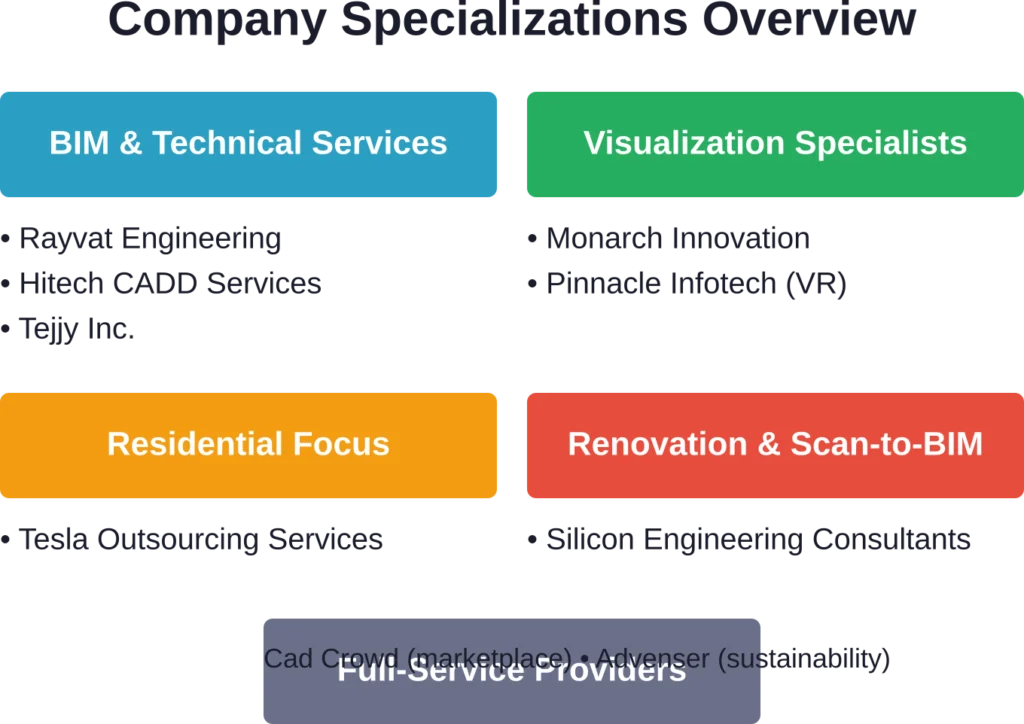
These companies represent the strongest options across different specializations, geographic regions, and project types. Each profile covers their core services, what makes them distinctive, and which types of firms they serve best.

1. Powerkh
Powerkh is a UK-based BIM and VDC consultancy with offices in the United States and Ukraine, supporting architectural firms, contractors, engineers, and developers with outsourced BIM and design support services. The company provides architectural BIM modelling, 3D rendering, Scan to BIM, coordination support, and project documentation for residential, commercial, and industrial projects. Their services are used by teams that need additional BIM and modelling support during design and construction stages.
The company works with Autodesk Revit, Navisworks, and point cloud-based workflows to support architectural, structural, and MEP coordination across different project phases. Powerkh provides BIM modelling from LOD 100 to LOD 500, clash detection, constructability review, Revit family creation, and as-built modelling. They also support renovation and reconstruction projects through point cloud processing and existing conditions modelling.
Powerkh’s approach focuses on practical BIM workflows, coordination between disciplines, and maintaining accurate project information throughout the project lifecycle. Their outsourced support services are used to help project teams manage modelling workloads, improve coordination, and prepare project documentation for construction and fabrication stages.
Contact Information:
- Website: www.powerkh.com
- Email: [email protected]
- Facebook: www.facebook.com/100064039650167
- LinkedIn: www.linkedin.com/company/powerkh
- Instagram: www.instagram.com/powerkh_com
- Address: 3, Lavinia Walk, Taw Hill, Swindon SN25 1AP
- Phone: +44 7490 426678
2. Cad Crowd
Cad Crowd operates as a marketplace-style platform connecting architecture firms with vetted CAD professionals and design specialists worldwide. Their model differs from traditional outsourcing firms—instead of maintaining permanent in-house teams, they curate a network of pre-screened freelancers and small studios.
This approach provides unusual flexibility. Projects can be matched with professionals who have specific experience in the exact building type, design software, or documentation standard required. A healthcare facility project gets assigned to drafters who’ve worked on medical buildings; a historic renovation connects with specialists familiar with preservation standards.
The quality control system addresses the inherent challenge of marketplace models. All professionals undergo portfolio review and skills testing before joining the network. Project managers oversee deliverables, conducting multi-stage reviews before files reach clients.
Services span CAD drafting, 3D modeling, rendering, construction documentation, and as-built drawings. Software coverage includes AutoCAD, Revit, SketchUp, Rhino, and major rendering platforms.
Cad Crowd works well for firms seeking variable capacity without long-term commitments. The marketplace structure means they can handle everything from single-sheet as-builts to multi-building development documentation, scaling resources to match project size.
Communication happens primarily through their project management platform, with assigned coordinators handling task briefings and revision cycles. Response times typically run faster than traditional outsourcing companies because projects get matched with available professionals rather than queued for busy teams.

3. Monarch Innovation
Monarch Innovation specializes in high-end architectural visualization and virtual reality experiences for commercial and residential development projects. While many companies offer rendering services as one option among many, Monarch Innovation focuses exclusively on creating photorealistic imagery and immersive presentations.
Their client base skews toward real estate developers, architecture firms pitching major projects, and design-build companies marketing luxury residential developments. If the goal involves stunning imagery for marketing materials, investor presentations, or public hearings, Monarch Innovation delivers exceptional results.
The team uses industry-leading rendering engines including V-Ray, Corona, and Unreal Engine for real-time walkthroughs. They’ve developed specialized expertise in exterior visualizations that accurately represent how buildings interact with natural light throughout the day—critical for presentations where lighting conditions significantly impact perceived design quality.
Beyond static renderings, Monarch Innovation produces animated flythroughs, interactive VR experiences viewable through headsets, and 360-degree panoramas for web-based virtual tours. These deliverables help clients communicate design intent more effectively than traditional presentation boards or static images.
Project timelines vary based on complexity, but they’ve built reputation around meeting tight deadlines for proposal submissions and client presentations. Rush projects get accommodated more readily than at larger, more bureaucratic outsourcing firms.
The main limitation? Monarch Innovation doesn’t handle construction documentation, technical drafting, or BIM coordination. They’re visualization specialists, period. Firms needing comprehensive outsourcing services will require additional partners for production work.

4. Rayvat Engineering
Rayvat Engineering brings substantial technical depth to architectural outsourcing, particularly for complex commercial, industrial, and infrastructure projects requiring coordination across multiple disciplines.
Based in India with project managers covering North American time zones, Rayvat maintains teams specializing in architectural drafting, structural engineering support, MEP coordination, and BIM services. This multidisciplinary capability makes them valuable for projects where architectural drawings need tight integration with engineering systems.
Their BIM services deserve particular attention. Rayvat has invested heavily in Revit expertise, developing internal standards and family libraries that align with both American and international BIM protocols. They handle clash detection, quantity takeoffs, 4D scheduling integration, and facility management model preparation.
The company serves architecture firms, engineering consultancies, construction companies, and facility management organizations. Project types span commercial office buildings, manufacturing facilities, hospitals, educational campuses, and transportation infrastructure.
Quality assurance follows a three-tier review process: the assigned drafter or modeler completes initial work, a senior technician reviews for technical accuracy and standard compliance, then a project manager conducts final checks before delivery. This systematic approach reduces errors that plague some outsourcing relationships.
Communication infrastructure includes dedicated project managers, cloud-based collaboration through BIM 360 or similar platforms, and structured weekly review calls for ongoing projects. Response times to emails and revision requests typically fall within four to six hours during overlap periods.
Rayvat Engineering works best for firms with clearly defined standards, detailed project briefs, and the internal processes to manage offshore teams effectively. They deliver excellent results when given thorough direction but require more guidance than some Western firms accustomed to self-directed team members.

5. Tesla Outsourcing Services
Tesla Outsourcing Services (unrelated to the automotive company) has built a strong reputation in residential architecture, particularly for custom home builders, residential design firms, and renovation contractors across North America.
Their specialization makes the difference. Rather than attempting to serve all building types, Tesla focuses exclusively on residential projects. This narrow focus means their teams understand residential building codes, typical construction methods, and the documentation requirements that municipalities expect for permit submissions.
Services include schematic design development, construction documentation, permit drawing preparation, 3D modeling, and rendering. They handle everything from single-family homes to multi-unit residential developments, including townhomes, condominiums, and apartment buildings.
The company maintains offices in both India and the United States, providing project management support during North American business hours while production work happens overnight. This arrangement enables fast turnaround cycles that residential firms appreciate when working toward permit submission deadlines or client presentation dates.
Tesla has developed template libraries for common residential building elements—standard stair details, typical wall sections, fixture schedules—that accelerate production while maintaining consistency. These resources get customized for each project but provide solid starting points that reduce drafting time.
Communication happens through a client portal for file sharing, email for day-to-day coordination, and video calls for project kickoffs or complex discussions. The portal system keeps project files organized and maintains revision history, addressing a common pain point in outsourcing relationships where tracking file versions becomes problematic.
Tesla Outsourcing Services fits residential firms seeking reliable production support without the overhead of additional in-house staff. They’re less suitable for commercial work or highly experimental residential design that requires extensive custom detailing.

6. Hitech CADD Services
Hitech CADD Services operates as a comprehensive architectural and engineering outsourcing provider serving a global client base from production facilities in India and project management hubs in the United States and Europe.
What distinguishes Hitech is their investment in process standardization and technology infrastructure. They’ve developed ISO-certified workflows, comprehensive quality management systems, and sophisticated project tracking tools that provide clients with unusual visibility into work progress.
Service offerings cover architectural drafting, BIM modeling, structural engineering support, MEP design and coordination, 3D rendering, virtual reality development, and construction administration support. This breadth means firms can consolidate multiple outsourcing needs with a single provider rather than managing relationships with separate vendors for different services.
Hitech maintains specialized teams organized by building type—commercial, residential, healthcare, hospitality, industrial, and institutional. Assigning projects to teams with relevant experience improves deliverable quality because drafters understand typical construction methods and regulatory requirements for specific building categories.
The company’s quality system implements multi-stage reviews at 30%, 60%, 90%, and 100% completion milestones. Clients receive progress updates at each stage and can redirect work before teams invest too much effort in incorrect directions. This checkpoint system prevents the unpleasant surprise of receiving completed drawings that missed the brief.
Software capabilities span AutoCAD, Revit, ArchiCAD, Tekla, Navisworks, SketchUp, 3ds Max, Lumion, and Enscape. Teams can work in whichever platform clients prefer rather than forcing format conversions.
Hitech CADD Services suits mid-size to large architecture and engineering firms seeking a strategic outsourcing partner capable of handling substantial workloads with professional project management and quality assurance. Smaller firms might find their processes more structured than necessary for simple projects.
7. Silicon Engineering Consultants
Silicon Engineering Consultants has carved out a niche in BIM services, scan-to-BIM conversion, and construction documentation for architecture and construction firms managing renovation, retrofit, and historic preservation projects.
Their scan-to-BIM capability addresses a specific pain point: converting laser scan data from existing buildings into accurate Revit models. Many firms invest in 3D scanning equipment but lack the internal capacity to process point cloud data into usable BIM models efficiently.
Silicon’s teams extract structural elements, architectural features, MEP systems, and site conditions from scan data, creating detailed as-built models that serve as the foundation for renovation design. This service proves valuable for healthcare facility upgrades, industrial plant modifications, and adaptive reuse projects where accurate existing conditions documentation determines project feasibility.
Beyond scan-to-BIM, Silicon provides traditional architectural drafting, BIM coordination, clash detection, construction documentation, and shop drawing preparation. Their project experience includes commercial buildings, healthcare facilities, educational institutions, and industrial plants.
The company maintains partnerships with major scanning hardware vendors and has developed workflows optimized for processing large scan datasets efficiently. They can handle projects ranging from single rooms to entire campuses, delivering models at LOD 300-400 depending on project requirements.
Quality control focuses on dimensional accuracy verification—randomly checking model measurements against scan data to ensure geometry matches real-world conditions within acceptable tolerances. This validation step catches modeling errors before clients base design decisions on incorrect existing conditions information.
Silicon Engineering Consultants works well for firms specializing in renovation work, facility management organizations maintaining BIM records of existing properties, and construction companies coordinating complex retrofit projects. New construction specialists without scan-to-BIM needs might find better fits elsewhere.
8. Advenser
Advenser positions itself as a design and engineering services provider emphasizing sustainability analysis, energy modeling, and performance-driven design support alongside traditional architectural outsourcing services.
This focus on building performance distinguishes them from pure production outsourcing firms. Advenser teams include energy modelers, daylighting analysts, and sustainability consultants who can run simulations, evaluate design alternatives, and support LEED or other green building certification processes.
Services span architectural design development, BIM modeling, construction documentation, MEP engineering, structural engineering support, energy analysis, CFD simulation, and daylighting studies. The integration of design services with technical analysis creates value for firms pursuing high-performance buildings or navigating increasingly stringent energy codes.
Software expertise includes Revit, AutoCAD, SketchUp, Rhino + Grasshopper for parametric modeling, EnergyPlus and IES-VE for energy analysis, Radiance for daylighting, and ANSYS for CFD work. This technical stack supports both conventional documentation and advanced performance analysis.
Advenser serves architecture firms, engineering consultancies, real estate developers, and facility owners pursuing sustainable design. Project types include commercial offices, educational facilities, healthcare buildings, residential developments, and industrial facilities.
The company’s approach works best when engaged early in design development, where performance analysis can actually inform design decisions rather than just documenting outcomes of completed designs. Late-stage engagement for production work alone underutilizes their technical capabilities.
Project management happens through cloud collaboration platforms with weekly progress reviews, milestone deliverables, and structured quality checkpoints. Teams can work as an extension of client design teams or operate semi-independently with periodic check-ins, depending on client management preferences.

9. Tejjy Inc.
Tejjy Inc. specializes in Revit BIM services, focusing exclusively on building information modeling rather than attempting to cover all architectural services. This specialization has made them a go-to resource for firms implementing BIM workflows or managing complex projects requiring sophisticated coordination.
Services include BIM model development from design sketches or PDFs, architectural Revit families creation, BIM coordination and clash detection, quantity takeoffs, 4D scheduling integration, construction documentation from BIM models, and as-built model development.
What makes Tejjy valuable is their deep Revit expertise. They’ve developed extensive custom family libraries, standardized workflows for common project types, and troubleshooting knowledge that helps clients overcome technical challenges in Revit implementation.
The company serves architecture firms transitioning from CAD to BIM, contractors using models for coordination and estimation, owners developing BIM standards for facility management, and engineering firms requiring architectural model development.
Tejjy’s teams stay current with Revit updates and emerging BIM technologies, regularly training on new features and workflows. This commitment to technical currency matters in BIM outsourcing where software capabilities evolve rapidly and yesterday’s best practices become outdated.
Communication infrastructure includes dedicated BIM managers, cloud-based model sharing through BIM 360 or similar platforms, and regular coordination meetings. They can integrate directly into client project teams or operate as a separate documentation resource depending on workflow preferences.
Quality assurance emphasizes model integrity—checking for warnings and errors that compromise model reliability, validating that families are built correctly, ensuring linked models coordinate properly, and confirming that documentation extracted from models matches design intent.
Tejjy Inc. fits firms committed to BIM who need production capacity or specialized technical expertise. Architecture practices still working primarily in 2D CAD might find the BIM-exclusive focus doesn’t match their current needs.

10. QuickBIM Solutions
QuickBIM Solutions delivers fast-turnaround BIM and drafting services tailored for architecture firms facing tight deadlines, sudden workload spikes, or project schedule compression.
Speed defines their value proposition. While many outsourcing companies promise quick turnarounds, QuickBIM has built systems explicitly optimized for rapid delivery. They maintain buffer capacity, run extended shifts to accommodate rush projects, and structure teams to pivot quickly when urgent requests arrive.
Services include architectural drafting, Revit modeling, construction documentation, 3D rendering, and drawing conversions between formats. They handle both new construction and renovation projects across commercial, residential, and institutional building types.
The rapid turnaround capability comes with some trade-offs. QuickBIM works best with clearly defined scopes where deliverable requirements can be specified precisely. Complex design development requiring iterative exploration and frequent direction changes suits their model less well than straightforward production tasks.
Software coverage includes AutoCAD, Revit, SketchUp, and major rendering platforms. Teams can work in client-provided templates and standards, adapting to different documentation approaches rather than imposing their own conventions.
Communication happens through email, instant messaging for urgent items, and video calls for project kickoffs. The informal communication style matches their quick-turnaround positioning—less formal process, more responsive flexibility.
Quality control follows a two-stage review: senior technician review and project manager final check. While less elaborate than some competitors’ multi-tier systems, it provides reasonable error-catching without introducing delays.
QuickBIM Solutions fits firms that occasionally need emergency capacity when projects compress or internal staff face unexpected absences. They’re less suitable as a primary strategic outsourcing partner for firms seeking ongoing capacity augmentation with highly structured workflows.

11. Pinnacle Infotech Solutions
Pinnacle Infotech Solutions operates as a full-service architectural and engineering outsourcing provider with particular strength in large-scale commercial, hospitality, and mixed-use development projects.
The company maintains substantial capacity—large enough to staff entire project documentation efforts for significant developments while providing the infrastructure to manage complex multi-building projects requiring coordination across disciplines.
Services span architectural design development, construction documentation, BIM services, interior design support, landscape architecture, MEP engineering, structural engineering support, 3D visualization, virtual reality, and construction administration documentation.
What distinguishes Pinnacle is their account management approach. Rather than treating each project as a standalone transaction, they assign dedicated account managers who learn client standards, understand firm culture, and maintain continuity across multiple projects. This relationship-oriented model reduces onboarding friction for subsequent projects.
The company has developed specialization in hospitality projects—hotels, resorts, restaurants—where they’ve accumulated deep knowledge of operational requirements, brand standards, and the unique documentation needs of hospitality construction. Architecture firms with strong hospitality practices find this specialized experience valuable.
Software capabilities include all major platforms: AutoCAD, Revit, ArchiCAD, Vectorworks, SketchUp, Rhino, 3ds Max, V-Ray, Lumion, Enscape, and Unreal Engine. Teams can work in whatever software environment clients prefer.
Quality management follows ISO 9001 standards with documented procedures, checkpoint reviews, and quality metrics tracking. Projects get assigned quality scores based on revision rates and error frequency, with continuous improvement processes addressing recurring issues.
Pinnacle Infotech Solutions suits established architecture firms seeking a long-term strategic outsourcing partner capable of handling substantial workloads with professional management infrastructure. Smaller firms or those needing only occasional support might find the relationship-oriented approach more than they require.
Key Services Offered by Architectural Outsourcing Companies
Understanding what services these companies actually deliver helps match capabilities to project needs.
CAD Drafting and Documentation
Traditional 2D drafting remains foundational despite BIM adoption. Many projects still require AutoCAD production, particularly renovations of older buildings, municipal permit sets that don’t accept 3D models, and work for clients not yet using BIM workflows.
Drafting services typically include floor plans, sections, elevations, detail drawings, site plans, and construction documentation. Deliverables follow client-provided templates and layer standards, ensuring consistency with in-house work.
The quality of CAD drafting varies significantly between providers. Excellent drafters produce clean, well-organized drawings with proper line weights, dimensioning, and annotation. Poor drafters create cluttered drawings riddled with shortcuts that cause problems during construction.
BIM Modeling and Coordination
Building Information Modeling has become standard practice for most commercial projects and many high-end residential developments. BIM services from outsourcing companies include creating 3D models in Revit or ArchiCAD, developing custom families and components, coordinating models across disciplines, conducting clash detection, and extracting construction documents from models.
Advanced BIM services extend to 4D scheduling integration, 5D cost estimation support, energy analysis, daylighting studies, and facility management model preparation. Not all outsourcing companies offer these sophisticated services—many focus on basic modeling and documentation.
Model quality matters enormously in BIM. Well-constructed models with clean geometry, appropriate levels of detail, and proper object relationships support smooth project delivery. Sloppy models with excessive warnings, poorly built families, and coordination errors create more problems than they solve.
3D Visualization and Rendering
Photorealistic renderings serve marketing, client presentations, design development, and public approval processes. Visualization services range from basic SketchUp renderings to hyperrealistic images indistinguishable from photographs.
Quality depends on technical skill—lighting, materials, composition, entourage—and artistic sensibility. The best visualization specialists understand architecture well enough to enhance designs through camera angles and presentation choices while maintaining accuracy.
Beyond static images, many companies produce animated walkthroughs, 360-degree panoramas, and interactive virtual reality experiences. These advanced deliverables require different skill sets and significantly more production time than traditional renderings.
Construction Documentation
Producing complete construction document sets represents high-value outsourcing work. This involves converting design development drawings into detailed, coordinated, code-compliant documentation ready for permitting and construction.
Construction documentation requires understanding building codes, construction methods, material specifications, and coordination between disciplines. The best outsourcing teams bring this knowledge; weaker providers produce drawings that technically meet specifications but lack the judgment that prevents field problems.
Documentation services typically include architectural drawings, specification writing support, detail development, code analysis, accessibility compliance checking, and coordination with engineering consultants.
As-Built Documentation
Recording existing conditions for renovation projects or creating permanent records of completed construction often gets outsourced. As-built services include processing field measurements into CAD drawings, converting laser scan data into models, creating record drawings from contractor redlines, and developing facility management documentation.
Accuracy is paramount in as-built work. Errors in existing conditions documentation cascade through renovation design, potentially causing expensive field changes when reality doesn’t match drawings.
| Service Type | Typical Applications | Key Quality Factors |
|---|---|---|
| CAD Drafting | Permit sets, renovation projects, detail development | Drawing organization, line quality, annotation clarity |
| BIM Modeling | Commercial projects, multi-discipline coordination, facility management | Model integrity, family quality, clash-free coordination |
| 3D Visualization | Marketing, design presentations, public approvals | Photorealism, composition, architectural accuracy |
| Construction Docs | Permit submissions, contractor bidding, construction | Code compliance, constructability, coordination completeness |
| Scan-to-BIM | Renovation documentation, existing condition modeling | Dimensional accuracy, appropriate level of detail |
How to Evaluate and Select an Architectural Outsourcing Partner
Choosing the right outsourcing company requires more consideration than comparing service lists and turnaround promises.
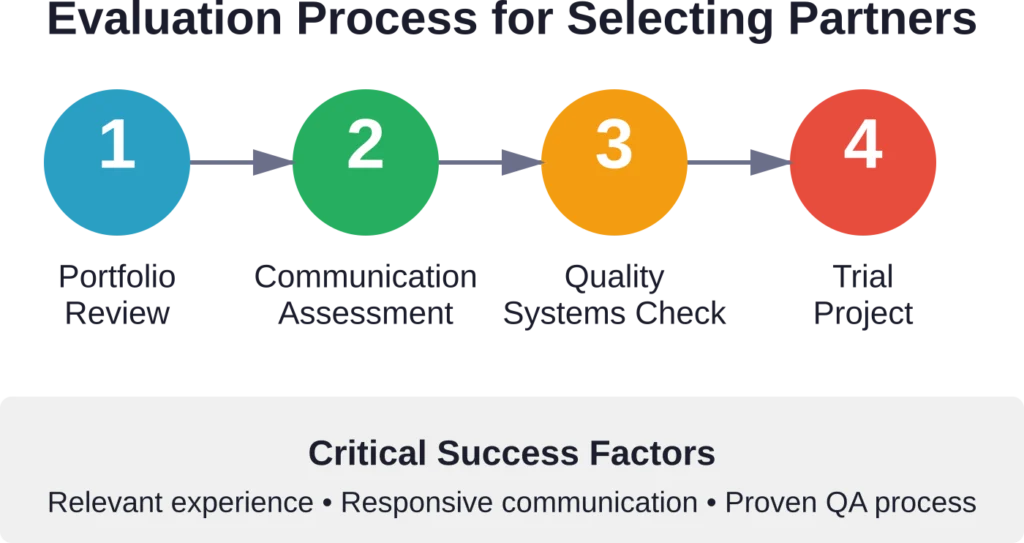
Portfolio Review and Relevant Experience
Examine actual project work, not just company marketing materials. Request samples similar to the projects planned for outsourcing—same building type, similar complexity, comparable documentation standards.
Look for drawing quality, not just visual appeal. In CAD work, check line weights, dimension placement, note organization, and overall clarity. In BIM models, examine whether geometry is clean, families are properly built, and views are set up thoughtfully.
Relevant experience matters more than portfolio volume. A company with fifty residential projects but no commercial work won’t navigate commercial building codes effectively, regardless of how impressive their house designs look.
Communication and Project Management
Communication quality determines outsourcing success as much as technical ability. During initial conversations, evaluate responsiveness, clarity, and whether the company asks insightful questions about project requirements.
Understand the project management structure. Who serves as primary contact? What communication channels get used? How frequently do status updates happen? What’s the escalation path when problems arise?
Time zone considerations affect communication significantly. Companies with overlapping work hours enable real-time collaboration; those operating completely opposite schedules require more asynchronous communication discipline.
Quality Control Systems
Ask specifically about quality assurance processes. How many review stages occur before deliverables reach clients? Who conducts reviews? What checking procedures do they follow?
Companies with documented QA systems generally deliver more consistent results than those relying on individual drafter judgment alone. Multi-stage reviews catch errors that single-person checking misses.
Request references from current clients and ask about error rates, revision frequencies, and how the company handles mistakes. Every outsourcing relationship encounters errors occasionally; what matters is how companies respond and whether they learn from problems.
Trial Projects and Pilot Engagements
Starting with a small trial project reduces risk while evaluating actual performance versus sales promises. Choose a representative task—complex enough to test capabilities but contained enough to limit exposure if results disappoint.
Evaluate the trial project experience holistically: deliverable quality obviously matters, but also assess communication smoothness, deadline reliability, revision responsiveness, and whether working together felt easy or frustrating.
Some companies perform brilliantly on trial projects because they assign senior staff, then shift to junior teams for ongoing work. Discuss staffing explicitly—who worked on the trial and who will handle regular projects?
Technical Capabilities and Software Proficiency
Confirm the company works proficiently in required software platforms. Request work samples created in the specific applications planned for collaboration, not just format conversions from their preferred tools.
For BIM projects, verify their Revit version matches yours or is compatible. Version mismatches create file exchange problems that derail collaboration. Similarly, confirm they can work with client-provided templates, families, and standards rather than forcing their own conventions.
Advanced capabilities like energy modeling, parametric design, or VR development require specialized skills. If these services matter, request specific examples and potentially conduct technical interviews with the staff who would perform the work.
Contractual Terms and Data Security
Review contract terms carefully, particularly intellectual property ownership, confidentiality provisions, and liability limitations. Architectural drawings and models constitute intellectual property; contracts should clearly assign ownership to clients.
Data security deserves attention when sharing project files internationally. How does the company protect client data? What file transfer methods do they use? Do they maintain cybersecurity insurance?
Understanding contractual terms around revisions, project scope changes, and schedule modifications prevents disputes later. What constitutes normal revisions versus additional services? How do rush requests get handled?
Common Challenges in Architectural Outsourcing (and How to Avoid Them)
Understanding typical problems helps prevent them or respond effectively when they occur.
Communication Breakdowns
Misunderstood instructions produce wrong deliverables, wasting time and budget on work that requires complete redoing. Communication problems stem from unclear briefs, language barriers, different technical vocabularies, or insufficient project context.
Prevention starts with thorough project briefings. Provide reference materials, mark up examples showing desired approaches, and confirm understanding through two-way communication rather than one-way instruction dumps.
Establish communication protocols upfront: preferred channels for different message types, expected response times, scheduled check-in meetings, and escalation paths for urgent issues.
Quality Inconsistency
Deliverable quality that varies unpredictably across projects or even within single projects signals problems with the outsourcing company’s training, quality systems, or staffing stability.
Address quality issues immediately rather than accepting substandard work hoping it improves. Provide specific feedback documenting problems and expected standards. Companies genuinely committed to quality will respond constructively; those offering excuses probably won’t improve.
Some quality variation reflects unclear client standards. Developing comprehensive drafting or modeling standards documents prevents many disputes about whether deliverables meet expectations.
Missed Deadlines
Schedule reliability matters enormously when outsourcing supports deadline-driven permit submissions or client presentations. Late deliverables that miss critical dates undermine the entire value proposition.
Build buffer time into schedules rather than planning for perfect execution. If the permit deadline is Friday, request deliverables by Tuesday to accommodate potential delays or necessary revisions.
Monitor progress actively rather than waiting for final deliverables. Request work-in-progress updates at interim milestones to verify projects remain on track.
Scope Creep and Billing Disputes
Disagreements about what services the original scope included versus what constitutes additional work create friction and unexpected costs.
Define project scopes clearly at the outset, documenting deliverables, revision allowances, and boundaries explicitly. When scope changes become necessary mid-project, acknowledge them formally and agree on adjustments before proceeding.
Some outsourcing companies intentionally underbid projects then nickel-and-dime clients through change orders. Trial projects help identify this pattern before committing to major work.
Security and Confidentiality Concerns
Sharing project files internationally raises legitimate concerns about intellectual property protection and client confidentiality. High-profile projects or proprietary design approaches warrant particular caution.
Use secure file transfer methods—dedicated collaboration platforms, encrypted transfers, or VPN connections—rather than emailing files. Include strong confidentiality provisions in contracts and verify the outsourcing company maintains reasonable data security practices.
For extremely sensitive projects, consider whether outsourcing makes sense at all or whether limiting information sharing to less critical project aspects provides adequate protection.
Future Trends in Architectural Outsourcing
The architectural outsourcing landscape continues evolving as technology, work patterns, and industry practices shift.
AI and Automation Integration
Artificial intelligence tools are beginning to automate routine drafting tasks—space planning, code checking, quantity takeoffs, and even basic design exploration. Outsourcing companies integrating these technologies can deliver faster turnarounds and potentially lower costs for commodity services.
But AI amplifies the importance of human expertise for complex judgment calls, coordination decisions, and design refinement that algorithms can’t handle reliably. The best outsourcing companies will combine AI efficiency for routine tasks with human expertise for sophisticated work.
Distributed Collaboration Tools
Cloud-based BIM platforms, real-time co-authoring capabilities, and virtual reality collaboration environments make geographic location increasingly irrelevant for project delivery. These technologies enable tighter integration between in-house teams and outsourcing partners.
The trend favors outsourcing relationships that function as seamless team extensions rather than arms-length vendor transactions. Companies investing in collaboration infrastructure and workflow integration will outcompete those treating outsourcing as simple task delegation.
Specialization and Niche Services
The days of undifferentiated CAD drafting services are ending. Successful outsourcing companies increasingly specialize in particular building types, service niches, or technical capabilities rather than attempting to serve all needs for all clients.
This specialization benefits clients seeking expertise in specific areas—healthcare facility planning, historic preservation documentation, hospitality design development—where deep knowledge creates more value than generic production capacity.
Hybrid Work Models
The widespread adoption of remote work by architecture firms has blurred distinctions between in-house staff, remote employees, and outsourcing partners. Some firms now build core teams mixing permanent employees, contractors, and outsourcing relationships into integrated delivery models.
This hybrid approach provides flexibility while maintaining quality and cultural cohesion. The legal and contractual structures supporting these arrangements continue evolving to accommodate new working patterns.
Frequently Asked Questions
Projects with well-defined scopes and clear deliverable specifications tend to outsource most successfully. Construction documentation, permit drawing preparation, as-built documentation, 3D rendering, and BIM modeling for conventional building types all work well. Complex design development requiring extensive iteration and close collaboration suits outsourcing less naturally, though experienced partnerships can handle it. Renovation projects with uncertain existing conditions may need more direct oversight than straightforward new construction.
Effective quality control combines several approaches: selecting outsourcing partners with strong internal QA systems, providing comprehensive standards and template documents, conducting thorough project briefings, reviewing work-in-progress at interim milestones rather than waiting for completion, maintaining clear communication channels for questions, and performing internal checks on received deliverables before incorporating them into project documentation. Quality improves significantly once outsourcing relationships mature and partners learn firm-specific standards and preferences.
Comprehensive outsourcing contracts should address intellectual property ownership (typically assigning all work product to the client), confidentiality provisions protecting project information and client data, scope definition with clear deliverables and revision allowances, schedule commitments with consequences for missed deadlines, quality standards and acceptance criteria, payment terms and change order procedures, liability limitations and professional indemnity insurance requirements, data security protocols, termination provisions, and dispute resolution mechanisms. Legal counsel familiar with architectural service agreements should review contracts before signing.
Turnaround times vary enormously based on project complexity, company workload, and urgency. Simple tasks like converting PDFs to CAD or creating basic renderings might complete within 24-48 hours. Moderate complexity projects such as residential permit sets or BIM model development typically require one to three weeks. Complex commercial construction documentation could take several months. Many companies offer expedited services for rush projects, though this usually requires advance notice to allocate resources. Time zone differences can enable overnight turnarounds for revision cycles when leveraged effectively.
Geographic location significantly impacts outsourcing costs, though quality doesn’t necessarily correlate with price. Analysis across multiple industry sources shows typical regional patterns: North American outsourcing firms generally range between $50-$150 per hour with higher labor costs but minimal time zone challenges for US-based clients. Eastern European companies typically charge $25-$60 per hour, balancing reasonable costs with strong technical education and European building standards familiarity. Asian outsourcing hubs often range $20-$50 per hour, offering maximum cost savings but requiring more structured communication due to time differences. These ranges vary based on service complexity, company reputation, and project requirements.
Small firms often gain proportionally more value from outsourcing than large practices. Outsourcing provides small firms with surge capacity without the overhead of additional permanent employees, access to specialized skills that don’t justify full-time hires, and the ability to compete for larger projects by flexibly scaling resources. The key is selecting outsourcing partners comfortable working with smaller firms and willing to accommodate modest project volumes. Marketplace-style platforms or companies explicitly serving small practices often work better than large firms focused on enterprise clients with substantial ongoing workloads.
Successful revision management requires clear initial direction, documented markup procedures, and systematic tracking. Most firms use digital markup tools (Bluebeam, PDF annotators, or BIM collaboration platforms) to provide specific, graphical feedback rather than lengthy written descriptions. Establishing how many revision rounds the original scope includes prevents billing disputes—typically contracts specify one or two revision cycles with clearly defined additional costs beyond that. Video calls work well for explaining complex changes or discussing alternative approaches. Maintaining revision logs helps track what changed and why, particularly valuable on longer projects with multiple feedback cycles.
Making the Right Choice for Your Practice
Selecting an architectural outsourcing partner ultimately depends on specific practice needs, project types, workflow preferences, and quality standards.
The ten companies profiled here represent proven options, but the “best” choice varies by circumstance. A residential firm needs different capabilities than a commercial practice. A firm seeking occasional surge capacity requires different arrangements than one building a strategic long-term partnership.
Start with clarity about what problems outsourcing should solve. Need visualization capacity for marketing presentations? Focus on rendering specialists like Monarch Innovation. Seeking reliable production support for construction documentation? Consider full-service providers like Hitech CADD or Rayvat Engineering. Wrestling with BIM implementation? Tejjy Inc.’s Revit expertise might fit best.
Geography matters less than it once did, but time zone overlap and cultural affinity still influence communication effectiveness. Some firms prefer the responsiveness possible with overlapping work hours; others value overnight turnarounds from teams working opposite schedules.
Test relationships before committing to major projects. Trial engagements reveal how companies actually perform versus how they present during sales conversations. Chemistry matters—some partnerships click smoothly while others feel effortful despite similar technical capabilities.
Architectural outsourcing has matured from a cost-cutting tactic into a legitimate strategic tool for practice management. The companies that thrive provide not just cheaper labor but genuine expertise, reliable quality, and professional service delivery that extends rather than diminishes firm capabilities.
The market will continue evolving as technology advances, work patterns shift, and new companies emerge. But the fundamental value proposition remains constant: accessing specialized skills, flexible capacity, and professional execution that helps architecture firms deliver better projects more efficiently.
Ready to explore outsourcing for your architecture firm? Start by defining specific needs, reviewing portfolios from companies specializing in those services, and testing partnerships through contained trial projects before scaling up collaboration.