

Quick Summary: Penis enlargement is possible through medical procedures like surgery and hyaluronic acid injections, with research showing measurable increases in length and girth. However, most products marketed for enlargement lack scientific evidence. Men considering enhancement should understand realistic expectations, potential risks, and consult qualified urologists to determine if they’re genuinely candidates for treatment.
The question of whether penis size can be increased has sparked countless online discussions, dubious product claims, and genuine medical research. Here’s the reality: penile enlargement is possible through specific medical interventions, but the landscape is filled with ineffective treatments alongside legitimate options.
An increasing number of men with anatomically normal penises seek enlargement procedures. According to research published in Current Urology, this trend has prompted comprehensive evaluations of both surgical and non-surgical treatments, along with the psychological factors driving these requests.
Understanding Normal Penis Size and Realistic Expectations
Before exploring enlargement methods, it’s crucial to understand what constitutes normal dimensions. Many men seeking enhancement actually fall within typical ranges but perceive themselves as smaller due to distorted expectations.
Medical research uses stretched penile length (SPL) as the standard measurement for adult men, as it most closely replicates erect length. This measurement is taken from the pubic bone to the tip while the penis is maximally stretched.
Research examining men seeking enlargement procedures found that most had normal-sized penises according to established nomograms. The definition of “normal” typically falls above the 2.5 percentile mark based on population data.
But here’s what matters: perception doesn’t always match reality.
What Actually Works: Evidence-Based Methods
Separating legitimate treatments from ineffective products requires examining peer-reviewed medical research rather than marketing claims.
Surgical Lengthening Procedures
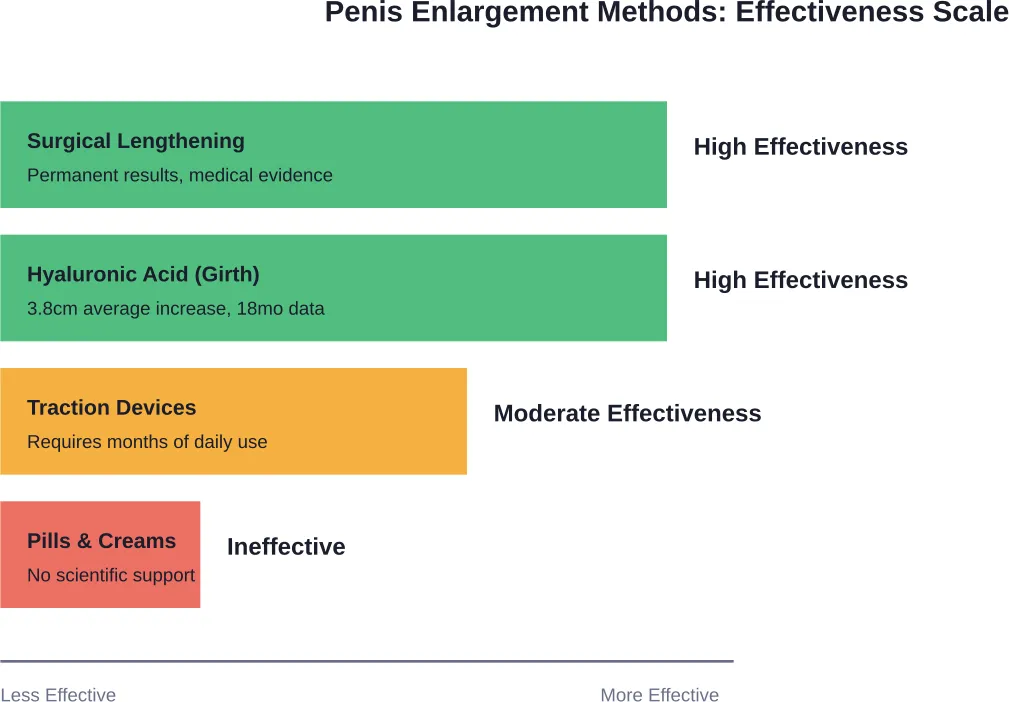
Penile elongation surgery represents the most established method for permanent length increase. According to NIH research, these procedures typically involve suspensory ligament division, sometimes combined with other techniques.
The surgery works by cutting the ligament that anchors the penis to the pubic bone, allowing more of the internal shaft to extend outward. A modified technique using cross-plasty of the skin has been developed to address earlier complications like scar deformation and penile retraction.
Research on 20 patients using this modified ligamentolysis technique demonstrated improvements over traditional methods, though results vary by individual anatomy and surgical approach.
Real talk: surgical lengthening requires collaboration between urologists and plastic surgeons, with careful patient selection being critical for satisfaction.
Girth Augmentation Methods
Increasing penile circumference has become increasingly common, with several approaches showing measurable results in clinical studies.
| Treatment Method | Study Type | Patients | Girth Increase | Follow-up Period |
|---|---|---|---|---|
| Hyaluronic acid injection | Prospective | 52 | 3.8 cm | 18 months |
| Dermal fillers | Various studies | Multiple cohorts | Variable | 6-24 months |
| Fat injection | Case series | Limited data | Variable absorption | Variable |
Hyaluronic acid injections have shown particularly promising results. Research tracking 52 patients over 18 months found an average girth increase of 3.8 cm with no serious complications reported.
However, the American Urological Association specifically states that subcutaneous fat injection for increasing penile girth has not been shown to be safe or efficacious, distinguishing between different injection materials and techniques.
Non-Surgical Options: Penile Traction Therapy
Penile traction devices represent the only non-surgical method with substantial research support. These devices work by applying controlled stretching force over extended periods.
According to Mayo Clinic Health System, traction therapy involves wearing a self-applied device for as little as 30 minutes to as much as eight hours daily. It’s particularly noted for treating Peyronie’s disease while improving penile length and correcting deformities.
The mechanism relies on tissue expansion principles—consistent, gentle stretching can promote cellular growth over time. But this requires months of consistent use.
What Doesn’t Work: Debunking Common Myths
The market overflows with products claiming miraculous enlargement results. Nearly all lack credible scientific support.
Pills and supplements: No oral medication has been proven to increase penis size. These products often contain unregulated ingredients with no established mechanism for enlargement.
Topical creams and oils: Despite aggressive marketing, no topical product can permanently alter penile dimensions. Any temporary effects result from increased blood flow, not structural changes.
Vacuum pumps: While these devices can create temporary enlargement by drawing blood into the penis, they don’t produce permanent size increases. They’re primarily used for erectile dysfunction treatment.
Jelqing and manual exercises: These techniques lack scientific validation and carry potential risks including tissue damage and scarring.
Risks and Complications to Consider
Every medical intervention carries risks. Penile enhancement procedures are no exception.
Surgical complications can include infection, scarring, loss of sensation, erectile dysfunction, and unsatisfactory aesthetic results. Early surgical techniques had high rates of scar deformation and penile retraction, leading to low patient satisfaction.
A three-year single-centre retrospective study of 355 cosmetic penile enhancement cases found that while many patients reported satisfaction improvements, complications do occur. The study tracked erectile function using the 5-item International Index of Erectile Function (IIEF-5), which showed IIEF-5 improvement of 6.74% compared to baseline.
Injectable fillers carry risks including migration of material, lumps, asymmetry, and infection. Choosing qualified practitioners with specific experience in penile procedures is essential.
The Psychological Component
Research increasingly recognizes that many men seeking enlargement procedures have normal-sized penises but experience significant distress about their perceived inadequacy.
Studies examining the psychological characteristics of males seeking penile enlargement surgery reveal that body dysmorphia and distorted self-perception often drive these requests more than actual anatomical concerns.
A comprehensive review evaluated the mental health status of men complaining of small penis size. The findings suggest that psychological counseling should be considered before pursuing physical interventions, particularly for men with normal dimensions.
Sound familiar? Many men compare themselves to unrealistic standards from adult content or overestimate what partners consider ideal dimensions.
Choosing the Right Path Forward
For men genuinely interested in enlargement, several factors should guide decision-making.
When Surgery Might Be Appropriate
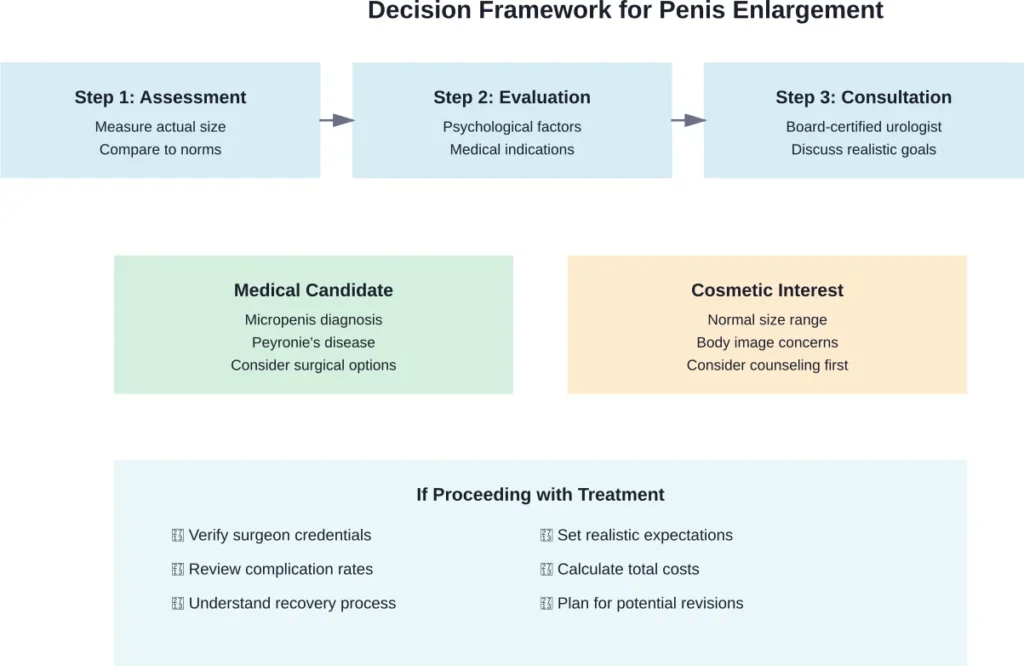
Congenital and acquired micropenis represent the classic medical indications for penile elongation surgery. These conditions involve objectively small dimensions that fall significantly below population norms.
Peyronie’s disease causing significant penile shortening and curvature represents another legitimate indication, where treatment addresses a medical condition rather than purely cosmetic concerns.
For men with normal anatomy seeking enhancement, thorough consultation with board-certified urologists specializing in these procedures is essential. Realistic expectations must be established before any intervention.
Questions to Ask Before Proceeding
Prospective patients should thoroughly investigate:
- The surgeon’s specific experience with penile enhancement procedures
- Complication rates for the proposed technique
- Expected outcomes with measurements from previous patients
- Recovery time and potential impact on sexual function
- Long-term satisfaction rates among prior patients
- Total costs including potential revision procedures
Frequently Asked Questions
Yes, through surgical procedures like ligament division for length and hyaluronic acid injections for girth. Research shows measurable permanent increases, though results vary. Non-surgical methods like traction devices can produce modest gains but require months of consistent use.
Surgical lengthening typically adds 1-2 inches to flaccid length by releasing the suspensory ligament. However, this doesn’t increase actual shaft tissue—it reveals more of the existing internal penis. Erect length gains are usually more modest than flaccid increases.
No. Despite widespread marketing, no oral supplement or topical cream has been scientifically proven to increase penis size permanently. These products lack credible research support and often contain unregulated ingredients. Any temporary effects come from increased blood flow, not structural changes.
Clinical research on hyaluronic acid injections found an average girth increase of 3.8 cm in a study of 52 patients tracked over 18 months. Results vary based on the amount injected, technique used, and individual anatomy. The American Urological Association specifically notes that fat injections haven’t been proven safe or effective.
Recovery varies by procedure type. Most surgical patients need 4-6 weeks before resuming sexual activity. Full healing and final results may take several months. Complications like infection or unsatisfactory results can extend recovery time and require additional procedures.
Medical professionals define micropenis as stretched penile length below the 2.5 percentile for the population. This represents the primary medical indication for enlargement surgery. Most men seeking cosmetic enhancement actually fall within normal ranges but perceive themselves as smaller due to distorted expectations.
Penile traction devices have research support showing modest length gains when used consistently over months. Mayo Clinic Health System notes these devices can improve penile length while treating conditions like Peyronie’s disease. However, they require wearing the device 30 minutes to 8 hours daily for extended periods.
Making an Informed Decision
Penis enlargement is medically possible through specific surgical and non-surgical interventions backed by peer-reviewed research. But it’s not appropriate for everyone.
Men with genuine medical conditions like micropenis or Peyronie’s disease have legitimate reasons to explore these options. For those with normal anatomy seeking cosmetic enhancement, the decision becomes more complex.
The psychological component can’t be ignored. Body image concerns and distorted perceptions drive many requests for enlargement among men with normal dimensions. Professional counseling may address these concerns more effectively than physical interventions.
For those who proceed, choosing qualified practitioners with specific experience in penile procedures is non-negotiable. Board-certified urologists with documented outcomes and reasonable complication rates should perform these procedures.
Look, the bottom line is this: enlargement works through legitimate medical procedures, but it’s not risk-free, not always necessary, and definitely not something to pursue based on online product claims.
If considering enhancement, start with an honest consultation with a board-certified urologist who can provide objective assessment, discuss realistic expectations, and determine whether treatment is genuinely appropriate. That conversation—not marketing promises—should guide the decision.