

Quick Summary: Yes, it’s possible to get pregnant without having penetrative sex, though it’s unlikely. Pregnancy can occur if sperm comes into contact with the vaginal opening through splash pregnancy, or intentionally through assisted reproductive technologies like IUI and IVF. Understanding how conception works helps people make informed decisions about pregnancy prevention or family planning.
The question seems almost too simple, right? Can pregnancy happen without sexual intercourse?
The short answer is yes. But the details matter.
While pregnancy without penetrative sex is rare, it’s not impossible. Sperm are remarkably resilient little swimmers, and under the right conditions, conception can occur without traditional intercourse. Some pregnancies happen accidentally through what’s called “splash pregnancy,” while others are intentional through medical interventions.
Here’s everything worth knowing about getting pregnant without having sex.
How Does Conception Actually Work?
Before diving into the scenarios where pregnancy can happen without intercourse, it helps to understand the basics of conception.
Pregnancy occurs when a sperm cell successfully fertilizes an egg. This typically happens in the fallopian tube after ovulation releases an egg from the ovary.
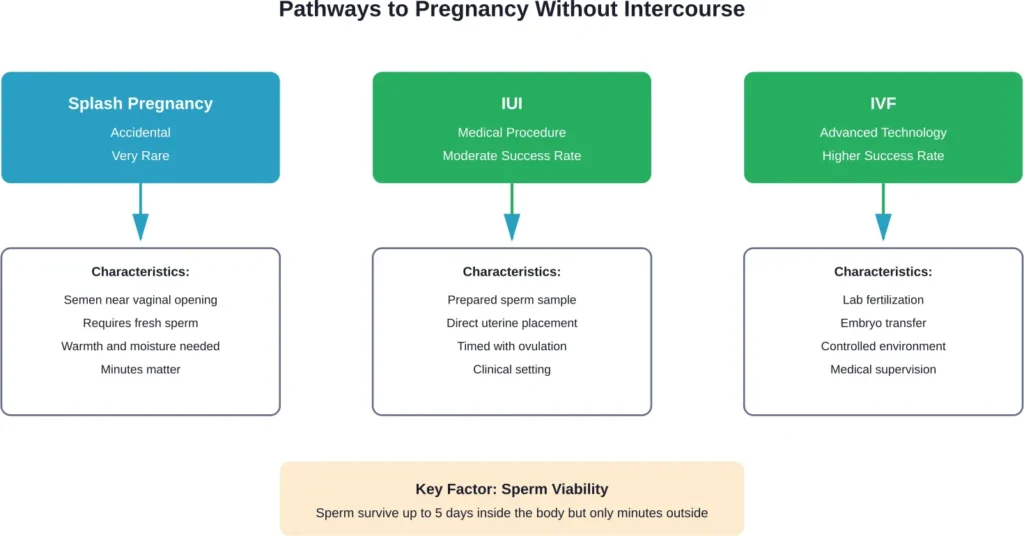
Once released, an egg can survive for 12 to 24 hours. Sperm, however, are more persistent. When inside the female reproductive tract, sperm can live for up to five days, though most survive only the first 24 to 48 hours. This means the fertile window extends roughly five days before ovulation plus the day of ovulation itself.
For fertilization to occur, sperm must travel through the vagina, past the cervix, through the uterus, and into the fallopian tubes. This journey requires millions of sperm because most don’t make it.
Now here’s where things get interesting.
Can Pregnancy Happen From “Splash Pregnancy”?
Splash pregnancy refers to conception that occurs when semen comes into contact with the vaginal opening without penetrative intercourse.
Is it possible? Technically yes. Is it common? Not really.
Splash pregnancy can theoretically occur in several scenarios. Ejaculation might happen right outside the vaginal opening, allowing sperm to swim inside the reproductive tract. Semen could get on someone’s fingers and then be transferred inside the vagina. An erect penis might come into contact with the vaginal area, and the small amount of fluid released before ejaculation (pre-ejaculate or precum) could contain sperm.
But wait. Sperm face serious challenges outside the body.
Sperm need warmth and moisture to survive. They’re extremely fragile outside the male body and die quickly when exposed to air, temperature changes, or dry surfaces. Most sperm die within minutes when exposed to these conditions.
That said, if semen is fresh and comes into direct contact with the vaginal opening quickly, pregnancy becomes theoretically possible. The closer to the vaginal opening, the higher the risk.
Assisted Reproductive Technology: Pregnancy By Design
When people intentionally seek pregnancy without sexual intercourse, medical science offers several proven options.
Intrauterine Insemination (IUI)
IUI involves placing specially prepared sperm directly into the uterus around the time of ovulation. This procedure bypasses the vagina and cervix entirely, giving sperm a head start on their journey to the egg.
The process is straightforward. Semen is collected and processed in a laboratory to concentrate the healthiest, most motile sperm. The prepared sample is then concentrated to a small volume (typically 0.2-0.3 ml) and injected directly into the uterus using a thin catheter.
According to the CDC, assisted reproductive technology procedures have become increasingly common for individuals and couples facing infertility challenges.
In Vitro Fertilization (IVF)
IVF takes things a step further. Eggs are retrieved from the ovaries and fertilized with sperm in a laboratory setting. The resulting embryos are then transferred into the uterus.
The national single-embryo transfer (SET) rate among all embryo-transfer procedures varied by state, with rates ranging from 28.2% in Puerto Rico to 89.5% in Delaware among women aged <35 years, with an average of 1.3 embryos transferred among women under 35 years old and 1.4 among women over 37 years old, according to CDC surveillance data.
IVF offers options for same-sex couples, single parents, and those with medical conditions preventing traditional conception.
Home Insemination Methods
Some people attempt conception at home using insemination kits. Medical research has documented successful pregnancies using home intravaginal insemination methods.
In documented cases, fresh semen was drawn into a syringe and injected into the vagina, with the person lying down for at least 20 minutes afterward. While less controlled than medical procedures, this approach has resulted in successful pregnancies.
Common Myths About Getting Pregnant Without Sex
Let’s clear up some persistent misconceptions.
Myth: You can get pregnant from a toilet seat. This isn’t happening. Sperm die almost immediately when exposed to air and temperature changes. The conditions on a toilet seat are hostile to sperm survival.
Myth: Pregnancy can occur from swimming in a pool or hot tub with someone who ejaculated. Again, no. Chlorine kills sperm. Even in unchlorinated water, sperm would be too diluted and exposed to unfavorable conditions to cause pregnancy.
Myth: Kissing can lead to pregnancy. Absolutely not. Saliva doesn’t contain reproductive cells, and there’s no biological pathway for conception through kissing.
Myth: Tight clothing or sitting close together causes pregnancy. Pregnancy requires sperm to enter the reproductive tract. Proximity alone, even with clothing barriers, won’t cause conception.
Myth: You can’t get pregnant during your period. While less likely, it’s not impossible. Ovulation timing varies, and sperm can survive for several days. Someone with shorter cycles might ovulate soon after their period ends, and sperm from intercourse during menstruation could still be viable.
Understanding Infertility and Conception Challenges
Not everyone who wants to conceive finds it easy, with or without traditional intercourse.
According to the CDC, in the United States, 1 in 5 (19%) of married women aged 15 to 49 with no prior births are unable to get pregnant after one year of trying. About 1 in 4 (26%) of women in this group have difficulty getting pregnant or carrying a pregnancy to term.
Infertility affects both men and women. Male factor infertility accounts for a significant portion of conception difficulties, which is why assisted reproductive technologies often involve semen analysis and preparation to select the most viable sperm.
Many couples who struggle with infertility do eventually have children, sometimes with medical intervention through procedures like IUI or IVF.
How to Prevent Unintended Pregnancy
For those concerned about preventing pregnancy, understanding the risks and using appropriate protection matters.
Barrier Methods
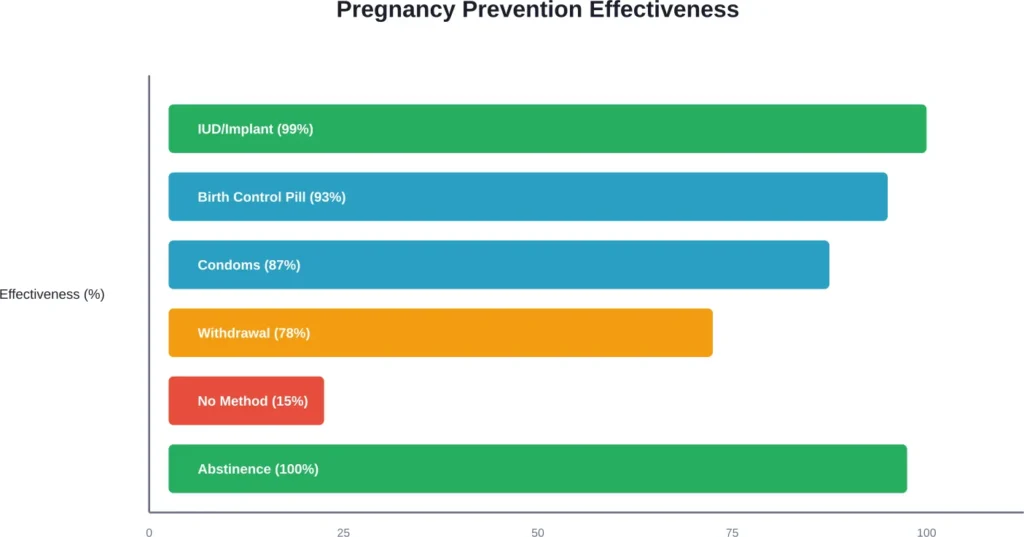
Male condoms are easy to find and relatively inexpensive. They are around 87 percent effective at preventing pregnancy without the use of any additional method. Beyond pregnancy prevention, condoms also protect against sexually transmitted infections.
Female condoms, dental dams, and other barrier methods provide additional options.
Hormonal Birth Control
There are several types of birth control pills. Some contain only progestin (mini pill) while others contain a mix of progestin and estrogen (combo). The pill is taken daily.
Other hormonal options include patches, vaginal rings, injections, and implants. Each has different effectiveness rates and duration of protection.
Long-Acting Reversible Contraception
Intrauterine devices (IUDs) and contraceptive implants offer years of highly effective pregnancy prevention. These methods don’t require daily attention and have failure rates below 1%.
Understanding Risk Situations
Even without penetrative intercourse, certain situations carry pregnancy risk. If genital contact occurs, if semen comes near the vaginal opening, or if fingers contaminated with semen enter the vagina, pregnancy becomes theoretically possible.
The key is minimizing sperm contact with the vaginal area and using reliable contraception when any risk exists.
When Medical Assistance Makes Sense
Several situations might lead someone to pursue pregnancy without traditional intercourse through medical intervention.
Same-sex couples often use assisted reproductive technology to build families. Single individuals choosing parenthood may opt for donor sperm and IUI or IVF. Medical conditions preventing intercourse don’t prevent parenthood when alternatives exist.
Infertility affecting either partner might require medical assistance. Male factor infertility, female reproductive challenges, or unexplained infertility all have treatment options.
The decision to pursue assisted reproduction involves considering success rates, costs, emotional factors, and medical recommendations. Consulting with reproductive endocrinologists provides personalized guidance based on individual circumstances.
What to Do If Pregnancy Might Have Occurred
If concerned that pregnancy might have happened without penetrative sex, several steps make sense.
Take a home pregnancy test. These tests detect the hormone hCG in urine and become accurate around the time of a missed period. Most modern tests are highly sensitive and reliable when used correctly.
Watch for early pregnancy symptoms. These might include missed period, breast tenderness, nausea, fatigue, or frequent urination. However, many early pregnancy symptoms overlap with premenstrual symptoms.
Schedule a medical appointment. Healthcare providers can perform more sensitive blood tests and provide accurate information about pregnancy status and options.
Emergency contraception remains an option if concerned about recent exposure. Plan B and similar medications work best when taken within 72 hours of potential conception, though some formulations remain effective up to five days.
Frequently Asked Questions
Theoretically yes, but it’s extremely unlikely. Precum can contain sperm, especially if ejaculation occurred recently without urination in between. However, the small amount of precum combined with exposure to air makes pregnancy from this scenario very rare. Direct contact with the vaginal opening would be necessary.
Sperm die quickly outside the body. In most environments, sperm survive only a few minutes once exposed to air, temperature changes, or dry surfaces. They need warmth, moisture, and specific conditions to remain viable. Inside the female reproductive tract, sperm can live up to five days, but outside the body, survival time drops dramatically.
IVF generally has higher success rates per cycle than IUI, but effectiveness depends on individual factors including age, fertility diagnosis, and sperm quality. IVF involves more medical intervention and higher costs. IUI is less invasive and less expensive, making it a common first option for many couples. Medical consultation helps determine the best approach for specific situations.
No. This is a persistent myth without scientific basis. Chlorine in pools kills sperm almost instantly. Even in unchlorinated water, sperm would be too diluted and exposed to unfavorable temperature and chemical conditions to cause pregnancy. Pregnancy requires direct sperm contact with the vaginal tract under conditions supporting sperm survival.
Long-acting reversible contraception like IUDs and contraceptive implants offer the highest effectiveness rates at over 99%. These methods don’t rely on daily compliance and last for years. Hormonal birth control pills, when taken correctly, reach about 93% effectiveness with typical use. Combining methods (like condoms plus hormonal birth control) increases protection further.
Home pregnancy tests become accurate around the time of a missed period, typically about two weeks after conception. Some sensitive tests claim earlier detection, but accuracy increases with waiting. Blood tests administered by healthcare providers can detect pregnancy slightly earlier. Testing too soon often produces false negatives because hCG levels haven’t risen enough for detection.
Yes. Age-related fertility decline affects conception regardless of the method. Women’s fertility begins declining in the late 20s and drops more significantly after 35. This affects both natural conception and assisted reproductive technology success rates. Egg quality and quantity decrease with age, making conception more challenging. However, assisted technologies can sometimes overcome certain age-related challenges better than natural conception attempts.
The Bottom Line
Pregnancy without penetrative sex is possible but uncommon.
Accidental pregnancy from genital contact or sperm exposure near the vaginal opening remains rare because sperm are fragile outside the body. The circumstances must align perfectly—fresh semen, immediate contact with the vaginal area, warmth and moisture present, and fertile timing.
Intentional pregnancy without intercourse succeeds regularly through assisted reproductive technologies. IUI, IVF, and home insemination methods offer proven pathways to parenthood for same-sex couples, single parents, and those facing medical challenges.
Understanding the facts helps with both pregnancy prevention and family planning. Whether concerned about unintended pregnancy or seeking to conceive, knowledge about how conception works empowers better decisions.
If questions or concerns arise about pregnancy risk or fertility challenges, healthcare providers offer personalized guidance based on individual circumstances. Medical professionals can recommend appropriate contraception, discuss assisted reproductive options, or provide pregnancy testing and counseling.
The human reproductive system is both remarkably efficient and surprisingly particular. Pregnancy requires specific conditions, but those conditions can occur in more ways than many people realize.