
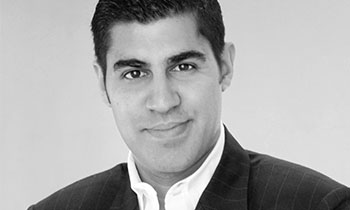
Scientist, analyst, consultant for the United States National Intelligence Council, foreign policy expert under President Barack Obama, global development theorist, and columnist for The World — Parag Khanna reveals to us the deep connection between the Middle Ages and our time, returns to the world the allure of the Silk Road. Wherever the Road reached, from East Asia to the Mediterranean, there sprouted new life — in the arts, sciences, crafts, and medicine. Parag Khanna sees much of the Silk Road in the modern world, and holds that the connectivity it creates is an indispensable driver of unification and development.
I was born in India and I spent my childhood in Abu Dhabi, Dubai. Then I lived in New York, then in Germany, then again in America, then in Switzerland, then back again to America, then in London, and now I live in Singapore. My life is connectivity, a principle symbolised by the Silk Roads. They also symbolise the fundamental economic principle of supply and demand, and a new, different way of understanding geography — the Silk Roads can’t exist without connectivity, whereas sovereignty can’t exist without borders. When I refer to the new Middle Ages, I’m talking about connectivity between different civilisations, a view I wish to promote.
The Middle Ages were a period of history, from the fall of the Roman Empire until the Renaissance, during which time, more than a thousand years, the world was truly multi-civilisational. Europe was in crisis, but it was still very important, and culturally alive. The Middle East was thriving, with its caliphates, and the birth of Islam in the 7th century. There was Russian civilisation, Indian civilisation, and the Chinese dynasties. The most powerful dynasty of the era, the Song dynasty, was around the 10th and 11th centuries. So, you had a world that was actually multi-civilisational, but that was beginning to connect internally. With the Silk Road emerged dia- logue. When I’m asked if I feel like a person of the Middle Ages, my response is that I think I’m a person of the Silk Road. It never actually went away. It had times of robust growth, as well as times of weakness. The Black Death, for instance, was difficult for the Silk Road. But, clearly, in the 21st century, the Silk Roads are alive and well, more so than ever before.

We have to understand and appreciate that, in order to build the necessary foundations for a dignified society, the number one prior- ity is investment — investment in infrastructure, in connectivity, in housing, in healthcare, in trade networks, and so forth. That’s the first thing. The second is to appreciate that when we do make those investments, we all benefit, we all grow, and we all become more interdependent. Thirdly, we need to realise that as we become more interdependent, we are less likely to fight with each other.
Russia — Russia is, amongst the major economies of the world, the least connected. How do we measure that? Well, it has the fewest major international transportation linkages. It does not have a strongly diversi- fied economy, so its linkages to the world are based on one commodity, on energy. And of course, it only very recently began its negotiations with the World Trade Organization. So measurably, Russia is not connected. Now look at all the tensions the world has with Russia — a lot of these are due to that lack of connection. When two countries are more connected, these tensions are less likely to arise. So my argument has been, for many years, that we should not be fighting with Russia, isolating it, imposing sanctions. We should be building connections and investing there, helping Russia become the passageway of the new Silk Roads.
In order to establish a connection with the world, Russia has to invest in itself. I see a lot of effort here, to regenerate and strengthen Russian cities, to attract investment, to create jobs. But it has to move strongly in the direction of joining these trade and investment frameworks. It has to strengthen the rule of law and the protection of foreign investment. It has to reform its corporate governance to match international standards. And it has to diversify its economy.
There are a lot of things that Russia has to do, but when we talk about Russia, we should be talking about those things, not whether it’s good or bad, whether it’s an evil empire, whether Putin is trying to become a new tyrant in the world or if he’s the most powerful man. If you look beyond those things, to the issues I’m pointing out, then you have a very clear pathway and agenda that Russia should follow, and that everyone else should also follow in order to help Russia.
You know, I realised that small countries —the opposite of Russia —face the most pressure to survive, to compete, to be noticed, to attract investment, and to be influential. For Russia these things are easy, because Russia is big. So one of my revelations is that if large countries acted like smaller countries, they would prog- ress much faster. It’s an academic point, but it’s one that I’ve realised from a lot of my travelling around the world.
One of my revelations is that if large countries acted like smaller countries, they would progress much faster
I’m certainly a spiritual person. I believe that, rather than one belief system, there are common human values today that it would be difficult to argue existed a hundred years ago. If you ask me what I believe, it’s the belief system of the millennial generation. We have a lot of surveys telling us what that is. People of the millennial generation believe in connectivity, they believe in mobility, they believe in tolerance, they believe in sustainability. Those are some of the pillars of the belief system.
In the future, I see my children being very mobile, always physically moving around. That’s the way we’re raising them and training them. It’s not just a lifestyle; I think it’s a method. It’s a science, not just an art. There is a science to designing one’s life. There’s a business model, an approach — it’s strategic always to be mobile in a way that allows you to experience the rich opportunities that are available.