

Quick Summary: Yes, you can sneeze with your eyes open, though it’s difficult because eye closure is part of an autonomic reflex during sneezing. Your eyeballs won’t pop out—that’s just a myth. The reflex likely protects eyes from germs expelled during the sneeze.
That old schoolyard warning probably still echoes in your head: sneeze with your eyes open and your eyeballs will pop right out of your skull. Terrifying, right?
Here’s the good news—it’s complete nonsense. But the question itself? That’s worth exploring.
The Short Answer: Yes, But It’s Really Hard
You absolutely can sneeze with your eyes open. It won’t hurt you, and your eyes will stay exactly where they belong. The challenge is that closing your eyes during a sneeze is an autonomic reflex—meaning your body does it automatically without conscious control.
An autonomic reflex is a response your nervous system triggers without you thinking about it. Think of pulling your hand away from a hot stove or your pupils contracting in bright light. Eye closure during sneezing falls into this same category.
According to medical research, sneezing follows a specific sequence: eye closure, inspiration, glottic closure, forced expiration with sudden glottic opening, and release of elevated intrathoracic pressure creating explosive airflow through the nose. Eye closure isn’t just incidental—it’s built into the entire process.
Why Do Our Eyes Close When We Sneeze?
The most widely accepted explanation is protection. When you sneeze, you’re expelling germs, bacteria, and irritants at high velocity. According to Dr. Susan Blakeney of the College of Optometrists, we automatically close our eyes when we sneeze thanks to a reflex mechanism that stops germs or bacteria flying out of our nose from getting into our eyes.
The reflex makes sense from an evolutionary standpoint. Your eyes are vulnerable mucous membranes, and a sneeze can launch particles at considerable speed. Closing your eyes creates a temporary barrier.
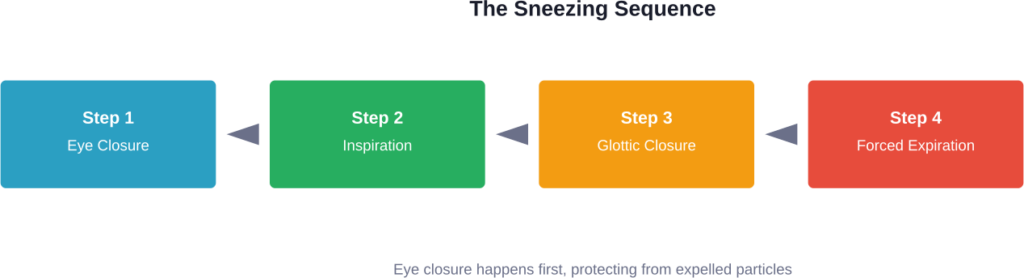
What Happens If You Try to Keep Your Eyes Open?
Some people have managed to sneeze with their eyes open—usually by physically holding their eyelids. But it takes deliberate effort and feels unnatural.
The internet is full of claims about eyeballs popping out if you sneeze with open eyes. This is anatomically impossible. Your eyeballs are held securely in their sockets by muscles, connective tissue, and orbital fat. The pressure generated during a sneeze, while noticeable, isn’t nearly strong enough to overcome these structures.
That said, doctors generally don’t recommend trying to override natural reflexes. Your body developed these responses for good reasons.
The Neurological Basis of Sneezing
Sneezing originates in the brainstem, specifically the medulla. Research published in the Journal of Neurology, Neurosurgery & Psychiatry identified a sneeze-related area in the medulla—what some researchers call a “sneezing center.” In cats, this center has been well-documented, though human research continues.
The trigeminal nerve plays a crucial role. According to NIH research on the trigeminal sensory system, this nerve receives sensory information from the skin, mucous membranes, and nasal passages. When irritants trigger these nerves, they send signals to the brainstem, initiating the sneeze reflex—eye closure included.
Other Interesting Sneeze Facts
While we’re on the topic, here are some fascinating sneeze-related phenomena:
Photic sneezing: About 24% of people sneeze when exposed to bright light, according to a Swedish blood donor study cited in NIH research. This is called the photic sneeze reflex, and scientists are still studying why it happens. An EEG study published in PLoS One identified neural bases for this phenomenon, suggesting a connection between optical and nasal sensory pathways.
Don’t suppress sneezes: Holding in a sneeze can be dangerous. The pressure needs somewhere to go, and blocking both your nose and mouth can potentially damage your eardrums, sinuses, or even rupture blood vessels.
FAQ: Common Questions About Sneezing With Eyes Open
No, this is a myth. Your eyeballs are securely held in their sockets by muscles and connective tissue. The pressure from a sneeze cannot dislodge them.
Eye closure is an autonomic reflex that protects your eyes from germs, bacteria, and particles expelled during the sneeze. It’s a built-in defense mechanism.
Yes, some people have managed it by physically holding their eyelids open, but it requires deliberate effort and feels unnatural because it overrides an automatic reflex.
No, your heart doesn’t stop during a sneeze. The rhythm may briefly change due to pressure fluctuations in your chest, but it continues beating normally.
The trigeminal nerve detects irritants in your nasal passages and sends signals to the sneeze center in your medulla (brainstem), which coordinates the entire sneezing response including eye closure.
Yes, suppressing a sneeze can potentially damage your eardrums, sinuses, or rupture blood vessels because the pressure needs to be released somewhere.
This is called the photic sneeze reflex, affecting about 24% of people. Research suggests it’s caused by crossed signals between optical and nasal sensory pathways in the brain.
The Bottom Line
So yes, sneezing with your eyes open is absolutely possible—just difficult. Your eyes will stay safely in your head, myth debunked.
The automatic eye closure during sneezing is one of countless protective reflexes your body performs without conscious thought. It’s a reminder that evolution has fine-tuned our responses to keep us safe, even in moments as brief as a sneeze.
Next time you feel a sneeze coming, you can rest easy knowing your eyeballs aren’t going anywhere. And maybe don’t fight the reflex—sometimes it’s best to let your body do what it does best.