
Quick Summary: No, humans cannot be born with naturally pink hair. Human hair pigmentation is determined by two melanins—eumelanin (black/brown) and pheomelanin (yellow/red)—which can only produce shades ranging from black to red. Pink hair requires artificial dye or color treatment, as the genetic machinery for pink pigmentation does not exist in human biology.
The internet loves a good debate, and few questions spark as much curiosity as whether someone can be born with naturally pink hair. Viral videos claim it’s possible. Social media influencers share stories about rare pigmentation conditions. Community discussions on platforms like Reddit dissect the science behind unusual hair colors.
But here’s the thing—human biology has strict rules about what’s possible when it comes to hair color.
This article cuts through the myths and explains exactly why natural pink hair can’t happen, what determines hair color at the genetic level, and what the closest natural shade to pink actually looks like.
Understanding Human Hair Pigmentation
Hair color isn’t random. It’s the result of a carefully orchestrated biological process involving specialized cells called melanocytes and the pigments they produce.
According to research published in the National Institutes of Health database, human hair and skin color are determined by melanin polymers produced by melanocytes and secreted into keratinocytes. These pigments come in exactly two types, and they’re the only options available in human genetics.
The Two Types of Melanin
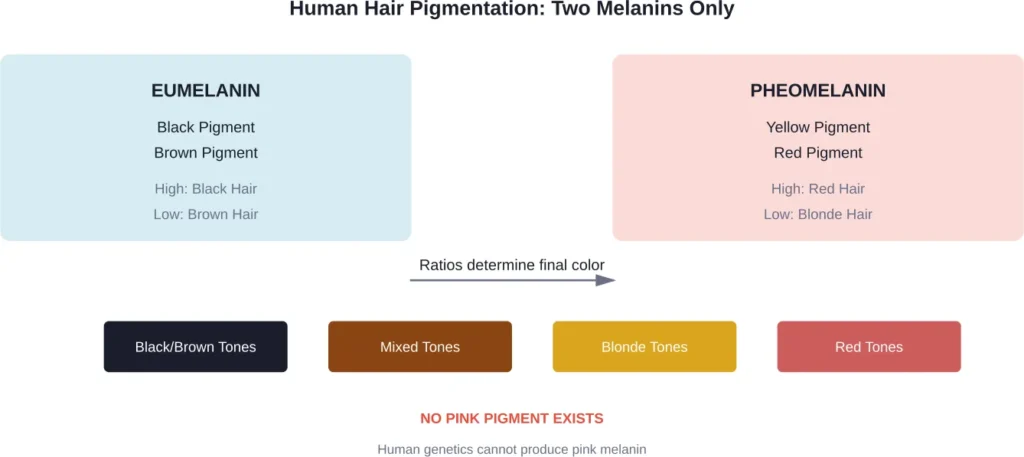
Every hair color on Earth—from deepest black to palest blonde—comes down to the ratio and amount of two melanin types.
Eumelanin produces black and brown tones. High concentrations create black hair, while lower amounts result in various shades of brown. This pigment is dense and opaque, which is why darker hair tends to be more resistant to sun damage.
Pheomelanin produces yellow and red tones. When pheomelanin dominates with minimal eumelanin, hair appears blonde. Higher concentrations of pheomelanin create the orange-red spectrum seen in redheads.
That’s it. Those are the only two pigments human melanocytes can produce.
Genetic Control of Hair Color
Stanford University researchers discovered that subtle changes in DNA determine whether someone is blonde or brunette. A single nucleotide change on human chromosome 12—where an adenine is replaced by a guanine—occurs over 350,000 nucleotides away from the KITLG gene and alters gene expression by about 20 percent.
That tiny change makes a massive difference in visible hair color. But notice what it doesn’t do—it doesn’t create new pigment types. It only adjusts the ratios of the two existing melanins.
Research published in the NIH database confirms that pigmentary phenotype is genetically complex, with multiple genes determining the amount, type, and packaging of melanin polymers. Studies in model organisms have revealed genes and pathways involved in pigmentation, and they all converge on the melanin synthesis pathway.
Pink simply isn’t part of that pathway.
Why Natural Pink Hair Is Biologically Impossible
The short answer? Human cells don’t have the genetic instructions to produce pink pigment.
Melanin synthesis follows specific biochemical pathways controlled by genes like TYR, OCA2, TYRP1, and others. According to NIH research on oculocutaneous albinism, these genes regulate melanin production in predictable ways. Mutations in these genes can reduce or eliminate melanin production—resulting in albinism—but they can’t create novel pigment colors.
The Color Spectrum Limits
Think about the visible spectrum of natural hair colors worldwide. According to data from the NIH, albinism affects approximately one in 20,000 individuals globally, with prevalence varying by ethnic background. OCA2 is particularly common in sub-Saharan Africa, reaching rates as high as 1 in 1,000 in some populations due to genetic factors.
Even in cases of albinism—where melanin production is severely reduced or absent—hair appears white, pale yellow, or very light blonde. Not pink.
Here’s why that matters: if genetic mutations that completely disrupt normal pigmentation can’t produce pink hair, then normal genetic variation certainly can’t either.
What About Red Hair?
Red hair is the closest natural color to pink, but it’s still fundamentally orange-red, not pink. Redheads have high concentrations of pheomelanin with minimal eumelanin, creating that distinctive copper-to-auburn spectrum.
Some redheads with very pale, translucent hair might appear to have a pinkish tint in certain lighting conditions—but that’s an optical effect caused by the scalp showing through, not actual pink pigment in the hair shaft.
Debunking Viral Pink Hair Claims
Social media has amplified claims about naturally occurring pink hair, with influencers sharing videos and photos purporting to show this phenomenon. These claims typically fall into a few categories.
The Pink Dragon Fruit Diet Myth
One viral claim suggests that consuming large amounts of pink dragon fruit during pregnancy can cause babies to be born with pink hair. This has zero scientific basis.
While diet can influence some aspects of fetal development, it cannot alter the fundamental genetic programming that determines melanin production. Food pigments don’t transfer to hair follicles in a way that would change hair color—if they did, eating blueberries would turn hair blue.
Medical Conditions and Pink Hair
Some claims attribute pink hair to rare medical conditions. While conditions like oculocutaneous albinism affect pigmentation, NIH research confirms these conditions cause hypopigmentation (reduced or absent color), not novel colors like pink.
According to research published in the NIH database, oculocutaneous albinism is characterized by hypopigmentation in skin, hair, and eyes due to reduced or absent melanin. Hair in OCA patients appears white, pale yellow, or light blonde—never pink.
Optical Illusions and Lighting
Photography and lighting can create misleading appearances. Blonde or white hair photographed under pink-tinted lighting, filtered through social media apps, or affected by color grading can appear pink without actually being pink.
This explains many viral images that claim to show natural pink hair.
The Closest Natural Hair Color to Pink
If someone wants a color as close to pink as biologically possible without dye, red hair is the answer—specifically, very light auburn or strawberry blonde shades.
These colors occur when pheomelanin dominates with minimal eumelanin interference. The result is a warm, orange-red tone that, in certain lighting conditions or when sun-bleached, can take on a slightly coral or peachy appearance.
But it’s still not pink. The underlying pigment structure remains orange-red, not the cool-toned pink that people envision.
Gray and White Hair
Research from the University of Alabama at Birmingham suggests that hair graying involves more complex mechanisms than previously understood. By age 61 to 65, 91% of people will exhibit some level of hair graying.
Gray and white hair result from melanocyte depletion or dysfunction, not from a new pigment. When melanin production decreases, hair appears gray (a mix of pigmented and non-pigmented strands) or white (complete absence of melanin).
Some people with white or very light gray hair might appear to have a pinkish tint due to the scalp showing through, but again—this is an optical effect, not actual pink pigment.
Achieving Pink Hair: The Only Real Options
Since natural pink hair is impossible, artificial coloring is the only route. Modern hair dye technology offers multiple approaches.
Permanent Hair Dye
Permanent dyes use oxidative processes to deposit color molecules deep within the hair shaft. Pink shades require pre-lightening (bleaching) for most natural hair colors, as the underlying melanin must be removed to allow the pink pigment to show clearly.
This is the most long-lasting option but also the most damaging to hair structure.
Semi-Permanent and Temporary Colors
Semi-permanent dyes deposit color on the hair surface without lifting natural pigment. They gradually fade over weeks or months. Temporary options like hair chalk, sprays, or wash-out colors provide even shorter-lasting results.
These methods work best on pre-lightened or naturally very light hair.
Pink Wigs
Wigs offer pink hair without any chemical processing. Synthetic and human hair wigs come in countless pink shades, from pastel rose to vibrant magenta. This option preserves natural hair health while allowing style flexibility.
| Method | Duration | Hair Damage | Best For |
|---|---|---|---|
| Permanent Dye | Until hair grows out | High (requires bleaching) | Long-term commitment |
| Semi-Permanent Dye | 4-8 weeks | Moderate | Experimenting with color |
| Temporary Color | 1-3 washes | Minimal | Special occasions |
| Pink Wig | Reusable indefinitely | None | Versatility without damage |
The Science of Hair Color Genetics
Understanding why pink hair can’t occur naturally requires looking at the genes involved in pigmentation.
Columbia University Medical Center researchers discovered that mutations in the P2RY5 gene cause hereditary “woolly hair”—coarse, dry, tightly curled, and sparse hair. This demonstrates how specific genes control hair texture, but not color outside the melanin spectrum.
The KITLG gene plays a crucial role in melanocyte function and hair color determination. Stanford research showed that single nucleotide changes near this gene significantly impact whether hair appears blonde or brunette by altering gene expression levels.
But notice the pattern—genetic research consistently identifies variations that adjust melanin ratios, not genes that create entirely new pigment types.
Albinism and Pigmentation Disorders
Research on oculocutaneous albinism provides insight into what happens when pigmentation genes malfunction. According to NIH studies, OCA1 and OCA2 are caused by mutations in the TYR and OCA2 genes, which are responsible for most cases worldwide.
OCA1 accounts for approximately 50 percent of cases globally and is most common in Caucasian populations. OCA2 is particularly prevalent in sub-Saharan Africa. OCA3 (rufous oculocutaneous albinism) affects approximately 1 in 8,500 individuals in Africa while remaining very rare in Caucasian and Asian populations.
In all these conditions, the result is reduced or absent melanin—never alternative pigments like pink, blue, or green.
Could Future Technology Create Natural Pink Hair?
The question shifts from “can it happen naturally” to “could genetic engineering make it possible?”
Theoretically, advanced genetic engineering could introduce genes from other organisms that produce pink pigments. Some animals and plants produce pink pigmentation through carotenoids, pterins, or other biochemical pathways.
But this would require fundamentally altering human biology at the cellular level—introducing new pigment synthesis pathways that don’t currently exist in mammals. The technical, ethical, and regulatory barriers are immense.
As of now, no such technology exists. Research on human pigmentation genetics focuses on understanding disease states like albinism and melanoma risk, not creating novel hair colors.
Popular Culture and Pink Hair
Pink hair has become iconic in fashion, entertainment, and pop culture. Celebrities frequently sport pink locks, from pastel rose to vibrant hot pink.
This cultural popularity fuels curiosity about whether pink hair could occur naturally. The visible prevalence of pink hair—all achieved through dye—creates a perception that it might be within the range of natural possibility.
But biology doesn’t bend to cultural trends. The melanin synthesis pathway remains unchanged regardless of how popular pink hair becomes.
| Natural Hair Colors | Melanin Type Responsible | Genetic Basis |
|---|---|---|
| Black | High eumelanin | Multiple genes including TYR, OCA2 |
| Brown | Moderate eumelanin | Variable expression of melanin genes |
| Blonde | Low eumelanin, some pheomelanin | KITLG, other modifier genes |
| Red/Auburn | High pheomelanin, low eumelanin | MC1R gene variants primarily |
| White (albinism) | Absent/minimal melanin | TYR, OCA2 mutations |
| Pink | N/A – Not possible | No genetic pathway exists |
Frequently Asked Questions
No, humans cannot be born with naturally pink hair. Human hair color is determined exclusively by two melanin types—eumelanin (black/brown) and pheomelanin (yellow/red)—which can only produce colors ranging from black to red. Pink pigmentation requires biological pathways that don’t exist in human genetics.
Red hair is the rarest natural hair color, occurring in approximately 1-2 percent of the global population. It’s most common in people of Northern or Northwestern European ancestry and results from high pheomelanin levels combined with specific MC1R gene variants.
No known medical condition causes truly pink hair. Conditions affecting pigmentation, like oculocutaneous albinism, cause reduced or absent melanin, resulting in white, pale yellow, or very light blonde hair—not pink. Any apparent pink coloration would be due to optical effects or external factors, not the hair itself being pink.
Strawberry blonde is not pink—it’s a pale reddish-blonde color resulting from low levels of both eumelanin and pheomelanin, with pheomelanin slightly dominant. In certain lighting, it might appear to have peachy or coral undertones, but the actual pigment is in the yellow-red range, not pink.
No, maternal diet during pregnancy cannot change the fundamental hair color determined by the baby’s genetics. While nutrition affects overall fetal development, food pigments don’t alter melanin production in hair follicles or create new pigment types. Claims about pink dragon fruit causing pink hair have no scientific basis.
Theoretically, future genetic engineering could introduce novel pigment-producing pathways into human biology, but this would require inserting genes from organisms that naturally produce pink pigments—a massive undertaking with significant technical and ethical barriers. As of now, no such technology exists, and research priorities focus on medical applications rather than cosmetic traits.
Wearing a pink wig is the safest option, as it causes zero damage to natural hair. For dyed pink hair, semi-permanent colors on pre-lightened hair cause less damage than permanent dyes. Temporary options like hair chalk or spray provide the lowest-commitment approach. Any bleaching or permanent coloring should be done by a professional colorist to minimize hair damage.
Conclusion: The Biology Is Clear
Natural pink hair remains firmly in the realm of impossibility, constrained by the fundamental biology of human pigmentation. The two-melanin system—eumelanin and pheomelanin—creates remarkable diversity in natural hair colors, from deepest black to palest blonde to vibrant red.
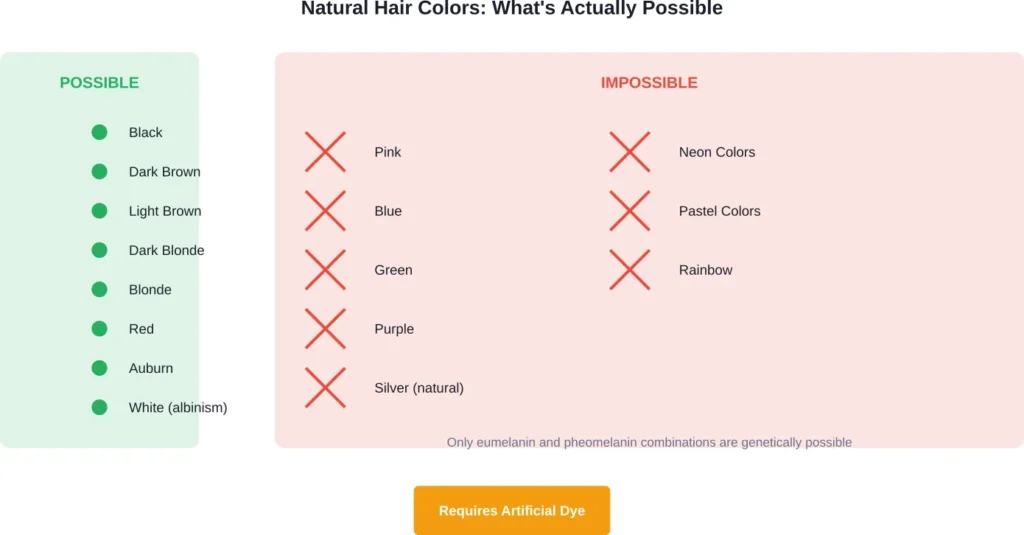
But it can’t produce pink. Or blue, green, purple, or any other color outside the black-to-red spectrum.
Viral claims and social media speculation don’t change the underlying genetic reality. Human melanocytes simply don’t possess the biochemical machinery to synthesize pink pigments.
That doesn’t diminish the beauty or appeal of pink hair—it just means achieving it requires artificial coloring methods, from permanent dye to wigs. Modern hair color technology offers countless options for anyone wanting to rock pink locks without waiting for biology to catch up.
Looking to explore hair color science further? Consider researching the genetics of red hair, understanding how hair dye chemistry works, or learning about safe bleaching techniques.