

Quick Summary: Pregnancy after tubal ligation is possible but rare. Research shows 3% to 5% of women who had their tubes tied later reported unplanned pregnancies. The failure rate varies by surgical method, age at time of procedure, and years since surgery. Women who wish to conceive after tubal ligation have two main options: tubal reversal surgery or IVF.
Tubal ligation is widely considered a permanent form of birth control. About 65% of women ages 15 to 49 in the U.S. use birth control, and tubal sterilization ranks as one of the most common methods worldwide.
But here’s the thing—it’s not 100% effective. While rare, pregnancies can and do happen after the procedure.
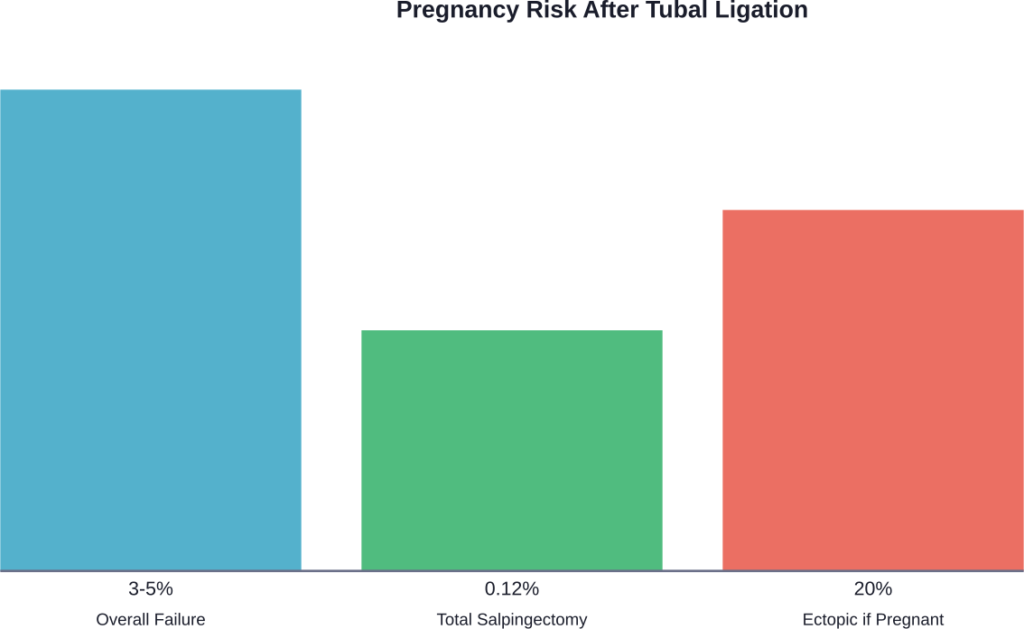
Research from UC San Francisco found that 3% to 5% of women in the United States who had their tubes tied later reported an unplanned pregnancy. That’s higher than many women realize when they choose sterilization.
How Does Tubal Ligation Fail?
Tubal ligation involves blocking, cutting, or removing the fallopian tubes. The goal is simple: prevent the egg from traveling from the ovary to the uterus and keep sperm from reaching the egg.
So why does it sometimes fail?
Several factors contribute to sterilization failure. According to research published by the National Institutes of Health, the tubes can spontaneously reconnect through a process called recanalization. This happens when the tissue heals and creates a new pathway for sperm and egg to meet.
The surgical method matters too. Different techniques carry different failure rates over time.
Failure Rates by Surgical Method and Age
Not all tubal ligation procedures are created equal. The 10-year failure rate varies substantially based on how the surgery was performed and how old you were when you had it done.
Research from the Collaborative Review of Sterilization revealed that women between ages 28 and 33 who had a postpartum partial salpingectomy have a failure rate of 1.2 per 1,000 cases. The study tracked outcomes from 1978 to 1986.
Total bilateral salpingectomy—where both fallopian tubes are completely removed—has an extremely low failure rate. Research from the Collaborative Review of Sterilization and subsequent studies show 10-year failure rates ranging from approximately 0.12% for total salpingectomy to higher rates for other methods, with rates varying by surgical technique and age. Medical research published in SAGE Open Medicine Case Reports (2024) documents that spontaneous intrauterine pregnancy after total bilateral salpingectomy is extraordinarily rare, with the study noting the sterilization failure rate after total bilateral salpingectomy is unknown but exceedingly rare.
| Surgical Method | Relative Failure Risk | Key Considerations |
|---|---|---|
| Silicone rubber band | Lower 10-year failure rate | Varies by clinical characteristics |
| Spring clip | Lower 10-year failure rate | Varies by demographic factors |
| Postpartum partial salpingectomy | 1.2 per 1,000 cases (ages 28-33) | Age-dependent |
| Total bilateral salpingectomy | Extremely rare | Lowest failure rate |
Age at the time of surgery plays a significant role. The younger you are at the time of tubal ligation, the higher the chance of pregnancy. Research from UC San Francisco (2002-2015) found that the chance of pregnancy was highest among those who were younger at the time of their tubal surgery.
Signs and Symptoms of Pregnancy After Tubal Ligation
If you’ve had your tubes tied and suspect pregnancy, the symptoms are the same as any other pregnancy.
Watch for these common signs:
- Missed period
- Breast tenderness or swelling
- Nausea, especially in the morning
- Unexplained fatigue
- Frequent urination
- Food cravings or aversions
- Feeling sick when thinking about certain foods
But here’s what’s critical: if pregnancy occurs after tubal ligation, there’s a higher risk of ectopic pregnancy. According to ACOG, in the small chance pregnancy does occur after tubal sterilization, about 20 percent have an ectopic pregnancy.
Warning Signs of Ectopic Pregnancy
An ectopic pregnancy happens when the fertilized egg implants outside the uterus, typically in the fallopian tube. This is a medical emergency.
Research has documented multiple cases of ectopic pregnancy following tubal ligation among women with previous sterilization. These findings confirm that tubal sterilization doesn’t invariably confer infertility.
Seek immediate medical attention if you experience:
- Sharp or stabbing abdominal pain
- Shoulder pain
- Vaginal bleeding or spotting
- Dizziness or fainting
- Weakness
Options for Getting Pregnant Intentionally After Tubal Ligation
Changed your mind about having children? You have two primary pathways: tubal reversal surgery or in vitro fertilization (IVF).
Each approach has distinct advantages and limitations.
Tubal Reversal Surgery
Tubal reversal (also called tubal reanastomosis) is a surgical procedure that reconnects the fallopian tubes. The surgeon removes the blocked portions and reattaches the healthy segments.
Success depends on several factors:
- Amount of healthy tube remaining
- Type of original ligation method
- Age and ovarian reserve
- Presence of other pelvic conditions
- Sperm quality
Research from Monash University examined pregnancy outcomes from tubal sterilization reversal by sutureless laparoscopic reanastomosis. The retrospective cohort study identified prognostic factors that affect success rates.
The advantage? Once successful, pregnancy can occur naturally in subsequent cycles without additional intervention. The downside is that it’s invasive surgery with recovery time and doesn’t guarantee pregnancy.
In Vitro Fertilization (IVF)
IVF bypasses the fallopian tubes entirely. Eggs are retrieved directly from the ovaries, fertilized in a lab, and embryos are transferred to the uterus.
This approach works regardless of tube condition. According to fertility specialists, IVF may be the better option when:
- Limited healthy tube remains
- Age or ovarian reserve is a concern
- Male factor infertility exists
- Other fertility issues are present
IVF typically offers faster results per attempt but requires repeated cycles if the first transfer doesn’t succeed. Each cycle involves medications, monitoring, and procedures.
| Factor | Tubal Reversal | IVF |
|---|---|---|
| Invasiveness | Major surgery | Minimally invasive |
| Recovery Time | Several weeks | Days to week |
| Ongoing Costs | One-time surgical cost | Per-cycle costs |
| Future Pregnancy | Natural conception possible | Requires new cycle |
| Success Factors | Tube quality dependent | Age and reserve dependent |
| Ectopic Risk | Higher (tubes involved) | Lower (bypasses tubes) |
How Tubal Ligation Compares to Other Birth Control
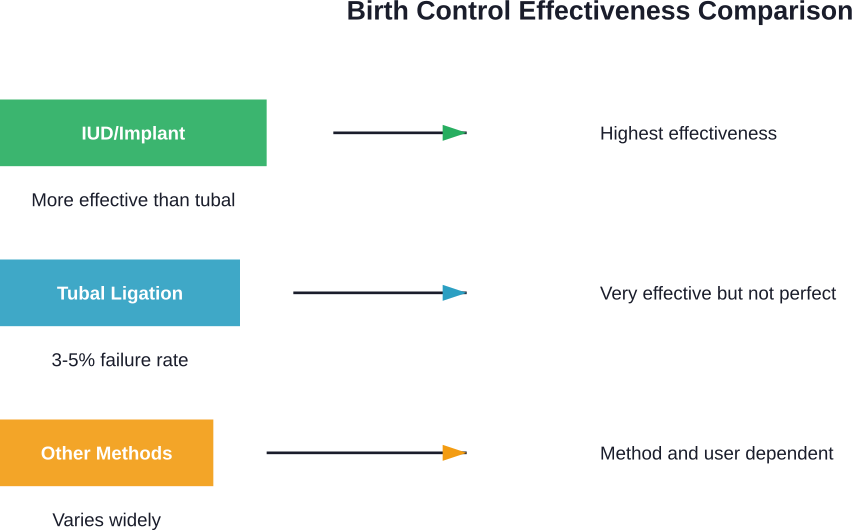
Here’s something surprising: tubal ligation isn’t necessarily more effective than long-acting reversible contraception.
UC San Francisco researchers found that people using a contraceptive arm implant or an IUD are less likely to become pregnant than those who have their tubes tied. This challenges the widely held assumption that tubal ligation, which requires surgery and is permanent, is more effective than an IUD.
A separate UCSF study analyzing six years of Medi-Cal claims data confirmed that IUDs work at least as well as tubal ligation while causing fewer side effects. This was the first rigorous look at how long-term birth control methods perform in the real world.
Research from Weill Cornell Medicine (published April 2022 in Fertility and Sterility) found that both hysteroscopic sterilization and laparoscopic sterilization had failure rates of five to six percent at 5 years post-procedure—higher than expected.
What to Do If You Suspect Pregnancy
Take a home pregnancy test first. These are highly accurate when used correctly.
If positive—or if negative but symptoms persist—contact your healthcare provider immediately. Early detection is critical, especially given the elevated ectopic pregnancy risk.
Your doctor will likely order a blood test to measure hCG levels and perform an ultrasound to confirm the pregnancy location. Don’t delay this step.
Frequently Asked Questions
The risk persists for years after the procedure. Research shows the 10-year cumulative probability varies by surgical method and age at time of surgery. The younger you were during the procedure, the higher your long-term failure risk.
Yes, though it’s rare. According to PubMed research, the risk of pregnancy after tubal sterilization persists for years and varies by method of tubal occlusion and age. Cases have been documented decades after the original procedure.
The main concern is ectopic pregnancy. ACOG reports that approximately 20% of pregnancies occurring after sterilization are ectopic. Ectopic pregnancy is a serious medical condition requiring immediate medical treatment.
Total bilateral salpingectomy—complete removal of both fallopian tubes—has the lowest failure rate. Medical research documents that spontaneous intrauterine pregnancy after this procedure is extraordinarily rare.
Yes, if the reversal is successful and sufficient healthy tube remains. Success depends on tubal anatomy, age, ovarian reserve, sperm quality, and other pelvic conditions. Research from Monash University identified these as key prognostic factors.
It depends on individual circumstances. IVF bypasses the tubes entirely and works regardless of tube condition. Reversal allows for natural conception but requires adequate healthy tube. Fertility specialists assess factors like age, ovarian reserve, remaining tube length, and other conditions to recommend the best option.
Pregnancy can occur at any time if the procedure fails. Early failures may result from incomplete occlusion or surgical error. Later failures typically involve recanalization, where tissue heals and creates a new passage.
The Bottom Line
Tubal ligation is highly effective but not foolproof. Research confirms that 3% to 5% of women experience unplanned pregnancy after the procedure—a rate that surprises many.
The failure risk depends on surgical method, age at time of surgery, and years since the procedure. Total bilateral salpingectomy offers the lowest failure rate, while other methods show higher long-term risk.
If pregnancy occurs, ectopic pregnancy risk increases significantly. Watch for warning signs and seek immediate medical care if you suspect pregnancy after tubal ligation.
For those who wish to conceive intentionally, tubal reversal and IVF both offer viable pathways. Consult with a fertility specialist to determine which approach best fits your situation.
And here’s the reality: long-acting reversible contraception like IUDs and implants actually outperform tubal ligation in real-world effectiveness. If you’re considering sterilization primarily for contraceptive effectiveness rather than permanence, discuss all options with your healthcare provider.