

Quick Summary: Getting pregnant right before your period is highly unlikely but technically possible. Most women ovulate mid-cycle (roughly day 14 of a 28-day cycle), making conception least probable during menstruation or the days immediately preceding it. However, irregular cycles, early ovulation, or long sperm survival can create rare windows where pregnancy occurs from intercourse just before a period.
The question of whether pregnancy can happen right before your period confuses many people. And it’s understandable—fertility timing isn’t exactly straightforward.
The short answer? Pregnancy right before your period is extremely unlikely for most women. But biology doesn’t follow strict rules, and certain circumstances can shift the odds.
Let’s break down what actually happens in the menstrual cycle and when pregnancy becomes possible.
Understanding the Menstrual Cycle and Ovulation
The menstrual cycle varies from woman to woman. While 28 days is the commonly cited average, normal cycles range anywhere from 21 to 35 days according to health authorities.
Here’s what happens during a typical cycle: The first day of bleeding marks day one. Over the next two weeks, follicles develop in the ovaries and estrogen levels rise. Around mid-cycle, a surge of luteinizing hormone triggers ovulation—when an ovary releases a mature egg.
That egg survives for roughly 12 to 24 hours after ovulation, according to the American College of Obstetricians and Gynecologists (ACOG). If sperm doesn’t fertilize it within that window, the egg disintegrates and pregnancy can’t occur that cycle.
But here’s where timing gets interesting. Sperm can survive inside a woman’s body for up to 5 days, sometimes even longer in ideal conditions. This creates what’s called the “fertile window”—approximately 6 days each cycle when pregnancy becomes possible.
When Can Pregnancy Actually Happen?
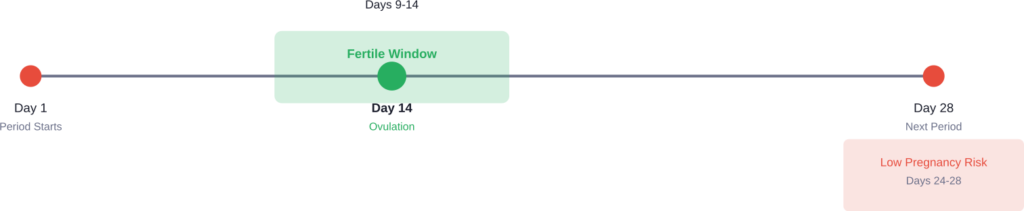
ACOG states that the fertile window includes the 5 days before ovulation plus the day of ovulation itself. This is when intercourse has the highest probability of resulting in pregnancy.
For a woman with a standard 28-day cycle who ovulates on day 14, the fertile window runs roughly from day 9 through day 14. Her period would then start around day 28—two full weeks after ovulation.
The days immediately before menstruation fall well outside this fertile window. By day 24, 25, 26, or 27 of a typical cycle, ovulation happened 10-13 days earlier. The egg is long gone, and pregnancy from intercourse on those days is essentially impossible.
But that’s only if everything follows the textbook pattern.
Why Pregnancy Before Your Period Might Still Happen
Real life doesn’t always match the textbook. Several factors can shift the fertile window in unexpected ways.
Irregular or Variable Cycles
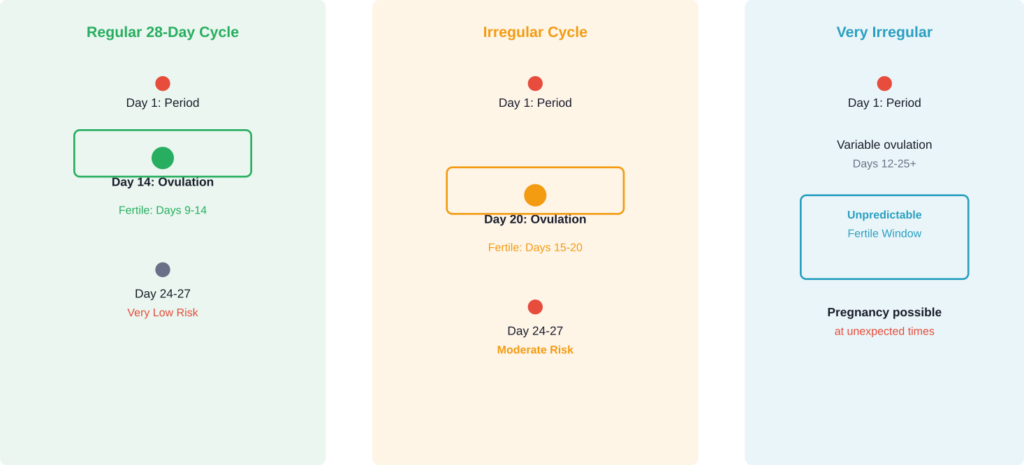
Not everyone has consistent 28-day cycles. Research analyzing real-world ovulation tracking data has revealed significant variation in both cycle length and ovulation timing among women trying to conceive.
Research indicates that in only about 30% of women does the fertile window fall entirely within days 10-17 of the cycle—the range clinical guidelines typically cite. Most women reach their fertile window earlier, and others much later.
If your cycles vary widely—say, ranging from 24 to 35 days—predicting ovulation becomes much harder. What you think is “right before your period” might actually be closer to ovulation than you realize.
Late Ovulation
Some women ovulate much later than day 14. If ovulation doesn’t happen until day 20 or 22 of a 28-day cycle, the fertile window shifts accordingly. In these cases, intercourse on day 18 or 19—which might feel like it’s right before the period—could absolutely result in pregnancy.
Sperm Longevity
While typical estimates put sperm survival at 3-5 days, sperm can occasionally persist longer in optimal cervical conditions. If intercourse happens 6 or 7 days before a late ovulation, conception remains possible even though it seems improbable.
Mistaking Bleeding for a Period
Sometimes women experience spotting or breakthrough bleeding mid-cycle that gets mistaken for a light period. If you have sex during what you think is the tail end of your period, you might actually be approaching ovulation—prime conception territory.
The Role of Cycle Tracking and Prediction Accuracy
Many women trying to conceive discover that predicting ovulation isn’t as simple as it sounds. Research suggests that only about 30% of women can accurately predict when they are fertile based on cycle counting alone.
The CDC notes that detailed history provides the most accurate assessment of pregnancy risk, but even careful tracking has limitations. Ovulation can shift due to stress, illness, travel, or hormonal fluctuations.
Methods like basal body temperature tracking, ovulation predictor kits, and cervical mucus monitoring improve accuracy. But these require consistent effort and don’t work for everyone.
What About Getting Pregnant During Your Period?
While the focus here is on pregnancy right before menstruation, it’s worth addressing a related question: Can pregnancy happen during your period?
Again, it’s rare but possible. For women with shorter cycles (21-24 days) or longer periods (7+ days), ovulation might occur soon after menstruation ends. Since sperm can survive 5 days, intercourse during the final days of a period could result in conception when the egg releases a few days later.
Healthcare providers report that many people are surprised to learn that any unprotected intercourse carries some pregnancy risk—even if timing suggests otherwise.
Real-World Pregnancy Statistics
Data from health authorities shows that at least 85% of women who have regular unprotected sex will become pregnant within one year. That’s true even for couples who aren’t specifically timing intercourse to coincide with ovulation.
Many women become pregnant from having sex just one time without birth control, according to public health guidance. The takeaway? Fertility is less predictable than most people assume.
For those actively trying to conceive, healthcare providers report that approximately 85% of healthy women will achieve pregnancy within a year of attempting. For couples who struggle beyond that timeframe, fertility evaluation becomes recommended.
When to Take a Pregnancy Test
If you had unprotected intercourse right before your expected period and menstruation doesn’t arrive on schedule, a pregnancy test is warranted.
Most home pregnancy tests detect the hormone hCG about 12-14 days after conception, which typically coincides with the first day of a missed period. Testing earlier might produce false negatives since hCG levels haven’t risen high enough yet.
For the most accurate results, wait until at least the first day of your missed period to test. If the result is negative but your period still doesn’t start, retest a few days later or consult a healthcare provider.
Frequently Asked Questions
Getting pregnant 2 days before your period is extremely unlikely in a regular cycle. Ovulation typically occurs about 14 days before menstruation, meaning the egg is long gone by that point. However, women with irregular cycles or late ovulation might still be in their fertile window.
No day is completely “safe” for unprotected sex if pregnancy prevention is the goal. While the days immediately before menstruation have the lowest pregnancy risk in regular cycles, variations in ovulation timing mean pregnancy remains theoretically possible. Reliable contraception is necessary for pregnancy prevention.
Yes, irregular periods make predicting fertile days much harder. Ovulation timing becomes unpredictable, so the fertile window can shift unexpectedly. Women with irregular cycles may ovulate much earlier or later than average, increasing the chance of surprise pregnancies from intercourse that seemed “safe.”
According to ACOG, sperm typically survive 3-5 days inside a woman’s body, though survival up to 5 days occurs mainly in optimal cervical mucus conditions around ovulation. This extended lifespan explains why intercourse several days before ovulation can still result in pregnancy.
Early pregnancy symptoms can appear before a missed period for some women, but they’re often subtle and easily confused with premenstrual symptoms. The most reliable approach is waiting until your period is at least one day late, then taking a home pregnancy test for accurate results.
Stress can absolutely impact ovulation timing. Significant stress may delay ovulation or, in severe cases, prevent it entirely for a cycle. This adds another layer of unpredictability to fertility tracking, since lifestyle factors can shift the fertile window without warning.
The withdrawal method has a typical-use failure rate of about 22%, meaning it’s unreliable for pregnancy prevention regardless of cycle timing. Even right before your period—when pregnancy risk is naturally lower—withdrawal doesn’t provide adequate protection if preventing pregnancy is important.
The Bottom Line on Pregnancy Timing
So can you get pregnant right before your period? For most women with regular cycles, the answer is no—pregnancy is extremely unlikely in the days immediately preceding menstruation.
But biology isn’t perfectly predictable. Irregular cycles, late ovulation, long sperm survival, and mistaken bleeding can all create scenarios where pregnancy happens at unexpected times.
The safest assumption? Any unprotected intercourse during your reproductive years carries some pregnancy risk, regardless of where you are in your cycle.
If preventing pregnancy is your priority, consistent contraception is essential. If you’re trying to conceive, tracking ovulation through multiple methods improves your chances of timing intercourse during your actual fertile window.
When in doubt, consult with a healthcare provider. They can help clarify your individual fertility patterns and provide personalized guidance based on your cycle history and reproductive goals.