
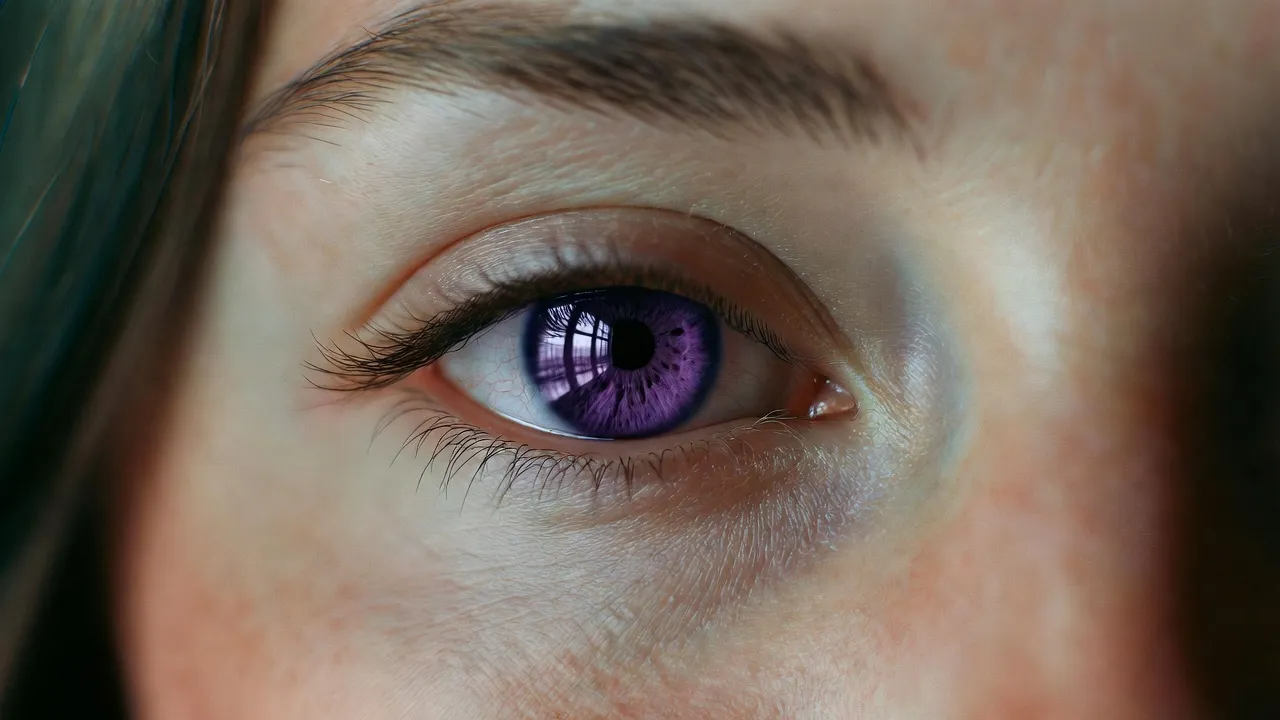
Quick Summary: True purple eyes do not occur naturally in humans. While extremely rare cases of violet or violet-blue eyes exist due to low melanin levels combined with light scattering effects, genuine purple eye color is biologically impossible. The popular myth of “Alexandria’s Genesis” causing purple eyes is entirely fictional.
Purple eyes have captured imaginations for years, fueling internet myths and celebrity rumors. But here’s the thing—if you’re picturing eyes the color of an amethyst gemstone, that’s not happening in real life.
The question “can humans have purple eyes?” pops up constantly online. And there’s a reason for the confusion. Between digitally edited photos, colored contacts, and that persistent Alexandria’s Genesis hoax, separating fact from fiction gets tricky.
So what’s actually possible? Let’s break down the science.
The Science of Eye Color: How Melanin Creates What We See
Eye color isn’t as simple as mixing paint. According to research published by the American Academy of Ophthalmology, the presence of melanin pigment within the iris determines what color eyes appear to be.
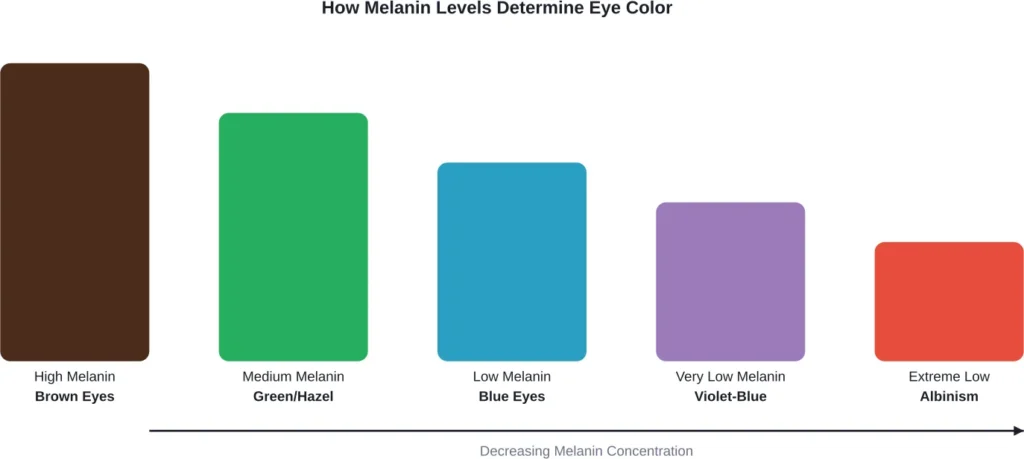
Here’s how it works. Melanin is the same pigment that colors skin and hair. The more melanin in your iris, the darker your eyes. Brown eyes have lots of melanin. Blue eyes have very little. Green and hazel fall somewhere in between.
But blue eyes don’t actually contain blue pigment. Research from the American Academy of Ophthalmology confirms that blue and other lighter eye colors result from how light scatters through the iris structure when melanin levels are low. It’s the same phenomenon that makes the sky look blue.
According to a 2014 Harris Poll survey cited by the American Academy of Ophthalmology, approximately 45% of Americans have brown eyes, 27% have blue eyes, 18% have hazel eyes, and 9% have green eyes. Only about 1% have eyes classified as “other colors.”
The Genetic Complexity Behind Eye Color
The University of Delaware notes that one of the oldest myths in human genetics is that blue eyes are determined by a single gene. That’s completely wrong.
Modern genetic research shows eye color is far more complex. A genome-wide association study involving almost 195,000 individuals identified 50 previously unidentified genetic loci for eye color. This research demonstrates that genetic complexity of human eye color considerably exceeds previous expectations.
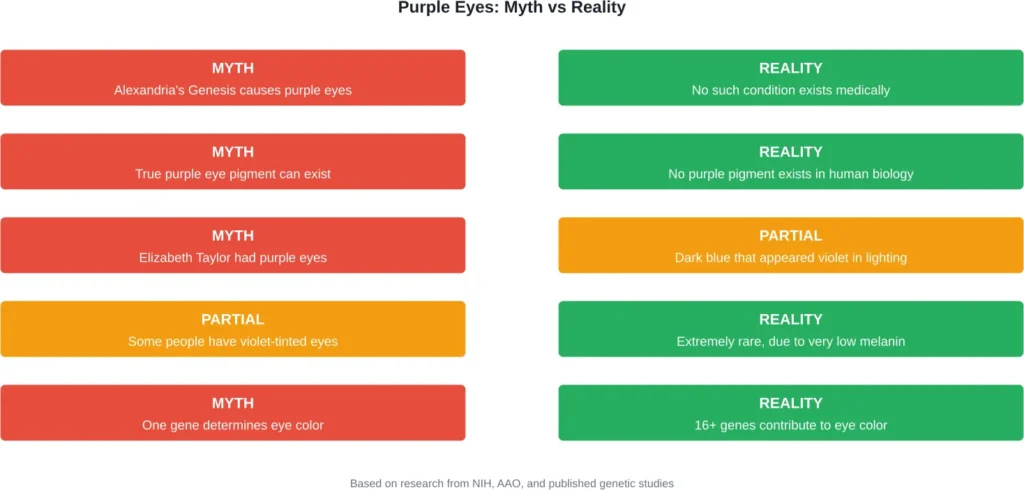
According to research published in Nature, about 16 different genes contribute to eye color, though recent research suggests considerably more genetic complexity, with it being mostly attributed to two adjacent genes on chromosome 15: HERC2 and OCA2. Research published on PubMed confirms that OCA2 polymorphism underlies most of the natural variability in human iris pigmentation.
Can Humans Actually Have Purple Eyes?
The short answer? No, not true purple.
Purple as a color presents a unique problem. Research cited by Popular Mechanics explains that the human eye does not actually see purple as it exists on the visual spectrum. Purple is created when our brain perceives wavelengths from opposite extremes of the spectrum simultaneously—red and blue.
The visible light spectrum detectable by human eyes makes up only 0.0035% of all wavelengths. Those colors are processed by photoreceptor cells called cones in the retina. But there’s no single wavelength that produces purple the way there is for red, green, or blue.
Real talk: For eyes to appear genuinely purple, they’d need a pigment that doesn’t exist in human biology.
What About Violet Eyes?
Now, violet is slightly different from purple. Some extremely rare cases of violet-tinted eyes have been documented.
According to the American Academy of Ophthalmology, green eyes are the rarest standard eye color, occurring in only about 2% of the world’s population. Violet would be even rarer.
These violet-appearing eyes result from an extremely low amount of melanin combined with specific lighting conditions and the way light scatters through the iris structure. They’re essentially a more extreme version of blue eyes—so little melanin that certain lighting makes them appear to have a violet tint.
Medical conditions can also affect apparent eye color. Albinism, caused by little to no melanin production, sometimes creates eyes that appear reddish or violet due to blood vessels showing through the iris. According to NIH research on albinism, this affects pigmentation throughout the body, including the eyes.
Alexandria’s Genesis: The Internet’s Favorite Purple Eye Hoax
Here’s where things get interesting. You’ve probably heard of Alexandria’s Genesis—that supposed genetic mutation that gives people perfect purple eyes.
According to Medical News Today, Alexandria’s Genesis is an online myth traced back to 2005, though it may have spread earlier. The fake condition claims a genetic mutation turns some people into “perfect” human beings with purple eyes from birth, pale skin, no body hair, perfect vision, and the ability to live to 150 years old.
Sound too good to be true? It is. Completely fabricated.
Medical News Today confirms: “This is fiction, and a person cannot be born with purple eyes.” No scientific documentation of Alexandria’s Genesis exists. No medical literature references it. Zero genetic research supports it.
The myth likely originated from online fan fiction and spread through social media. But it has no basis in medical reality whatsoever.
Why the Myth Persists
People want to believe in rare, extraordinary traits. Purple eyes sound magical and exclusive. Add some pseudoscientific jargon about “genetic mutations” and the story gains credibility.
But genetics doesn’t work that way. Melanocytes—cells that produce melanin—respond to light exposure. According to Medical News Today, melanocytes become more active during the first year of life, explaining why babies’ eye colors change. Usually, changes in eye color will have stopped by the age of 6, though some people experience them throughout adolescence and adulthood.
No known genetic mutation produces actual purple pigment in human eyes. The biochemistry simply isn’t there.
Elizabeth Taylor and the Violet Eyes Legend
Elizabeth Taylor’s supposedly violet eyes are another source of purple eye mythology. The legendary actress was famous for her striking eye color.
But were they actually purple? Probably not.
According to the American Academy of Ophthalmology, Elizabeth Taylor’s eyes were more accurately described as dark blue to violet. Lighting, makeup, and her naturally low melanin levels created the appearance of violet eyes in certain conditions—especially on film.
Photography and cinematography in Taylor’s era used specific lighting techniques and film stock that could intensify or shift colors. Her eyes were genuinely unusual and beautiful, but calling them true purple stretches reality.
They were an extremely rare shade of blue that appeared violet under the right circumstances. That’s still remarkable, just not supernatural.
Rare Eye Colors That Actually Exist
While purple eyes aren’t real, some genuinely rare eye colors deserve attention.
| Eye Color | Approximate Prevalence | Cause |
|---|---|---|
| Green | 2% worldwide | Low melanin with specific lipochrome deposits |
| Amber | Very rare | High lipochrome, minimal melanin |
| Violet-blue | Extremely rare | Very low melanin with light scattering effects |
| Red (albinism) | Very rare | Absence of melanin showing blood vessels |
| Heterochromia | Less than 1% | Different melanin levels in each iris |
Heterochromia: Two Different Colored Eyes
According to research published by StatPearls and the American Academy of Ophthalmology, heterochromia occurs when a person’s irises are different colors. It can involve the whole iris or only part of it (sectoral heterochromia).
Heterochromia affects less than 1% of the population. It’s caused by variations in melanin concentration between the two eyes or within different parts of the same iris. Most cases are harmless and present from birth, though some develop later due to injury or disease.
Medical Conditions That Change Eye Color
While purple eyes aren’t possible, certain medical conditions can alter eye color in unusual ways.
Waardenburg syndrome is a group of genetic conditions that can cause hearing loss and changes in pigmentation of hair, skin, and eyes. According to MedlinePlus Genetics, Waardenburg syndrome affects an estimated 1 in 40,000 people and accounts for 2 to 5 percent of all cases of congenital hearing loss. People with this condition may have pale blue or differently colored eyes.
Albinism, caused by mutations affecting melanin production, can create eyes that appear pink, red, or pale violet due to visible blood vessels. The NIH has developed stem cell models to study albinism and related eye conditions.
According to the American Academy of Ophthalmology, actual eye color changes in adults are rare. When they occur, they sometimes indicate underlying health issues. Anyone noticing genuine color changes should see an ophthalmologist for a complete eye exam.
Colored Contacts: The Easy Way to Get Purple Eyes
Want purple eyes? Colored contact lenses offer the only reliable method.
Modern cosmetic contacts can create virtually any eye color imaginable—including vivid purple, violet, or amethyst shades. They’re safe when properly fitted and prescribed by an eye care professional.
But here’s the catch. Even cosmetic contacts require a prescription and proper care. They’re medical devices that sit directly on the eye. Buying contacts without a prescription or from unreliable sources can cause serious eye infections, corneal ulcers, or vision loss.
Frequently Asked Questions About Purple Eyes
No, babies cannot be born with true purple eyes. Newborns are often born with blue or gray eyes due to low melanin levels, which typically darken over the first year as melanocytes become more active. Extremely rare cases of violet-blue eyes can occur, but genuine purple is not biologically possible.
No, Alexandria’s Genesis is completely fictional. Medical News Today confirms it’s an online myth with no scientific documentation or medical literature supporting its existence. No genetic mutation produces purple eyes along with the other claimed traits.
Green eyes are the rarest standard eye color, occurring in only about 2% of the world’s population according to the American Academy of Ophthalmology. Amber, violet-blue, and red eyes (from albinism) are even rarer, each affecting far less than 1% of people.
Elizabeth Taylor had extremely rare dark blue eyes that appeared violet under certain lighting conditions and on film. The American Academy of Ophthalmology describes them as “dark blue to violet” rather than true purple. Her low melanin levels and specific lighting created this remarkable appearance.
According to the American Academy of Ophthalmology, eye color typically stabilizes by age six, though some changes can occur through adolescence. In adults, genuine eye color changes are rare. When they do occur, they may indicate underlying medical conditions and warrant examination by an ophthalmologist.
Violet-appearing eyes result from extremely low melanin levels combined with how light scatters through the iris structure. They’re essentially an extreme version of blue eyes. In albinism, visible blood vessels can create reddish or violet appearance due to minimal pigmentation.
No population has a higher incidence of purple eyes because true purple eyes don’t exist. Lighter eye colors including blue and the extremely rare violet-blue are more common in European populations due to genetic variations, but genuine purple remains impossible regardless of ancestry.
The Bottom Line on Purple Eyes
So can humans have purple eyes? Not in the way most people imagine.
True purple—like you’d see in a grape or amethyst—doesn’t occur in human eyes. The pigments and genetics required simply don’t exist. Alexandria’s Genesis is fiction. Those viral photos are edited or show colored contacts.
But extremely rare violet-blue eyes? Those exist at the furthest edge of the melanin spectrum. They’re not purple, but they’re close enough to create legends.
The science of eye color is fascinating enough without myths. According to large-scale genetic studies, eye color involves complex interactions between dozens of genes, light scattering physics, and melanin production. Recent research has identified substantially more genetic loci than previously understood—far more than the simple inheritance models taught in basic biology.
If you’re interested in changing your eye color, safe cosmetic contacts offer endless options. Just consult an eye care professional first. And if you notice actual color changes in your eyes without contacts, get checked out. According to the American Academy of Ophthalmology, eye color changes can occasionally indicate health issues.
Ready to explore more eye color mysteries? Understanding the genetics and biology behind eye color opens up a world of fascinating science—no fictional mutations required.