

Quick Summary: True biological immortality remains scientifically implausible, though human lifespan may moderately extend. Current research suggests a natural ceiling around 115-122 years, with no proven path to indefinite life extension. While scientists have extended lifespan in laboratory animals, translating these findings to humans faces fundamental biological barriers that likely cannot be overcome in this century.
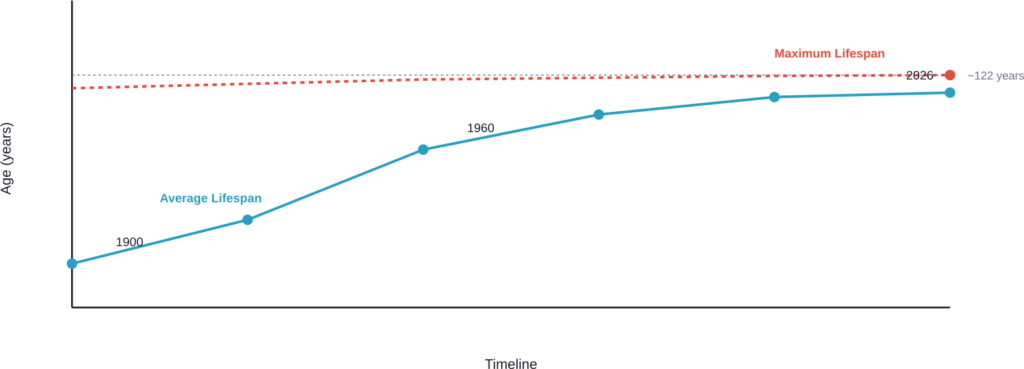
The question of whether humans can live forever has shifted from philosophical speculation to rigorous scientific inquiry. For decades, the record has stood at 122 years and 164 days—the age reached by Jeanne Calment in 1997. But can science push beyond this barrier?
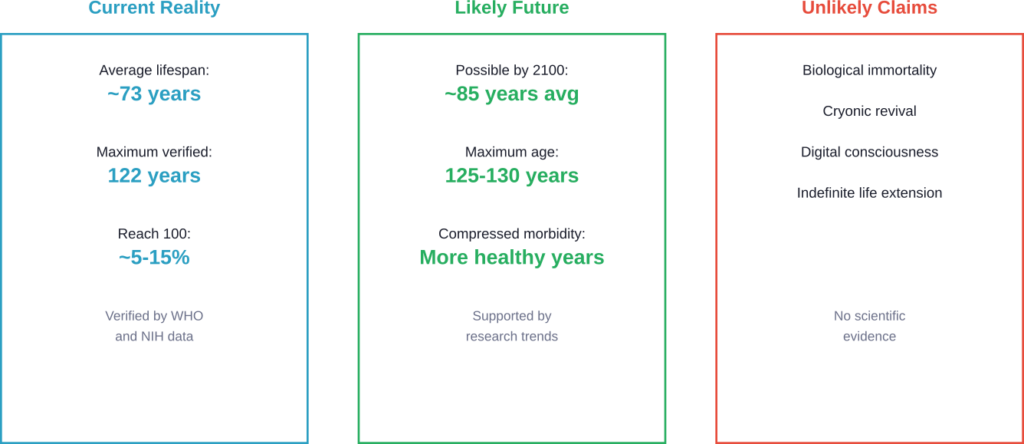
Recent research paints a more sobering picture than futurist predictions suggest. According to a 2024 study published in Nature Aging, radical life extension in humans during the twenty-first century is implausible. The analysis revealed that survival to age 100 is unlikely to exceed 15% for females and 5% for males, even with continued medical advances.
The reality? Living forever isn’t just difficult—it may be fundamentally impossible given how human biology works.
The 122-Year Ceiling and Maximum Human Lifespan
Scientists remain divided on whether a hard limit exists for human lifespan. Research from Albert Einstein College of Medicine published in Nature suggests the maximum age at death plateaued in the 1990s, with no further increases observed despite continued improvements in average life expectancy.
However, other researchers challenge this view. A study from Roswell Park Cancer Institute argues there’s no fixed limit to maximal lifespan in humans, noting that limits don’t exist in animals either. The debate hinges on whether we’re hitting biological constraints or simply haven’t developed the right interventions yet.
Here’s what the data shows: while average human life expectancy increased by approximately 30 years during the twentieth century, maximum lifespan increased only modestly. This disconnect reveals something crucial—extending average lifespan by preventing early deaths differs fundamentally from pushing the upper boundary of how long humans can survive.
Why Cellular Aging Makes Forever Impossible
The biological barriers to immortality run deep. At the cellular level, aging follows predictable patterns that researchers have studied extensively.
Back in 1961, scientists Leonard Hayflick and Paul Moorhead discovered that human cells reach a limit of replication—the Hayflick limit—and then stop dividing. This happens because of telomeres, protective caps on chromosome ends that shorten with each cell division.
According to the Genetic Science Learning Center at the University of Utah, telomeres function like the plastic tips on shoelaces, preventing chromosomes from fraying. When telomeres become too short, cells enter senescence or die. This fundamental process limits how long tissues can maintain themselves.
But here’s where it gets complicated. Cells have tumor suppressor pathways—particularly involving the p53 and retinoblastoma proteins—that prevent damaged cells from replicating. Research published in Nature shows these pathways create a tradeoff: they protect against cancer but accelerate aging. Mutant forms that reduce tumors also decrease lifespan.
Community discussions on scientific forums highlight this paradox repeatedly. The same mechanisms protecting humans from cancer in youth contribute to deterioration in old age. Solving one problem without worsening the other remains an unsolved challenge.
What Animal Studies Reveal About Longevity
Scientists have achieved remarkable lifespan extensions in laboratory animals. In the 1980s, researchers Tom Johnson and Michael Klass discovered the age-1 gene in nematode worms—a mutation that produced a 40 percent increase in average lifespan.
Since then, investigators have found numerous longevity genes in various organisms. But translating these findings to humans faces enormous obstacles.
Research on C. elegans published in the journal npj Aging demonstrates how competing causes of death create a hierarchy. When scientists prevented bacterial infection in elderly worms, they could then extend life by suppressing uterine tumors. Remove one cause of death, and another emerges as the limiting factor.
This hierarchical effect suggests that even if medical science conquers one age-related pathology, others will unmask themselves. The approach of targeting individual diseases differs fundamentally from slowing the overall aging process.
| Organism | Lifespan Extension Achieved | Method | Translates to Humans? |
|---|---|---|---|
| C. elegans worms | 40% | age-1 gene mutation | Uncertain |
| Laboratory mice | Varies by intervention | Caloric restriction, genetic modification | Limited evidence |
| Turritopsis dohrnii jellyfish | Biological immortality | Returns to juvenile form | No—vastly different biology |
Can Technology Overcome Biology?
Some futurists predict technology will enable humans to achieve immortality through approaches like nanotechnology, cryonics, or digital consciousness transfer. One company charges $200,000 to preserve and store bodies in liquid nitrogen, betting that future science will enable revival.
But experts point out that no evidence exists for the viability of these approaches. Freezing causes cellular damage that current science cannot reverse. Digital consciousness transfer assumes the mind can be separated from its biological substrate—an unproven hypothesis.
Stanford Medicine researchers studying health span—the portion of life spent free from chronic disease—suggest a more realistic goal. Rather than indefinite life extension, science might compress morbidity, allowing people to remain healthy longer before a relatively brief period of decline.
According to the World Health Organization, healthy life expectancy has increased alongside overall life expectancy, reflecting success in dealing with fatal childhood illness and maternal mortality. These achievements represent tremendous progress, even if they don’t deliver immortality.
The Blue Zones Approach: Living Well, Not Forever
Research into populations with exceptional longevity—the so-called Blue Zones—reveals practical patterns. According to research on Blue Zones populations, those approaching extreme old age share common traits: caloric restriction (the “Hara Hachi Bu” principle of eating until 80% full), strong community ties, and regular movement.
These factors consistently extend health span rather than pushing maximum lifespan boundaries. Caloric restriction remains one of few proven methods to extend lifespan across multiple species, though the effect in humans appears modest compared to laboratory animals.
The takeaway? Lifestyle interventions can help more people reach their eighties and nineties in good health. But they won’t produce 150-year-old humans.
Frequently Asked Questions
Based on current scientific understanding, biological immortality for humans is extremely unlikely. Research from the National Institutes of Health indicates that radical life extension is implausible in the twenty-first century due to fundamental biological constraints, including cellular senescence, telomere shortening, and competing causes of age-related death.
The verified record stands at 122 years and 164 days, achieved by Jeanne Calment. Research suggests a natural limit around 115-122 years, with demographic data showing that maximum age at death plateaued in the 1990s. Some scientists believe this ceiling could potentially be pushed to 125-130 years with future interventions, but not dramatically beyond.
No. While companies charge up to $200,000 to preserve bodies in liquid nitrogen, no evidence exists that cryonically frozen individuals can be revived. The freezing process causes cellular damage that current science cannot reverse, and revival technology remains entirely theoretical.
Scientists have achieved significant lifespan extensions in laboratory animals—up to 40% in some cases. However, these interventions haven’t translated successfully to humans. The biological complexity of humans, longer generation times, and ethical constraints on experimentation make direct translation extremely difficult.
Lifespan refers to the total number of years lived, while health span refers to years lived in good health without chronic disease or disability. Current research increasingly focuses on extending health span—compressing the period of morbidity at the end of life—rather than pursuing radical lifespan extension.
Telomeres play a crucial role in cellular aging, but they’re not a simple key to immortality. While telomere shortening limits cell division, artificially extending telomeres increases cancer risk. Research shows that longevity mechanisms involve complex tradeoffs between cancer prevention and aging—solving one problem often worsens the other.
Evidence from Blue Zones and longevity research suggests focusing on proven factors: moderate caloric restriction, regular physical activity, strong social connections, stress management, and avoiding smoking. These interventions extend health span and help more people reach their eighties and nineties, though they won’t enable someone to reach 150 years.
The Bottom Line on Immortality
Can humans live forever? The scientific consensus says no—at least not in any foreseeable timeline.
Research from authoritative sources including the National Institutes of Health, Nature, and multiple academic institutions points to fundamental biological barriers that prevent indefinite life extension. The maximum human lifespan appears bounded by cellular mechanisms that evolved over millions of years, creating tradeoffs between cancer prevention and longevity that can’t be easily circumvented.
That said, the picture isn’t entirely bleak. Average life expectancy continues to rise, and research into compressing morbidity could deliver more years of healthy, active life. The goal of living well may prove more attainable—and more valuable—than the quest to live forever.
For those interested in maximizing their own longevity, the evidence supports focusing on proven lifestyle factors rather than waiting for speculative technologies. The strategies that help people reach 90 in good health are well-documented and accessible today.