
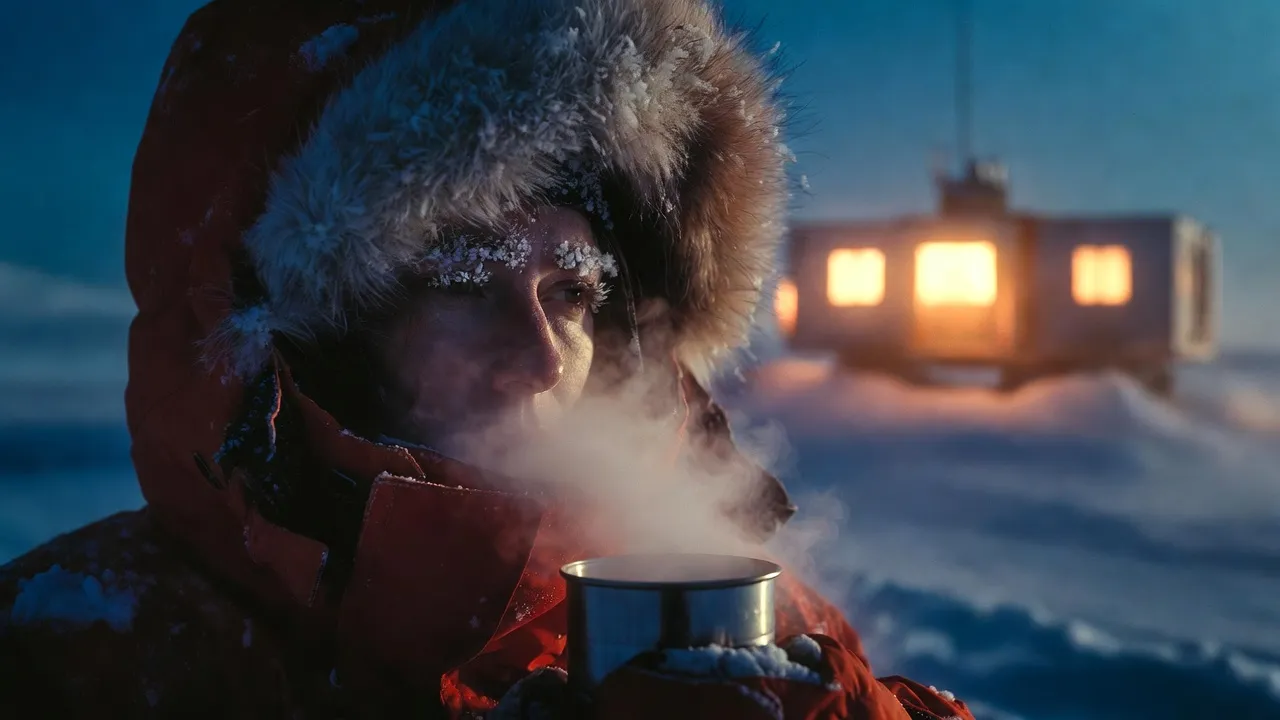
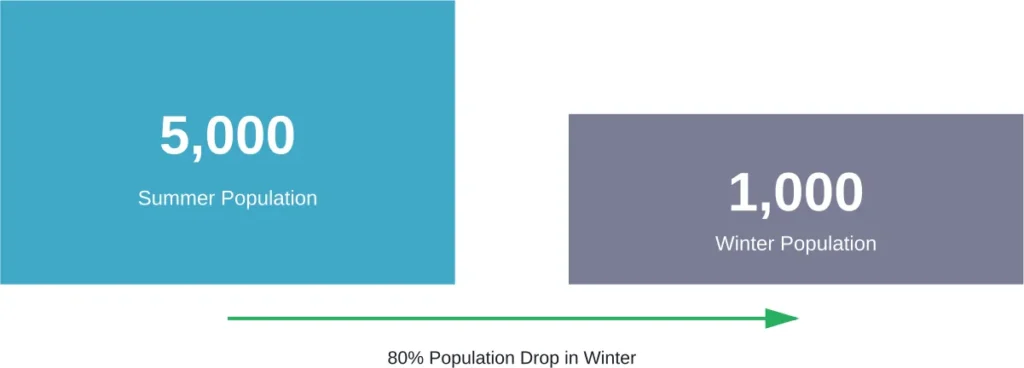
Quick Summary: No one can permanently live in Antarctica. The Antarctic Treaty prohibits permanent settlement, and the continent has no indigenous population. However, around 5,000 researchers and support staff temporarily reside at research stations during summer, dropping to about 1,000 in winter. These temporary residents work on scientific projects, typically staying for months at a time before rotating out.
Antarctica stands as Earth’s final frontier—a frozen expanse where human ambitions meet nature’s absolute limits. The question of whether someone can actually live there isn’t just about survival. It’s about law, logistics, and the sheer audacity of maintaining human presence in the planet’s most hostile environment.
Here’s the thing though: Antarctica doesn’t work like other continents. There are no countries, no cities, no permanent addresses. What exists instead is a carefully orchestrated dance of scientific research, international cooperation, and temporary human occupation.
The Legal Reality: Why Permanent Settlement Is Banned
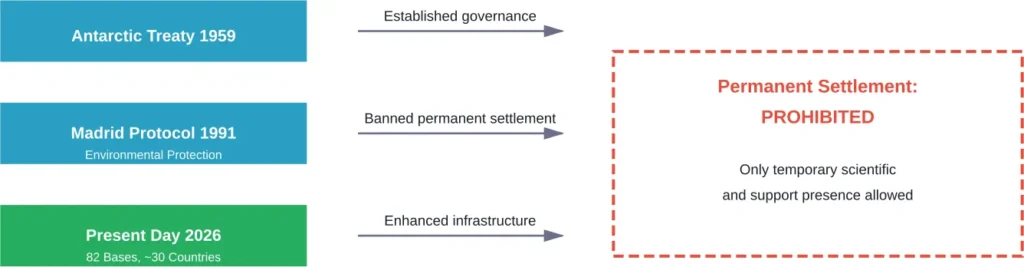
The Antarctic Treaty, established in 1959, governs everything that happens on the continent. But the real game-changer came later.
According to the Protocol on Environmental Protection to the Antarctic Treaty, signed in Madrid on October 4, 1991 and entering into force in 1998, Antarctica is designated as a “natural reserve, devoted to peace and science.” This protocol fundamentally prohibits all activities relating to permanent human settlement.
The treaty doesn’t just discourage permanent living—it actively prevents it. No country can claim sovereignty over Antarctic territory. No one can establish citizenship there. No permanent infrastructure for civilian settlement is permitted.
Real talk: even if you wanted to build a house and declare yourself an Antarctic resident, international law wouldn’t recognize it. The continent exists in a unique legal status where science trumps settlement, and temporary presence is the only option allowed.
Who Actually Lives in Antarctica
Although there are no permanent residents or indigenous population in Antarctica, people do live there temporarily. The continent hosts researchers, support staff, maintenance workers, and logistics personnel across approximately 82 bases operated by approximately 30 countries.
The population swings dramatically with the seasons. During summer months (November through February), around 5,000 people work across the continent. When winter darkness descends and temperatures plummet, that number drops to roughly 1,000 hardy souls who overwinter at year-round stations.
These aren’t settlers. They’re contracted workers who arrive for specific periods—sometimes a few months, occasionally a full year—and then rotate out. Think of it less like living somewhere and more like an extended work deployment.
Research Scientists
Scientists form the core reason for human presence in Antarctica. They study climate change, glaciology, marine biology, astronomy, and countless other disciplines that benefit from the continent’s unique environment.
British Antarctic Survey (BAS), for example, operates multiple research stations supporting UK and international scientists. Their Antarctic Infrastructure Modernisation Programme is currently transforming research capabilities with upgraded facilities designed to support world-leading climate, biodiversity, and ocean research for generations to come.
Scientists typically arrive with specific research projects, collect data during favorable weather windows, and return home to analyze their findings. Some projects require year-round monitoring, necessitating winter-over crews who maintain equipment and continue observations through the brutal dark months.
Support and Logistics Personnel
For every scientist in Antarctica, there are roughly two support staff members keeping operations running. These include:
- Mechanics who maintain vehicles and equipment in extreme cold
- Electricians and plumbers managing station infrastructure
- Chefs preparing meals from supplies delivered once or twice yearly
- Communications specialists maintaining satellite links
- Doctors and medics providing emergency healthcare
- Pilots flying supply missions and emergency evacuations
The British Antarctic Survey’s recent blog update from Rothera Research Station, dated March 6, 2026, highlights ongoing construction work on the Discovery building—a new scientific support and operations facility. The update mentions multi-purpose areas, showers, saunas, vehicle workshops, and fabrication spaces, all requiring skilled personnel to operate and maintain.
What Makes Antarctica Unlivable for Permanent Settlement
Beyond legal restrictions, Antarctica presents physical challenges that make traditional permanent living nearly impossible.
The Climate Extremes
Antarctica holds the title as the highest, driest, coldest, and windiest continent on Earth. The average yearly rainfall at the South Pole over the past 30 years measured just 10 millimeters—about 0.4 inches. That makes it technically a desert, despite all that ice.
During winter, the continent disappears into darkness for six months. Temperatures at inland stations regularly drop below -70°F (-57°C). Coastal areas stay slightly warmer but still reach extremes that freeze exposed skin within minutes.
Around 99.5% of Antarctica is permanently covered by ice. There’s essentially no arable land, no naturally occurring food sources for humans, and no materials for traditional construction.
Complete Isolation
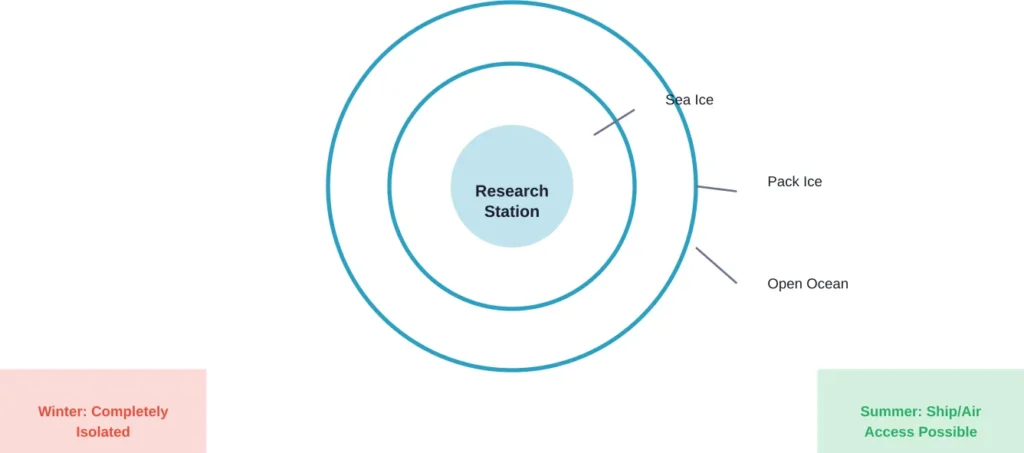
Antarctica sits separated from mainland South America by over 500 miles of the Drake Passage—one of the most tempestuous ocean crossings on Earth. During winter, sea ice extends hundreds of miles from shore, making ship access impossible. Even aircraft can’t land safely in winter conditions at most stations.
When winter sets in, research stations become completely cut off from the outside world. Medical evacuations become impossible. Supply deliveries stop. Whatever food, fuel, and equipment exists on-site must last until spring.
This isolation existed for 35 million years before humans even discovered the continent in 1820. There are no land bridges, no indigenous populations that evolved there, no historical human settlements.
Life at Antarctic Research Stations
So what does temporary living in Antarctica actually look like? The experience varies considerably between large coastal stations and small inland outposts.
Modern Research Station Facilities
Stations have evolved significantly from the heroic age of exploration. Modern facilities include heated living quarters, laboratories, gyms, communal dining areas, and even saunas. The British Antarctic Survey’s new Discovery building at Rothera Research Station features thermal efficiency, wind deflectors to reduce snow accumulation, and a new energy center with solar panels and combined heat and power plants estimated to reduce the station’s carbon emissions by 25%.
But don’t mistake these comforts for luxury. Space remains tight. Privacy is limited. Fresh food runs out within weeks of the last supply ship, leaving crews dependent on frozen and preserved provisions. Internet connections are slow and unreliable. Entertainment consists of whatever books, movies, and games people bring with them.
Daily Routines and Work
Days revolve around work schedules and station maintenance. Scientists collect data, run experiments, and maintain sensitive equipment. Support staff handle meal preparation, facility upkeep, waste management, and emergency preparedness.
During summer, the pace intensifies. The 24-hour daylight allows extended work periods. Supply ships and aircraft arrive with new personnel, equipment, and provisions. Construction projects move forward while weather permits.
Winter brings a different rhythm. The small overwintering crews settle into routines designed to maintain both station operations and mental health through months of darkness. Social activities become crucial—movie nights, hobby clubs, elaborate holiday celebrations.
The Psychological Challenge
Overwintering personnel report significant psychological demands from extended isolation and close quarters. Living in small groups unable to leave, with limited privacy and constrained communication with loved ones back home—it tests everyone.
Stations carefully screen personnel for psychological resilience. Medical staff watch for signs of depression, anxiety, or interpersonal conflicts. Extended daylight during summer months can affect sleep patterns for newcomers.
| Aspect | Summer Season | Winter Season |
|---|---|---|
| Population | ~5,000 continent-wide | ~1,000 continent-wide |
| Daylight | 24 hours (November-February) | 0-24 hours darkness (May-July) |
| Access | Ships and aircraft operational | Complete isolation |
| Temperature | -20°F to 32°F (-29°C to 0°C) | -40°F to -100°F (-40°C to -73°C) |
| Work Focus | Intensive research, construction | Maintenance, continuous monitoring |
| Supply Deliveries | Regular scheduled arrivals | None—stations self-sufficient |
Can You Move to Antarctica Temporarily?
Now, this is where it gets interesting. While permanent living isn’t possible, working in Antarctica is absolutely achievable for those with the right qualifications and temperament.
Getting a Job in Antarctica
National Antarctic programs hire for seasonal and year-round positions. Competition is fierce. Research positions typically require advanced degrees and specific scientific expertise. Support roles need relevant professional qualifications—licensed mechanics, certified chefs, medical professionals, experienced tradespeople.
Most positions require:
- Relevant professional qualifications and experience
- Excellent physical health (comprehensive medical screening is mandatory)
- Psychological evaluation and clearance
- Ability to work effectively in isolated, confined environments
- Practical skills beyond your primary role (everyone contributes to station operations)
Contract lengths vary. Summer positions might last three to five months. Winter-over positions typically run 12 to 15 months, including the summer shoulder seasons before and after the dark winter.
What About Tourism?
Tourism offers another way to experience Antarctica, though it’s definitely not living there. Cruise ships visit coastal areas during summer months, typically offering 10-day to three-week voyages. Passengers see penguin colonies, research stations, and dramatic ice formations, but never venture far from the coast.
These trips provide a taste of the continent’s majesty without the hardship of overwintering. But they’re expensive, environmentally controversial, and offer only a curated glimpse of Antarctic reality.
The Future of Human Presence in Antarctica
Climate change is transforming Antarctica faster than almost anywhere on Earth. Rising temperatures affect ice stability, wildlife populations, and research priorities. The continent’s role as a climate sentinel makes the scientific work there increasingly critical.
Infrastructure investments like the British Antarctic Survey’s modernisation programme indicate long-term commitment to maintaining research presence. Enhanced facilities with reduced carbon footprints suggest that temporary human occupation will continue, possibly expand, but always within the treaty framework prohibiting permanent settlement.
Some have proposed Antarctic tourism expansion or even resource extraction as climate change makes access easier. But the Antarctic Treaty’s environmental protections remain strong. The 1991 Madrid Protocol specifically prohibits mining and mineral resource activities other than scientific research.
Comparing Antarctica to Other Extreme Environments
Understanding Antarctica’s unique status helps to compare it with other challenging places where humans do live permanently.
| Location | Permanent Population | Key Challenges | Why Permanent Living Works |
|---|---|---|---|
| Antarctica | 0 (1,000-5,000 temporary) | Extreme cold, isolation, legal prohibition | It doesn’t—only temporary presence allowed |
| Arctic Communities | 4 million+ | Cold, darkness, remoteness | Less extreme climate, sovereignty, indigenous populations, resource access |
| Sahara Desert | 2.5 million+ | Extreme heat, water scarcity | Oases, ancient trade routes, adapted cultures, national territories |
| High Altitude (Tibet/Andes) | Millions | Low oxygen, cold, isolation | Evolutionary adaptation, traditional cultures, agricultural systems |
| Remote Islands | Thousands | Isolation, limited resources | Fishing, sovereignty, traditional settlement |
The key difference? Every other extreme environment either has indigenous populations with thousands of years of adaptation, or sits within national territory where governments support permanent settlement. Antarctica has neither.
Frequently Asked Questions
No. The Antarctic Treaty prevents any nation from claiming sovereignty over Antarctic territory. Without national jurisdiction, no property rights exist. You cannot purchase, own, or claim land in Antarctica.
Antarctic stations operate under their home nation’s laws. A researcher at a British station would be subject to UK law, for example. Serious crimes would be handled by the person’s home country. In practice, the isolation and small populations make criminal activity rare. Station leaders and national programs handle disputes and rule violations.
Yes, though very rarely. People have been born in Antarctica, particularly at Argentine and Chilean bases. However, being born there doesn’t confer any special citizenship or right to live there permanently.
Each research station has medical facilities and trained medical personnel. Minor issues are treated on-site. During summer, serious cases can be evacuated by ship or aircraft. During winter, evacuation is often impossible—stations must handle medical emergencies with available resources and personnel. This is why health screening before deployment is so rigorous.
Even with significant warming, Antarctica would remain extremely challenging for human habitation. Climate projections suggest coastal areas might become slightly less hostile, but the interior would stay brutally cold. More importantly, the Antarctic Treaty’s legal framework prohibits permanent settlement regardless of climate conditions. The treaty focuses on preservation and scientific research, not colonization.
Yes, workers remain citizens of their home countries and are subject to those nations’ tax laws. Antarctic employment doesn’t create a tax haven or exempt anyone from their usual tax obligations.
Recreational activities vary by station size and location. Common pastimes include photography, hiking near stations during summer, gym workouts, movie nights, board games, reading, hobby clubs, and elaborate celebrations for holidays and birthdays. Some stations have organized sports events or musical performances. Social activities become especially important during winter isolation.
The Bottom Line on Living in Antarctica
So, can you live in Antarctica? Temporarily, yes. Permanently, absolutely not.
The Antarctic Treaty system created something unique in human history—a continent dedicated entirely to science and environmental protection, where no permanent settlement is allowed and no nation holds sovereignty. This framework has held since the Antarctic Treaty was established in 1959 and shows no signs of changing.
What exists instead is a rotating population of researchers and support personnel, working in extreme conditions to understand our planet’s climate systems, ecosystems, and geological history. These temporary residents endure isolation, brutal weather, and significant personal sacrifice to advance human knowledge.
The continent’s scientific importance grows each year as climate change accelerates. Antarctica holds clues to Earth’s past climates in its ice cores and serves as an early warning system for global environmental shifts. Maintaining research presence there matters enormously, even if that presence remains temporary and carefully limited.
For those drawn to Antarctica, opportunities exist—but they require relevant expertise, physical and psychological resilience, and acceptance that you’re going for a job, not to establish a home. The experience transforms those who go, offering glimpses of Earth’s most pristine wilderness and the satisfaction of contributing to vital scientific work.
But Antarctica itself remains unowned, uncolonized, and legally protected from permanent human settlement. That’s probably how it should stay. Some places on Earth should remain wild, studied but not settled, preserved for their own sake and for the knowledge they provide. Antarctica is that place—humanity’s frozen laboratory at the bottom of the world, visited but never truly inhabited.
Interested in learning more about extreme environment research? Explore the British Antarctic Survey’s ongoing projects or investigate how climate change is reshaping polar regions. The work happening in Antarctica today will shape our understanding of Earth’s future for generations to come.