

Quick Summary: Yes, it is possible to ovulate right after your period, especially if you have a shorter menstrual cycle (24-26 days) or longer periods. Since sperm can survive in the body for up to 5 days and the fertile window spans 6 days before ovulation, having sex during or immediately after your period can result in pregnancy if you ovulate early in your cycle.
The timing of ovulation varies significantly from woman to woman. While many assume pregnancy isn’t possible right after menstruation, the reality is more nuanced.
Understanding when ovulation occurs in relation to your period matters whether you’re trying to conceive or prevent pregnancy. Let’s break down the science behind ovulation timing and why it’s entirely possible to ovulate shortly after your period ends.
Understanding the Menstrual Cycle and Ovulation Timing
The menstrual cycle begins on the first day of your period. According to the Office on Women’s Health, the average menstrual cycle lasts 28 days, but normal cycles can range between 24 and 38 days.
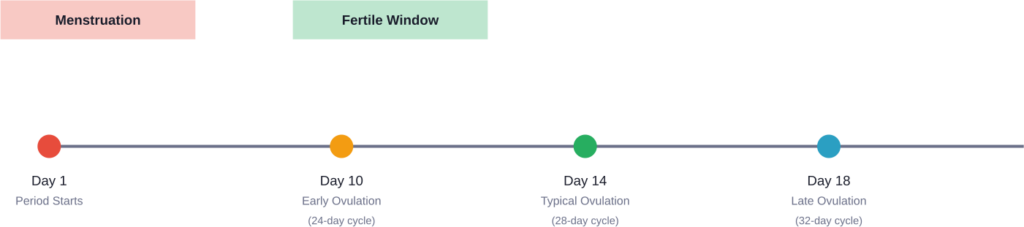
Ovulation typically occurs around the middle of the cycle. For a standard 28-day cycle, that means ovulation happens roughly on day 14. But here’s the thing—not everyone has a 28-day cycle.
If your cycle is shorter, say 24 days, ovulation might occur as early as day 10. If your period lasts 6-7 days, you could ovulate just 3-4 days after your period ends. That’s what makes early ovulation not just possible, but relatively common for women with shorter cycles.
The Fertile Window: Why Timing Matters
According to the American College of Obstetricians and Gynecologists (ACOG), the fertile window is approximately 6 days long. This includes the five days before ovulation and the day of ovulation itself.
Why such a wide window? Sperm can survive in the female reproductive tract for up to 5 days, though ACOG notes that 3 days is more typical. The egg, on the other hand, survives only 12 to 24 hours after ovulation.
Research published by the National Institute of Environmental Health Sciences shows that among healthy women trying to conceive, nearly all pregnancies result from intercourse during this six-day window ending on the day of ovulation.
Here’s where it gets interesting. If you have sex on the last day of your period and ovulate 5 days later, sperm could still be viable when the egg is released. That’s conception right after your period.
| Cycle Length | Typical Ovulation Day | Fertile Window Starts | Days After Period Ends |
|---|---|---|---|
| 24 days | Day 10 | Day 5 | 0-1 days |
| 26 days | Day 12 | Day 7 | 2-3 days |
| 28 days | Day 14 | Day 9 | 4-5 days |
| 32 days | Day 18 | Day 13 | 8-9 days |
Who Is Most Likely to Ovulate Right After Their Period?
Certain factors increase the likelihood of ovulating soon after menstruation ends.
Women With Shorter Cycles
If your menstrual cycle consistently falls between 21-25 days, you’re likely to ovulate earlier. The Office on Women’s Health confirms that normal cycles can be as short as 24 days. For these cycles, the fertile window can begin while you’re still bleeding or immediately after.
Women With Longer Periods
Menstruation typically lasts 3-7 days. If yours runs longer—say, 7 days—and you have a 26-day cycle, ovulation could occur just 5 days after your period starts. That means you might still be spotting when your fertile window opens.
Irregular Cycle Patterns
Cycle irregularity makes ovulation timing harder to predict. According to ACOG’s guidance on menstrual cycles in adolescents, environmental factors, nutrition, and health conditions can all influence cycle timing. If your cycles vary month to month, ovulation might occur at unexpected times, including shortly after your period.
Pregnancy Risk During and After Menstruation
Research published in Reproductive Health examined pregnancy risk misconceptions. The study found that only about one-third of women correctly identified when during the menstrual cycle pregnancy is most likely to occur.
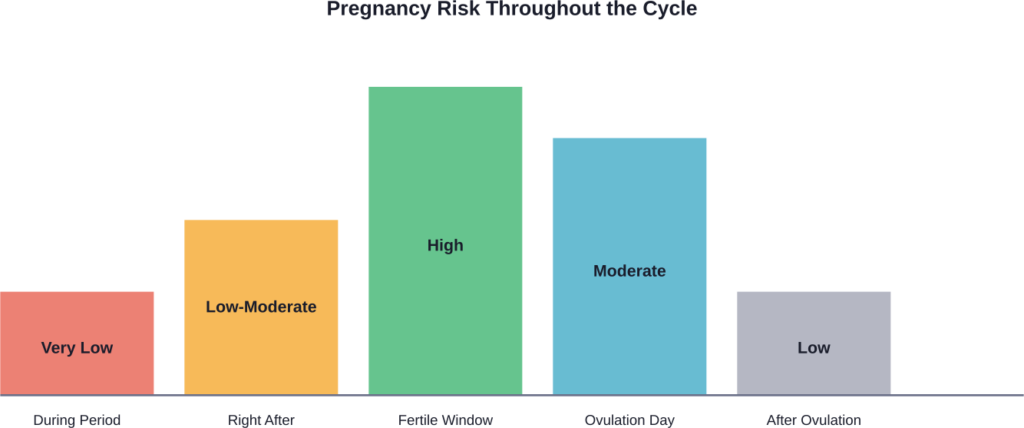
The probability that a single act of intercourse occurs within the fertile window is approximately 25%, according to data from the National Institute of Environmental Health Sciences. This means roughly one in four instances of intercourse happen during the time when pregnancy is possible.
Real talk: the risk isn’t zero even during your period. While pregnancy during menstruation is uncommon, it’s not impossible if you have a short cycle and early ovulation.
Tracking Ovulation to Understand Your Timing
Knowing when you ovulate requires tracking your cycle. Several methods can help identify your fertile window.
Calendar Method
Track your cycle length for several months. Ovulation typically occurs 14 days before your next period starts. For a 26-day cycle, that’s day 12. For a 30-day cycle, it’s day 16.
Basal Body Temperature
According to the Office on Women’s Health, basal body temperature rises slightly after ovulation. Temperature tracking requires a sensitive thermometer (available at most pharmacies) and daily measurements before getting out of bed. The temperature spike confirms ovulation has already occurred.
Ovulation Predictor Kits
These tests detect the surge in luteinizing hormone that occurs 24-36 hours before ovulation. They’re useful for pinpointing your fertile window in real-time.
Cervical Mucus Changes
Fertile cervical mucus becomes clear, stretchy, and resembles raw egg whites around ovulation. This change indicates the fertile window is open.
Implications for Pregnancy Prevention
If preventing pregnancy is the goal, understanding that ovulation can occur right after your period matters.
According to ACOG’s guidance on fertility awareness-based methods, these approaches require avoiding intercourse or using barrier methods during the fertile window. The challenge? Identifying that window accurately, especially with irregular cycles.
Research shows that approximately 85% of healthy women will get pregnant within a year of trying. This underscores how frequently the fertile window and intercourse align naturally—even when timing isn’t intentional.
For those relying on fertility awareness for contraception, the margin for error is slim when cycles are short or irregular.
What This Means If You’re Trying to Conceive
If conception is the goal, knowing you can ovulate soon after your period expands your fertile opportunities.
According to research published by the National Institute of Environmental Health Sciences, timing sexual intercourse in relation to ovulation is critical. The study found that intercourse during the six-day fertile window—particularly the three days before ovulation—accounts for nearly all pregnancies.
For women with shorter cycles, this means starting to have regular intercourse shortly after menstruation ends. Waiting too long could mean missing the fertile window entirely.
| Days Before Ovulation | Pregnancy Probability |
|---|---|
| 5 days before | Low (10%) |
| 3 days before | Moderate-High (25-30%) |
| 2 days before | High (30-35%) |
| 1 day before | Highest (30-35%) |
| Day of ovulation | High (20-25%) |
| After ovulation | Very Low (0-5%) |
Common Misconceptions About Period and Ovulation Timing
Several myths persist about when pregnancy can and cannot occur.
Myth: You can’t get pregnant during your period.
Reality: While uncommon, it’s possible if you have a short cycle and early ovulation, since sperm can survive several days.
Myth: Ovulation always occurs on day 14.
Reality: Day 14 applies only to a standard 28-day cycle. Cycle length varies, so ovulation timing varies too.
Myth: The fertile window is just one day.
Reality: ACOG confirms the fertile window spans approximately 6 days due to sperm survival time.
Myth: Irregular periods mean you’re not ovulating.
Reality: Many women with irregular cycles still ovulate—it just happens at less predictable times.
Frequently Asked Questions
Yes, especially if you have a cycle shorter than 26 days or periods lasting longer than 5-6 days. Ovulation could occur as early as day 10-12 of your cycle, which might be just 3-5 days after bleeding stops.
According to ACOG, sperm can survive up to 5 days in the female reproductive tract. If you have sex during or right after your period and ovulate within that timeframe, pregnancy is possible. For short cycles, this could mean pregnancy risk begins immediately after menstruation.
For a 24-day cycle with a 6-day period, ovulation might occur around day 10, which is only 4 days after your period ends. Some women with even shorter cycles could ovulate while still experiencing light bleeding.
Absolutely. The Office on Women’s Health notes that while the post-ovulation phase is relatively consistent at 12-16 days, the pre-ovulation phase varies significantly. Shorter cycles mean earlier ovulation; longer cycles mean later ovulation.
Yes. Irregular cycles make ovulation timing unpredictable. You might ovulate earlier some months and later others, making it difficult to identify safe and fertile periods without tracking methods like basal body temperature or ovulation predictor kits.
Ovulation predictor kits, basal body temperature tracking, and cervical mucus monitoring can help identify your fertile window. Combining multiple methods provides the most accurate picture of your ovulation timing.
If pregnancy prevention is important, using protection throughout your cycle is the safest approach. The fertile window can be difficult to predict precisely, especially with irregular cycles, and ovulating right after your period is possible.
Understanding Your Unique Cycle
So yes—it’s absolutely possible to ovulate right after your period, particularly if your cycle is on the shorter end of the normal range or if your periods last longer than average.
The key takeaway? Every woman’s cycle is different. The 28-day standard is just an average, and normal cycles can range from 24 to 38 days according to the Office on Women’s Health.
Whether you’re trying to conceive or prevent pregnancy, understanding your individual ovulation timing is crucial. Track your cycle length, pay attention to fertility signs, and consider using ovulation tracking tools to identify your personal fertile window.
Knowledge about your cycle empowers better reproductive health decisions. Start tracking today to understand when ovulation occurs in your body—the answer might surprise you.