

Quick Summary: The UK architectural visualization market features world-class studios combining technical excellence with artistic vision. This comprehensive guide profiles 11 leading companies transforming architectural concepts into photorealistic renders, from London-based boutiques to internationally recognized firms delivering complex commercial and residential projects across Britain.
The British architectural visualization industry has evolved into one of Europe’s most sophisticated markets. Studios across London, Manchester, Bristol, and Edinburgh now compete on the global stage, delivering renders that blur the line between photography and computer-generated imagery.
But here’s the thing — not all rendering companies operate at the same level. Some excel at moody residential interiors, others dominate commercial property marketing, and a few specialize in competition visuals that win international design awards.
This guide examines the studios shaping how Britain’s built environment gets visualized before construction begins. Each company brings distinct strengths, from photogrammetry expertise to real-time rendering workflows.
Why UK Architectural Visualization Studios Stand Out
British rendering companies occupy a unique position in the global visualization market. Geography matters — London’s proximity to mainland Europe creates natural connections with continental developers, while the UK’s architectural heritage informs a particular aesthetic sensibility.
Several factors distinguish UK studios from competitors elsewhere. The concentration of internationally recognized architectural practices in London creates constant demand for high-calibre visualization work. British studios regularly collaborate with firms like Foster + Partners, Zaha Hadid Architects, and Heatherwick Studio on competition entries and client presentations.
The UK property development cycle also shapes visualization requirements. Real estate marketing demands differ from architectural competition visuals — developers need renders that sell units, while architects require images that communicate design intent to planning committees and award juries.
Technical sophistication represents another differentiator. Leading UK studios adopt cutting-edge rendering technologies quickly, from GPU-accelerated render engines to AI-assisted workflow tools. The best companies maintain render farms capable of producing 8K resolution exteriors and complex animation sequences.
Project diversity strengthens UK studio portfolios. A typical London visualization company might handle luxury residential towers, mixed-use regeneration schemes, hospitality interiors, and historic building conversions simultaneously. This breadth develops technical versatility that pure residential or commercial specialists lack.
What Makes a Visualization Studio Truly Exceptional
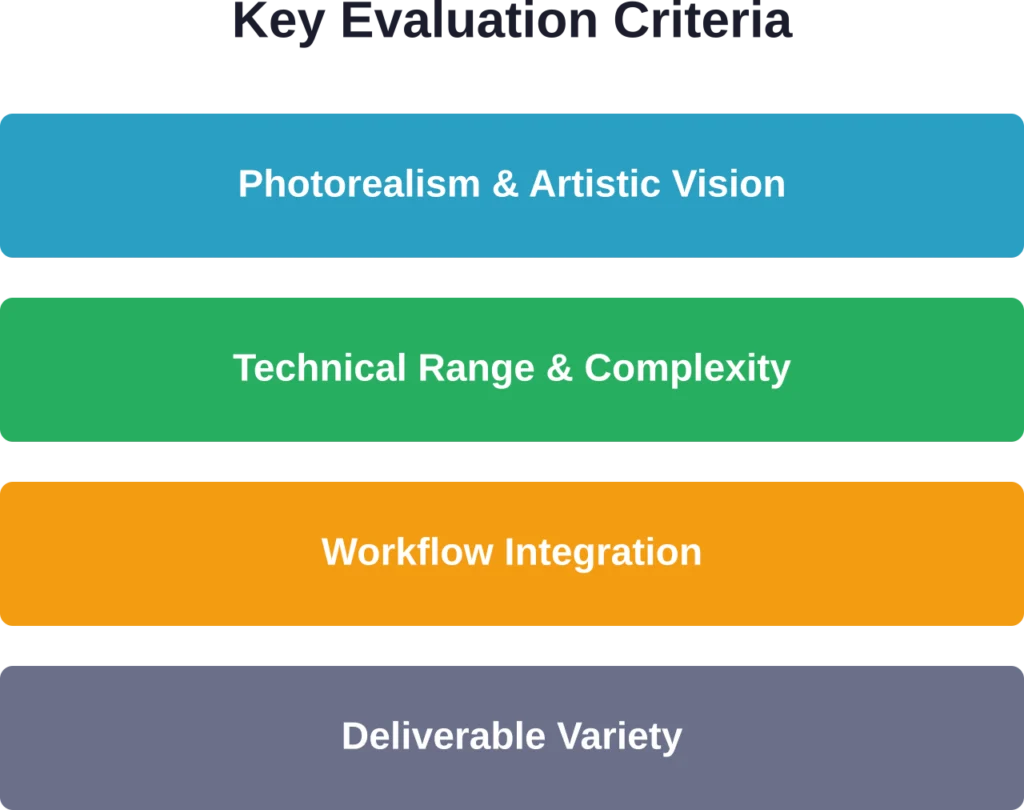
Evaluating architectural visualization companies requires looking beyond portfolio aesthetics. Several criteria separate competent studios from exceptional ones.
Photorealism and Artistic Direction
Technical accuracy forms the foundation, but artistic vision creates memorable images. The best studios employ artists who understand composition, lighting, and atmospheric perspective as deeply as they know 3D software.
Recent industry shifts have altered what photorealism means. According to ArchDaily’s analysis published in December 2025, architectural visuals have increasingly become “interpretive tools rather than literal records” — a shift reflecting how renderings were traditionally understood as speculative instruments offering atmospheres and intentions rather than fixed realities.
Camera work separates mediocre renders from exceptional ones. Professional studios consider sightlines, focal length psychology, and vertical perspective correction. An interior shot needs human-scale viewpoints; masterplan aerials demand careful altitude selection to show context without losing detail.
Project Complexity and Technical Range
Portfolio diversity indicates studio capability. Companies handling varied project types — from compact residential refurbishments to mixed-use megaprojects — demonstrate adaptability. Complex geometries, challenging materials, and intricate lighting scenarios test technical proficiency.
The best studios tackle edge cases other companies decline. Glass curtain wall buildings with complex reflections, timber structures with detailed grain patterns, and heritage buildings requiring archaeological accuracy all demand specialized expertise.
Workflow Integration and Collaboration
Modern architectural practice requires visualization studios that integrate smoothly with design workflows. Studios accepting native Revit, ArchiCAD, and Rhino files reduce coordination friction. Some companies embed staff in architect offices during competition sprints, enabling real-time design iteration.
Communication protocols matter enormously. Clear briefing processes, structured revision rounds, and realistic timeline estimates prevent project derailment. The best studios establish feedback mechanisms that keep projects on schedule without endless revision cycles.
Deliverable Variety
Single-image renders represent just one visualization type. Leading studios offer comprehensive services: exterior and interior stills, aerial views, ground-level perspectives, cinematic animations, interactive 360-degree panoramas, and virtual reality experiences.
Real estate marketing particularly benefits from varied deliverables. According to research cited by BluEntCAD, 90% of clients want to see previous work before making decisions — diverse portfolio formats demonstrate capability across media types.
Top 11 UK Architectural Visualization Companies
The following studios represent Britain’s visualization elite. Each company brings distinct strengths to architectural rendering, from boutique specialists to full-service agencies handling international commissions.

1. Powerkh
Powerkh is a UK-based company with offices in the USA and Ukraine, providing 3D architectural visualization services for architects, developers, and construction teams. The company creates detailed 3D models and renderings from 2D drawings, BIM models, and shop drawings to support design review, presentations, and project coordination during different project stages.
Their work focuses on exterior architectural visualization, including facade details, materials, lighting, dimensions, and overall building appearance. Powerkh uses BIM-based workflows to keep renderings aligned with project documentation and coordination models, helping teams review design decisions more accurately before construction starts.
The company also supports cloud-based collaboration between architects, engineers, designers, and clients, allowing project teams to review updates and coordinate changes in real time. Along with architectural rendering, Powerkh provides BIM modelling, Scan to BIM, and visualization support for residential, commercial, and mixed-use developments.
Contact Information:
- Website: www.powerkh.com
- Email: [email protected]
- Facebook: www.facebook.com/100064039650167
- LinkedIn: www.linkedin.com/company/powerkh
- Instagram: www.instagram.com/powerkh_com
- Address: 3, Lavinia Walk, Taw Hill, Swindon SN25 1AP
- Phone: +44 7490 426678

2. Hayes Davidson
Hayes Davidson anchors London’s architectural visualization scene as one of the UK’s longest-established specialist studios. Founded in the 1980s, the company pioneered photomontage techniques that remain industry standards.
Hayes Davidson has worked on major London developments including infrastructure schemes and urban regeneration masterplans. Technical methodology distinguishes Hayes Davidson’s output. The studio emphasizes accurate camera matching and contextual integration — their renders sit convincingly within existing urban fabric because they use surveyed camera positions and photographic backgrounds.
Project types span commercial offices, residential towers, mixed-use developments, infrastructure visualizations, and public realm schemes. The studio handles planning inquiry work where technical accuracy carries legal weight, alongside competition entries requiring atmospheric impact.
What makes Hayes Davidson exceptional? Consistency. Projects maintain rigorous technical standards whether visualizing a 50-storey tower or a modest housing scheme. Their understanding of planning policy and visual impact assessment sets them apart from studios focused purely on marketing imagery.

3. Uniform
Uniform brings a distinctive aesthetic to British architectural visualization, with operations focused on northern England and international commissions. The studio’s portfolio emphasizes atmospheric lighting and carefully composed narrative scenes that feel cinematic rather than technical.
Their residential project work stands out particularly. Uniform’s interior renders capture the lived quality of domestic space — morning light filtering through kitchen windows, textures that suggest materiality rather than just displaying it, human elements that feel naturalistic rather than staged.
The studio works extensively with northern England developers and architects, producing marketing suites for residential schemes across Manchester, Leeds, Liverpool, and Newcastle. This regional focus provides deep understanding of local property markets and buyer expectations.
Uniform also handles international commissions, demonstrating that location matters less than capability. Their portfolio includes European residential projects and Middle Eastern hospitality work alongside UK developments.
Technical approach balances photorealism with artistic interpretation. Renders feel polished without becoming sterile — spaces maintain character and warmth. The studio’s lighting work particularly impresses, capturing time-of-day atmospherics that ground architectural concepts in emotional reality.

4. MIR
Though headquartered in Norway, MIR has collaborated with British architectural practices on UK projects. MIR’s aesthetic defined contemporary architectural rendering. Their signature style — atmospheric depth, subtle color grading, human activity suggesting but not dominating compositions — has influenced an entire generation of visualization artists.
British projects in MIR’s portfolio include competition entries for major London developments and international design competitions where UK practices partnered with the studio. Their work appears regularly in Dezeen, ArchDaily, and major architectural publications.
The studio’s technical sophistication enables complex visualizations other companies struggle with. Large-scale urban masterplans, intricate glass facades with multiple reflection layers, and atmospheric exterior scenes with thousands of vegetation elements all receive meticulous attention.
Project scope extends beyond single buildings to entire urban districts. MIR visualizes the relationship between architecture and context, showing how proposed buildings reshape neighborhoods and city skylines.

5. Arqui9
Arqui9 works with British developers and architects on UK projects. The studio’s work emphasizes clean modernist aesthetics suited to contemporary architectural language.
Real estate marketing forms a core competency. Arqui9 produces comprehensive marketing suites including exterior views, interior perspectives, amenity space renders, and contextual aerials. Their deliverables package efficiently for property websites, brochures, and sales centers.
The studio handles UK residential and commercial projects ranging from urban apartments to suburban housing developments. Their portfolio demonstrates versatility across architectural styles, from minimalist contemporary to traditional contextual designs.
Technical execution emphasizes clarity and light. Arqui9’s renders feel bright and spacious, using natural lighting to showcase architectural volumes. This approach particularly suits residential marketing where aspirational lifestyle imagery drives purchase decisions.
Workflow efficiency enables competitive delivery timelines. The studio provides reliable turnaround schedules that align with property marketing launch dates and planning submission deadlines.

6. Factory Fifteen
Factory Fifteen occupies unique territory in British visualization, blending architectural rendering with experimental digital art and speculative design. Based in London, the studio pushes boundaries beyond conventional property marketing.
Their portfolio includes commercial visualization work alongside artistic projects exploring architecture’s social and environmental dimensions. This duality produces renders with conceptual depth — images that question as much as they depict.
The studio’s film and animation work stands out particularly. Factory Fifteen creates cinematic architectural films that function as short narratives, exploring how people inhabit and experience buildings. These aren’t simple camera fly-throughs but carefully scripted visual stories.
British architectural practices commission Factory Fifteen for competition entries where intellectual ambition matters as much as technical precision. The studio’s work appears in exhibition contexts, from the Venice Biennale to London Design Festival installations.
Technical innovation drives their practice. Factory Fifteen experiments with real-time rendering, procedural generation, and AI-assisted workflows, staying at the bleeding edge of visualization technology.

7. Dbox London
Dbox operates a London studio serving UK and European markets. The company represents the luxury end of architectural rendering, working with blue-chip developers on premium residential and commercial schemes.
British projects include super-prime London residential towers, mixed-use developments in regeneration districts, and flagship commercial offices. Dbox’s client base encompasses international developers investing in UK property markets.
The studio’s aesthetic emphasizes sophisticated materialism — renders showcase luxurious finishes, designer furniture, and aspirational lifestyle elements. This approach suits high-value residential marketing where imagery must convey exclusivity and prestige.
Technical capabilities extend across visualization types. Beyond still images, Dbox produces architectural films, interactive applications, and immersive VR experiences. Their deliverables integrate into comprehensive marketing campaigns spanning digital and physical media.
Project management processes suit complex multinational developments. Dbox coordinates with architects, developers, interior designers, and marketing agencies, maintaining quality control across multiple stakeholder inputs.

8. Mæ
Mæ brings perspective to British architectural visualization with focus on residential and commercial projects. The studio’s work emphasizes natural landscapes and contextual sensitivity, reflecting regional architectural character.
Their portfolio spans residential, commercial, and cultural projects across Southwest England and Wales. Mæ visualizes rural housing developments, coastal regeneration schemes, and heritage building conversions — project types requiring sensitivity to existing character.
The studio’s exterior renders particularly succeed at integrating architecture with landscape. Vegetation, topography, and natural lighting create renders that feel site-specific rather than generic. This contextualism matters for planning applications in sensitive locations.
Interior visualization balances realism with aspiration. Mæ’s domestic interiors feel livable rather than overly styled, using naturalistic furniture layouts and lighting scenarios that suggest everyday occupation.
Scale flexibility allows the studio to handle projects from individual houses to mixed-use masterplans. This range suits regional practices working across diverse commission types.

9. Atchain
Atchain focuses exclusively on real estate marketing visualization, serving UK property developers with efficient rendering services. The London-based studio emphasizes workflow optimization and reliable delivery schedules.
Their project portfolio concentrates on residential developments — apartment buildings, housing estates, and mixed-use schemes with significant residential components. Atchain produces the marketing imagery that appears on property websites, sales brochures, and billboard hoardings.
Technical approach prioritizes clarity and sales effectiveness over artistic experimentation. Renders showcase unit layouts, amenity spaces, and building exteriors with sufficient realism to inform purchase decisions without unnecessary stylization.
The studio’s efficiency suits volume house builders and residential developers operating at scale. Atchain can produce comprehensive marketing suites — dozens of images covering multiple views, unit types, and amenity spaces — within tight timelines.
Quality consistency matters as much as individual image excellence. Developers need entire marketing campaigns where imagery maintains uniform standards and visual identity across all deliverables.

10. Vyonyx
Vyonyx serves the UK market from Eastern Europe, offering architectural visualization services that compete on technical quality while maintaining efficient pricing structures. The studio handles British residential and commercial projects across multiple scales.
Their portfolio demonstrates competence across visualization types — exteriors, interiors, aerials, and eye-level perspectives. Vyonyx produces workmanlike renders that communicate architectural designs clearly without pursuing cutting-edge aesthetics.
The studio suits practices and developers prioritizing reliable delivery over distinctive artistic vision. Vyonyx provides solid technical execution at predictable quality levels, valuable for planning submissions and basic marketing requirements.
Project types include residential apartments, commercial offices, retail developments, and hospitality interiors. Geographic focus covers London and Southeast England, where development activity concentrates.
Workflow integration accommodates various CAD formats and coordination methods. Vyonyx adapts to client processes rather than requiring elaborate briefing protocols.
11. Kilograph
Kilograph works with British architectural practices on UK projects. Their UK portfolio includes London residential towers and commercial office developments designed by international practices. Kilograph’s involvement typically indicates projects with significant budget and ambition.
The studio’s aesthetic emphasizes dramatic compositions and cinematic lighting. Renders feel stage-managed and deliberate, prioritizing visual impact over documentary naturalism. This approach suits competition entries and design publications.
Technical sophistication enables complex scenarios — crowded urban contexts, intricate material assemblies, and atmospheric effects all receive careful attention. Kilograph’s render quality positions them among global visualization leaders.
Animation and film work extends their capabilities beyond still images. The studio produces architectural films that function as brand narratives, exploring design concepts through moving image storytelling.
Comparing UK Studios by Project Type
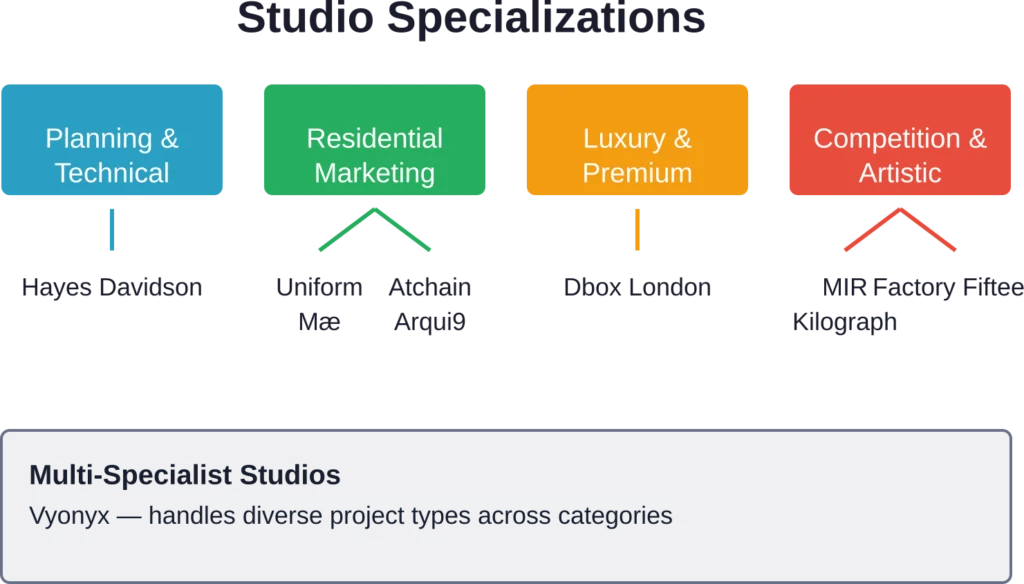
Different visualization requirements demand different studio strengths. Understanding which companies excel at specific project types helps match clients with appropriate partners.
| Project Type | Best Suited Studios | Key Considerations |
|---|---|---|
| Planning Applications | Hayes Davidson, Mæ | Accuracy, contextual integration, technical rigor for legal proceedings |
| Luxury Residential Marketing | Dbox London, MIR | Aspirational aesthetics, lifestyle imagery, premium materiality |
| Volume Housing Marketing | Atchain, Vyonyx, Arqui9 | Efficiency, consistent quality, rapid turnaround capability |
| Design Competitions | MIR, Factory Fifteen, Kilograph | Artistic vision, conceptual depth, publication-quality aesthetics |
| Regional Developments | Uniform, Mæ | Local market understanding, contextual sensitivity, naturalistic approach |
| Commercial Offices | Hayes Davidson, Dbox London, Uniform | Urban context integration, corporate aesthetics, workplace visualization |
Planning and Technical Visualization
Planning inquiry work requires different priorities than marketing imagery. Accuracy trumps aesthetics when renders form part of legal proceedings or environmental impact assessments.
Studios specializing in planning visualization emphasize measured surveys, accurate camera positions, and verifiable sight lines. These renders must withstand technical scrutiny from planning officers and public inquiries.
Hayes Davidson built their reputation partly on planning work. Their photomontages use surveyed camera positions and calibrated perspectives that can be verified against site conditions. This rigor provides defensible imagery for contentious applications.
Technical visualization extends beyond statutory planning to include design development renders showing construction details, material assemblies, and structural systems. Some studios bridge architecture and engineering visualization, producing images that communicate technical intent alongside spatial qualities.
Residential Marketing Visualization
Property marketing drives substantial visualization demand. Developers need comprehensive image suites covering exterior views, interior perspectives, amenity spaces, and contextual aerials.
Marketing imagery balances realism with aspiration. Interiors must feel attainable yet desirable, showing furniture layouts and finishes without becoming overly styled. Exteriors need contextual accuracy while presenting buildings in flattering lighting conditions.
The volume residential market particularly demands efficiency. House builders launch multiple schemes simultaneously, requiring visualization studios that can produce consistent quality across numerous projects without bottlenecking marketing timelines.
Studios like Atchain and Arqui9 optimize workflows for residential marketing, producing reliable results at scales matching developer requirements. Their processes accommodate standard briefing inputs and deliver formatted outputs ready for website integration and print reproduction.
Competition and Publication Work
Design competitions require visualization that communicates architectural concepts while making emotional impact. Competition juries see hundreds of entries — successful images must arrest attention immediately while rewarding sustained viewing.
Studios pursuing competition work invest in artistic direction beyond technical rendering. Composition, atmospheric lighting, and narrative elements separate memorable entries from technically competent but visually forgettable submissions.
MIR established their reputation through competition success. Their renders appear regularly in winning entries for international design competitions, from urban masterplans to individual buildings. The studio’s aesthetic — atmospheric depth, carefully calibrated color palettes, subtle human presence — has influenced competition visualization globally.
Publication-quality visualization extends beyond competitions to architectural media. Studios producing work for Dezeen, ArchDaily, and print journals require images that reproduce effectively across scales and media formats while maintaining conceptual clarity.
How to Select the Right Studio for Your Project
Choosing among UK visualization companies requires matching project requirements with studio capabilities. Several factors guide appropriate selection.
Define Visualization Purpose
Different objectives require different approaches. Marketing imagery prioritizes sales effectiveness; planning visuals emphasize technical accuracy; competition work demands conceptual impact.
Clarify deliverable requirements before approaching studios. How many images? Which views? What formats and resolutions? Will animation or interactive media add value? Specific requirements enable targeted studio selection.
Timeline constraints significantly impact studio options. Rush projects limit choices to companies with available capacity and expedited workflows. Standard timelines open the full market.
Review Relevant Portfolio Work
Studio portfolios reveal capability far better than marketing claims. Look for projects resembling yours in scale, typology, and complexity.
But here’s the thing — portfolio curation shows best work, not typical output. Ask to see complete project sets rather than curated highlight reels. Full marketing suites reveal consistency across varied views and lighting conditions.
Pay attention to contextual integration in exterior renders. Do buildings sit convincingly in their surroundings? Are reflections and shadows consistent with lighting direction? These details indicate technical rigor.
For interior work, examine material representation. Do surfaces show appropriate texture and specularity? Does furniture scale correctly to spaces? Are sight lines and ceiling heights proportionally accurate?
Assess Communication and Process
Technical capability means little without effective collaboration. Studios need clear briefing processes, structured feedback mechanisms, and realistic timeline estimates.
Initial consultations reveal studio working methods. Do they ask probing questions about project requirements? Can they articulate their process clearly? Do timeline estimates feel realistic or optimistic?
Revision protocols particularly matter. How many feedback rounds does the studio include? What constitutes minor versus major revisions? How do additional changes get managed? Clear terms prevent disputes later.
Consider Geographic and Logistic Factors
Physical location matters less than it once did — remote collaboration works effectively for most projects. However, proximity enables face-to-face meetings for complex briefings or collaborative design development.
London studios offer easy access for practices and developers based in the capital. Regional studios may better understand local contexts for projects outside Southeast England.
International studios working on UK projects need reliable coordination methods. Time zone differences can aid or hinder communication depending on project urgency and feedback requirements.
Emerging Trends in UK Architectural Visualization
The visualization industry evolves rapidly as technology advances and aesthetic preferences shift. Several trends currently reshape how British studios approach architectural rendering.
Real-Time Rendering and Interactive Media
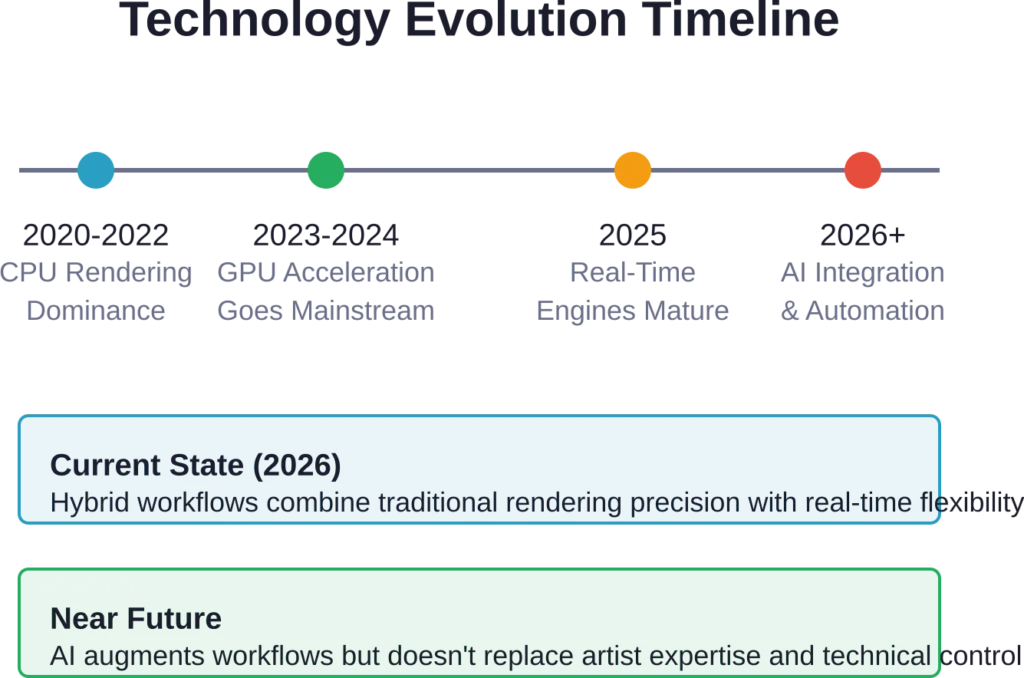
Game engine technology has transformed visualization workflows. Unreal Engine and Unity enable real-time rendering at quality levels approaching traditional offline renders.
Interactive capabilities add value beyond static images. Clients can explore designs from any angle, test material options, and modify lighting conditions during presentations. This flexibility particularly benefits design development phases where multiple options require evaluation.
Virtual reality extends interactivity further. VR enables clients to experience architectural scale and spatial relationships directly, providing intuitive understanding that floor plans and static renders cannot match.
The shift toward real-time rendering democratizes visualization somewhat. Faster iteration reduces costs and timelines, making high-quality visualization accessible to smaller projects that couldn’t justify traditional rendering expenses.
AI-Assisted Workflows
Artificial intelligence increasingly augments visualization processes. AI tools handle repetitive tasks — entourage placement, vegetation scattering, material application — freeing artists for higher-level creative decisions.
Image generation models like Midjourney and Stable Diffusion have sparked debates about visualization’s future. Can AI replace traditional rendering? The consensus suggests augmentation rather than replacement — AI excels at ideation and concept exploration but struggles with technical accuracy and consistent design coordination.
According to ArchDaily’s December 2025 analysis, architectural visuals have become “disputed media” as AI generation blurs lines between photography, rendering, and synthetic imagery. This shift raises questions about representation, authenticity, and professional standards.
Leading studios experiment with AI thoughtfully, using generative tools for early-stage exploration while maintaining traditional rendering for client deliverables requiring technical precision.
Sustainability Visualization
Environmental performance increasingly influences architectural decisions. Visualization studios now depict sustainability features explicitly — green roofs, photovoltaic arrays, natural ventilation strategies, and biodiversity enhancements.
Some studios integrate environmental analysis into visualizations, overlaying daylighting analysis, thermal performance data, or wind studies onto rendered views. This synthesis communicates design performance alongside aesthetic qualities.
Landscape integration has grown more sophisticated. Studios model seasonal change, plant maturation, and ecological succession, showing how developments evolve over time rather than depicting single frozen moments.
Hyperrealism and Stylistic Diversity
Photorealism remains the dominant aesthetic, but alternatives gain traction. Some studios pursue deliberately stylized approaches — illustrative renders, painterly treatments, or graphic abstraction that communicates design intent without mimicking photography.
Factory Fifteen exemplifies this expanded palette. Their work ranges from photorealistic renders to conceptual visualizations using collage, illustration, and experimental techniques. This versatility suits diverse project requirements from marketing to exhibition contexts.
The growth of architectural media creates demand for distinctive imagery. Publications and Instagram feeds saturate with photorealistic renders — stylistic differentiation helps images stand out in crowded visual landscapes.
Cost Considerations and Project Budgeting
Visualization costs vary enormously based on project complexity, deliverable quantity, studio reputation, and timeline constraints. Understanding cost drivers helps budget appropriately.
Factors Affecting Visualization Costs
Image complexity represents the primary cost variable. Simple exterior views with minimal context cost substantially less than intricate urban scenes with detailed entourage, complex reflections, and atmospheric effects.
Interior renders generally cost more than exteriors because they require furniture modeling, lighting design, and styling decisions. Each interior view needs careful composition and material specification.
Deliverable quantity affects total project cost but typically includes volume discounts. A single hero image costs more per image than a ten-image marketing suite because setup work amortizes across multiple views.
Timeline pressure increases costs. Rush projects require studios to prioritize your work over others, often necessitating overtime or additional staff allocation. Standard timelines allow efficient resource scheduling.
Revision complexity impacts budgets. Minor adjustments like furniture changes or color shifts cost less than significant modifications requiring remodeling or relighting entire scenes.
Typical Project Investment Ranges
While specific pricing isn’t discussed here, general budget frameworks help project planning. Small residential projects might need modest investment for basic marketing imagery, while major commercial developments require substantial visualization budgets covering dozens of images, animations, and interactive media.
Planning applications typically need fewer but more technically rigorous images than marketing campaigns. Budget allocations should reflect deliverable purposes — statutory planning work may justify premium technical specialists even for modest projects.
Design competitions often warrant significant visualization investment because winning depends partly on presentation quality. Successful competition entries increasingly include cinematic films and immersive experiences beyond traditional still images.
Value Beyond Individual Images
Visualization investment should be evaluated against broader project economics. For residential developments, compelling marketing imagery influences sales velocity and achieved prices. Enhanced visualization costs might represent tiny fractions of improved revenue.
According to research cited by BluEntCAD, 90% of clients want to see previous work before making decisions. This statistic underscores visualization’s role in sales conversion — poor imagery doesn’t just fail to attract buyers, it actively repels them.
Planning applications represent different value calculations. Visualization supporting successful planning permission for contentious schemes delivers value far exceeding its cost if it secures approval that might otherwise fail.
Working Effectively With Visualization Studios
Successful visualization projects require effective collaboration. Several practices improve outcomes and prevent common friction points.
Provide Comprehensive Briefs
Clear briefs enable accurate quotes and appropriate work. Studios need architectural drawings, site context information, material specifications, and reference imagery showing desired aesthetic direction.
Specify deliverable requirements explicitly: image quantities, view types, resolutions, file formats, and intended uses. Marketing imagery has different requirements than planning documentation or publication submissions.
Timeline expectations should be realistic. Most studios need several weeks for complex projects; rush work compresses quality assurance and increases costs.
Establish Clear Feedback Protocols
Structured revision processes prevent scope creep and miscommunication. Agree upfront how many feedback rounds are included and what constitutes minor versus major changes.
Consolidate feedback from all stakeholders before sending revisions to studios. Multiple conflicting feedback streams create confusion and inefficiency. Appoint a single project coordinator who synthesizes input and communicates unified direction.
Provide specific, actionable feedback rather than subjective reactions. “Make it more modern” offers little guidance; “increase window-to-wall ratio and simplify external cladding” gives clear direction.
Trust Studio Expertise
Professional visualization studios bring artistic and technical knowledge developed across hundreds of projects. Their recommendations about camera angles, lighting scenarios, and compositional approaches merit serious consideration.
Micromanagement typically degrades results. Communicate desired outcomes but allow studios flexibility in achieving them. The best renders emerge from collaborative partnerships respecting mutual expertise.
Plan Ahead for Marketing Timelines
Property marketing campaigns require coordination across multiple workstreams. Visualization typically sits on critical paths — images must be complete before brochures print, websites launch, or sales centers open.
Build buffer time into schedules. Design changes, planning amendments, and stakeholder feedback often delay projects. Starting visualization early provides cushion for inevitable adjustments.
The Future of UK Architectural Visualization
Several forces will shape how British visualization studios evolve over coming years.
Technology Democratization
Rendering technology becomes increasingly accessible as hardware costs fall and software interfaces improve. This democratization enables smaller practices and developers to produce visualization in-house.
But technology access doesn’t eliminate expertise requirements. Professional studios add value through artistic direction, technical problem-solving, and production management that software alone cannot provide.
The market will likely bifurcate — commodity visualization for straightforward projects gets commoditized, while complex, high-value work concentrates among elite studios offering expertise beyond rendering execution.
Regulatory and Standards Evolution
Planning systems increasingly recognize visualization’s role in public consultation and decision-making. Regulatory frameworks may emerge governing accuracy standards, disclosure requirements, and ethical representation practices.
The distinction between photorealistic renders and photography will receive more scrutiny. Clear labeling and context provision help prevent misleading representations of speculative developments.
Sustainability Integration
Environmental performance visualization will grow from niche specialty to standard practice. Clients increasingly expect renders showing sustainability features, ecological integration, and long-term landscape maturation.
Studios may integrate environmental analysis more deeply, producing visualizations that communicate both aesthetic and performance qualities simultaneously. This synthesis supports more holistic design decision-making.
Media Convergence
Boundaries between still images, animation, interactive media, and immersive experiences continue dissolving. Future visualization projects will likely combine multiple media types in integrated campaigns.
Studios that master cross-media production — delivering still renders, cinematic films, interactive configurators, and VR experiences from unified workflows — will gain competitive advantages over specialists working in single media.
Frequently Asked Questions
Standard project timelines range from two to six weeks depending on complexity and deliverable quantity. Simple exterior renders might be complete within a week, while comprehensive marketing suites with dozens of images require several weeks. Rush projects can be accelerated with premium fees, though quality typically benefits from standard timelines allowing proper iteration and refinement.
The terms are often used interchangeably, though architectural visualization represents a specialized subset of 3D rendering focused specifically on buildings and spaces. Architectural visualization requires understanding of design documentation, construction methods, and spatial composition beyond general 3D rendering skills. Studios specializing in architectural work bring domain expertise that generalist rendering companies lack.
Many British studios serve international clients, particularly in Europe, Middle East, and North America. Remote collaboration tools enable effective coordination across distances. However, studios with local UK presence better understand British planning systems, construction standards, and regional architectural contexts. International studios working on UK projects often partner with local consultants for planning-related visualization requiring technical accuracy.
Professional studios can work from various design stages, from concept sketches to fully detailed construction documents. Early-stage visualization helps design development but requires more interpretation and typically needs revision as designs evolve. Final documentation enables more accurate rendering with fewer assumptions. Communicate your design stage clearly so studios can set appropriate expectations about accuracy and likely revision requirements.
Most studios prefer native CAD files — Revit, ArchiCAD, Rhino, or SketchUp models containing 3D geometry. These files import directly into rendering software, reducing manual remodeling. Studios also accept standard exchange formats like IFC, DWG, and FBX, though some detail may be lost in translation. PDF drawings provide essential reference for models lacking complete information. Material specifications, site photographs, and precedent images help communicate desired aesthetic direction.
British planning systems increasingly rely on visualization for assessing development proposals, particularly regarding visual impact and contextual appropriateness. Planning authorities generally welcome high-quality renders that communicate proposals clearly, though some require verified views using surveyed camera positions for contentious applications. Accurate contextual integration matters enormously — planning officers scrutinize how proposed buildings relate to existing surroundings. Misleading or inaccurate renders can undermine applications and damage credibility.
Development strategies vary, but visualization often proves valuable throughout planning processes. Pre-application renders support community consultation and help planning officers understand proposals before formal submission. Application-stage visualization communicates designs to planning committees making decisions. Post-approval renders drive marketing campaigns. The investment timing depends on project confidence and planning risk — controversial schemes benefit from early visualization supporting public engagement, while straightforward applications might defer marketing imagery until approval seems likely.
Conclusion
Britain’s architectural visualization industry offers world-class expertise across project types and scales. From London’s established technical specialists to regional studios bringing local market knowledge, UK companies deliver the imagery shaping how buildings are designed, approved, and marketed.
Selecting the right studio requires understanding your specific requirements and matching them with appropriate capabilities. Planning visualization demands different expertise than luxury marketing imagery; residential volume work needs different workflows than bespoke competition entries.
The ten studios profiled here represent diverse approaches and specializations. Hayes Davidson’s technical rigor suits planning work; MIR’s artistic sophistication elevates competition entries; Uniform’s naturalistic aesthetic resonates with residential buyers; Dbox London’s luxury focus serves premium developments.
Technology continues transforming visualization workflows, from real-time rendering enabling interactive exploration to AI tools augmenting production efficiency. Yet artistic vision and technical expertise remain irreplaceable — software provides tools, but professional studios bring judgment, creativity, and problem-solving accumulated across thousands of projects.
As architectural practice becomes increasingly visual, the partnerships between designers and visualization specialists grow more critical. The best outcomes emerge from true collaboration where studios contribute creative insight alongside technical execution.
Whether seeking planning approval, launching property marketing, or entering design competitions, the UK visualization industry offers studios capable of translating architectural concepts into compelling imagery that communicates vision, drives decisions, and shapes Britain’s built environment before the first foundation gets poured.
Ready to bring your architectural project to life? Research these studios’ portfolios, evaluate which specializations match your requirements, and reach out to discuss how professional visualization can strengthen your design communication, planning submissions, or marketing campaigns.