

Quick Summary: Losing 20 pounds in a month is technically possible but neither safe nor sustainable for most people. According to the CDC, healthy weight loss occurs at a gradual pace of about 1 to 2 pounds per week. Rapid weight loss of this magnitude requires extreme calorie restriction and can lead to muscle loss, nutritional deficiencies, and metabolic complications.
The promise of dropping 20 pounds in just 30 days sounds tempting. Social media influencers and crash diet programs make it seem achievable, even easy.
But here’s the thing—just because something is technically possible doesn’t mean it’s safe or sustainable.
According to the CDC, people who lose weight at a gradual, steady pace—about 1 to 2 pounds a week— are more successful at keeping it off long-term. That translates to roughly 4 to 8 pounds per month, not 20.
So what does the science actually say about rapid weight loss? And if someone is determined to lose weight quickly, what’s the safest approach?
The Math Behind Losing 20 Pounds
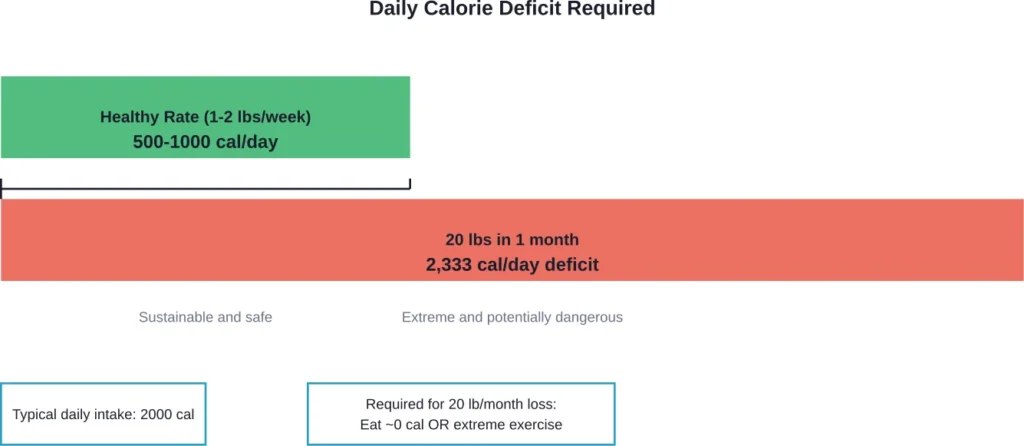
Weight loss fundamentally comes down to creating a calorie deficit. One pound of body fat contains approximately 3,500 calories.
To lose 20 pounds in 30 days, someone would need to create a total deficit of 70,000 calories over that month. Break that down daily, and it means burning 2,333 more calories than consumed every single day.
For most people, that’s an extremely large deficit.
Consider this: a moderately active adult might burn 2,000 to 2,500 calories per day through normal metabolism and activity. Creating a 2,333-calorie daily deficit would require either eating almost nothing or combining severe calorie restriction with hours of intense exercise.
Neither approach is medically recommended.
What Health Authorities Actually Recommend
The CDC emphasizes that healthy weight loss includes a lifestyle with healthy eating patterns, regular physical activity, enough sleep, and stress management. Their guidance consistently points to 1 to 2 pounds per week as the appropriate pace.
But there’s good news in those numbers. According to the CDC, even modest weight loss helps. For example, a 5% weight reduction for a person who weighs 200 pounds is 10 pounds. This change could lower the risk for some chronic diseases such as heart disease, prediabetes, and type 2 diabetes.
Research published in StatPearls notes that loss of approximately 5% to 10% of body weight over 6 months has improved glycemic control and clinically reduced cardiovascular risk factors. Losing more than this, or weight loss at faster rates, may improve overall health but increases the possibility of health risks.
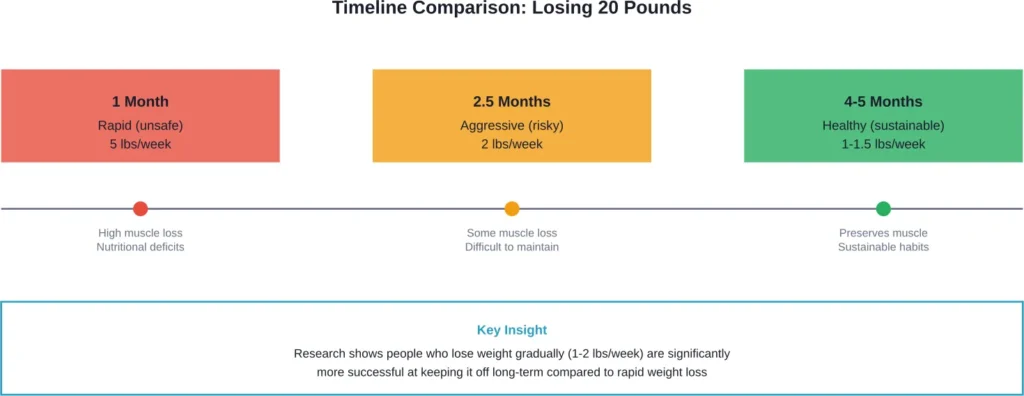
The National Institutes of Health defines rapid weight loss as more than 2 pounds per week over several weeks. By that definition, losing 20 pounds in a month—which averages to 5 pounds per week—definitely qualifies as rapid.
Risks of Rapid Weight Loss
When someone loses weight too quickly, they’re not just losing fat. Medical research identifies several significant risks associated with excessive weight loss.
Muscle Loss
Rapid weight loss typically results in substantial muscle loss alongside fat loss. A study on combat athletes showed that rapid weight loss practices negatively impact body composition, particularly lean muscle mass.
Muscle tissue is metabolically active, meaning it burns calories even at rest. Losing muscle slows metabolism, making it harder to maintain weight loss long-term.
Nutritional Deficiencies
Creating an extreme calorie deficit makes it nearly impossible to get adequate nutrition. The body needs essential vitamins, minerals, protein, and healthy fats to function properly.
Severe calorie restriction can lead to deficiencies in iron, calcium, vitamin D, B vitamins, and other crucial nutrients.
Metabolic Consequences
According to research on metabolic consequences of weight reduction, the body responds to rapid weight loss by decreasing metabolic rate. This adaptive response makes continued weight loss increasingly difficult and weight regain more likely.
The body essentially goes into conservation mode, burning fewer calories at rest than it did before the diet started.
Other Health Complications
Rapid weight loss can also cause:
- Gallstones
- Dehydration
- Electrolyte imbalances
- Fatigue and weakness
- Hair loss
- Irritability and mood changes
- Decreased bone density
Who Might Lose 20 Pounds in a Month?
While not recommended for most people, certain individuals might experience this level of weight loss under specific circumstances.
| Scenario | Likelihood | Notes |
|---|---|---|
| Very high starting weight (300+ lbs) | Possible | Initial water weight and larger deficit capacity make faster loss possible in first month |
| Medically supervised program | Possible | Very low calorie diets under medical supervision may be appropriate for individuals with obesity and related health complications |
| Post-bariatric surgery | Common | Surgical intervention results in rapid initial weight loss |
| Average weight individual (150-200 lbs) | Not realistic | Would require unsafe calorie restriction |
| Already lean individual | Unsafe | Little fat to lose; would primarily lose muscle and water |
Real talk: most of the dramatic weight loss stories involve people with substantial weight to lose. Someone who weighs 350 pounds might lose 20 pounds in their first month as their body sheds excess water weight and responds to dietary changes.
That same rate isn’t achievable—or healthy—for someone who weighs 170 pounds.
A Realistic Timeline for Losing 20 Pounds
Based on CDC guidelines of 1 to 2 pounds per week, losing 20 pounds safely would take approximately 10 to 20 weeks—roughly 2.5 to 5 months.
That might sound discouraging compared to the 30-day promise. But consider this: those months are going to pass anyway. The question is whether someone wants to lose 20 pounds and keep it off, or lose it quickly and likely regain it.
Evidence-Based Strategies for Sustainable Weight Loss
Rather than chasing an unrealistic one-month goal, focusing on sustainable strategies produces better long-term results.
Create a Moderate Calorie Deficit
Aim for a deficit of 500 to 1,000 calories per day to lose 1 to 2 pounds per week. This can be achieved through a combination of eating fewer calories and increasing physical activity. Individual calorie needs vary based on age, sex, height, weight, and physical activity level.
Prioritize Protein Intake
Eat higher-protein, lower-carbohydrate meals to control hunger and appetite, as recommended by CDC guidance. Research consistently shows that adequate protein supports better body composition outcomes.
Incorporate Regular Physical Activity
The CDC recommends at least 150 minutes per week of moderate-intensity aerobic activity for overall health. This could be brisk walking 22 minutes a day or 30 minutes a day, 5 days a week.
Combining cardio with strength training offers the best results. Strength training helps maintain muscle mass during calorie restriction, while cardio increases total calorie burn.
Focus on Whole Foods and Fiber
Eating more fiber-rich foods like vegetables, fruits, whole grains, and legumes increases satiety while providing essential nutrients. These foods have high volume and water content relative to their calorie density.
Reducing refined carbohydrates and processed foods naturally decreases calorie intake without requiring extreme restriction.
Prioritize Sleep and Stress Management
According to CDC guidance, adequate sleep and stress management are integral components of healthy weight loss. Sleep deprivation disrupts hormones that regulate hunger and fullness, making weight loss harder.
Aim for 7 to 9 hours of quality sleep per night and implement stress-reduction practices like meditation, yoga, or regular walks.
When Medical Intervention Makes Sense
For individuals with obesity and related health complications, medically supervised rapid weight loss programs may be appropriate.
Very low calorie diets under medical supervision may be appropriate for individuals with obesity and related health complications. These programs include regular monitoring and nutritional supplementation to prevent complications.
FDA-approved weight loss medications like semaglutide have demonstrated effectiveness in weight reduction when combined with lifestyle changes.
Bariatric surgery remains the most effective intervention for severe obesity, producing significant weight loss and improvement in obesity-related conditions.
These medical interventions should only be pursued under healthcare provider guidance after thorough evaluation.
The Weight Regain Reality
Here’s what most rapid weight loss programs won’t tell anyone upfront: the weight usually comes back.
Research on weight loss maintenance shows that among people who lost weight and maintained it for a year, most continued eating a diet with fewer calories than they consumed before weight loss. They also remained physically active.
Maintaining weight loss requires ongoing lifestyle changes, not temporary extreme measures. The habits developed during gradual weight loss are far more sustainable than the deprivation required for rapid results.
According to CDC research on successful weight loss maintainers, common factors include regular physical activity (typically 60 to 90 minutes of moderate-intensity activity most days), continued dietary monitoring, and early detection of weight regain.
Better Questions to Ask
Instead of asking whether losing 20 pounds in a month is possible, consider asking:
- What’s a sustainable rate of weight loss for my situation?
- What lifestyle changes can become permanent habits?
- How can weight loss improve health markers, not just appearance?
- What support systems will help maintain results long-term?
- Are there underlying health issues affecting weight?
These questions lead to more meaningful and lasting results than chasing an arbitrary deadline.
FAQ
No, losing 20 pounds in 30 days is not considered safe for most people. This rate of 5 pounds per week far exceeds the CDC’s recommended pace of 1 to 2 pounds weekly. Such rapid loss typically involves extreme calorie restriction that can cause muscle loss, nutritional deficiencies, and metabolic complications. Medically supervised programs for individuals with severe obesity represent the only exception where this might be appropriate.
Based on CDC guidelines, realistic weight loss is 1 to 2 pounds per week, which translates to approximately 4 to 8 pounds per month. Individuals with higher starting weights might experience slightly faster initial loss due to water weight reduction. This pace allows for sustainable habits, adequate nutrition, and preservation of muscle mass while still producing meaningful health improvements.
Rapid weight loss can result in several negative consequences including significant muscle loss, metabolic slowdown, nutritional deficiencies, gallstones, dehydration, electrolyte imbalances, fatigue, hair loss, and decreased bone density. Research shows that rapid loss also makes long-term maintenance significantly harder because the body adapts by reducing metabolic rate and increasing hunger signals.
Following CDC recommendations of 1 to 2 pounds per week, losing 20 pounds should take approximately 10 to 20 weeks, or roughly 2.5 to 5 months. This timeline allows for sustainable dietary changes, preservation of muscle mass, adequate nutrition, and development of long-term habits that support weight maintenance after reaching the goal.
A 1,000-calorie daily deficit falls within the acceptable range for weight loss of 2 pounds per week and may be appropriate for some individuals under certain circumstances. However, this should not result in total calorie intake falling below 1,200 calories for women or 1,500 for men without medical supervision. The deficit should come from a combination of reduced intake and increased activity rather than extreme food restriction alone.
The fastest safe approach combines a moderate calorie deficit (500-1,000 calories daily), high protein intake to preserve muscle, regular exercise including both cardio and strength training, adequate sleep, and stress management. This produces 1 to 2 pounds of loss weekly. For individuals with significant obesity and health complications, medically supervised very low calorie diets or FDA-approved medications may accelerate safe loss under healthcare provider guidance.
FDA-approved weight loss medications like semaglutide can enhance weight loss results when combined with lifestyle changes. These medications can support sustained weight reduction, though results typically accumulate over several months rather than weeks. These medications work best as part of a comprehensive approach including diet and exercise modifications, not as standalone quick fixes.
The Bottom Line
Is it possible to lose 20 pounds in a month? Technically yes, for some people under specific circumstances. Is it advisable? Almost never.
The CDC’s guidance on gradual weight loss of 1 to 2 pounds per week isn’t arbitrary—it’s based on extensive research showing this pace produces the best long-term outcomes. Medical research consistently demonstrates that rapid weight loss carries significant risks while offering little advantage in long-term success.
Weight loss doesn’t need to be dramatic to be meaningful. According to the CDC, even a 5% to 10% reduction in body weight produces measurable health improvements. For someone weighing 200 pounds, that’s just 10 to 20 pounds—achievable in 2 to 5 months through sustainable habits.
Rather than chasing rapid results that likely won’t last, focusing on gradual, sustainable changes produces lasting transformation. The lifestyle built during that 4-month journey becomes the foundation for maintaining results indefinitely.
Anyone considering significant weight loss should consult with healthcare providers to develop an appropriate plan based on individual health status, goals, and circumstances. Professional guidance helps avoid the pitfalls of rapid loss while maximizing long-term success.