
Quick Summary: Yes, it’s possible to be pregnant and test negative due to testing too early, diluted urine, faulty tests, or rare conditions like the hook effect. Research shows up to 5% of home pregnancy tests can return false negatives. Blood tests and ultrasounds provide more reliable confirmation when home tests conflict with symptoms.
Each year, women in the U.S. rely on approximately 20 million home pregnancy tests to determine whether they’re pregnant. The tests claim to be 99% accurate, but research from Washington University School of Medicine reveals a different story. Up to 5% of pregnancy tests can indicate a woman is not pregnant when she actually is.
So yes, it’s absolutely possible to be pregnant and test negative.
This isn’t just a theoretical problem. False negative results can lead to delayed prenatal care, continued exposure to substances that might harm a developing fetus, or unnecessary medical procedures. Understanding why these tests fail matters for anyone trying to conceive or concerned about an unplanned pregnancy.
How Home Pregnancy Tests Work
Home pregnancy tests detect human chorionic gonadotropin (hCG) in urine. This hormone appears in your body shortly after a fertilized egg attaches to the uterine lining, typically 6-12 days after conception.
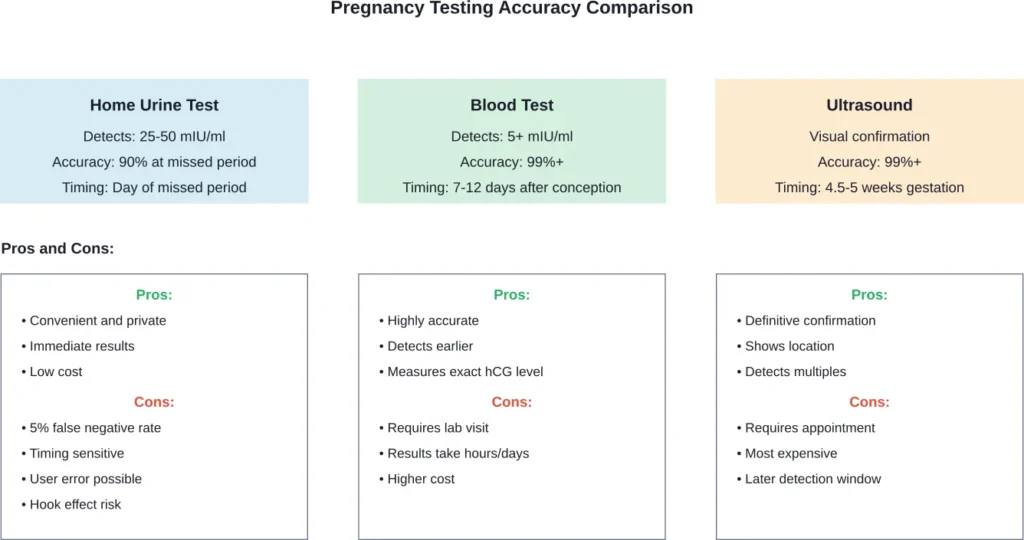
Most over-the-counter tests can detect hCG in the range of 25 to 50 mIU/ml. According to the FDA, point-of-care urine pregnancy tests reach maximum sensitivity of 90% at the time of a missed period. That means even when used correctly at the right time, these tests miss 1 in 10 pregnancies.
The tests use antibodies that bind to the beta subunit of hCG. When enough hormone is present, it triggers a chemical reaction that produces the positive result line. But several factors can interfere with this process.
7 Reasons You Can Be Pregnant With a Negative Test
Testing Too Early
The most common reason for false negatives is testing before hCG levels rise high enough to detect. Even though some tests claim to work before a missed period, their accuracy drops significantly.
According to CDC data, the earliest ovulation reported in one study occurred at 25 days after delivery, though the mean day of first ovulation among postpartum nonlactating women occurs 45–94 days after delivery. For most women, hCG doesn’t reach detectable levels until at least the first day of a missed period. Testing even 72 hours earlier can produce a negative result that would be positive just a few days later.
Diluted Urine
The FDA recommends using first-morning urine specimens because hCG concentration is highest at this time. Drinking excessive fluids before testing dilutes your urine and can drop hCG below the test’s detection threshold.
If you’re testing later in the day after drinking multiple glasses of water, your hCG concentration might be too low to register, even if you’re pregnant.
The Hook Effect
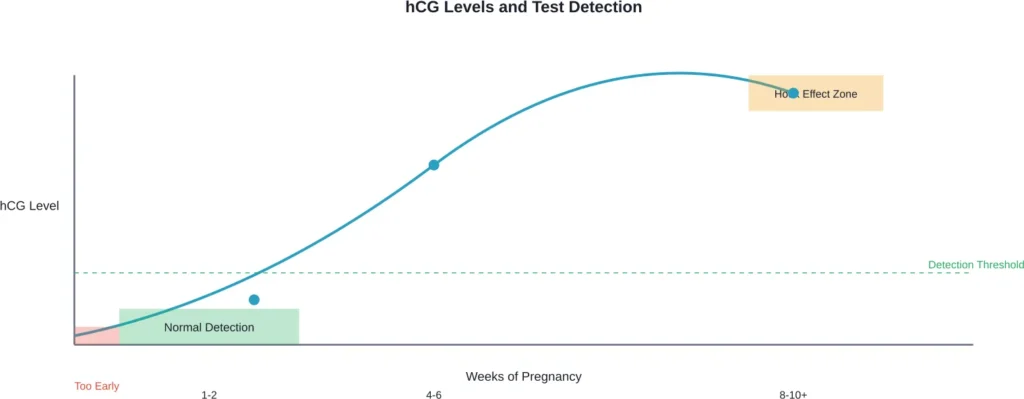
Here’s where things get counterintuitive. Sometimes hCG levels can be too high for a test to detect accurately.
The hook effect occurs when extremely elevated hCG levels overwhelm the test’s antibodies, preventing them from binding properly. Research published in Cureus documented cases where urine pregnancy tests returned false negatives due to this phenomenon.
This typically happens after 8-10 weeks of pregnancy or in cases of twins or triplets where hCG production is significantly higher than normal. The hormone literally “hooks” the antibodies in a way that prevents the color-change reaction.
Faulty or Expired Tests
Research from Washington University tested 11 different home pregnancy test brands. Seven were somewhat susceptible to errors, two were highly susceptible, and only two weren’t susceptible to giving false negatives. The worst performer gave false negatives in 5% of urine samples from confirmed pregnant women.
Expired tests, improper storage, or manufacturing defects can all compromise accuracy. That pregnancy test sitting in your bathroom cabinet for two years? It might not work reliably.
Test Misuse
Not following the instructions exactly can invalidate results. Common mistakes include:
- Reading results too early or too late
- Not using enough urine on the test strip
- Testing with diluted afternoon urine instead of concentrated morning urine
- Checking results after the specified time window when evaporation lines can appear
Ectopic Pregnancy
In ectopic pregnancies, where the fertilized egg implants outside the uterus, hCG levels often rise more slowly than in normal pregnancies. This can result in levels below the detection threshold of home tests, even when you’re several days past your missed period.
Ectopic pregnancies are medical emergencies that require immediate treatment. If you have a negative test but experience severe abdominal pain, shoulder pain, or vaginal bleeding, seek medical attention immediately.
Very Early Miscarriage
Chemical pregnancies occur when a fertilized egg implants but stops developing very early. You might test positive one day and negative a few days later as hCG levels drop rapidly. Some women never get a positive test because hCG never rises high enough before the pregnancy ends.
When Home Tests Are Most Accurate
According to research on over 750,000 non-invasive prenatal tests (NIPT), timing affects detection. However, NIPT differs from home urine pregnancy tests. Home pregnancy tests work best when you follow these guidelines:
| Testing Time | Accuracy Rate | Best Practice |
|---|---|---|
| Before missed period | 60-75% | Not recommended |
| First day of missed period | 90% | Use first-morning urine |
| One week after missed period | 97-99% | Most reliable timing |
| Two weeks after missed period | 99%+ | Backup test if needed |
The FDA emphasizes that first-morning urine provides the most accurate results because it contains the highest concentration of hCG. If specimens cannot be tested immediately, they should be stored at 2-8°C for up to 48 hours.
What To Do If You Feel Pregnant But Test Negative
Many women experience pregnancy symptoms before tests turn positive. Research shows that detailed patient history provides the most accurate assessment of pregnancy risk in most cases, according to CDC recommendations for healthcare providers.
Wait and Retest
The simplest solution is waiting 3-5 days and testing again with first-morning urine. Even retesting after 72 hours can produce different results as hCG levels double approximately every 48-72 hours in early pregnancy.
Get a Blood Test
Blood tests detect much lower levels of hCG than urine tests, typically as low as 5 mIU/ml. There are two types:
- Qualitative blood test: Simply confirms whether hCG is present
- Quantitative blood test: Measures the exact amount of hCG, which helps determine how far along you are or whether levels are rising appropriately
Blood tests can detect pregnancy 7-12 days after conception, before a missed period.
Request an Ultrasound
Ultrasounds provide definitive pregnancy confirmation. Transvaginal ultrasounds can detect a gestational sac as early as 4.5-5 weeks after your last menstrual period. By 6 weeks, a heartbeat is usually visible.
The American College of Obstetricians and Gynecologists (ACOG) notes that ultrasound confirmation is particularly important when pregnancy tests conflict with symptoms or when ectopic pregnancy is suspected.
Other Reasons for a Missed Period
Not every missed period means pregnancy. Several conditions can cause late or absent periods with negative pregnancy tests:
Polycystic Ovary Syndrome
PCOS affects up to 10% of women of reproductive age and commonly causes irregular or missed periods. Women with PCOS may experience cycles that vary from 35 days to several months.
Stress and Lifestyle Factors
Significant stress, excessive exercise, rapid weight loss, or eating disorders can disrupt your menstrual cycle. The hypothalamus, which regulates reproductive hormones, is highly sensitive to physical and emotional stress.
Thyroid Disorders
Both hyperthyroidism and hypothyroidism can cause menstrual irregularities. Thyroid hormones play a crucial role in regulating the menstrual cycle.
Perimenopause
Women in their 40s may experience irregular periods as they approach menopause. Ovulation becomes less predictable, making periods sporadic.
Medications
Certain medications can interfere with menstruation or pregnancy test results. Antipsychotics, some antidepressants, chemotherapy drugs, and medications containing hCG can all affect results.
Frequently Asked Questions
Wait at least 3-5 days after your first negative test, then retest with first-morning urine. If you’re a week past your expected period with a negative test but still no period, schedule a blood test with your healthcare provider.
Yes. Excessive fluid intake dilutes your urine and can reduce hCG concentration below the test’s detection threshold. Always use first-morning urine for the most concentrated sample.
Research indicates that up to 5% of home pregnancy tests return false negatives. At the time of a missed period, even properly used tests have only 90% sensitivity, meaning they miss 1 in 10 pregnancies.
Yes. In very early pregnancy, hCG levels may be below 25 mIU/ml, which is too low for most home tests to detect. Ectopic pregnancies also often produce lower hCG levels than normal pregnancies. Blood tests can detect levels as low as 5 mIU/ml.
The hook effect occurs when hCG levels are so high that they overwhelm the test antibodies, preventing proper binding and causing a false negative. This typically happens after 8-10 weeks of pregnancy or in cases of multiples where hCG production is exceptionally high.
Both types have similar detection thresholds of 25-50 mIU/ml. Digital tests eliminate interpretation errors since they display words instead of lines, but they’re not inherently more accurate at detecting hCG. Line tests may actually be slightly more sensitive in some cases.
If your first test is negative but your period doesn’t start, retesting after 3-5 days is reasonable. However, if you get multiple negative results over 1-2 weeks with no period, schedule an appointment with your healthcare provider rather than continuing to test at home.
The Bottom Line on Negative Pregnancy Tests
Getting a negative pregnancy test doesn’t always mean you’re not pregnant. Multiple factors can produce false negatives, from testing too early to the rare hook effect where hormone levels are actually too high.
Research confirms that home pregnancy tests fail to detect pregnancy in up to 5% of cases. If you’re experiencing pregnancy symptoms with negative tests, or if your period is more than a week late, don’t rely solely on home tests.
Blood tests and ultrasounds provide definitive answers when home tests leave you uncertain. Contact your healthcare provider if you have concerning symptoms like severe abdominal pain, or if you continue to have negative tests but no period for several weeks.
Trust your body. If something feels off or if you’re convinced you might be pregnant despite negative tests, medical evaluation is the most reliable next step. Early prenatal care matters, so getting accurate confirmation one way or another is worth the effort.