

Quick Summary: A true zombie apocalypse as depicted in fiction is scientifically implausible, but certain real-world diseases and parasites can cause zombie-like symptoms. Rabies, parasitic infections, and emerging pathogens demonstrate nature’s capacity to alter behavior and neurological function. While a complete societal collapse from reanimated corpses won’t happen, understanding zoonotic disease transmission helps us prepare for actual pandemic threats.
The zombie apocalypse has shuffled its way through popular culture for decades. From George Romero’s shambling ghouls to the rage-infected sprinters of modern horror, these reanimated corpses have become a cultural phenomenon.
But here’s what actually keeps epidemiologists up at night: not the fictional undead, but the very real pathogens that inspired these terrifying narratives. And some of them behave in ways that’ll make you rethink what’s possible.
The question isn’t whether corpses will rise from graves—they won’t. The real question is whether nature can produce something that looks disturbingly similar.
The Scientific Reality Behind Zombie Behavior
According to the WHO, zoonotic spillover of pathogens from animals to humans is recognized as the predominant cause of emerging infectious diseases and as the primary cause of recent pandemics. That’s not science fiction. That’s documented reality.
Real-world organisms already manipulate host behavior in ways that seem pulled straight from horror movies. The difference? These aren’t reanimated corpses, but living hosts whose neurological systems have been hijacked.
The mechanisms are frighteningly sophisticated. Some pathogens don’t just infect—they reprogram.
How Rabies Rewires the Brain
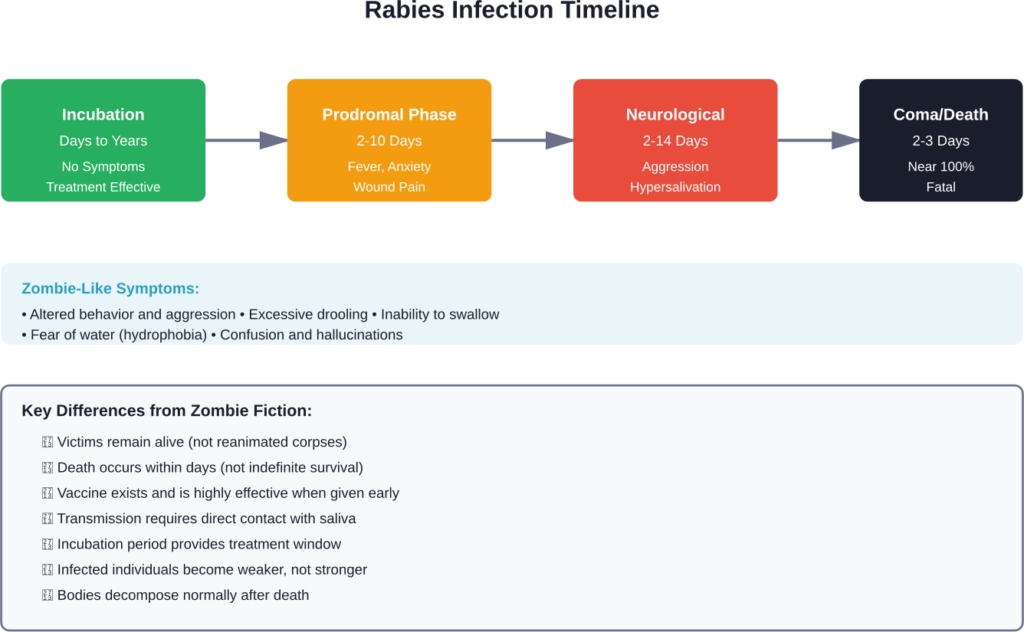
Rabies stands as the closest real-world parallel to zombie infection. The CDC reports that rabies is distributed worldwide, infecting various mammals including dogs, cats, bats, livestock, and wildlife. Transmission occurs through the saliva of infected animals, contaminating bites, open skin, or mucous membranes.
Here’s where it gets unsettling. Research published by the National Center for Biotechnology Information reveals that rabies virus modifies host behavior through a snake-toxin-like region of its glycoprotein that inhibits neurotransmitter receptors in the central nervous system.
The virus doesn’t just cause random symptoms. It specifically induces aggression and hypersalivation—behaviors that maximize transmission to new hosts. That’s evolutionary optimization at its most disturbing.
According to NCBI research, rabies virus infection often begins with symptoms similar to a febrile viral illness and vague neurological signs. The incubation period ranges from fewer than 10 days to longer than 2 years, usually 1–3 months. Five stages are recognized: incubation, prodrome, acute neurologic period, coma, and death.
The fatality rate? Near-uniform once symptoms appear. That’s zombie-apocalypse-level lethality, just without the reanimation part.
Parasites That Turn Hosts Into Puppets
Nature has perfected mind control long before science fiction writers imagined it. The fungus Ophiocordyceps unilateralis—inspiration for “The Last of Us”—actually exists and creates zombified ants in tropical regions.
This parasitic fungus hijacks ant behavior with terrifying precision. Infected ants abandon their colonies, climb to specific heights on vegetation, clamp down with their mandibles, and remain there while the fungus consumes them from within. Eventually, a fruiting body erupts from the ant’s head, raining spores onto unsuspecting victims below.
Sound familiar? It should. Community discussions frequently cite this as evidence that zombie-like behavior isn’t just possible—it’s already happening.
But here’s the critical distinction: these parasites evolved over millions of years to target specific insect species. The biological leap to human hosts isn’t just unlikely. It’s mechanistically implausible given current evolutionary constraints.
Why a True Zombie Apocalypse Won’t Happen
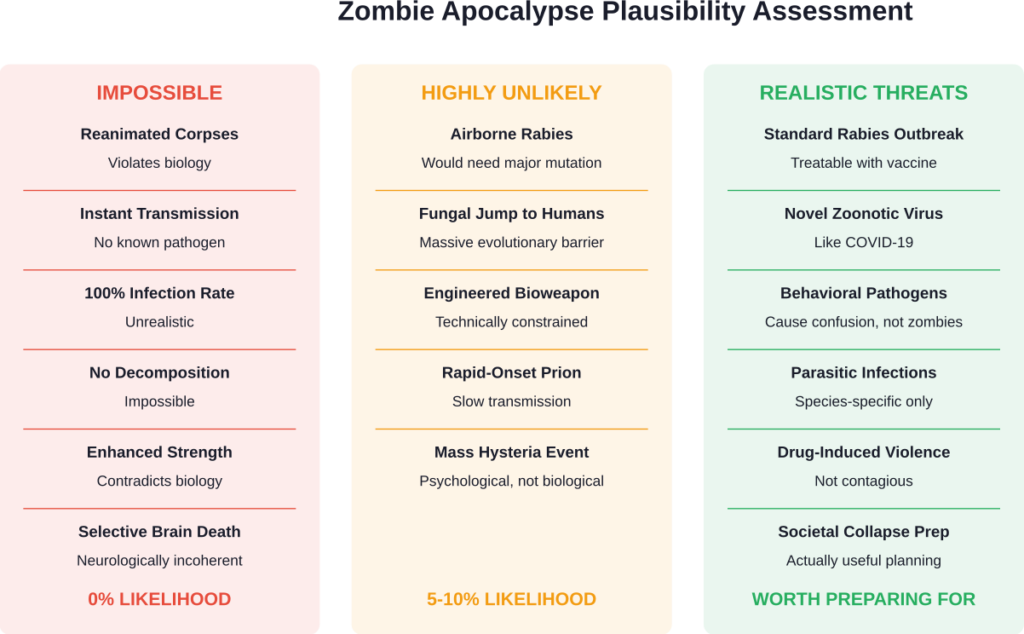
Now for the reassuring part. Despite nature’s impressive arsenal of behavior-modifying pathogens, a true zombie apocalypse faces insurmountable biological obstacles.
The Decomposition Problem
Let’s address the elephant in the room: dead bodies decompose. There’s no biological mechanism that allows corpses to reanimate and function.
Once death occurs, cellular processes cease. ATP production stops. Muscles become rigid through rigor mortis, then flaccid as tissue breaks down. Bacteria begin consuming the body from within. The brain—that incredibly delicate organ—deteriorates rapidly without oxygen and blood flow.
No pathogen can reverse this cascade. Death is biochemically irreversible.
The Transmission Bottleneck
Fictional zombie outbreaks spread with impossible efficiency. One bite, instant infection, guaranteed transmission.
Real pathogens don’t work that way. According to WHO research on zoonotic spillover, transmission from animals to humans involves complex biological barriers. Most animal pathogens can’t infect humans at all. Those that do typically require specific conditions.
Even rabies—arguably the most zombie-like disease—has preventable transmission. The CDC notes that pre-exposure and post-exposure strategies exist to minimize rabies risk. Vaccination remains highly effective when administered promptly after exposure.
Compare that to fictional zombies with 100% transmission rates and no treatment options. The gap between reality and fiction is massive.
The Cognitive Function Contradiction
Here’s where zombie logic falls apart completely. These fictional creatures supposedly have enough brain function to hunt, navigate, and track prey. Yet they’ve lost all higher reasoning, pain response, and self-preservation instinct.
That’s neurologically incoherent. The brain regions controlling movement and basic motor functions are deeply interconnected with those managing survival instincts. Damage severe enough to eliminate reasoning would also impair basic locomotion.
NCBI research on rabies encephalitis notes that neuronal dysfunction explains severe clinical disease, but this dysfunction leads to weakness and death—not enhanced predatory behavior.
| Characteristic | Fictional Zombies | Real-World Rabies | Parasitic Infections |
|---|---|---|---|
| Host Status | Reanimated corpses | Living but dying patients | Living hosts |
| Transmission Rate | Near 100% from bites | Requires saliva contact | Species-specific |
| Incubation Period | Minutes to hours | Days to years | Varies widely |
| Treatment Available | None (fictional) | Yes, if given early | Depends on parasite |
| Duration of Infection | Indefinite | Days to weeks before death | Varies |
| Behavior Changes | Extreme aggression, no fatigue | Aggression with weakness | Highly specific actions |
| Physical Capabilities | Maintained or enhanced | Rapidly deteriorating | Often impaired |
Diseases That Could Mimic Zombie Outbreaks
While true zombies remain impossible, certain disease scenarios could create zombie-like chaos. The distinction matters for actual pandemic preparedness.
Prion Diseases and Neurological Disorders
Prion diseases like Creutzfeldt-Jakob disease cause rapid neurological deterioration. These misfolded proteins spread through brain tissue, causing dementia, loss of coordination, and behavioral changes.
Mad cow disease demonstrated how a prion outbreak can create widespread panic. The key difference? Affected individuals become progressively less functional, not more aggressive or mobile.
Mutated Rabies Scenarios
Community discussions often speculate about airborne rabies or faster-incubating strains. While theoretically concerning, NCBI research indicates that rabies virus has remained relatively stable.
The virus evolved to maximize transmission through biting behavior. Mutations that kill hosts faster would actually reduce transmission success. Evolution tends toward pathogens that keep hosts alive long enough to spread—not rapid-onset killers.
Engineered Bioweapons
The most plausible zombie-adjacent scenario involves deliberately engineered pathogens. Modern synthetic biology could theoretically combine traits from multiple organisms.
But even weaponized diseases face the same biological constraints. Bodies still decompose. Transmission still requires viable mechanisms. Host survival still depends on basic cellular functions that degrade rapidly with severe neurological damage.
What Preparedness Actually Looks Like
The CDC famously published zombie apocalypse preparedness materials. Before dismissing this as gimmicky, recognize the strategic brilliance: emergency preparedness for fictional zombies translates directly to real disaster readiness.
The same supplies needed for zombie survival—water, non-perishable food, first aid, communication devices—work for hurricanes, earthquakes, pandemics, and civil unrest.
Real Threats Worth Preparing For
The WHO emphasizes that the health of humans, animals, and ecosystems are closely interlinked. Changes in these relationships can increase the risk of new human and animal diseases developing and spreading.
That’s the actual concern. Not zombies, but emerging zoonotic diseases that jump species barriers. COVID-19 demonstrated how quickly a novel pathogen can disrupt global society.
Future pandemic threats likely involve:
- Novel influenza strains with high transmission rates
- Antibiotic-resistant bacteria that render modern medicine ineffective
- Vector-borne diseases expanding into new geographic regions due to climate change
- Zoonotic spillover events from wildlife trade and habitat destruction
None of these create zombies. All of them can overwhelm healthcare systems and disrupt society.
The One Health Approach
According to WHO documentation, One Health is an integrated, unifying approach to balance and optimize the health of people, animals, and ecosystems. This framework recognizes that addressing linkages between human, animal, and environmental health provides a transformative approach to improved global health.
This matters more than zombie fiction. Real pandemic prevention requires:
- Surveillance systems monitoring wildlife diseases
- Rapid response protocols for emerging infections
- International cooperation on outbreak containment
- Investment in vaccine development infrastructure
- Public health education and disease literacy
Why Zombie Fiction Persists Despite Impossibility
If zombies are scientifically impossible, why does the concept maintain such cultural grip? The answer reveals something about human psychology and societal anxieties.
Zombie narratives provide a framework for exploring collapse scenarios without directly confronting real fears. Economic instability, climate change, political polarization, pandemic threats—these complex problems become metaphorically digestible through zombie apocalypse storytelling.
The appeal lies in simplification. Zombies provide clear enemies, straightforward rules, and survival as the sole objective. Real crises involve ambiguity, moral complexity, and no obvious antagonists.
There’s also the preparedness fantasy. Many people find comfort in imagining they’d survive catastrophic collapse. Zombie scenarios allow exploring self-sufficiency, community building, and resourcefulness in safe fictional spaces.
The Intersection of Science and Storytelling
“The Last of Us” achieved critical acclaim partly because it grounded zombie fiction in real mycology. The Cordyceps fungus actually exists. That kernel of scientific truth makes the fiction feel plausible, even though the species jump remains impossible.
This technique—anchoring fiction in factual biology—creates compelling narratives while educating audiences about actual pathogens. Rabies became more widely understood through zombie comparisons. Parasitic behavior modification entered public consciousness through horror media.
The educational value shouldn’t be dismissed. Popular media introducing scientific concepts reaches audiences that might never read NCBI research papers or CDC reports.
Frequently Asked Questions
Rabies would need multiple simultaneous mutations that contradict evolutionary pressures. The virus evolved to keep hosts alive long enough to transmit through biting. Mutations causing faster death or reanimation would reduce transmission success. According to NCBI research, rabies virus has remained relatively stable because its current form optimally balances infectivity with transmission opportunity.
Ophiocordyceps unilateralis specifically evolved over millions of years to infect certain ant species. The biological mechanisms involve precise molecular interactions with ant neurochemistry. Jumping to human hosts would require completely different infection pathways, as human brains operate with different neurotransmitter systems and immune responses. The evolutionary distance makes this scenario scientifically implausible.
Historical events sometimes called “zombie outbreaks” typically involved rabies, encephalitis, or mass hysteria. The 18th-century vampire panics in Eastern Europe likely involved rabies misidentification. Some documented cases of “zombies” in Haiti resulted from tetrodotoxin poisoning combined with psychological trauma, not actual reanimation or infectious disease.
Bioweapon research focuses on enhancing transmissibility or lethality of existing pathogens, not creating Hollywood zombies. The biological constraints preventing zombie existence—decomposition, energy requirements, neurological coherence—can’t be overcome through genetic engineering. Labs study dangerous pathogens for defensive purposes and vaccine development, not to create reanimated corpses.
A novel neurological pathogen causing severe aggression and confusion in living patients represents the most plausible scenario. This would resemble rabies with faster onset and easier transmission. However, affected individuals would weaken rapidly from the disease, require basic sustenance, and remain vulnerable to conventional medical interventions. This scenario would be a serious pandemic but not a zombie apocalypse.
The CDC uses zombie apocalypse scenarios as engaging frameworks for teaching actual emergency preparedness. The supplies and plans needed for zombie survival—water, food, first aid, communication, evacuation routes—directly apply to real disasters like hurricanes, earthquakes, and pandemics. The novelty of zombie framing increases public engagement with otherwise dry preparedness information.
Advanced neurotechnology might theoretically control basic motor functions remotely, but this wouldn’t constitute reanimation. Living people might become controlled through brain-computer interfaces, but they’d require normal biological maintenance. Dead tissue cannot be reanimated because cellular death is irreversible. Decomposition, energy depletion, and structural breakdown prevent corpses from functioning regardless of technological intervention.
The Real Takeaway About Zombie Apocalypses
So is a zombie apocalypse possible? The answer remains definitively no—at least not the version depicted in popular media.
Reanimated corpses violate fundamental biological principles. Dead tissue decomposes. Brains require oxygen and nutrients. Bodies need functional circulatory and metabolic systems. No pathogen can overcome these constraints.
But that doesn’t mean the zombie apocalypse genre lacks value. These narratives help audiences explore societal collapse, moral dilemmas, and survival priorities. The best zombie fiction asks: what happens to humanity when civilization crumbles?
The diseases that inspired zombie fiction—rabies, parasitic infections, neurological disorders—deserve serious attention. According to WHO data, zoonotic spillover remains the predominant cause of emerging infectious diseases. The next pandemic might not create zombies, but it could still overwhelm healthcare systems and require coordinated global response.
Real preparedness means understanding actual disease transmission, supporting public health infrastructure, and maintaining emergency supplies for realistic disasters. The CDC’s approach of using zombie scenarios to teach preparedness combines education with engagement effectively.
Nature has created behavior-modifying pathogens that seem like science fiction. Rabies rewires brains to maximize transmission. Parasitic fungi turn insects into puppet hosts. These realities are fascinating and concerning enough without requiring reanimated corpses.
The cultural obsession with zombies reflects deeper anxieties about loss of control, societal breakdown, and mortality itself. Rather than dismissing these concerns, channel them toward practical preparation for actual emergencies.
Want to be truly prepared? Focus on evidence-based emergency planning. Stock essential supplies. Learn basic first aid. Understand disease prevention. Support public health funding. These actions address real risks rather than fictional threats.
The zombie apocalypse won’t happen. But pandemics, natural disasters, and social disruptions will continue occurring. The preparedness mindset sparked by zombie fiction can translate into genuine readiness for actual challenges.
Stay informed about emerging infectious diseases through WHO and CDC resources. Understand how zoonotic pathogens jump species barriers. Recognize that science fiction, at its best, helps us think critically about real-world vulnerabilities.
The walking dead will remain safely confined to screens and pages. The real threats require real preparation, real understanding, and real action.