
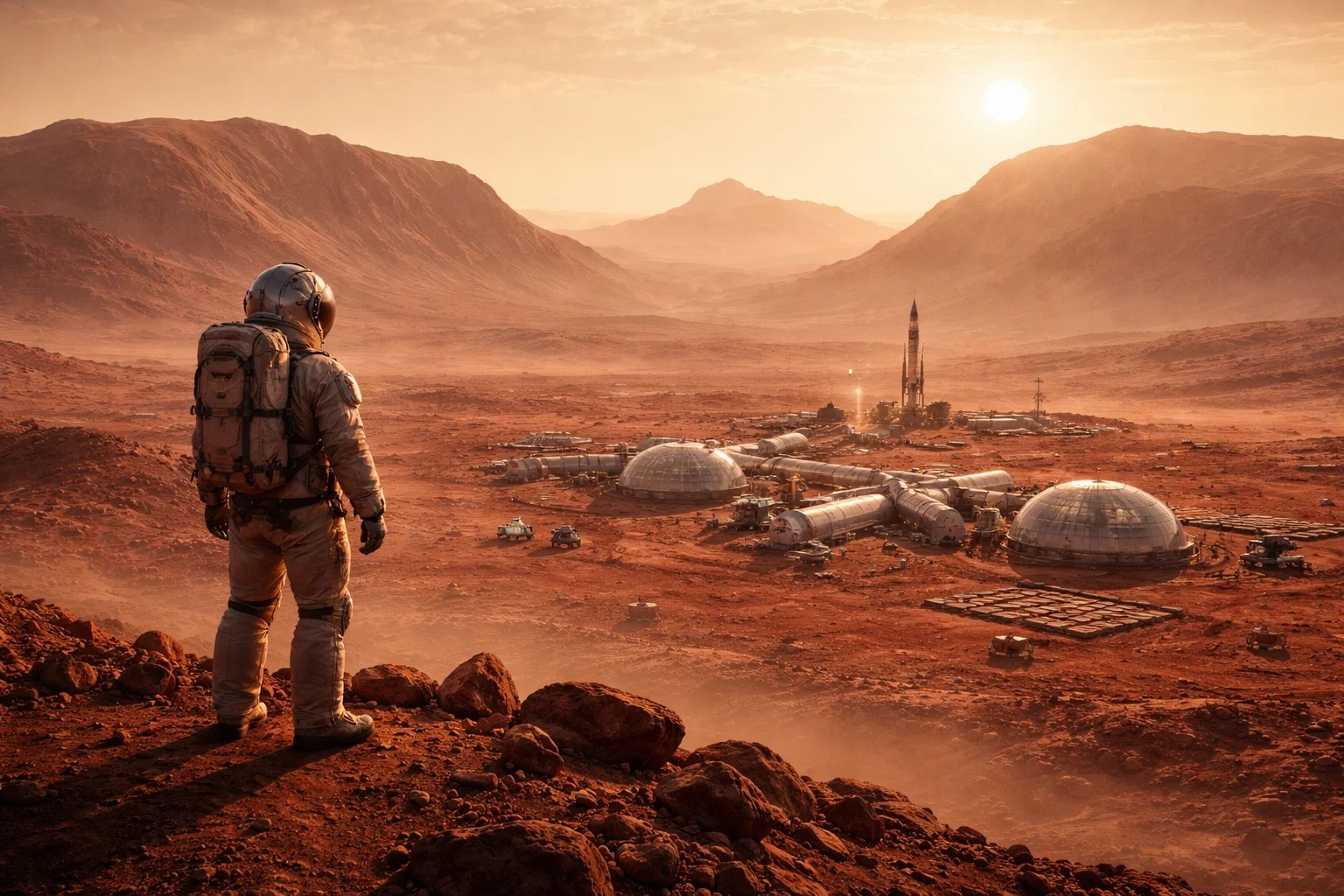
Quick Summary: Living on Mars is theoretically possible but presents extreme challenges including radiation exposure, unbreathable atmosphere, extreme temperatures, and lack of liquid water. According to NASA research, humans could potentially establish Mars bases if missions don’t exceed four years and technologies for oxygen production, food cultivation, water extraction, and radiation shielding are developed. While robotic missions continue exploring Mars habitability, permanent human settlement remains decades away.
Mars has captivated human imagination for decades. As NASA’s robotic missions uncover more about the Red Planet, one question dominates: could humans actually live there?
The short answer? It’s complicated.
According to NASA, Mars remains a horizon goal for human exploration partly because it’s one of the only places in our solar system where life may have existed. What scientists discover about Mars could reveal crucial information about Earth’s past and future.
But wanting to live somewhere and actually surviving there are two very different things.
Why Mars Makes Sense as a Second Home
Among planets in our solar system, Mars stands out as the most viable option for human colonization. Not because it’s easy—it’s absolutely not—but because it shares some similarities with Earth.
NASA data shows one Martian day lasts about 37 minutes longer than an Earth day. That’s remarkably similar compared to other planets. Mars also has polar ice caps, seasonal weather patterns, and evidence of ancient river valleys.
The ESA-Roscosmos ExoMars Trace Gas Orbiter has discovered significant water deposits beneath Mars’ surface, particularly in the Valles Marineris canyon system. According to Igor Mitrofanov of the Space Research Institute of the Russian Academy of Sciences, the orbiter can detect water-rich areas up to one meter below the surface that previous instruments couldn’t identify.
That’s crucial. Water means potential for life support, fuel production, and agriculture.
The Brutal Reality of Mars Environment
Here’s where things get challenging. Mars isn’t just inhospitable—it’s actively hostile to human life.
Temperature Extremes
Temperatures on Mars range from -284°F to 86°F according to NASA measurements. Those swings would kill an unprotected human in minutes. Even the warmest Martian day barely reaches temperatures comfortable for humans, and those occur rarely near the equator.
Unbreathable Atmosphere
The Martian atmosphere contains 96% carbon dioxide. Zero oxygen for breathing. The atmospheric pressure is so low that liquid water can’t exist on the surface—it either freezes solid or evaporates immediately.
Space.com research indicates that making Mars breathable would require increasing air pressure by a factor of almost 200 while ensuring the right oxygen mixture. The problem? There’s likely not enough carbon dioxide trapped in Mars’ ice caps and soil to accomplish this through terraforming.
Deadly Radiation
This is the big one. Without Earth’s magnetic field and thick atmosphere, Mars gets bombarded by galactic cosmic rays and solar energetic particle events.
UCLA research published in 2021 concluded that Mars missions would only be viable if they don’t exceed four years. Yuri Shprits, a UCLA research geophysicist, emphasized that limiting round-trip duration helps reduce dangerous radiation exposure to which astronauts would be subjected.
The Mars Science Laboratory’s Radiation Assessment Detector has detected multiple solar energetic particle events both during transit and on the Martian surface. Research indicates nowcasting systems could provide astronauts with approximately 30 minutes warning to seek shelter during these events, though this only partially mitigates the constant exposure to background radiation.

Essential Technologies for Mars Living
If humans are going to survive on Mars, several technologies must work flawlessly. NASA’s research through programs like their Mission to Mars educational units highlights these critical systems.
Oxygen Production
Breathing comes first. Technologies must extract oxygen from Mars’ CO₂-rich atmosphere or mine it from subsurface ice deposits. NASA has demonstrated oxygen production technology, including concepts for in-situ resource utilization from Mars’ CO₂-rich atmosphere.
Water Extraction and Recycling
Hidden subsurface water detected by the ExoMars Trace Gas Orbiter offers hope. Settlement systems would need to mine this ice, melt it, purify it, and recycle every drop. No margin for waste exists when resupply missions take months.
Food Production
Growing food in Martian soil presents unique challenges. The soil contains perchlorates toxic to humans. Controlled environment agriculture in pressurized greenhouses becomes mandatory, requiring massive energy inputs and careful nutrient management.
Radiation Shielding
Habitats must provide serious radiation protection. Options include building underground, piling Martian regolith on top of structures, or developing advanced shielding materials. Research on active shielding systems continues, but passive shielding remains the most practical near-term solution.
Power Generation
Solar panels work on Mars but generate less power due to distance from the Sun and frequent dust storms. Nuclear power systems offer more reliable alternatives. Energy storage becomes critical during the long Martian nights and dust storm seasons.
| Life Support System | Technology Readiness | Primary Challenge |
|---|---|---|
| Oxygen Generation | Demonstrated in prototype | Scaling to human needs |
| Water Extraction | Conceptual design | Locating reliable sources |
| Food Production | Early testing phase | Soil toxicity, energy requirements |
| Radiation Shielding | Multiple approaches tested | Weight vs protection tradeoff |
| Power Systems | Nuclear systems proven | Transport and deployment |
| Atmospheric Pressure | Well understood | Maintaining sealed habitats |
The Timeline Challenge
Getting to Mars takes roughly six to nine months with current propulsion technology. That means a round-trip mission, including time on the surface, stretches to years.
The four-year limit identified by UCLA researchers creates a tight constraint. Astronauts would spend months traveling each direction, leaving limited time for surface operations before radiation exposure reaches dangerous levels.
According to Wikipedia’s coverage of Martian life research, rovers on Mars could find dormant but still viable life at a depth of one meter below the surface, according to estimates that if surface life has been reanimated as recently as 450,000 years ago. This presents both opportunity and risk—the possibility of discovering life, but also potential planetary protection concerns.
Who Would Actually Want to Live There?
Community discussions reveal interesting perspectives. The psychological challenge might rival the physical ones.
Mars colonists would face permanent isolation from Earth. Communication delays of 4-24 minutes each way make real-time conversations impossible. Returning to Earth might not be an option due to mission costs and health impacts of the journey.
Living in sealed habitats without stepping outside unprotected—ever—requires a special type of person. The confinement, isolation, and constant danger would test human psychology in ways Antarctic research stations only hint at.
The Case for Robotic Exploration First
NASA’s current approach focuses on robotic missions through programs like ExoMars. The ESA’s rovers and orbiters gather crucial data about Martian geology, climate, and potential resources without risking human lives.
These missions explore subsurface voids that could harbor signs of extinct or even extant life. According to research teams participating in DARPA’s Subterranean Challenge adaptations for planetary exploration, subsurface environments represent primary candidates for both detecting life and establishing future human colonies.
Robots don’t need oxygen, can withstand extreme temperatures, and don’t suffer psychological effects from isolation. They’re ideal for the dangerous preliminary work of characterizing landing sites, testing resource extraction, and establishing initial infrastructure.

What About Terraforming?
Science fiction loves the idea of transforming Mars into an Earth-like planet. The reality? It’s incredibly difficult, possibly impossible with current understanding.
Terraforming would require releasing massive amounts of greenhouse gases to warm the planet, thickening the atmosphere, and somehow generating a magnetic field to protect against radiation. Each step presents monumental engineering challenges spanning centuries or millennia.
Research suggests Mars lacks sufficient volatile materials locked in its surface to create an Earth-like atmosphere even if we could release them all. The planet’s lower gravity also means it would slowly lose any thick atmosphere we created.
The Real Question Nobody Asks
Here’s what gets overlooked in Mars colonization discussions: why?
Scientific research? Absolutely valuable. Robotic missions accomplish that more efficiently. Backup location for humanity? Mars doesn’t solve extinction-level threats like asteroid impacts or nuclear war—it creates new vulnerabilities.
The honest answer involves human nature. We explore because we can. Because the challenge exists. Because pushing boundaries defines our species.
But practical Mars settlement faces obstacles beyond current technology. The economic model doesn’t exist. The social structures required for isolated colonies remain untested. The legal frameworks for off-world governance haven’t been established.
Near-Term Reality vs Long-Term Possibility
Can humans live on Mars in 2026? No. The technology exists in pieces, but integration into reliable, redundant systems supporting long-term habitation hasn’t happened.
Could humans establish a research base on Mars within 20-30 years? Maybe. If funding continues, if international cooperation holds, if no catastrophic failures occur during early missions.
Will Mars ever support self-sustaining cities independent of Earth? That’s the trillion-dollar question with no clear answer.
NASA’s educational materials designed for K-9 students teach kids to design Mars missions, build spacecraft models, and think through the engineering challenges. That’s the right timeframe—preparing the next generation for challenges that might take multiple generations to solve.
Frequently Asked Questions
No. Mars’ atmosphere is 96% carbon dioxide with essentially zero oxygen. Humans would need constant life support systems providing breathable air. The atmospheric pressure is also too low to support human life—about 0.6% of Earth’s pressure.
With current propulsion technology, the journey takes six to nine months depending on the alignment of Earth and Mars. This creates a significant challenge since astronauts face extended radiation exposure during transit.
Yes, but not liquid water on the surface. The ExoMars Trace Gas Orbiter has detected substantial water ice beneath Mars’ surface, particularly in the Valles Marineris region. This subsurface ice could potentially be extracted and used by future missions.
Radiation exposure represents the most serious threat according to UCLA research. Without Earth’s magnetic field and thick atmosphere, Mars colonists would face constant bombardment by galactic cosmic rays and solar energetic particles. Research indicates missions shouldn’t exceed four years to keep radiation exposure within acceptable limits.
NASA data shows Mars temperatures range from -284°F to 86°F. The average temperature hovers around -80°F. Even the warmest locations at midday barely reach temperatures comfortable for humans, and nights are brutally cold everywhere on the planet.
Not in native Martian soil exposed to the atmosphere. The soil contains toxic perchlorates, there’s no liquid water, and the atmosphere lacks oxygen. However, plants could potentially grow in controlled environment greenhouses with imported or heavily processed soil, artificial lighting, and carefully managed conditions.
NASA and other space agencies target the 2030s or 2040s for first crewed missions, though timelines regularly shift. Establishing permanent settlements would come much later, assuming the technological and physiological challenges can be overcome.
The Bottom Line
Is it possible to live on Mars? Technically, yes. Humans possess the fundamental knowledge to build life support systems capable of sustaining people on the Red Planet for limited periods.
Is it practical or imminent? Not yet.
The gap between theoretical possibility and actual implementation remains enormous. Every system—oxygen production, water extraction, food cultivation, radiation shielding, power generation—must work perfectly with no room for failure. Resupply from Earth takes months. Medical emergencies can’t be evacuated quickly.
Mars settlement will likely happen eventually, driven by human curiosity and determination. But it’ll start small—research outposts supporting a handful of people for months at a time. Self-sustaining colonies supporting thousands of permanent residents remain science fiction for now.
The Red Planet guards its secrets carefully. Before humans can truly live there, robotic explorers must continue mapping resources, testing technologies, and answering the fundamental question that makes Mars so compelling: did life ever exist there, and could it exist there again?
That answer might determine whether Mars becomes humanity’s second home or remains a fascinating but inhospitable world we visit but never truly inhabit.