
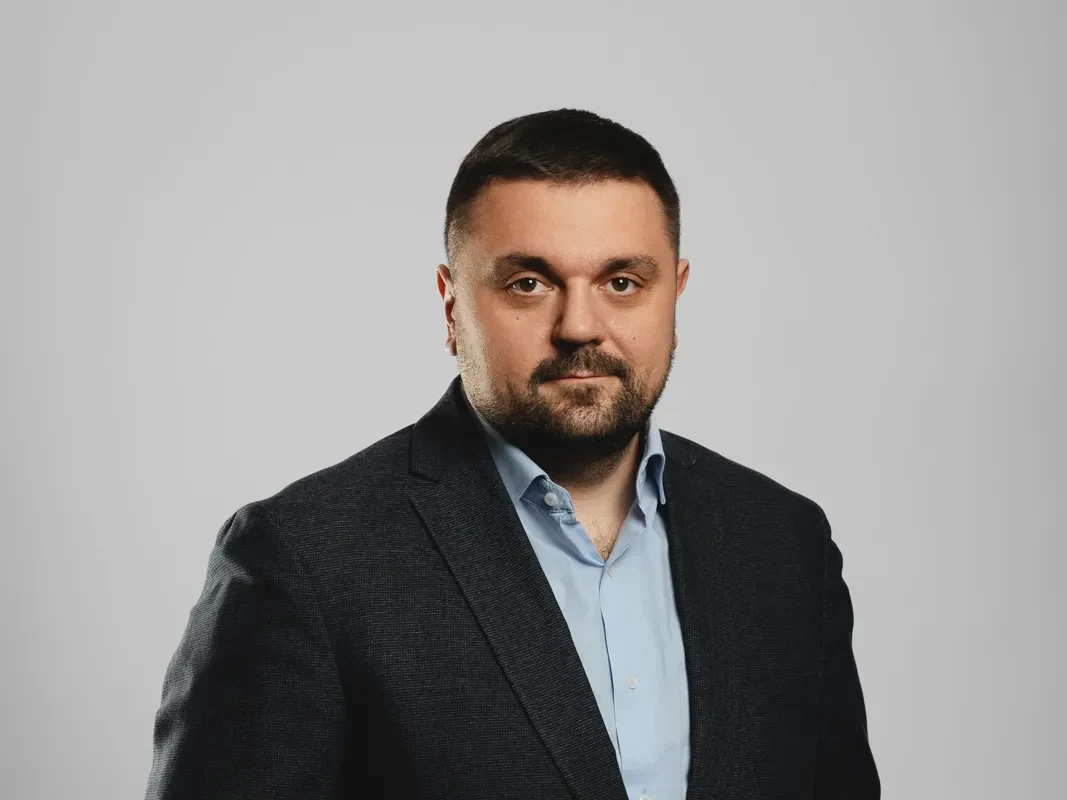
In financial services, a reputation is built from concrete choices: how the product works, how carefully clients are guided, and whether they come back with new problems. Oleg Ilyin went from Belarus, by way of finance and consulting, to launching the mortgage platform Mortix in the UAE. In conversation with Lara Palmer, he talks about what he learned in the CIS and Emirati markets, how banks assess borrowers, and why the quality of service became his main growth strategy.
Lara Palmer: Before you moved to the Emirates, you had already run several financial businesses in Belarus. How did they begin?
Oleg Ilyin: For a while I had three projects running in parallel. We created Belarus’s first licensed ratings agency and later sold it to a major local company.
Then there was Finup24, a brokerage that allowed people to buy Belarusian bonds remotely. It was acquired by Softline, a Russian holding company.
The third, ASER, has taken up the last ten years of my life. It is a consultancy — business plans, research, development strategies. The Belarusian business grew into an international group with offices in Russia, Kazakhstan, Uzbekistan and Kyrgyzstan. The Minsk office alone now has around forty people, which is a lot for financial consulting, and we handle roughly two hundred projects a year.
L. P.: Did you come to the Emirates to open an ASER office?
O. I.: Yes. I own half of the group; my partner Alexander runs operations. I planned to build the business here, but once I arrived I wanted to do something new that drew on my financial background. That is how Mortix came about — a digital mortgage platform that connects property buyers with banks.
L. P.: What surprised you about working in a new market?
O. I.: Prices change dramatically. A business plan might cost two thousand dollars in Belarus, about ten thousand in Kazakhstan and up to fifty thousand here. That changes the economics: you can take on fewer projects and still keep a strong team.
Competition works differently too. Someone searching online will find very cheap offers, while the top end is occupied by large international consultancies. A newcomer needs time to earn trust and prove their value.
When we opened, we had plenty of work. We helped entrepreneurs with research, analysis and business models. One client wanted to build a platform for finding tradespeople. We defined the format, chose the niche, set realistic prices and built the financial model, so he came away with a project and a roadmap.
We also published industry studies. There are about thirty sectors on the ASER website, from healthcare to e-commerce, all free to download. We chose topics that mattered to investors and entrepreneurs and shared the results. People still download them. For the market it was useful information, and for us it was a way to introduce our work.
L. P.: An entrepreneur can register a company, get a licence and invest in setting up, but that doesn’t guarantee a working model. Which mistakes most often stop people from establishing themselves? In your experience, how many companies that open in the Emirates survive?
O. I.: I don’t have exact statistics. My feeling is that if someone has already spent ten, twenty or thirty thousand dollars on consulting, about seven out of ten go on to register. What happens next is harder to say. Sometimes people get a licence, operate for a year or two and then don’t renew it. Perhaps half don’t get past that stage — but that is only my impression, not research.
I have seen ventures struggle with the economics. One group imported organic fertiliser from Belarus, but logistics made it too expensive. A large food distributor found the supply chains difficult: Belarusian cheese on the shelf could cost more than French cheese, and at that price you have to explain why a customer should choose it.
Over time entrepreneurs understand the market better and find products where the numbers work. Savushkin Product and Santa Bremor have been selling here for years. You have to look at the particular category, the supply routes and the price. The same market behaves differently for different goods.
L. P.: You came to develop consulting. Why mortgages? What about that market matched your experience and your interests as an entrepreneur?
O. I.: After Belarus I wanted something on a bigger scale. I was looking for a field close to my financial background and large enough in terms of market size. Property itself didn’t appeal to me, but mortgages let me apply my knowledge of financial products, banks and digital platforms. I had already worked in financial services and built platforms before.
My research suggests that every third apartment is bought with a mortgage. That is a big market. We are building a service that helps buyers understand bank offers and get from application to completion.
L. P.: Let’s follow a client. Someone is buying a home but doesn’t know which bank to go to or what documents to prepare. What happens once they submit a request through Mortix?
O. I.: The user creates an account, submits a request and uploads documents, then talks to a mortgage broker through an in-app chat. We review the profile and suggest banks that may suit that particular situation. Employees and entrepreneurs need different documents, so we start by understanding who we are dealing with.
Estate agents have their own route: they can refer clients through the app and track the status of each application. We want an infrastructure that is convenient for buyers, agents and our brokers alike. Many clients come through agents, so we are building a partner network in which the agent receives part of the commission Mortix earns from the bank.
The service is free for clients. In the Emirates, banks pay mortgage brokers a commission for the clients they bring — by my estimate around one per cent of the loan amount. With a good volume of applications, that model works without charging separately for finding the right offer.
L. P.: So you compare options across banks and help choose the best one?
O. I.: Yes. We try to find the best option available at that moment, so that clients understand the terms and can save money. There are more than twenty banks in the Emirates, but only about seven or eight are active in mortgages. Each has its own requirements for applications and partners. You build relationships with banks one by one and then maintain them constantly.
We would like to organise meetings at which banks present their mortgage products, so that clients and agents can ask questions directly and compare options. Those meetings help us too — we understand the banks’ offers better and strengthen our working contacts.
L. P.: Can a buyer simply go to a bank and arrange a mortgage on their own?
O. I.: Of course. But a mortgage involves several stages, and the conditions vary from bank to bank. A rate can be fixed for a certain period or variable. Variable rates are tied to EIBOR plus the bank’s margin, and margins differ too. On a large purchase, even a small difference noticeably changes the total cost of the loan.
There is pre-approval, a property valuation and the final agreement. A preliminary yes doesn’t always mean everything will go through automatically. Sometimes a bank wants to check an entrepreneur’s company — whether it has an office and employees, for example. It helps buyers to understand the sequence before they pay a deposit on a property.
We collect the client’s information, explain which documents will be needed and accompany the application. After pre-approval the bank values the property. If the valuation doesn’t meet the buyer’s expectations, further discussion or an appeal may be needed. It is important to understand in advance that a transaction involves several decisions, each with its own timeline.
L. P.: How long does pre-approval take?
O. I.: Sometimes a bank answers within a few hours. But speed on its own says little about the final decision. Some banks take longer to review an application, yet their pre-approval is more likely to become a final approval. That process can take two, three or four weeks.
So we explain to clients exactly what a bank’s response means and what will happen next. Buyers need to know how far they can rely on a preliminary decision when planning a transaction. The timing depends on the borrower’s profile, the documents and the specific bank.
L. P.: You mentioned that banks look at employees and entrepreneurs differently. What does that mean in practice?
O. I.: An acquaintance of mine, a wealthy entrepreneur, couldn’t get a mortgage. He has a business and assets, but not the average monthly balance the bank wanted to see. In business, money comes in and immediately goes out on expenses. The size of a business and the balance in an account tell a bank different things.
His employee, who has a stable salary, got a mortgage. The bank saw regular income and a clear employment situation. We sometimes joke that an employee with tidy paperwork can be an easier client than an entrepreneur with substantial assets.
An employee usually needs proof of employment, six months of bank statements, a passport, an Emirates ID and a residence visa. For an entrepreneur a bank may ask for twelve months of statements and check the average monthly balance; some banks, for instance, look for something in the region of forty thousand dirhams. The requirements depend on the bank and on the individual client.
L. P.: What should someone do in advance if they are planning to apply for a mortgage?
O. I.: I would start by checking your credit history with the Etihad Credit Bureau, which you can do in the bureau’s app. For a few months before applying, watch your payments carefully and avoid being late on any accounts, utilities or phone bills.
For employees, the regularity of salary matters: if it arrives on roughly the same day every month, the bank sees a stable picture more easily. Entrepreneurs should understand that their income is viewed differently and that more documents may be needed. None of this guarantees approval, but preparing helps you understand your position in advance.
L. P.: You say you want to make the process simpler. What does good service mean to you, and how do you organise the work so that new clients come through recommendations?
O. I.: Our motto is “Making your mortgage journey easier”. Clients hand over their documents, and we take care of the application and accompany them from there. They don’t have to take time away from their main work to go to banks themselves and figure out every detail on their own.
Service quality matters to me partly because this is my fourth business. Earlier projects taught me that when you do your job well, clients come back and recommend you to others. The ASER consulting group is twelve years old, and today we have no sales department. New clients come by recommendation: one customer orders a business plan, then tells a partner or a friend about working with us, and new projects appear.
We gradually stopped using salespeople — that happened in about our fifth year. I would like to build the same system of recommendations at Mortix. That takes time and quality. Our ambitions are big: we want to become a visible mortgage player in the Emirates. But for now the most important thing is for the service to prove genuinely useful to clients and partners.
L. P.: Have you ever tested the accuracy of your business plans in practice?
O. I.: One example is the 2014 Ice Hockey World Championship in Belarus. We prepared the business plan, budget and financial model for the project. If I remember correctly, the difference between the budget and the final cost was five per cent — a good result for a project of that scale.
L. P.: What is the next step you would like to take with Mortix?
O. I.: I am thinking about a service that could help buyers with the down payment. Sometimes a person can manage the monthly mortgage payments but finds it hard to save the amount banks want upfront. I would like to offer a solution for that situation too.
There is a difficulty: banks want to see that the down payment belongs to the buyer. If the money is borrowed, the bank may have questions. So the structure of the product has to be thought through carefully to take those requirements into account. For now it is an idea I am still working on.
L. P.: You also help bring Belarusian entrepreneurs together in the Emirates. What led you to that?
O. I.: We are setting up a Belarusian Business Council within the Dubai Chamber of Commerce. We want to bring together entrepreneurs who live and work in the Emirates so that they can meet, share experience and help each other find new projects. The chat already has about a hundred members.
It is community work. We don’t earn anything from it; we invest our time. I saw that entrepreneurs needed a place where they could get initial advice and talk to people who had already travelled part of the road. Since no such place existed, it seemed important to help create one.
L. P.: What is the main principle you try to follow in business?
O. I.: I believe significant capital comes from work that creates value for people. I am drawn to services that help companies and private clients, and every project I have been involved in is connected with that.
First you have to create a good product, step by step. When it genuinely helps people, the financial results follow. What matters to me is to work with care and to develop the business steadily.