

Quick Summary: Achieving a 5.0 GPA is possible but depends entirely on your school’s grading scale. Most high schools use a 4.0 unweighted scale where a 5.0 isn’t achievable. However, schools with weighted GPA systems can award 5.0 or higher for advanced courses like AP, IB, or honors classes. Some colleges like MIT also use a 5.0 scale for their own institutional grading.
The question of whether someone can achieve a 5.0 GPA sparks confusion across student forums, college admissions offices, and high school guidance counselor meetings. The answer isn’t straightforward because GPA scales vary dramatically between institutions.
Here’s the thing though—there’s no universal GPA system. What’s possible at one school might be mathematically impossible at another.
Understanding GPA Scales: The Foundation
Before determining if a 5.0 GPA is achievable, it’s essential to understand that schools use different grading systems. The two primary types are unweighted and weighted scales.
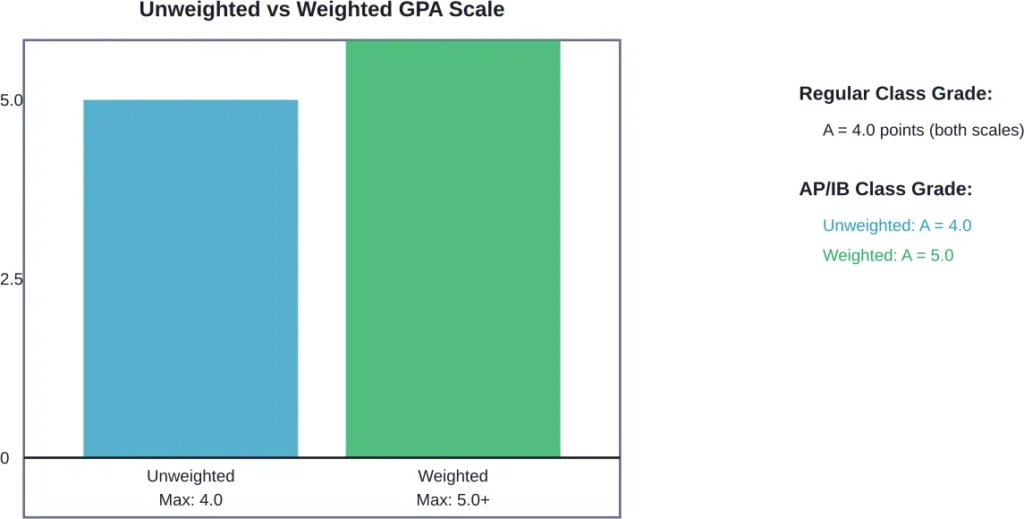
Most traditional grading operates on a 4.0 unweighted scale where an A equals 4.0 points, B equals 3.0, C equals 2.0, and so forth. Under this system, earning straight A’s results in a 4.0 GPA—the maximum possible.
But that’s not the whole story.
Weighted GPA Systems Change Everything
Weighted GPA scales award extra points for challenging coursework. Advanced Placement (AP), International Baccalaureate (IB), and honors classes typically receive bonus points.
In weighted systems, an A in an AP or IB class might be worth 5.0 points instead of 4.0. Some schools even award 4.5 points for honors courses. This creates the mathematical possibility of exceeding a 4.0 GPA.
However, not all schools weight grades the same way. According to research from the University of Chicago Consortium on School Research, high school GPAs remain strong predictors of college success regardless of the specific calculation method used.
When Is a 5.0 GPA Actually Possible?
Achieving a 5.0 GPA requires meeting specific conditions that aren’t available to every student.
High School Weighted Systems
Students can potentially reach a 5.0 GPA in high schools that use weighted grading and offer sufficient advanced courses. But there’s a catch—not every subject has an AP or IB equivalent, especially in freshman and sophomore years.
Even when advanced courses exist, maintaining perfect grades across an entirely AP/IB schedule is exceptionally challenging. The rigor of these courses means even high-achieving students occasionally earn B’s, which would lower the GPA below 5.0.
Real talk: most students who report weighted GPAs above 4.0 have mixed schedules containing some regular classes, making a perfect 5.0 rare.
College GPA Systems
According to MIT’s Registrar’s Office, the Massachusetts Institute of Technology calculates GPA on a 5.0 scale. In this system, an A equals 5.0 points, making a perfect 5.0 GPA theoretically achievable through straight A’s.
Stanford University uses a 4.3 scale where an A+ equals 4.3 points. Each institution designs its own grading framework.
| Institution Type | GPA Scale | Maximum GPA | 5.0 Possible? |
|---|---|---|---|
| Most High Schools (Unweighted) | 4.0 | 4.0 | No |
| High Schools (Weighted) | Varies (often 5.0) | 5.0+ | Yes, with all AP/IB |
| MIT | 5.0 | 5.0 | Yes, with straight A’s |
| Stanford | 4.3 | 4.3 | No |
| Most Colleges | 4.0 | 4.0 | No |
The Reality Check: Why 5.0 Is Extremely Rare
Community discussions on platforms like Reddit and College Confidential reveal that even students at schools offering weighted GPAs rarely achieve perfect 5.0s.
Several obstacles stand in the way:
- Limited AP/IB course availability in early high school years
- Required non-weighted courses (PE, health, certain electives)
- The immense difficulty of earning A’s in every advanced course
- School-specific caps on weighted GPA maximums
According to a dissertation examining South Carolina’s 5.0-scale weighted GPA system (the SC UGP GPA) for English placement at Florence-Darlington Technical College, the study analyzed outcomes to determine suitable cut scores for placement.
Sound familiar? That’s because grade distributions naturally create variation even among high-performing students.
Strategies to Maximize Your GPA
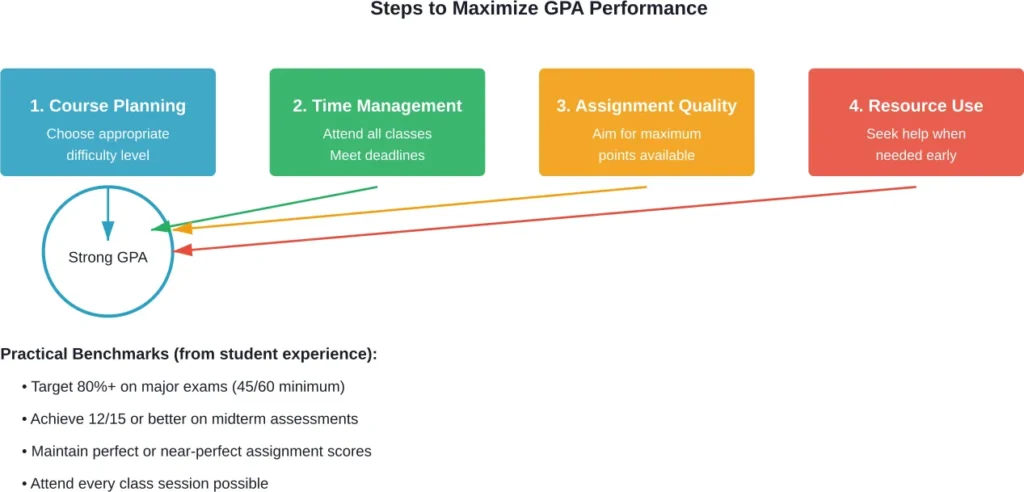
While achieving a perfect 5.0 might be unlikely or impossible depending on circumstances, students can take concrete steps to optimize their GPA.
Course Selection Strategy
Enrollment in advanced courses demonstrates academic rigor that colleges value. When schools offer weighted grading, AP and IB classes provide dual benefits—challenging curriculum and GPA boost potential.
But there’s a balance. Taking courses beyond capability can backfire if grades suffer. A B in an AP class (4.0 weighted) doesn’t help more than an A in a regular class (4.0 unweighted) at many schools.
Consistent Performance Matters Most
According to findings from the University of Chicago Consortium on School Research, students with GPAs of 3.75 or higher have around 80% college graduation rates, compared to around 20% for students with GPAs under 1.5.
The research emphasizes that incremental GPA increases correlate with improved college outcomes. This means consistent strong performance across all courses matters more than chasing a specific number.
What Actually Matters to Colleges
Now, this is where it gets interesting. Colleges don’t evaluate GPAs in isolation.
Admissions offices recalculate GPAs using their own methodologies. They examine course rigor, grade trends, and academic context. A 4.5 weighted GPA with challenging courses often impresses more than a 5.0 achieved through easier paths.
The University of Georgia’s admissions office explicitly states that different high schools have different weighting systems, so they focus on the transcript’s full story rather than a single number.
Georgia Tech’s admissions director explains that holistic review considers multiple factors beyond GPA—standardized test scores, extracurricular activities, essays, and recommendations all contribute to admission decisions.
Frequently Asked Questions
At most colleges, no—the standard scale maxes out at 4.0. However, MIT uses a 5.0 scale where straight A’s result in a 5.0 GPA. Each institution sets its own grading scale, so checking your specific college’s policy is essential.
This comparison only makes sense within the same grading system. A 4.0 on a 4.0 scale (perfect grades) equals a 5.0 on a 5.0 scale (also perfect grades). Colleges evaluate GPAs within the context of each school’s specific grading system.
Extremely rare. Even at schools offering weighted grading, achieving 5.0 requires taking exclusively AP/IB courses and earning straight A’s in every single class—a combination of circumstances and performance that few students accomplish.
Colleges typically recalculate GPAs using their own formulas and look at both numbers. Research from the University of Chicago Consortium on School Research found that high school GPAs are five times stronger than ACT scores at predicting college graduation.
Context matters enormously. Generally speaking, weighted GPAs above 4.0 indicate strong performance in advanced courses. However, colleges evaluate GPAs relative to available courses, school profile, and overall academic trajectory rather than absolute numbers.
It depends on the school’s weighting system. Some schools award 5.0 points for AP/IB courses but only 4.5 for honors classes. In such systems, a schedule exclusively of honors courses wouldn’t reach 5.0.
No. Colleges value academic rigor. A slightly lower GPA with challenging courses typically looks stronger than a perfect GPA from easy classes. Admissions offices examine both the numbers and the course difficulty when evaluating transcripts.
Final Thoughts
So is a 5.0 GPA possible? Yes, but only under specific circumstances—attending a school with weighted grading, having access to advanced courses in every subject, and maintaining perfect grades throughout.
That said, obsessing over reaching exactly 5.0 misses the bigger picture. Academic success comes from challenging oneself appropriately, maintaining consistent performance, and developing genuine knowledge rather than grade-chasing.
Focus on taking rigorous courses that match capabilities, earning the best grades possible, and building a well-rounded academic profile. Those factors matter far more to college admissions and future success than whether the final GPA number hits a specific threshold.
Check your school’s specific grading policies to understand what’s actually possible at your institution—and then concentrate on making the most of available opportunities.