

Quick Summary: Yes, twins can have different biological fathers through an extremely rare phenomenon called heteropaternal superfecundation, where two eggs released during the same menstrual cycle are fertilized by sperm from different men during separate acts of intercourse within a short timeframe.
The idea sounds like something from a medical drama, but it’s scientifically possible for twins to have different biological fathers. This rare occurrence challenges common assumptions about reproduction and genetics.
So how does this happen? And just how rare is it?
Understanding Heteropaternal Superfecundation
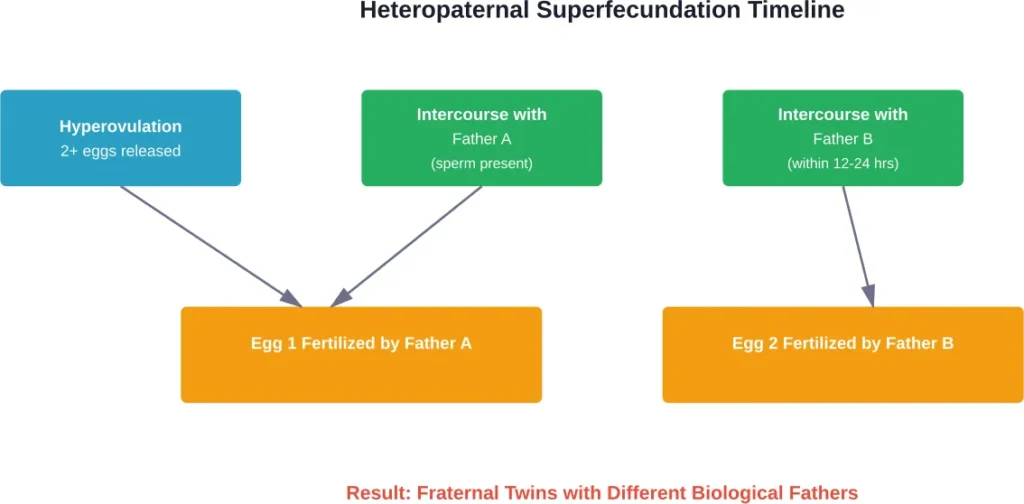
The medical term for twins with different fathers is heteropaternal superfecundation. According to research published in the journal Biomedica, this phenomenon occurs when a second egg released during the same menstrual cycle is fertilized by sperm cells from a different man in separate sexual intercourse.
Here’s the thing though—this requires very specific biological timing.
For heteropaternal superfecundation to occur, a woman must release multiple eggs during the same cycle (called hyperovulation). Research indicates that hyperovulation can occur in approximately 20% of women, though it’s often sporadic and unpredictable.
Each egg would then need to be fertilized by sperm from different men. That’s where timing becomes critical.
The Critical Window for Fertilization
Fertilization isn’t just about biology—it’s about timing. An ovulated egg remains available for fertilization for only 12-24 hours. Sperm, however, can survive in the fallopian tubes for up to five days.
This means a woman would need to have intercourse with two different men within a relatively narrow timeframe for both eggs to be fertilized by different fathers. The sperm from both men must be present when eggs are available.
How Rare Is This Phenomenon?
Heteropaternal superfecundation is extremely rare in humans. While research published by the National Center for Biotechnology Information confirms documented cases exist, the exact frequency remains difficult to determine.
One study estimated that it might occur in as many as one in 400 twin births in the US. Most cases are only discovered through paternity testing. In August 2018, the Grupo de Genética de Poblaciones e Identificación at the Instituto de Genética, Universidad Nacional de Colombia documented a case where DNA testing revealed twins had different fathers.
The testing involved amelogenin gene analysis, autosomal short tandem repeat (STR) analysis, and Y-STR analyses using human identification commercial kits. The paternity index calculation confirmed one man was the biological father of only one twin.
A case from Vietnam gained international attention when a father requested paternity testing and discovered he was the biological father to just one of his twins—the other twin was fathered by another man.
Fraternal vs. Identical Twins: Key Differences
Understanding heteropaternal superfecundation requires knowing how different twin types form.
| Twin Type | How They Form | Genetic Similarity | Different Fathers Possible? |
|---|---|---|---|
| Identical Twins | Single egg splits after fertilization | Nearly 100% identical DNA | No—same egg, same sperm |
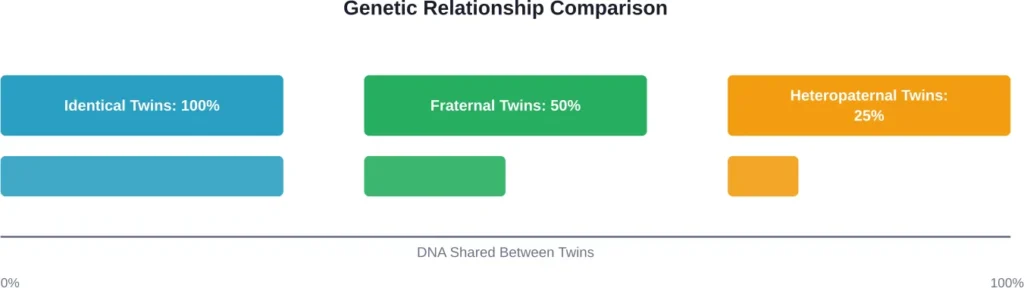
| Fraternal Twins | Two separate eggs fertilized by two sperm | 50% shared DNA (like siblings) | No—typically same father |
| Heteropaternal Twins | Two eggs fertilized by sperm from different men | 25% shared DNA (half-siblings) | Yes—different biological fathers |
Heteropaternal twins are technically fraternal twins, but they share approximately 25% of their segregating genes (compared to 50% for typical fraternal twins)—the same as half-siblings—rather than the typical genetic relationship of full fraternal twins.
Legal and Social Implications
Beyond the biological curiosity, heteropaternal superfecundation carries significant legal and social implications. PubMed research notes that advances in DNA analysis have made detecting such cases more frequent, which raises questions about paternity rights, child support obligations, and custody arrangements.
Forensic genetic testing has become valuable in identifying these cases. The testing methods used—including STR analysis and paternity index calculations—can definitively establish biological relationships.
But wait. There’s another layer here.
Many cases likely go undetected because families don’t request paternity testing unless there’s reason to question biological relationships. The twins may look different, but fraternal twins often do anyway.
Detection Through DNA Testing
The only definitive way to confirm heteropaternal superfecundation is through DNA paternity testing. Standard testing analyzes multiple genetic markers to establish biological relationships.
Testing typically examines autosomal STRs (short tandem repeats), which are highly variable regions of DNA inherited from both parents. Y-chromosome STR testing can also be performed for male children to trace paternal lineage.
The paternity index—a statistical measure—calculates the likelihood that a man is the biological father. In the Colombia case documented in Biomedica, one twin showed a paternity index of 2.5134E+7, indicating an extremely high probability of paternity, while the other twin showed no biological relationship to the tested father.
Frequently Asked Questions
No, identical twins cannot have different fathers. Identical twins form when a single fertilized egg splits, meaning they originate from one egg and one sperm—therefore, only one biological father is possible.
Heteropaternal superfecundation is extremely rare in humans. The exact frequency is unknown because most cases are only discovered through paternity testing, and many likely go undetected throughout the twins’ lives.
Heteropaternal twins share approximately 25% of their segregating genes (compared to 50% for typical fraternal twins), making them genetically equivalent to half-siblings rather than full siblings.
Yes, heteropaternal twins can look quite different from each other since they’re only half-siblings genetically. They may have different skin tones, facial features, hair textures, and other physical characteristics inherited from their different biological fathers.
Detection occurs through DNA paternity testing that analyzes genetic markers including autosomal short tandem repeats (STRs) and Y-chromosome STRs. Testing reveals that one alleged father is biologically related to only one twin, not both.
No, hyperovulation simply means releasing multiple eggs in one cycle—which occurs in approximately 20% of women. For heteropaternal superfecundation to occur, those eggs must be fertilized by sperm from different men during separate acts of intercourse within the narrow fertilization window.
Yes, multiple documented cases exist in medical literature. The National Center for Biotechnology Information has published case reports from Colombia, Vietnam, and other locations where DNA testing confirmed twins had different biological fathers.
The Bottom Line
Twins with different fathers aren’t just theoretically possible—they’re a documented biological reality, though exceedingly rare. Heteropaternal superfecundation requires the precise alignment of hyperovulation, specific timing of intercourse with different partners, and successful fertilization of separate eggs.
Advances in DNA testing have made identifying these cases easier, which may reveal that the phenomenon occurs more frequently than previously thought. The legal, social, and emotional implications remain complex.
If paternity questions arise regarding twins, professional DNA testing through accredited laboratories can provide definitive answers. Understanding the science helps remove stigma and supports informed decision-making for families navigating these unique circumstances.