
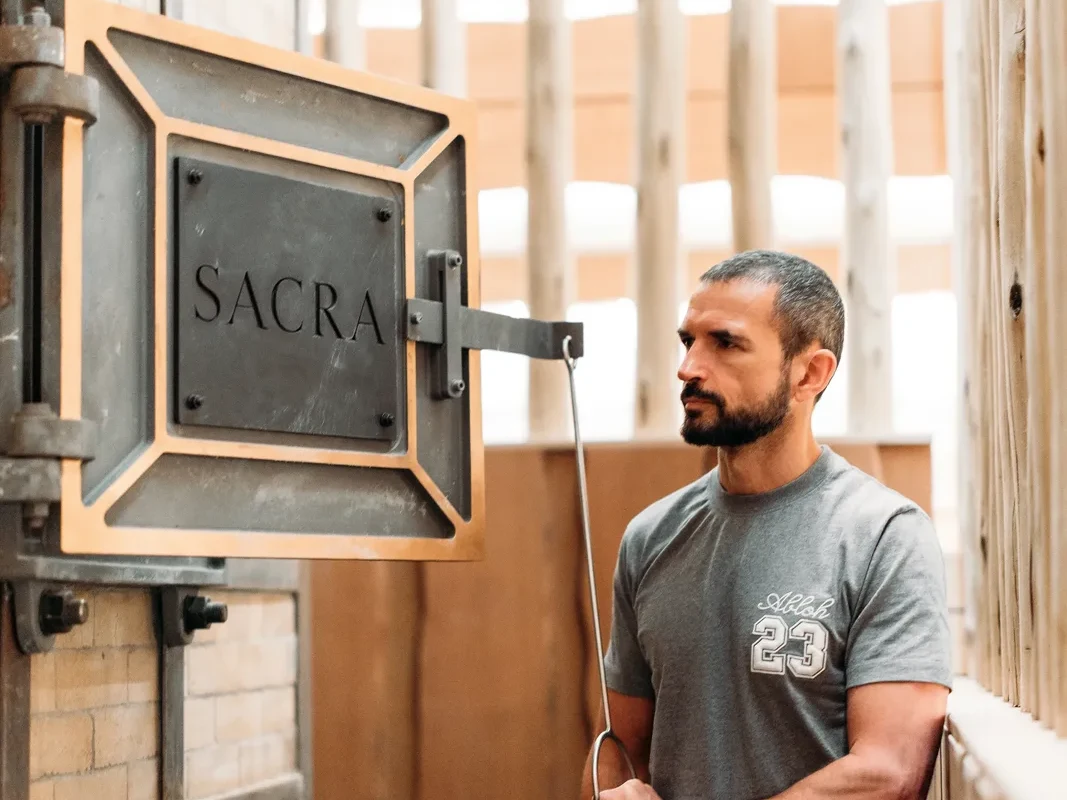
There comes a moment when a business turns into a philosophy, and creating lasting value becomes its main product. Alexander Orlov is an international entrepreneur who has built and grown several major hospitality holdings in different parts of the world. One of his key projects today is SACRA Global Baths & Wellness, an international platform that rethinks bathing and wellness culture for a new generation, with its flagship, SACRA Dubai, opening in the UAE. He talks about the cognitive biases of the premium segment, discipline in service and what true luxury really consists of.
Lara Palmer: Alexander, you once noted that only a handful of people actually succeed in business. Every month dozens of ambitious projects open in Dubai, and half a year later they quietly disappear. What fundamental illusion trips up people who have succeeded elsewhere when they enter the Emirati restaurant market?
Alexander Orlov: I think the most dangerous illusion is the belief that success in one country or industry automatically guarantees success in Dubai.
I have watched many talented entrepreneurs arrive here with strong brands, serious capital and impressive track records. But Dubai doesn’t reward what you did before. This market requires you to win the guest’s trust again, every single day.
Opening a beautiful venue simply isn’t enough. You are competing with the best establishments in the world. Guests here travel constantly and know the leading hotels, restaurants and wellness projects across the globe, so their expectations are far above average.
As I see it, the winners are those who build not just a business but a lasting culture around what they offer. That is exactly why at SACRA we are not building yet another spa complex or bathhouse. We are creating a place people will want to come back to for years — for a state of mind, for emotions, for the feeling of belonging to a community.
In the end, success in Dubai depends not on who you were yesterday, but on the value you create today.
L. P.: You hold a degree in clinical psychology from Moscow State University. Which cognitive bias among wealthy audiences is the most predictable, and how does that human weakness help monetise a premium experience?
A. O.: I wouldn’t call them weaknesses — they are patterns. Over the years in restaurants, hospitality and wellness, I have noticed something interesting. Whatever their income, status or country, people look for exactly the same things: emotion, recognition and the feeling that someone genuinely cares about them.
Many think the premium segment sells luxury. In fact, it sells attention to detail. A guest doesn’t pay extra for an expensive chair or a spectacular chandelier — they pay for the feeling that everything around them was made specifically for them.
That is why the world’s leading restaurants, clubs, hotels and wellness projects don’t compete on square metres or the size of the investment. They compete on the strength of the impression they leave. People forget what they ate and how much they spent, but they remember very clearly how they felt in your space. Every successful hospitality business is built on that.
L. P.: If you take intuition and luck out of the equation, what does the raw arithmetic of survival look like for a conceptual project such as BG Global SPA? What do romantic visionaries fail to see?
A. O.: Remove luck and intuition and you are left with simple arithmetic: value for the guest, economics and disciplined execution.
Romantics tend to fall in love with the idea. They create a beautiful concept, invest in the interior, write a brand story — and forget that a business only exists when the guest keeps coming back. In hospitality an impressive opening is never enough; you have to stay relevant after one year, five years, ten.
Any concept comes down to a few core questions. How often will a person return? What problem in their life are you solving? Do you have an advantage that can’t be copied quickly? And can the economics withstand not only the good times, but turbulent ones as well?
With BG Global SPA and SACRA, we look not at passing trends but at fundamental human needs. People will always need recovery, connection, health, good food and deep emotions. Fashions change; those needs remain.
L. P.: Is firmness in management a margin tool for you, or a form of armour? When has softness cost you dearly?
A. O.: Firmness is neither armour nor a way of protecting margins. It is responsibility — to the team, to the guests and to the business.
I have always been a fairly demanding leader, not because I like controlling people but because I know very clearly what the result should be. And that result has to be the best possible.
In hospitality there are no small things. Every day guests trust us with their time, their money and their expectations, so compromising on quality is completely unacceptable to me. The most expensive mistakes of my career were probably the times I was too lenient and kept people who didn’t share those standards for far too long. The team suffered, the product suffered and, most importantly, the guest suffered.
Over the years I have learned a simple truth: high standards are a form of respect — for the client, for the team and for the craft itself. My insistence on standards was never about firmness for its own sake. It has always been about doing the best work possible.
L. P.: You run a complex international organisation. People often say loyalty is a corporate myth and only a rigid KPI structure works. Which human flaw in an employee will you tolerate as long as they bring in revenue, and what means immediate dismissal?
A. O.: Honestly, character flaws bother me far less than indifference.
I can work with very ambitious people, with emotional, complicated, demanding people. Very often they are exactly the ones who drive a company forward.
What I find extremely hard is working with people who simply don’t care. Indifference may be the most dangerous failing in any business, because you can’t train it out of someone. Either a person cares about the result or they don’t.
In our company people have to care deeply about what they do — about how a guest feels, how the product is presented, what impression we leave. Outstanding projects grow out of that attitude.
Mistakes can be corrected. Lack of experience can be made up for with training. But if someone is indifferent to the result of their own work, sooner or later it starts to eat away at the culture of the whole team. So indifference is probably the only trait on which I am truly unwilling to compromise.
L. P.: Dubai has developed a very particular culture of consumption. How does that fit with your view that modern wellness should go beyond surface pleasures and offer something more lasting?
A. O.: I actually think Dubai is changing much faster than many people realise. Yes, the city loves impressions, novelty and an exceptional level of service. But more and more people here are starting to value quality of life alongside luxury. They are investing in health, longevity, emotional wellbeing and conscious recovery.
To me, modern luxury is no longer about displaying status. True luxury today is time, energy and health. That is why wellness has become one of the fastest-growing industries in the world.
SACRA is being created where these two movements meet. On one side, we understand what Dubai’s clientele expects in terms of service, design and guest experience. On the other, we offer not just pleasant leisure but practices that genuinely improve quality of life.
I am convinced the future of wellness lies not in an endless menu of new treatments, but in places where people can regularly recover — physically, emotionally and socially. That is the role we see for SACRA.
People don’t come back for beautiful interiors or fleeting trends; they come back for the state they are in after a visit. And that is the most valuable kind of luxury.
L. P.: With SACRA you are bringing high-end banya culture into a Middle Eastern setting. What is the commercial paradox of selling intense heat to people who live with 40°C as a matter of routine? What deeper need does the concept answer?
A. O.: At first sight it does look like a paradox. People naturally ask why anyone in Dubai would go to a bathhouse when it is scorching outside for most of the year.
But a banya was never about the air temperature. It is about controlled stress, adaptation and recovery. Enduring oppressive street heat and consciously going through a ritual of warmth, steam, cold and recovery are entirely different things.
What’s more, research shows that regular heat and contrast therapy helps the body adapt to high temperatures more efficiently. Thermoregulation improves, the body reacts faster to heat loads, and hot climates become far easier to tolerate. For a city like Dubai, that is especially relevant.
People in the Middle East understand the value of these practices very well — hammam culture has existed here for centuries. We are not bringing in something foreign to the region; we are offering a new interpretation of one of humanity’s oldest wellness traditions.
On a deeper level, SACRA answers not a need for heat but a need to reset. Modern people live in constant stimulation: notifications, meetings, flights, digital noise. The nervous system rarely gets a rest.
That is why we see such potential in contrast therapy. After a properly structured cycle of heat and cold, a person gets what is scarcest today: mental clarity, emotional resilience, physical recovery and a sense of inner calm.
I believe this will be the new luxury of the coming years. Not another restaurant or beach club, but places that help people feel better. SACRA is designed to be exactly that kind of place.
L. P.: Imagine an investor comes to you with a $10 million cheque and wants to enter Dubai’s hospitality sector. Which niche is a complete illusion and a guaranteed loss today, and where should smart money go?
A. O.: I would question the premise. In my career I have seen many projects that looked hopeless at the start become huge successes — and concepts that looked perfect on paper close within a few years.
So I don’t believe in bad ideas. I believe in the quality of execution.
Across our group there are more than 35 restaurants, clubs and hospitality concepts worldwide. That experience has taught us that understanding the guest, an obsessive attention to detail, an exceptional team and consistent execution of the vision over many years matter far more than the idea itself. With the right expertise, discipline and long-term thinking, almost any concept can be made to work.
Personally, what interests me most today are projects where hospitality, wellness, longevity and wellbeing meet. Not because it is fashionable, but because I see a fundamental change in the way people live. They are investing more and more in their health, quality of life, energy and longevity. I share that philosophy personally, I see its commercial potential as an entrepreneur, and I know demand for such projects will only grow.
L. P.: At your level, is the restaurant business mainly property development, experience direction or pure mathematics?
A. O.: At our level they can no longer be neatly separated. A successful hospitality project is development, experience direction and mathematics all at once. But if I had to pick one, I would say it is, above all, the creation of emotion.
A guest never remembers your financial model. They don’t see the operational processes or realise how complicated the execution was — they remember only how they felt.
At the same time, emotion can’t work without mathematics. The most breathtaking ventures in the world can fail if the economics don’t hold up over the years. And flawless economics rarely rescue a project that leaves people completely cold.
That is why I have always seen hospitality as a blend of art and discipline. On the one hand, we create the atmosphere, service, architecture, gastronomy and stories that become memories. On the other, behind every good impression there is an enormous amount of calculation, process and management.
Perhaps that is our main task: to give the guest a sense of complete ease while an extremely complex system runs behind the scenes. When someone leaves a restaurant, a club or a wellness complex and says, “I had a wonderful time,” that sentence is the direct result of the right mix of direction, development and mathematics.
L. P.: What can genuinely surprise a man whose profession is surprising the most discerning people on earth?
A. O.: It actually takes very little to surprise me. A strong concept can impress me, or talented architecture, an unusual approach to service, or simply someone who looks at familiar things from a new angle.
I study projects all over the world with real interest and try to stay open to new things. Curiosity is one of the most important qualities an entrepreneur can have. The moment you think you have seen and know everything, you stop growing.
That is why I still love travelling, discovering new concepts, meeting interesting people and looking for inspiration in very different fields — from gastronomy to art, design and wellness. If you stay open to the world, there are far more reasons to be amazed than it might seem.
L. P.: How do you keep a clear head and stay sharp when the business demands constant, aggressive expansion?
A. O.: The bigger a business becomes, the more important it is to look after your own state. I understood long ago that the quality of your decisions depends directly on the quality of your energy. You can be exceptionally smart, but if you are physically exhausted, emotionally overloaded and not recovering properly, sooner or later it shows in the business.
So today I treat my health as seriously as any company asset. Sport, physical training, meditation, periodic fasting, stress management — none of this is wellness for its own sake. These are precise tools that help me keep a clear mind and make decisions under pressure.
Contrast therapy and banya rituals hold a special place in my life. I prefer very intense heat sessions. For me it is one of the most effective ways to clear my head completely. After a proper steam, excess emotion, accumulated stress and digital noise literally leave you, and what remains is clarity and calm.
Incidentally, the same steam protocols I have practised for years will be available at SACRA. I should warn you, though: these programmes are not for beginners. They are for people who know banya culture well and are ready for genuinely intense physical work.
My formula is very simple: to run a large business, you first have to learn to manage your own state. Because the most important decisions are never made by numbers — they are made by people.