
Quick Summary: Yes, cavities can be reversed, but only in their earliest stage before the decay reaches the dentin. When tooth decay is caught early as enamel demineralization, the process can be stopped and reversed through remineralization using fluoride, proper oral hygiene, and dietary changes. Once a cavity has progressed beyond the enamel surface and created a hole, it requires professional dental treatment.
The question comes up constantly in dental offices: can you actually reverse a cavity? The answer isn’t a simple yes or no.
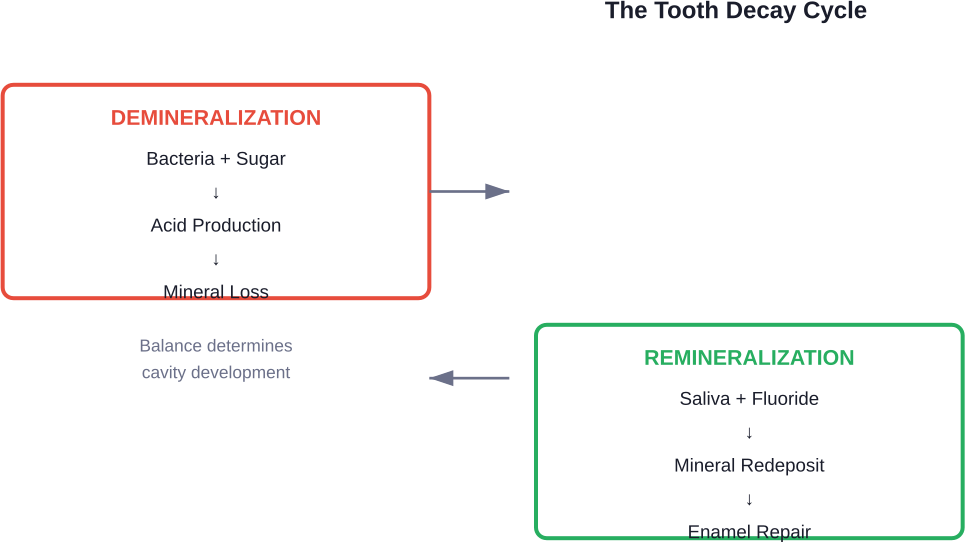
Here’s the thing—tooth decay is a dynamic process. It’s a constant battle between demineralization (mineral loss) and remineralization (mineral gain) happening in your mouth throughout the day. And when conditions are right, your teeth can actually win that battle.
But timing matters. A lot.
Understanding the Tooth Decay Process
According to the American Dental Association, dental caries is defined as a “biofilm-mediated, sugar-driven, multifactorial, dynamic disease that results in the phasic demineralization and remineralization of dental hard tissues.”
That’s a mouthful, but it tells us something critical: tooth decay isn’t just destruction. It’s a process that swings both ways.
Bacteria in the mouth produce acid when exposed to fermentable carbohydrates. That acid dissolves minerals from the tooth surface—calcium and phosphate primarily. When enough mineral is lost, the enamel weakens and a cavity begins to form.
But saliva naturally contains minerals that can be redeposited back into the tooth structure. This remineralization can repair early damage before a cavity actually forms.
When Cavities Can Be Reversed
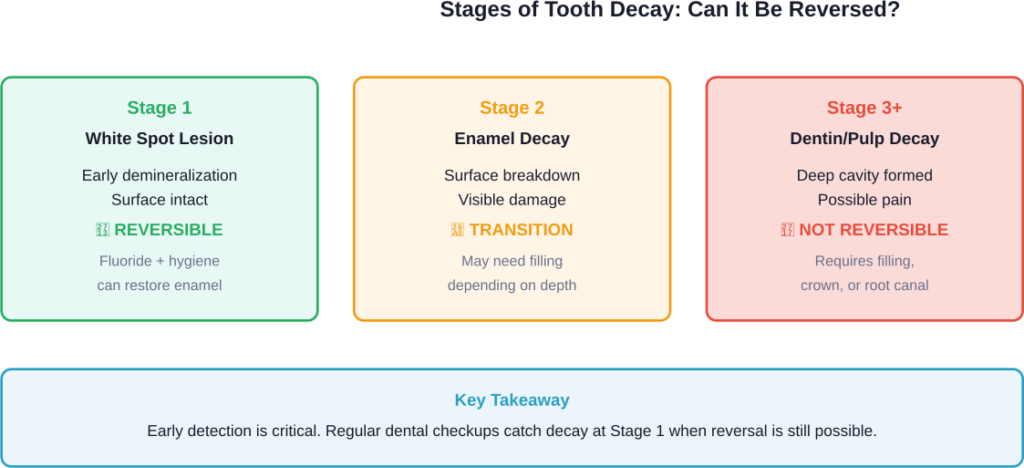
The window for reversal is narrow. Tooth decay must be caught at the initial demineralization stage—what dentists call a “white spot lesion.”
At this point, the enamel surface is still intact. No hole has formed. The area may appear chalky or white because minerals have been lost, but the tooth structure hasn’t collapsed.
Research indicates that remineralization can occur even in caries lesions extending into dentin, though shallow lesions respond better. The National Institute of Dental and Craniofacial Research (NIDCR) has identified remineralization as a key area for advancing novel therapies and treatments for dental structures.
According to the CDC, fluoride works to repair and prevent damage at this stage. It prevents mineral loss, replaces lost minerals, and reduces bacteria’s ability to produce acid. The CDC notes that fluoride can even reverse or stop early tooth decay.
The Critical Point of No Return
Once decay breaks through the enamel surface and reaches the dentin layer, natural remineralization can’t fix it. The damage is too extensive.
At that stage, bacterial infection has created a cavity—an actual hole in the tooth. Professional dental treatment becomes necessary. That typically means fillings, and potentially crowns or root canals if decay progresses further.
How to Reverse Early-Stage Tooth Decay
So what actually works to stop and reverse cavity formation when caught early?
Fluoride Treatment
Fluoride is the most evidence-based approach. According to competitor content, about 63% of Americans have access to fluoridated water. Drinking fluoridated water provides consistent low-level fluoride exposure throughout the day.
Professional fluoride treatments—varnishes, gels, and foams—deliver higher concentrations. The American Dental Association recommends these for people at risk of developing dental caries.
Fluoride toothpaste also helps. Research on remineralizing products has compared arginine-containing toothpaste formulations with sodium fluoride formulations for enamel recovery.
Silver Diamine Fluoride
The American Dental Association notes growing research interest in silver diamine fluoride (SDF) to arrest caries lesions. While SDF currently has FDA clearance for treating tooth sensitivity, it’s increasingly used off-label for caries arrest.
Research published through the University of Iowa found SDF effective in arresting initial approximal caries lesions in adults. The main drawback? Permanent black staining of arrested lesions. Biannual applications are recommended for sustained effectiveness.
Dietary Changes
Bacteria need sugar to produce acid. Reducing fermentable carbohydrate intake—particularly between meals—gives teeth more time in a neutral pH environment where remineralization can occur.
Some evidence suggests xylitol, a sugar substitute, doesn’t increase cavity-causing acids the way regular sugar does.
Proper Oral Hygiene
Brushing twice daily removes the bacterial biofilm before it produces significant acid. Flossing reaches areas where a toothbrush can’t.
But here’s what matters most: consistency. Sporadic brushing doesn’t shift the balance toward remineralization.
Saliva Stimulation
Saliva is the delivery mechanism for natural remineralization. It contains calcium and phosphate that can be redeposited into weakened enamel.
Research shows saliva has an inherent tendency to remineralize enamel. Staying hydrated, chewing sugar-free gum, and addressing dry mouth conditions all support this natural process.
When Professional Treatment Becomes Necessary
The old “drill and fill” approach doesn’t address the disease process itself—just the structural damage. That’s why the American Dental Association emphasizes caries risk assessment and management, not just restoration.
But once a cavity has formed, restoration is unavoidable. Composite fillings, glass ionomer materials, and in some cases crowns are used to restore tooth structure and function.
Ignoring cavities at this stage leads to deeper infection, potential abscess, and eventual tooth loss. Root canals or extractions become necessary when decay reaches the pulp.
Common Myths About Reversing Cavities
Oil pulling has gained attention as a natural remedy. Research does show coconut oil swishing for 20 minutes can reduce cavity-causing bacteria and help prevent gingivitis. But there’s no evidence it can reverse established decay.
Similarly, while calcium and vitamin D support overall tooth health, supplementation alone won’t remineralize teeth without topical fluoride exposure and proper oral hygiene.
Some emerging treatments like Curodont appear in discussions, but clinical evidence remains limited compared to fluoride-based approaches.
Prevention Beats Reversal
Real talk: preventing cavities in the first place is far easier than trying to reverse them.
That means brushing with fluoride toothpaste twice daily, flossing daily, limiting sugary snacks between meals, and seeing a dentist regularly for early detection.
The CDC data shows dental caries prevalence among children aged 12-17 declined from 90.4% in 1971-1974 to 67% in 1988-1991—largely due to widespread fluoride use and improved preventive care.
| Prevention Strategy | Mechanism | Evidence Level |
|---|---|---|
| Fluoride toothpaste | Promotes remineralization, reduces acid production | Strong (CDC, ADA) |
| Fluoridated water | Consistent low-level fluoride exposure | Strong (CDC) |
| Professional fluoride treatment | High-concentration mineral replacement | Strong (ADA) |
| Reduced sugar intake | Decreases acid production by bacteria | Moderate |
| Regular dental cleanings | Removes bacterial biofilm | Strong (standard of care) |
| Xylitol gum | Doesn’t feed cavity-causing bacteria | Moderate |
| Oil pulling | May reduce bacteria levels | Limited |
Frequently Asked Questions
No. Once decay has created an actual hole in the tooth by breaking through the enamel surface, it cannot be reversed naturally. The tooth structure has been lost and requires professional restoration with a filling or other dental work.
Remineralization of early white spot lesions typically takes several weeks to months with consistent fluoride exposure and proper oral hygiene. The exact timeline depends on the extent of demineralization and how well preventive measures are followed.
No. Brushing harder can actually damage enamel and gum tissue. Gentle brushing twice daily with fluoride toothpaste is more effective than aggressive brushing. The chemical action of fluoride matters more than mechanical force.
Research indicates fluoride remains the most evidence-based approach for remineralization. While natural substances are being explored, fluoride has the strongest clinical evidence for preventing and reversing early decay.
Dietary changes can stop the progression of early decay by reducing acid production, but diet alone typically won’t reverse demineralization. Fluoride exposure through toothpaste, water, or professional treatment is needed to actively rebuild enamel mineral content.
Not necessarily. White spots indicate early demineralization, but with proper fluoride use, good oral hygiene, and dietary changes, these lesions can remineralize and the tooth can be saved. Early detection and intervention are key.
According to the American Dental Association, silver diamine fluoride is effective at arresting caries lesions, but it causes permanent black staining of the treated areas. It’s particularly useful for patients who can’t tolerate traditional dental treatment, but cosmetic concerns limit its use on visible teeth.
The Bottom Line on Cavity Reversal
Cavities can be reversed—but only when caught at the earliest stage before structural damage occurs. The National Institute of Dental and Craniofacial Research continues to advance research on remineralization therapies, but fluoride remains the gold standard.
Early detection matters more than any treatment. Regular dental visits catch decay when it’s still reversible. Once a cavity forms, professional treatment is the only option.
If you suspect early tooth decay or notice white spots on teeth, schedule a dental exam. The difference between a reversible white spot lesion and an irreversible cavity might be just a few weeks.