
Quick Summary: Time travel to the future is not only possible but scientifically proven—astronauts aboard the International Space Station already experience it through time dilation. However, traveling backward in time remains theoretical, with solutions like closed timelike curves and wormholes permitted by Einstein’s general relativity but facing massive practical obstacles and paradoxes that physics has yet to resolve.
Time travel has captivated human imagination for over a century. From H.G. Wells’ The Time Machine to Doctor Who and Back to the Future, the idea of jumping backward or forward through time feels like pure fantasy.
But here’s the thing—physics doesn’t dismiss time travel as impossible. In fact, we’ve already proven one form of it exists.
The real question isn’t whether time travel is possible. It’s understanding which types are proven science and which remain theoretical puzzles that might never be solved. Let’s break down what modern physics actually tells us about traveling through time.
Time Travel to the Future: Already Happening
Traveling to the future sounds like science fiction, but it’s established scientific fact. Humans have already done it, and the physics behind it is rock-solid.
Time Dilation: The Proven Method
According to NASA, clocks on airplanes and satellites travel at different speeds than those on Earth. This isn’t a malfunction—it’s time dilation, a direct consequence of Einstein’s theory of special relativity.
Time moves slower when traveling at high speeds or in strong gravitational fields. An object moving near the speed of light experiences less time than a stationary observer. This means astronauts aboard the International Space Station age slightly slower than people on Earth.
The difference is minuscule—fractions of a second over months in orbit. But it’s measurable, real, and happens every single day.
Real talk: if someone could travel at 99.9% the speed of light for what feels like one year to them, they’d return to Earth to find decades or even centuries had passed. They’ve effectively traveled to Earth’s future.
GPS Satellites: Time Travel in Your Pocket
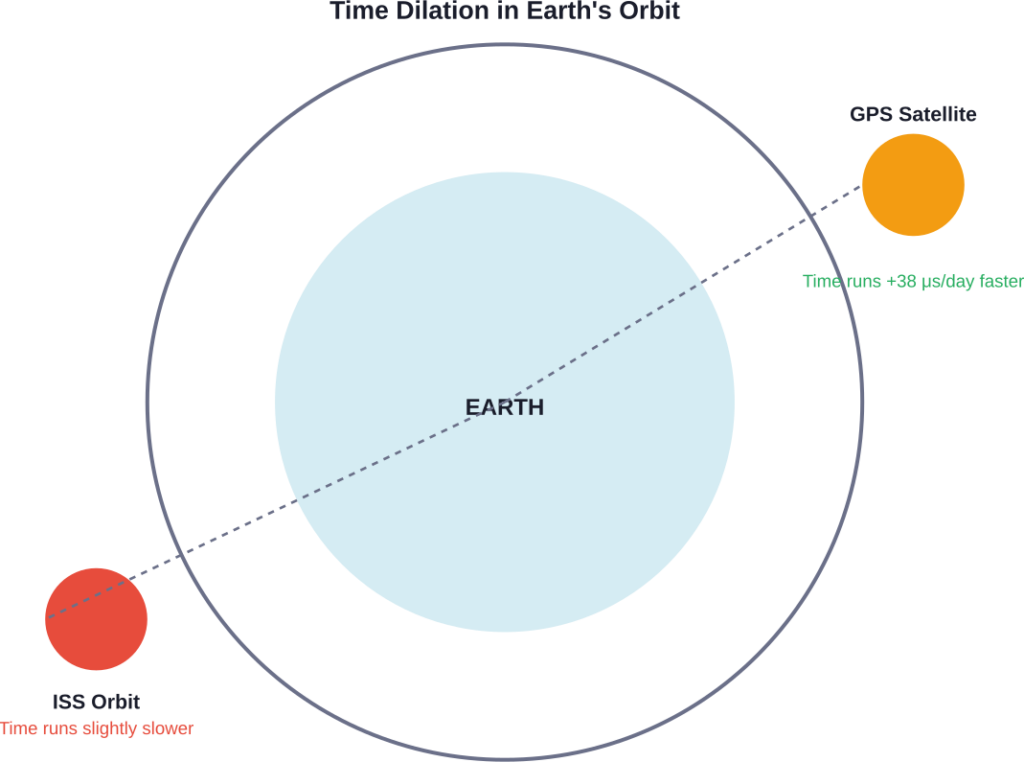
Global Positioning System satellites provide everyday proof of time travel. These satellites orbit roughly 20,000 kilometers above Earth, moving at high speeds and experiencing weaker gravity than ground-based clocks.
Both factors affect time. According to general relativity, weaker gravity makes time pass faster. According to special relativity, high orbital speeds make time pass slower. Engineers must account for both effects—otherwise, GPS coordinates would drift by kilometers within days.
The satellites’ atomic clocks experience time dilation effects that must be corrected for GPS accuracy, as described by NASA. That’s time travel, adjusted constantly to keep navigation systems accurate.
The Physics Behind Forward Time Travel
Why does time dilation happen? Einstein’s special relativity fundamentally changed how we understand time and space.
Einstein’s Revolutionary Insight
Before Einstein, people assumed time was absolute—one universal clock ticking the same for everyone, everywhere. Einstein proved that’s wrong.
Time and space are intertwined in a four-dimensional fabric called spacetime. Nothing can travel faster than light, which moves at roughly 300,000 kilometers per second. This cosmic speed limit has profound consequences.
When objects move at significant fractions of light speed, time literally slows down for them relative to stationary observers. This isn’t perception—clocks physically tick slower, particles decay slower, and aging slows down.
The faster something moves through space, the slower it moves through time. It’s a trade-off built into the structure of the universe.
General Relativity and Gravity’s Effect
Einstein’s general theory of relativity added another layer: gravity warps spacetime itself. Massive objects like planets and stars create curves in the fabric of spacetime, and these curves affect how time passes.
According to a University of Pittsburgh physics resource, gravity near a massive body slows down time. An observer close to a black hole’s event horizon would experience time much slower than someone far away. What feels like minutes near the black hole could be years for distant observers.
This effect is tiny on Earth but measurable. Clocks at sea level run slightly slower than clocks on mountaintops because they’re deeper in Earth’s gravitational well.
| Time Dilation Method | How It Works | Proven? | Practical Today? |
|---|---|---|---|
| High-Speed Travel | Moving near light speed slows time | Yes (particle accelerators) | No (requires enormous energy) |
| Strong Gravity | Massive objects slow nearby time | Yes (GPS satellites, lab tests) | Limited (only near massive bodies) |
| Cryogenic Freezing | Suspend biological processes | No (damages cells fatally) | No (science fiction only) |
Traveling Backward in Time: Theoretical Possibilities
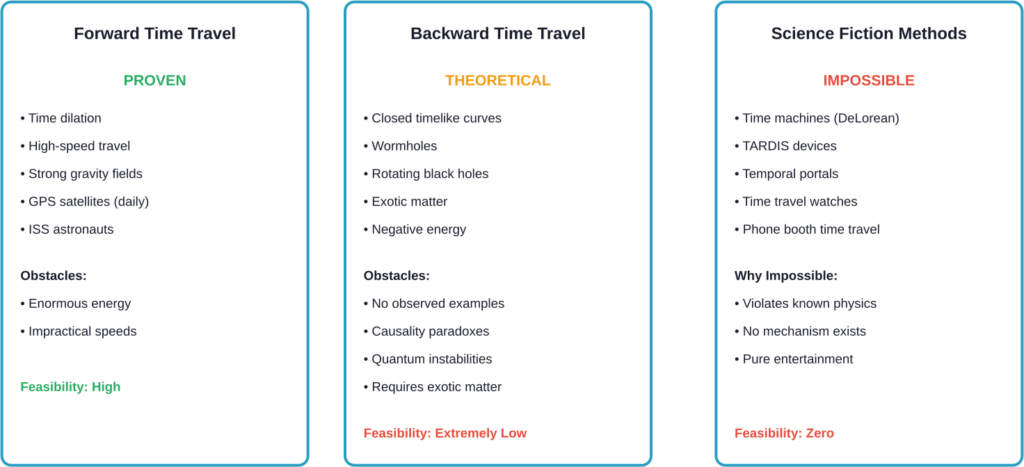
Forward time travel? Proven science. Backward time travel? That’s where things get weird.
General relativity doesn’t explicitly forbid traveling to the past. In fact, the equations allow for some exotic solutions that permit backward time travel. But whether these solutions represent physical reality remains hotly debated.
Closed Timelike Curves
According to research published on arXiv, general relativity permits solutions called closed timelike curves (CTCs). These are paths through spacetime that loop back on themselves—meaning an object could theoretically travel forward through time and arrive back at its starting point.
A paper by Barak Shoshany titled “Lectures on Faster-than-Light Travel and Time Travel” explores these concepts in depth. CTCs represent mathematical possibilities within Einstein’s equations, but creating one would require conditions that probably don’t exist in our universe.
What kind of conditions? Exotic matter with negative energy density, rotating black holes of immense proportions, or spacetime geometries that the universe doesn’t seem to produce naturally.
Just because the math allows something doesn’t mean nature does. As one Nature Physics article notes, these solutions test the boundaries between theoretical possibility and physical plausibility.
Wormholes: Shortcuts Through Spacetime
Wormholes are another theoretical solution from general relativity. Think of spacetime as a folded sheet of paper. A wormhole would be a tunnel connecting two distant points, creating a shortcut.
If one end of a wormhole moved at high speed (experiencing time dilation) while the other remained stationary, the two ends would experience time differently. Someone entering the stationary end might exit the moving end in the past—relative to the stationary reference frame.
Sound too good to be true? It probably is. Wormholes face enormous problems: they’d likely collapse instantly without exotic matter to prop them open, they’d require more energy than exists in observable galaxies, and quantum effects might destroy them before anything could pass through.
No one has ever observed a wormhole, and most physicists doubt traversable ones exist.
Rotating Black Holes and Kerr Solutions
Physicist Roy Kerr discovered that rotating black holes might create closed timelike curves in the spacetime around them. These “Kerr black holes” theoretically possess regions where time loops back on itself.
The catch? Getting to those regions would require passing through the black hole’s event horizon and surviving conditions that would tear apart atoms. Even if the math works, the physics appears insurmountably hostile to actual time travelers.
The Paradox Problem
Even if backward time travel were physically possible, it creates logical nightmares that might make it impossible anyway.
The Grandfather Paradox
This is the classic time travel paradox, explored in Nature publications and countless physics papers. Imagine traveling back in time and preventing your grandparents from meeting. If they never meet, your parents aren’t born. If your parents aren’t born, you don’t exist. But if you don’t exist, you can’t travel back to prevent their meeting.
It’s a logical loop with no consistent resolution. According to arXiv research on paradoxes of time travel by S. Krasnikov, these scenarios reveal deep tensions between general relativity (which permits CTCs) and causality (which demands consistent cause-and-effect sequences).
The Novikov Self-Consistency Principle
Physicist Igor Novikov proposed one solution: the self-consistency principle. This idea suggests that even if time travel to the past were possible, events would always conspire to prevent paradoxes.
Tried to stop your grandparents from meeting? You’d fail. Every attempt would somehow result in them meeting anyway. The universe would enforce logical consistency.
This principle is mathematically elegant but philosophically troubling. It implies a universe where free will might be an illusion, at least for time travelers. A paper on arXiv titled “Reversible time travel with freedom of choice” by Baumeler, Costa, Ralph, Wolf, and Zych explores whether time travel and genuine choice can coexist.
Many-Worlds Interpretation
Another proposed solution comes from quantum mechanics: the many-worlds interpretation. Perhaps when traveling to the past, time travelers enter a parallel universe instead of their own past.
Prevent your grandparents from meeting? No problem—it happens in an alternate timeline. Your original timeline remains unchanged, and paradoxes vanish.
This interpretation is controversial and unproven. It solves logical problems by multiplying universes, which many physicists find unsatisfying.
Why We Probably Can’t Build a Time Machine
Even setting aside paradoxes, the practical obstacles to building a time machine are staggering.
The Exotic Matter Problem
Most theoretical time travel mechanisms require exotic matter—substances with negative energy density. According to physics as we understand it, such matter probably doesn’t exist in usable quantities.
Some quantum field theory effects produce tiny amounts of negative energy (the Casimir effect), but scaling these to macroscopic levels appears impossible. Wormholes, Alcubierre drives, and other speculative technologies all founder on this requirement.
Energy Requirements
Accelerating objects to near-light speed requires ridiculous amounts of energy. To accelerate a single kilogram to 99% light speed would consume energy equivalent to thousands of nuclear bombs.
Bending spacetime significantly would require energies comparable to stars or galaxies. These aren’t engineering challenges—they’re fundamental limits imposed by physics.
Chronology Protection Conjecture
Physicist Stephen Hawking proposed the chronology protection conjecture: the laws of physics conspire to prevent time travel to the past, protecting history from time travelers.
Hawking suggested that quantum effects would destroy any potential time machine just before it became operational. Vacuum fluctuations near CTCs would grow without bound, creating destructive energy densities.
This remains unproven but provides a potential answer to why we haven’t encountered time travelers from the future.
Recent Developments and Research
Physics research on time travel continues, though most focuses on theoretical edge cases rather than practical devices.
Minkowskian Time-Travel Spacetimes
A December 2024 paper on arXiv by John D. Norton describes “A Simple Minkowskian Time-Travel Spacetime.” This relativistic model allows observers following timelike geodesics to eventually encounter their past selves, aging in opposite time directions.
The spacetime is everywhere metrically flat except for a conical singularity. While mathematically interesting, it doesn’t suggest a practical path to building time machines.
Quantum Mechanics and Time Travel
Some researchers explore whether quantum mechanics permits types of time travel forbidden by classical physics. Quantum teleportation and entanglement display strange temporal properties, though nothing resembling science fiction time travel.
According to research in quantum mechanics on time travel scenarios referenced by Nature Physics, closed timelike curves in quantum mechanics could theoretically allow violations of uncertainty principles. However, these remain highly speculative mathematical explorations.
Time Travel in Everyday Life
While dramatic time travel remains science fiction, subtle time effects appear in daily technology and experience.
GPS systems compensate for relativistic time dilation every moment. Particle accelerators routinely observe time dilation when subatomic particles traveling near light speed decay slower than stationary counterparts.
Muons created by cosmic rays in the upper atmosphere shouldn’t reach Earth’s surface—their half-lives are too short. But time dilation from their high speeds extends their lifespans enough that many survive the journey. That’s observable time travel happening constantly overhead.
What Scientists Actually Think
Community discussions and expert opinions on time travel tend toward skepticism about backward travel but acceptance of forward travel’s reality.
Most physicists acknowledge that general relativity permits some exotic solutions involving backward time travel. But they emphasize that mathematical possibility doesn’t equal physical reality.
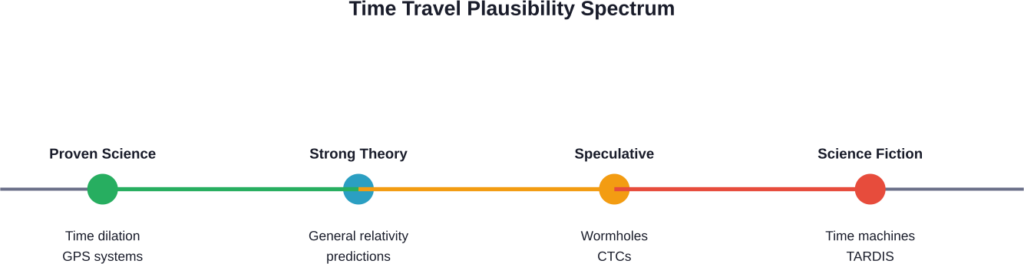
Practical consensus: forward time travel via time dilation is proven science. Backward time travel remains highly speculative, facing enormous obstacles that might be insurmountable. Building an actual time machine appears far beyond human technological capability and possibly prohibited by physics itself.
Frequently Asked Questions
Yes, but only forward time travel is proven. Time dilation allows moving into the future by traveling at high speeds or near massive objects. Astronauts aboard the International Space Station experience measurable time travel—they age slightly slower than people on Earth. Backward time travel remains theoretical with no practical mechanism demonstrated.
Every astronaut who’s orbited Earth has technically time traveled to the future by fractions of a second due to time dilation. Astronauts who have spent extended time in orbit experience measurable time dilation effects, aging fractions of a second less than people on Earth. It’s tiny, but it’s real, measurable time travel.
Backward time travel faces multiple obstacles: it requires exotic matter with negative energy that probably doesn’t exist, demands astronomical energy levels, creates logical paradoxes like the grandfather paradox, and might be prevented by quantum effects that destroy potential time machines. Stephen Hawking’s chronology protection conjecture suggests physics itself forbids backward time travel.
Closed timelike curves are mathematical solutions in general relativity where paths through spacetime loop back on themselves, theoretically allowing travel to one’s own past. Research published on arXiv demonstrates these are mathematically consistent with Einstein’s equations but require extreme conditions—like exotic matter or rotating black holes—that probably don’t exist in forms useful for time travel.
Theoretically yes, but practically no. Wormholes are solutions to Einstein’s equations that could connect distant points in spacetime. If one end experienced time dilation while the other didn’t, passing through might allow time travel. However, wormholes would likely collapse instantly, require exotic matter to stay open, need more energy than galaxies contain, and have never been observed in nature.
Quantum mechanics adds strange wrinkles to time travel discussions. Some research explores whether quantum effects might permit time travel scenarios forbidden in classical physics. According to papers in Nature Physics, closed timelike curves in quantum systems could theoretically violate uncertainty principles. But these remain highly speculative mathematical explorations with no experimental validation or practical applications.
Proposed by physicist Igor Novikov, this principle suggests that even if time travel to the past were possible, events would always arrange themselves to prevent paradoxes. Any attempt to change the past would fail because the universe enforces logical consistency. It’s an elegant solution to time travel paradoxes but raises philosophical questions about free will and determinism.
The Bottom Line on Time Travel
So is time travel possible? The answer depends entirely on which direction we’re talking about.
Forward time travel is not only possible—it’s proven science. We’ve measured it, tested it, and built technology around it. Astronauts do it. Satellites require constant corrections because of it. The physics is settled.
Travel fast enough or get close enough to extreme gravity, and time slows down for the traveler relative to everyone else. Want to reach Earth’s distant future? Build a ship that travels near light speed. The engineering is impossible with current technology, but the physics works.
Backward time travel sits in a different category entirely. Einstein’s equations permit some theoretical solutions—closed timelike curves, traversable wormholes, rotating black hole interiors. But every mechanism faces crushing practical obstacles and potentially insurmountable paradoxes.
Most physicists suspect that if backward time travel were possible, we’d already know. The absence of time travelers from the future suggests either they can’t exist or they’re remarkably good at staying hidden.
The universe appears to have a one-way arrow of time built into its fundamental structure. Entropy increases, causes precede effects, and the past stays stubbornly unchangeable.
That might sound disappointing if you were hoping to visit ancient Rome or correct past mistakes. But forward time travel remains genuinely possible—we’re all doing it right now, one second per second, and physics offers legitimate ways to speed up the journey.
For now, that’s as close to a time machine as science can deliver. And honestly? It’s still pretty extraordinary.