

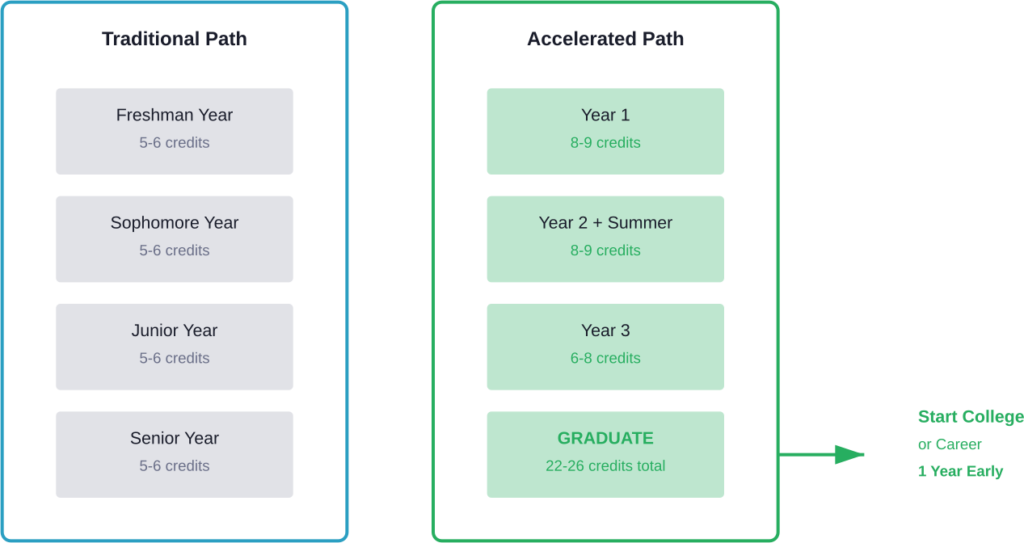
Quick Summary: Yes, it’s entirely possible to graduate high school early by earning credits faster through online classes, summer courses, dual enrollment, or AP exams. Most U.S. high schools require 20-26 credits to graduate, and motivated students can accelerate their timeline by completing requirements in 2-3 years instead of the traditional four.
The traditional four-year high school path isn’t the only option anymore. For motivated students ready to start college, launch careers, or simply move forward faster, early graduation has become an increasingly viable choice.
But here’s the thing—graduating early isn’t as simple as taking more classes. It requires strategic planning, understanding your state’s requirements, and weighing some serious trade-offs. So what does early graduation actually involve, and is it the right move?
What Does Early Graduation Mean?
Early graduation means completing all required high school credits and meeting graduation requirements before the traditional four-year timeline. Some students finish in three years, while exceptionally motivated learners graduate in two or even two-and-a-half years.
According to research published in Gifted Child Today (Plucker et al., 2022), state and local support for academic acceleration has expanded opportunities for students with advanced learning needs to move through education at a pace matching their abilities. These students can complete graduation requirements early and either continue with additional coursework or transition to postsecondary education.
Most U.S. high schools require between 20 and 26 credits for graduation, though state requirements vary significantly. Each full-year course typically earns one credit. For example, Alabama requires 24 total credits including 4 each in English, math, science, and social studies, while Alaska requires 21 credits with 4 in English.
How Students Accelerate Their Timeline
Several proven methods allow students to earn credits faster and graduate ahead of schedule.
Online and Summer Courses
Taking classes during summer breaks or through online platforms creates opportunities to double up on credits. Programs like U.S. Career Institute offer self-paced online high school options that accept up to 75% of previous high school credits, allowing students to complete remaining requirements on an accelerated schedule.
Online courses provide flexibility that traditional school schedules can’t match. Students work through material at their own pace, potentially completing a semester’s worth of content in weeks rather than months.
Dual Enrollment Programs
Dual enrollment lets high school students take college courses that count toward both high school graduation and college degree requirements. This approach doesn’t just accelerate high school completion—it provides a head start on postsecondary education.
Research on early college high school models shows these programs address multiple barriers students face: academic preparation, financial costs, and cultural adjustment to college environments. By merging high school and college systems, students gain simultaneous progress on both fronts.
Advanced Placement and Testing Out
AP courses and proficiency exams allow students to demonstrate mastery without sitting through traditional class time. Many schools accept these credits toward graduation requirements, though policies vary by institution.
Academic acceleration through these methods has shown no negative long-term effects on well-being, according to longitudinal research from Vanderbilt University’s Study of Mathematically Precocious Youth. The longitudinal study looked at 1,636 participants from three SMPY cohorts identified between 1972 and 1983 and surveyed again at age 50, finding that grade-skipping, early graduation, and advanced placement methods didn’t harm long-term outcomes.
Step-by-Step Planning Process
Strategic planning separates students who successfully graduate early from those who get overwhelmed trying.
Calculate Your Credit Requirements
Start by determining exactly how many credits your school and state require. Check your student handbook or meet with an academic advisor to get specific numbers for each subject area.
For example, a school requiring 21 total credits might break down to: 4 English, 4 math, 3 science, 3 social studies, 2 foreign language, 1 PE, 1 arts, and 3 electives. Calculate how many credits you’ve already earned and how many remain.
Map Your Course Schedule
Create a detailed timeline showing when you’ll complete each remaining requirement. Consider which courses have prerequisites and which can be taken simultaneously or during summer.
A student with 10 credits after freshman year who needs 21 total credits must earn 11 more credits across two years—meaning roughly 5-6 credits per remaining year plus summer courses. That’s an aggressive but achievable pace.
Verify College Admission Requirements
Here’s where many students hit a snag. State minimum graduation requirements often fall short of what competitive colleges expect. California’s minimum requirements might suffice for a diploma, but selective universities want to see four years of core academics.
Research admission requirements for your target colleges before committing to an early graduation plan. Some students discover that staying for senior year to complete additional coursework serves their college goals better than graduating a year early.
Get Approval and Support
Most schools require formal approval for early graduation plans. Schedule meetings with counselors, administrators, and parents to discuss your goals and secure necessary permissions.
According to a Jobs for the Future policy brief, many states have long allowed high-achieving students to skip senior year, with a growing number now offering financial rewards for fast-track completion.
Real Benefits of Early Graduation
Why do students choose to accelerate? The motivations vary, but several clear advantages emerge.
| Benefit | Description | Best For |
|---|---|---|
| Time Savings | Start college or career one year earlier | Goal-oriented students |
| Cost Reduction | Save one year of education expenses | Budget-conscious families |
| Academic Challenge | Maintain engagement through accelerated pace | Advanced learners |
| Career Head Start | Enter workforce or training programs sooner | Career-focused students |
| College Credit | Dual enrollment provides college credits | College-bound students |
Financial savings represent a significant draw. Graduating a year early eliminates expenses associated with senior year and allows students to begin earning income or college credits sooner.
For academically advanced students, early graduation prevents boredom and maintains intellectual engagement. Research from the University of Chicago Education Lab shows that intensive, personalized ‘high-dosage’ tutoring (daily 45-50 minute sessions) can double or triple student math learning annually—early graduation extends this principle to overall high school completion.
Potential Drawbacks to Consider
Early graduation isn’t universally beneficial. Several legitimate concerns deserve consideration.
Social and Developmental Impact
High school provides more than academics. Students miss social experiences, extracurricular activities, leadership opportunities, and developmental milestones when they graduate early.
Senior year traditions—prom, senior activities, final athletic seasons—become unavailable. For students who value these experiences, the trade-off may not justify the time savings.
College Readiness Questions
Younger college students face unique challenges. Maturity gaps become more apparent in college environments where independence and self-management determine success.
Some colleges view early graduation skeptically, particularly when transcripts show minimum requirements rather than academic depth. A thin senior year schedule might raise questions about academic rigor.
Limited Course Selection
Accelerated timelines sometimes force students to prioritize graduation requirements over interesting electives or advanced courses that would strengthen college applications. The pressure to accumulate credits quickly can narrow educational experiences.
Is Early Graduation Right for You?
Not every student benefits from early graduation. The decision depends on individual circumstances, goals, and priorities.
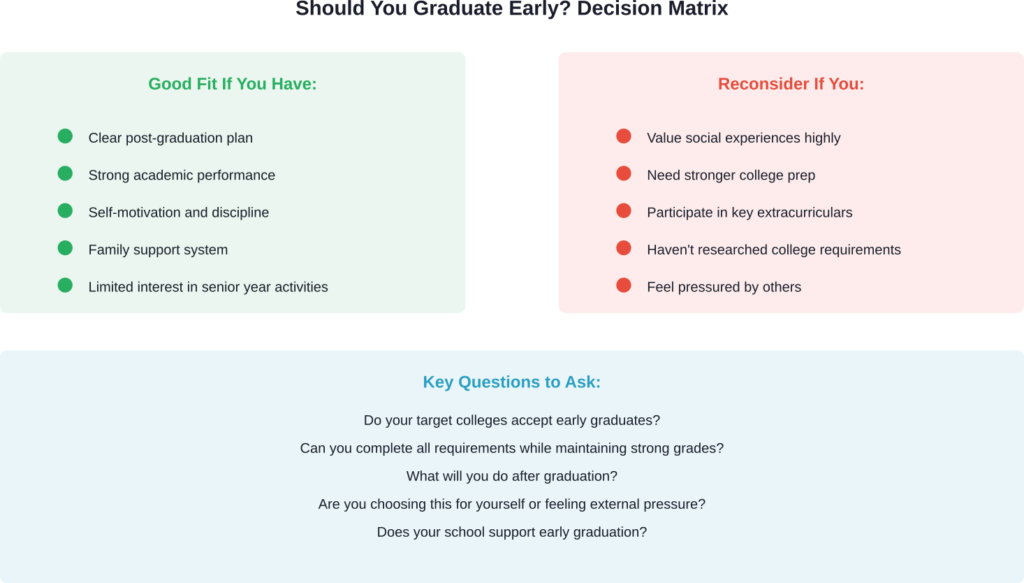
Strong candidates for early graduation typically demonstrate exceptional academic performance, clear post-graduation plans, strong self-motivation, and supportive family situations. They view high school primarily as an academic stepping stone rather than a comprehensive social experience.
Students who thrive in traditional school environments, value social connections and extracurriculars, or lack specific post-graduation plans may find staying for the full four years more beneficial. There’s no shame in taking the traditional path—most successful people do exactly that.
Frequently Asked Questions
Credit requirements vary by state and school district, but most U.S. high schools require 20-26 total credits for graduation. Early graduates must earn the same total number of credits as traditional students—they simply complete them in less time through summer courses, online classes, or increased course loads during the school year.
Yes, online high school programs offer flexible, self-paced learning that allows students to complete coursework faster than traditional classroom schedules. Programs like U.S. Career Institute accept up to 75% of previous high school credits and let students work through remaining requirements at their own pace, potentially shaving months or years off graduation timelines.
Selective colleges evaluate early graduates carefully. They want to ensure students took rigorous courses and met admission requirements—not just minimum graduation standards. Strong early graduates who take advanced courses and demonstrate college readiness face no disadvantages. However, thin transcripts showing only minimum requirements may raise concerns about academic preparation.
Early graduation means missing social experiences, extracurricular activities, leadership opportunities, and senior year traditions. Younger college students may face maturity challenges in independent college environments. The accelerated pace can also limit opportunities to take interesting electives or develop deeper expertise in subjects. Financial aid calculations may be affected since some scholarships target traditional-age students.
Generally speaking, schools cannot force students to graduate early against their will. Community discussions indicate that even when students accumulate excess credits, they retain the right to remain enrolled through their expected graduation year. However, specific policies vary by district, and students facing pressure to graduate early should consult with counselors and review district policies carefully.
No federal law sets a minimum age for high school graduation. Students who meet all credit and testing requirements can graduate regardless of age. Some exceptionally advanced learners graduate at 14 or 15, though this remains rare. State policies and individual school districts may set age guidelines, and colleges typically have minimum age requirements for enrollment that affect extremely young graduates.
Boredom alone isn’t sufficient justification for early graduation. First explore other options: advanced courses, dual enrollment that provides college credit while maintaining high school enrollment, independent study projects, or increased involvement in extracurriculars. If these options don’t address the issue and you have clear post-graduation plans, early graduation becomes more compelling. But make sure the decision stems from genuine readiness rather than temporary frustration.
Making Your Decision
Early high school graduation represents a significant decision with lasting implications. It’s absolutely possible—thousands of students do it successfully each year—but possibility doesn’t equal advisability for every individual.
The students who benefit most combine academic readiness with clear goals and realistic understanding of trade-offs. They plan strategically, secure necessary support, and make the choice for themselves rather than external pressure.
If early graduation aligns with your circumstances and aspirations, start by calculating credit requirements, mapping a realistic schedule, and discussing your plan with counselors and family. Research your target colleges’ expectations and verify that early graduation supports rather than hinders your long-term goals.
But if you’re uncertain, there’s wisdom in taking the traditional path. High school only happens once. The experiences and development that occur during those years have value beyond credit accumulation. Sometimes the best acceleration means diving deeper into subjects you love rather than racing through requirements.
Ready to explore early graduation options? Connect with your school counselor to discuss your specific situation and develop a customized plan that balances academic acceleration with your broader educational goals.