

Quick Summary: Humans cannot walk on ordinary water due to insufficient surface tension and low leg speed capabilities. However, basilisk lizards achieve water running through rapid leg movements that create air cavities and generate vertical force. Humans can walk on non-Newtonian fluids like cornstarch mixtures that solidify under impact, demonstrating the physics is possible with the right medium.
Walking on water sounds like something from mythology or superhuman feats. But the question isn’t just philosophical—it’s rooted in physics, biology, and material science.
Some animals actually do it. And under specific conditions, humans can too.
The Physics of Surface Tension
Water has a property called surface tension that creates a thin “skin” on its surface. According to the U.S. Geological Survey, surface tension allows lightweight objects to float even when they’re denser than water—like a paper clip resting on the surface.
But here’s the catch: surface tension only works for extremely light objects relative to their surface area. A human weighing 150-200 pounds exerts far too much force per square inch for water’s surface tension to provide any support.
The forces involved simply don’t scale up to human body mass. Water molecules can’t bond strongly enough to hold anything heavier than insects or small spiders.
How Basilisk Lizards Actually Walk on Water
The basilisk lizard—sometimes called the “Jesus Christ lizard”—genuinely runs across water surfaces. Research published in the Proceedings of the National Academy of Sciences reveals the biomechanics behind this remarkable ability.
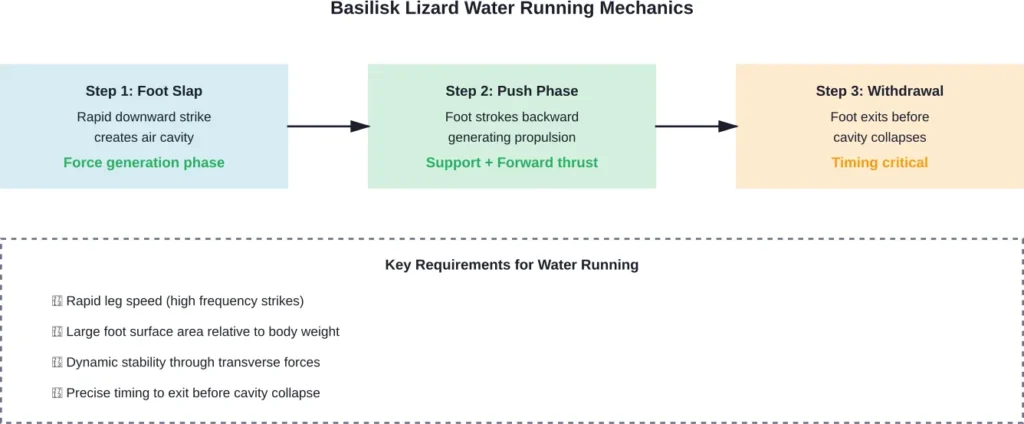
Juvenile basilisk lizards generate support through three-dimensional force production. According to studies from Harvard University’s Department of Organismic and Evolutionary Biology, these lizards create downward vertical force by slapping their feet against the water surface at high speed.
The mechanics work like this: when the lizard’s foot strikes water, it creates an air cavity. As the foot pushes down and then strokes backward, it generates both upward support force and forward propulsion before the cavity collapses.
Digital particle image velocimetry studies show that basilisk lizards produce sufficient support force during water running, with greatest forces generated during the first half of the step. These transverse forces help stabilize the animal dynamically during water running.
Can Humans Walk on Water?
The short answer? Not on regular water.
Some researchers have explored whether humans could theoretically train themselves to “float walk” since people can float on their backs. But floating and walking involve completely different physics.
Floating relies on buoyancy—displacing water equal to body weight. Walking requires generating downward force against a surface, which regular water can’t resist at human scales.
Research published in Nature examining underwater walking shows that humans can modulate muscle synergies when walking underwater. According to the study, the nervous system finely tunes basic locomotor muscle synergies used in land walking to meet biomechanical requirements in water environments.
But that’s walking under water with feet on the bottom—not walking on water’s surface.
The Non-Newtonian Fluid Solution
Here’s where things get interesting. Humans can walk on certain fluids that aren’t pure water.
Non-Newtonian fluids change viscosity based on applied force. A mixture of cornstarch and water—commonly demonstrated in science videos—behaves like a liquid when undisturbed but solidifies momentarily under rapid impact.
When someone runs across a pool filled with cornstarch mixture, their feet strike the surface fast enough that the fluid temporarily acts like a solid. The key is continuous rapid movement—stop moving, and the person sinks.
This demonstrates that the physics of walking on liquid surfaces is possible. It just requires the right fluid properties and sufficient speed.
| Surface Type | Human Walking Possible? | Key Limiting Factor | Force Required |
|---|---|---|---|
| Pure Water | No | Insufficient surface tension | ~150 lbs vertical support |
| Cornstarch Mixture | Yes (with speed) | Must maintain rapid movement | High-speed impact force |
| Underwater (on bottom) | Yes | Requires solid substrate | Reduced by buoyancy |
| Ice | Yes | Must be frozen solid | Normal walking force |
The Speed and Scale Problem
Even if humans had webbed feet and optimal technique, the speed required makes water walking impractical for people.
Basilisk lizards weigh just a few ounces and can move their legs at extraordinary frequencies relative to their body size. Scaling this up to human dimensions creates insurmountable challenges.
A person would need to strike the water surface with enough speed and force to generate upward reaction force exceeding body weight—while simultaneously maintaining forward momentum and dynamic stability.
The energy expenditure would be astronomical. And one misstep means immediate submersion.

Frequently Asked Questions
Humans cannot walk on regular water due to body weight exceeding water’s surface tension and inability to generate sufficient leg speed. However, humans can walk on non-Newtonian fluids like cornstarch mixtures when moving rapidly.
According to research from Harvard University published in the Proceedings of the National Academy of Sciences, basilisk lizards create air cavities with rapid foot slaps and generate vertical support force before the cavities collapse. They produce support force during the downward stroke phase.
Surface tension is the cohesive force between water molecules that creates a thin elastic “skin” on water’s surface. According to the U.S. Geological Survey, surface tension can support lightweight objects like paper clips but cannot generate enough upward force to support human body weight.
Non-Newtonian fluids change viscosity based on applied stress. Cornstarch mixed with water acts liquid when undisturbed but temporarily solidifies under rapid impact, allowing people to run across the surface if they maintain constant rapid movement.
While exact calculations vary, a human would need to strike the water surface with enough speed to generate upward reaction force exceeding 150-200 pounds while maintaining forward momentum. The energy expenditure and leg speed required are beyond human physiological capabilities on regular water.
Water striders and some spiders use surface tension because they’re extremely lightweight. Western grebes and other waterfowl can run across water for short distances during courtship displays, using wing assistance and rapid leg movements. But basilisk lizards are unique among vertebrates for sustained water running using legs alone.
According to available records, water-walking devices have been patented over the years. These typically involve flotation attachments or mechanical assists rather than replicating the natural biomechanics of water-walking animals.
The Bottom Line
Walking on water remains physically impossible for humans on ordinary water surfaces. The physics simply doesn’t work at human scale.
Basilisk lizards accomplish this feat through specialized anatomy, extremely rapid leg movements, and body proportions that make the biomechanics viable. Research using particle image velocimetry has revealed exactly how they generate sufficient three-dimensional force to stay atop water.
But the principles aren’t completely out of reach for humans. Non-Newtonian fluids demonstrate that with the right medium and sufficient speed, people can experience something remarkably close to walking on liquid surfaces.
The science shows us exactly where the boundaries lie—and why some feats remain in the domain of specialized creatures rather than everyday human experience.