

Quick Summary: According to Einstein’s theory of special relativity, nothing with mass can travel faster than light (299,792,458 m/s) because doing so would require infinite energy. While the speed of light is a universal constant that serves as the cosmic speed limit, certain phenomena like quantum entanglement and the expansion of space itself appear to violate this rule—though they don’t actually transmit information faster than light. Theoretical concepts like wormholes and warp drives suggest possible loopholes, but remain purely speculative with no experimental evidence.
The speed of light sits at roughly 299,792,458 meters per second—about 186,000 miles per second. That’s blazingly fast by any human standard. But here’s the thing: it’s also the universal speed limit.
Einstein’s 1905 theory of special relativity concluded that “speeds in excess of light have no possibility of existence,” according to NASA’s Goddard Space Flight Center. This isn’t just a physical barrier like breaking the sound barrier. It’s woven into the fabric of spacetime itself.
Yet the question persists. Can anything travel faster than light? Are there loopholes? What about quantum mechanics or exotic physics theories?
The short answer is complicated. While conventional matter can’t exceed light speed, the universe contains some fascinating exceptions and theoretical possibilities that deserve examination.
Why Light Speed Is the Universal Speed Limit
Einstein’s special relativity doesn’t just say “nothing goes faster than light.” It explains why this limit exists mathematically and physically.
When objects with mass accelerate toward light speed, two strange things happen. First, their mass effectively increases. Second, time slows down for them relative to stationary observers.
These aren’t just theoretical quirks. They’re experimentally verified phenomena.
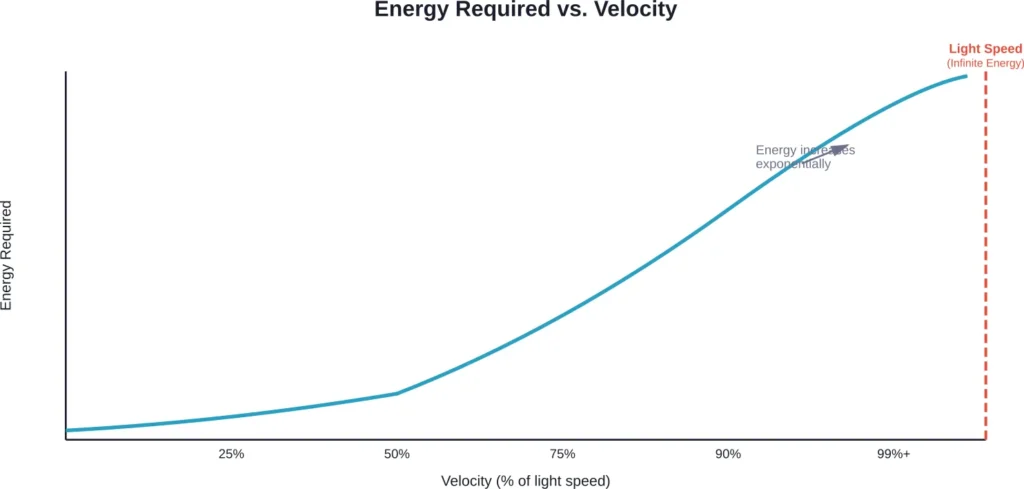
As an object approaches light speed, the energy required to accelerate it further increases exponentially. Reaching exactly the speed of light would require infinite energy—a physical impossibility for anything with mass.
Think of it this way: light itself travels at this speed because photons have zero rest mass. Massless particles can travel at light speed. But anything with even the tiniest mass? It’s permanently stuck below that threshold.
This creates what physicists call the “light barrier”—fundamentally different from the sound barrier, which aircraft routinely exceed.
The Mathematics Behind the Barrier
The Lorentz transformations form the mathematical foundation of special relativity. These equations describe how time, length, and mass change at high velocities.
As velocity approaches the speed of light (represented as c in physics), the Lorentz factor approaches infinity. This factor multiplies the rest mass of an object, meaning a spacecraft approaching light speed would become infinitely massive.
Accelerating infinite mass requires infinite energy. No engine in the universe could provide that.
But wait—doesn’t that seem arbitrary? Why is c = 3 × 10⁸ m/s specifically?
The speed of light isn’t arbitrary. It emerges from the fundamental properties of space and time. In fact, calling it the “speed of light” is somewhat misleading. It’s really the maximum speed at which causality can operate—the speed at which cause-and-effect relationships propagate through spacetime.
Light just happens to travel at this speed because photons are massless.
What Happens If You Try
Particle accelerators push subatomic particles to incredible velocities—often exceeding 99.99% of light speed. Yet no matter how much energy physicists pump into these particles, they never quite reach light speed.
The particles simply gain more and more relativistic mass instead of additional velocity. Their clocks slow down dramatically. From the particle’s perspective, distances contract.
Real talk: this isn’t speculation. Scientists observe these effects daily in accelerators worldwide.
Things That Actually Travel Faster Than Light
Now here’s where it gets interesting. While nothing with mass can exceed light speed, several phenomena do appear to break this rule.
The catch? None of them violate relativity’s fundamental principle: information and causality can’t travel faster than light.
The Expansion of Space
Space itself expands. During cosmic inflation immediately after the Big Bang, space expanded faster than light speed. Even today, distant galaxies recede from us faster than light due to the expansion of space between us.
This doesn’t violate relativity because the galaxies aren’t moving through space faster than light. Space itself is expanding, carrying them along.
Think of dots on a balloon. As the balloon inflates, dots move apart without actually traveling across the balloon’s surface.
NASA researchers note this distinction is crucial. The objects themselves aren’t exceeding light speed—the metric expansion of space creates the apparent superluminal recession.
Quantum Entanglement
Quantum mechanics introduces another apparent exception. When two particles become entangled, measuring one instantly affects the other—regardless of distance.
Einstein famously disliked this “spooky action at a distance.” According to NASA’s Jet Propulsion Laboratory, Einstein introduced the concept of entanglement but later rejected it because it seemed to violate his relativity theory.
Yet experiments confirm entanglement exists. Measure a particle’s spin here, and its entangled partner’s spin is instantly determined—even light-years away.
So does information travel faster than light? No. Here’s why:
The measurement results appear random to each observer. Only when they later compare results (using conventional slower-than-light communication) do they discover the correlation. You can’t encode and transmit information through entanglement alone.
It’s like having two magic coins that always land on opposite sides when flipped. Flip one here, and you instantly know the other coin’s state anywhere in the universe. But you can’t control which side your coin lands on, so you can’t send a message.
Shadows and Light Spots
Point a laser at the moon and sweep it across the lunar surface. The spot can move faster than light.
Sounds impossible? It’s not, because the spot isn’t a physical object. It’s just where photons happen to be hitting at any moment. No matter or information travels in the spot’s motion.
Similarly, shadows can move faster than light. Neither violates relativity because neither carries information or causality.
Phase Velocity and Group Velocity
Waves have two types of velocity: phase velocity (how fast the wave’s peaks move) and group velocity (how fast the wave’s envelope moves).
Phase velocity can exceed light speed in certain materials. But the signal velocity—the speed at which information propagates—never does.
This distinction matters for understanding various “faster than light” claims that periodically surface in physics.
The Curious Case of Tachyons
What if particles existed that always travel faster than light?
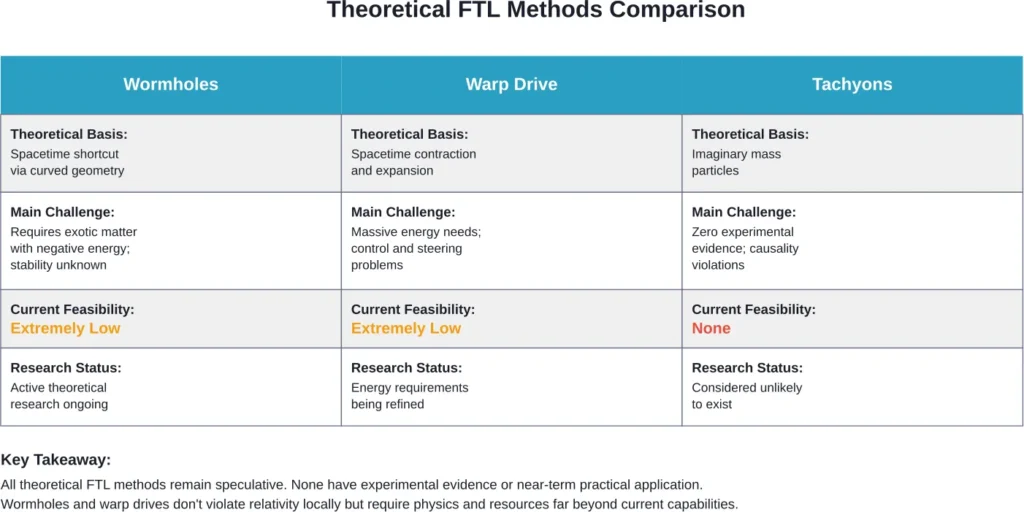
Physicists call these hypothetical particles “tachyons.” They’re theoretically consistent with relativity—sort of.
According to NASA’s Goddard Space Flight Center, Robert Ehrlich presented an overview of faster-than-light speeds and tachyons at their engineering colloquium on Monday, April 28, 2003, noting that while relativity appears to prohibit faster-than-light speeds, tachyons represent a theoretical exception.
Tachyons would have imaginary mass (yes, involving the square root of negative numbers). They’d be born traveling faster than light and could never slow down below light speed—a mirror image of ordinary matter.
But here’s the problem: no one has ever detected a tachyon. Decades of experiments have found zero evidence these particles exist.
Furthermore, tachyons create causality problems. They could theoretically send information backward in time, creating paradoxes.
Most physicists consider tachyons a mathematical curiosity rather than real particles.
The 2011 Faster-Than-Light Neutrino Debacle
In 2011, researchers announced neutrinos appeared to travel faster than light. The physics world buzzed with excitement.
According to Nature, an independent experiment later confirmed the neutrinos had the wrong energy spectrum for superluminal travel. The “faster than light” result stemmed from measurement errors—specifically, a faulty fiber optic cable connection.
After corrections, the neutrinos traveled at expected subluminal speeds. Einstein’s relativity survived intact.
This episode demonstrates how seriously physics takes potential relativity violations. Even a hint of faster-than-light travel triggers intense scrutiny.
Theoretical Loopholes and Exotic Physics
While conventional faster-than-light travel appears impossible, theoretical physics offers intriguing loopholes.
These remain purely speculative. But they’re worth examining.
Wormholes
According to NASA’s Cosmicopia, wormholes are allowed to exist in the mathematics of general relativity, our best description of the universe.
A wormhole is essentially a shortcut through spacetime—like tunneling through a mountain instead of driving over it.
If wormholes exist, you wouldn’t technically travel faster than light. You’d just take a shorter path through spacetime’s geometry.
The challenges? Keeping a wormhole open would require exotic matter with negative energy density. No one knows if such matter exists or if it’s even possible.
Moreover, the physics governing wormhole stability remains murky. They might collapse instantly, crushing anything attempting to traverse them.
And creating a wormhole artificially would likely require energies far beyond current technology—perhaps comparable to the energy output of entire stars.
Alcubierre Warp Drive
Physicist Miguel Alcubierre proposed a theoretical mechanism that contracts space in front of a spacecraft while expanding it behind.
The spacecraft sits in a “warp bubble” of flat spacetime, never locally exceeding light speed. But the bubble itself moves faster than light by manipulating spacetime geometry.
Sound familiar to science fiction fans? Star Trek’s warp drive operates on similar principles.
The problems are significant. The Alcubierre drive would require enormous amounts of exotic negative energy. Recent calculations suggest the energy equivalent of entire planets or stars.
Additionally, particles inside the warp bubble might not be able to steer it or control its speed. And decelerating could release devastating radiation that destroys the destination.
That said, ongoing theoretical work continues refining warp drive concepts. Some newer models reduce energy requirements to “merely” the mass-energy equivalent of large asteroids.
Still impossible with current technology. But perhaps less wildly impossible than before
What About Quantum Tunneling?
Quantum tunneling allows particles to pass through energy barriers they classically shouldn’t be able to cross.
Does this happen faster than light? Experiments suggest the tunneling time is extremely short—possibly instantaneous in some interpretations.
But once again, no information travels faster than light. The probability wave describing where the particle might be extends through the barrier. When measured, the particle appears on the other side according to quantum probabilities.
The process doesn’t transmit information superluminally. It’s quantum weirdness, not a relativity violation.
The Speed of Gravity
When massive objects move, they create ripples in spacetime called gravitational waves.
How fast do these waves travel? According to general relativity, exactly the speed of light.
Recent gravitational wave detections from merging black holes and neutron stars confirm this prediction. The gravitational waves and electromagnetic radiation from these events arrive nearly simultaneously after traveling billions of light-years.
So gravity propagates at light speed, not instantaneously as Newton’s theory suggested.
This reinforces that c isn’t just about light. It’s the universal speed limit for all causality and information transfer.
Why This Matters for Space Travel
The light-speed barrier creates enormous challenges for interstellar travel.
The nearest star system (Alpha Centauri) sits 4.37 light-years away. Even traveling at light speed—impossible for anything with mass—the journey would take over four years.
At more realistic spacecraft speeds, interstellar voyages take tens of thousands of years.
Research by Chris Reiss and Justin C. Feng on galactic empires and the Fermi paradox examines how civilizations might overcome vast distances between stars, noting that a Type II civilization can establish a galaxy-spanning civilization with a time dilation factor of 10^4, enabling trips spanning the Milky Way’s diameter within a human lifetime in the civilizational reference frame.
Time dilation offers one potential advantage. A spacecraft approaching light speed experiences slower time passage. Astronauts might age only a few years while decades or centuries pass on Earth.
But this creates its own problems. Returning travelers would find everyone they knew long dead. Civilizations would change beyond recognition.
And achieving those relativistic speeds remains far beyond current technology.
Generation Ships and Alternative Approaches
Without faster-than-light travel, practical interstellar colonization would likely require generation ships—spacecraft where multiple generations live and die during the journey.
Or perhaps suspended animation, if such technology becomes feasible.
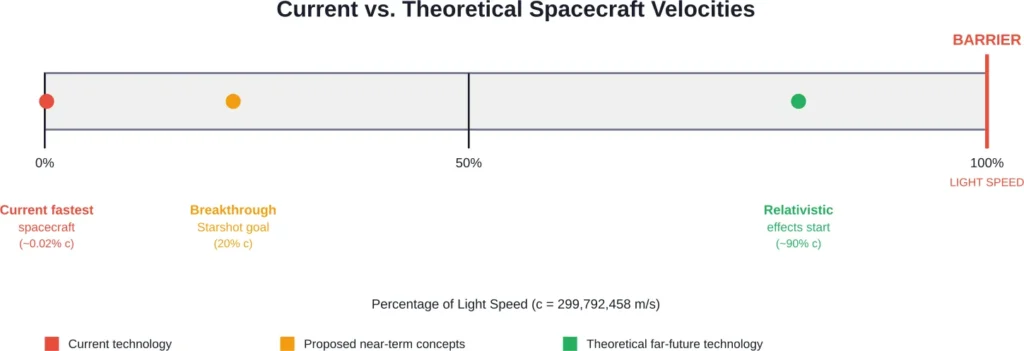
Some researchers propose sending tiny probes at high fractions of light speed rather than crewed spacecraft. The Breakthrough Starshot initiative aims to accelerate gram-scale probes to 20% light speed using laser arrays.
Even at those speeds, reaching Alpha Centauri would take about 20 years.
How Science Fiction Handles the Light Speed Barrier
Science fiction wouldn’t work without faster-than-light travel. Stories set across galactic empires need characters who can actually interact.
Writers have invented numerous workarounds, each with varying scientific plausibility.
Star Trek uses warp drive—inspired by theoretical physics but simplified for storytelling. Ships create “subspace bubbles” that bypass normal spacetime limitations.
Star Wars simply ignores the problem with “hyperdrive,” never explaining the mechanism in detail.
Other franchises use wormholes, jump gates, or “hyperspace”—alternate dimensions where different physics apply.
These aren’t scientifically rigorous. But they enable narratives that would otherwise be impossible given relativistic constraints.
Some harder science fiction embraces the light-speed limit. Stories set on generation ships or using time dilation as a plot element can be compelling precisely because they grapple with real physics.
| Sci-Fi Method | Franchise Example | Scientific Plausibility | How It “Works” |
|---|---|---|---|
| Warp Drive | Star Trek | Low (requires exotic matter) | Contracts space ahead, expands behind |
| Hyperspace | Star Wars, Battlestar Galactica | None (pure fiction) | Alternate dimension with different physics |
| Wormholes | Stargate, Interstellar | Very Low (theoretically possible) | Shortcuts through curved spacetime |
| Jump Drives | Dune, various | None | Instantaneous teleportation |
| Time Dilation | The Forever War | High (real physics) | Travel near light speed; time passes slower |
| Generation Ships | Aurora, Rendezvous with Rama | High (technically feasible) | Multi-generational voyages at sub-light speed |
Could We Ever Break the Light Barrier?
So what’s the bottom line? Will humanity ever achieve faster-than-light travel?
Based on current physics, conventional faster-than-light travel appears impossible. Not just technologically difficult—fundamentally impossible.
Einstein’s relativity has survived over a century of experimental tests. Every attempt to find violations has failed or been explained away by measurement errors.
That said, physics has surprised us before.
Quantum mechanics revealed reality works differently at small scales than anyone expected. General relativity showed space and time are flexible, not fixed.
Could future discoveries reveal loopholes or new physics that permit faster-than-light travel? Maybe. But betting against Einstein has historically been unwise.
What Would It Take?
Any viable faster-than-light mechanism would need to:
- Avoid requiring infinite energy
- Not create causality violations (time travel paradoxes)
- Work within or extend general relativity rather than contradict it
- Have some experimental evidence, however preliminary
Current theoretical proposals like warp drives and wormholes satisfy the third requirement. They don’t violate relativity—they exploit its flexibility.
But they fail the first and fourth requirements spectacularly. Energy needs are astronomical. Evidence is nonexistent.
Progress would require breakthroughs in understanding exotic matter, spacetime engineering, or entirely new physics.
Recent Research and Developments
Research on faster-than-light possibilities hasn’t stopped. Physicists continue exploring theoretical boundaries.
Recent work has focused on reducing the energy requirements for warp drives. Some models now suggest “merely” solar-system-scale energies rather than galaxy-scale energies.
Still impossible. But less impossible than before.
According to a CERN Courier article published March 22, 2002, research into superluminal phenomena continues to shed new light on fundamental questions about time and causality that have intrigued physicists since special relativity’s discovery.
Other researchers investigate quantum effects that might permit information transfer in ways that appear to violate light-speed limits—though always with careful attention to whether information truly propagates faster than light.
The Casimir effect, quantum tunneling times, and entanglement continue generating research papers exploring the boundaries between possible and impossible.
The Role of Dark Energy
Dark energy—the mysterious force accelerating cosmic expansion—might hold clues.
This energy effectively has negative pressure, similar to the exotic matter needed for wormholes and warp drives. Understanding dark energy’s nature might reveal whether similar effects can be harnessed locally.
But we’re nowhere close to that understanding yet. Dark energy remains one of physics’ biggest mysteries.
Practical Implications
Even if faster-than-light travel proves forever impossible, understanding why matters.
The light-speed limit reflects deep truths about spacetime’s structure. Studying these boundaries illuminates fundamental physics.
Moreover, near-light-speed travel—while extraordinarily difficult—isn’t necessarily impossible. Achieving even 10% or 20% of light speed would revolutionize space exploration.
Those speeds remain far beyond current capabilities. But they don’t violate physics the way exceeding light speed would.
Research into advanced propulsion—ion drives, nuclear rockets, laser sail propulsion—continues. Each incremental improvement brings higher velocities closer to reality.
Common Misconceptions About Light Speed
Several misconceptions about the speed of light persist in popular understanding.
Misconception: Light Speed Is Just Really Fast
Light speed isn’t merely the fastest velocity we’ve measured. It’s a fundamental constant woven into spacetime’s structure.
The distinction matters. Breaking a speed record is engineering. Exceeding light speed would require rewriting physics.
Misconception: We Just Need Better Engines
No engine improvement will overcome the light-speed barrier. The limitation isn’t technological—it’s fundamental.
As objects approach light speed, they gain relativistic mass. More powerful engines just add more mass, requiring even more energy. It’s an impossible race.
Misconception: Quantum Mechanics Lets Us Cheat Relativity
Quantum mechanics is weird, but it doesn’t violate relativity. The two theories work together in quantum field theory.
Phenomena like entanglement appear to violate light-speed limits but actually don’t transmit information faster than light.
Misconception: Scientists Might Have It Wrong
Community discussions sometimes suggest physicists might be fundamentally mistaken about light speed limits.
While science does occasionally undergo revolutions, relativity has survived over a century of increasingly precise tests. GPS satellites wouldn’t work if relativity were wrong—engineers must account for relativistic effects in orbit.
Any new theory would need to explain all the existing evidence while also predicting new phenomena. That’s a high bar.
The Philosophical Angle
The light-speed limit has philosophical implications beyond physics.
It enforces a kind of cosmic isolation. Civilizations separated by thousands of light-years can’t meaningfully communicate, let alone interact.
This might explain the Fermi Paradox—why we haven’t detected alien civilizations despite billions of potentially habitable planets. The universe might be teeming with life that’s simply too far away to ever contact.
The light-speed barrier also preserves causality and free will. If information could travel backward in time, cause and effect would break down.
Some physicists argue the universe’s structure prevents these paradoxes not through arbitrary rules but through deep mathematical consistency.
Frequently Asked Questions
Nothing with mass can travel faster than light through space according to Einstein’s theory of relativity. However, certain phenomena appear to exceed light speed: the expansion of space itself, quantum entanglement correlations, shadows, and phase velocities of waves. None of these transmit information or violate causality, so they don’t truly break the cosmic speed limit.
According to special relativity, accelerating any object with mass to light speed would require infinite energy—making it physically impossible. If an object somehow exceeded light speed, it would violate causality, potentially allowing effects to precede their causes and enabling time travel paradoxes. The mathematics of relativity predicts such objects would have imaginary mass and move backward in time.
Countless experiments since the late 1800s have measured light speed in different conditions, directions, and reference frames. The Michelson-Morley experiment in 1887 demonstrated light speed doesn’t change based on Earth’s motion. Modern tests using atomic clocks, particle accelerators, and astronomical observations consistently confirm c = 299,792,458 m/s remains constant. GPS satellite systems rely on this constancy and wouldn’t function correctly if light speed varied.
Both concepts are mathematically consistent with general relativity but face enormous practical challenges. Wormholes would require exotic matter with negative energy density to remain stable—something never observed in nature. Warp drives need similarly exotic energy sources on scales potentially requiring the mass-energy of planets or stars. Neither violates relativity locally, but both remain purely theoretical with no experimental evidence or clear path to implementation.
The specific number reflects how we’ve defined the meter and second, not a fundamental property of the universe. Since 1983, the meter is actually defined based on light speed: one meter equals the distance light travels in 1/299,792,458 of a second. What’s fundamental is that light speed exists as a universal constant; the numerical value just depends on our arbitrary measurement units.
In 2011, researchers announced neutrinos appeared to travel faster than light between CERN and Italy. The physics community was skeptical, and rigorous follow-up found the result stemmed from measurement errors—specifically a faulty cable connection. After corrections, the neutrinos traveled at expected subluminal speeds. According to Nature, independent experiments confirmed the neutrinos had the wrong energy spectrum for superluminal travel, vindicating Einstein’s theory.
While physics has surprised us before, relativity has survived over a century of precise experimental tests without any confirmed violations. Future discoveries might reveal loopholes or entirely new physics, but they would need to explain all existing evidence while predicting new phenomena. Most physicists consider conventional faster-than-light travel fundamentally impossible based on current understanding, though research into exotic theoretical possibilities like warp drives continues.
Conclusion: The Universe’s Ultimate Speed Limit
So can anything travel faster than light? For objects with mass moving through space—no.
Einstein’s speed limit isn’t arbitrary. It emerges from the fundamental structure of spacetime. Space and time are interwoven, and light speed represents the maximum rate at which causality propagates.
Certain phenomena—cosmic expansion, quantum correlations, shadows—appear to violate this limit. But none transmit information or matter faster than light when examined carefully.
Theoretical loopholes like wormholes and warp drives don’t technically exceed light speed locally. They manipulate spacetime geometry instead. But these concepts remain speculative, requiring exotic physics and energies far beyond current capabilities.
The light-speed barrier profoundly affects space exploration’s future. Interstellar travel faces enormous challenges. Even reaching nearby stars would require centuries with current technology.
That doesn’t make space exploration futile. Humanity might develop relativistic spacecraft that approach but don’t exceed light speed. Time dilation could make long journeys survivable for travelers even as centuries pass on Earth.
Or perhaps future physics will reveal unexpected loopholes. Science has surprised us before.
But betting against Einstein has historically been unwise. The cosmic speed limit appears to be here to stay.
Want to dive deeper into the physics of space travel? Explore related topics on relativistic effects, theoretical propulsion systems, and the challenges of interstellar exploration. Understanding why we can’t exceed light speed reveals profound truths about reality’s fundamental nature—and that’s just as fascinating as any faster-than-light spaceship.