

Quick Summary: Losing 20 pounds in 3 months is achievable and falls within the CDC-recommended safe weight loss rate of 1-2 pounds per week. This requires a consistent calorie deficit of 500-750 calories daily through diet modifications and physical activity, though individual results depend on starting weight, adherence, and metabolic factors.
The question isn’t just whether it’s possible—it’s whether it’s safe, sustainable, and worth the effort. According to the CDC, healthy weight loss happens at a gradual pace of about 1 to 2 pounds per week. That puts 20 pounds in 3 months (roughly 12 weeks) right within the recommended range.
But here’s the thing: losing weight isn’t a straightforward math equation. Bodies adapt, metabolisms shift, and life gets in the way. Some weeks deliver results, others stall completely. Understanding what actually drives weight loss—and what derails it—makes the difference between hitting the goal and burning out halfway through.
The Math Behind 20 Pounds in 12 Weeks
Weight loss fundamentals haven’t changed. A calorie deficit creates the conditions for fat loss. The traditional rule suggests that 3,500 calories equals one pound of body weight, though research from the National Institutes of Health shows this oversimplifies how bodies actually respond to energy restriction.
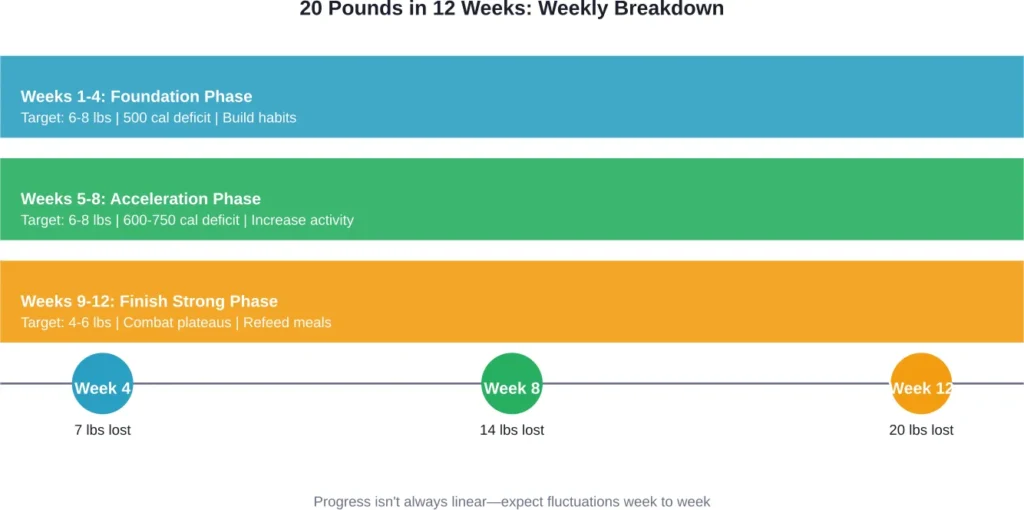
To lose 20 pounds in 3 months breaks down to roughly 1.67 pounds per week. That requires a daily calorie deficit of approximately 583 calories—or realistically, somewhere between 500 and 750 calories below maintenance needs.
Most adults maintain weight somewhere between 1,800 and 2,500 calories daily, depending on age, sex, activity level, and body composition. A deficit of 500-750 calories typically means eating 1,300 to 2,000 calories daily while incorporating regular physical activity.
What the CDC Actually Recommends
The Centers for Disease Control and Prevention emphasizes that healthy weight loss doesn’t require extreme measures. Their guidance focuses on sustainable lifestyle changes rather than aggressive dieting.
According to CDC data, even modest weight loss—around 5% to 10% of body weight—delivers measurable health improvements. For example, a 5% weight reduction for a person who weighs 200 pounds is 10 pounds. These reductions can improve blood pressure, cholesterol levels, and blood sugar control.
The CDC recommends these core components for effective weight management:
- A balanced eating pattern with appropriate portion sizes
- Regular physical activity most days of the week
- Adequate sleep (7-9 hours for most adults)
- Stress management techniques
- Consistent monitoring and adjustment
Notably, the CDC doesn’t promote rapid weight loss. Their research shows that gradual, steady progress—1 to 2 pounds weekly—leads to better long-term maintenance than aggressive crash diets.
Creating the Right Calorie Deficit
Not all calorie deficits produce the same results. Too aggressive, and the body downregulates metabolism, increases hunger hormones, and burns muscle tissue alongside fat. Too conservative, and progress stalls before reaching the goal.
Research indicates that creating a 500-calorie daily deficit typically produces about one pound of weekly weight loss. Doubling that to 1,000 calories daily approaches two pounds weekly—but sustainability becomes questionable.
For most people targeting 20 pounds in 3 months, a daily deficit of 500-750 calories strikes the right balance. This can come from:
- Reducing food intake by 400-500 calories
- Increasing activity expenditure by 200-300 calories
- Or any combination that hits the target deficit
The split between diet and exercise matters less than consistency.
Calculating Personal Calorie Needs
Maintenance calories vary dramatically between individuals based on age, sex, activity level, and body composition.
Online calculators provide estimates, but real-world tracking delivers precision. The National Institutes of Health offers a Body Weight Planner tool that accounts for metabolic adaptation—the slowdown in calorie burn that happens during weight loss.
| Daily Deficit | Weekly Loss | Time to 20 Pounds | Sustainability |
|---|---|---|---|
| 300-400 cal | 0.6-0.8 lbs | 25-33 weeks | Very high |
| 500 cal | 1.0 lb | 20 weeks | High |
| 750 cal | 1.5 lbs | 13-14 weeks | Moderate |
| 1,000 cal | 2.0 lbs | 10 weeks | Low |
Nutrition Strategies That Actually Work
Calorie deficits require eating less, but what gets eaten matters almost as much as how much. Protein, fiber, and meal timing all influence hunger, energy levels, and muscle preservation.
The National Institutes of Health research on optimal diet strategies shows that higher protein intake during calorie restriction helps preserve lean muscle mass. Aiming for 0.7 to 1.0 grams of protein per pound of body weight, based on research recommendations, supports muscle retention while promoting satiety.
For someone weighing 200 pounds targeting 20-pound loss, that’s 140-200 grams of protein daily. Chicken breast, fish, Greek yogurt, eggs, and legumes deliver protein without excessive calories.
The Role of Carbohydrates and Fats
Low-carb diets work for some people, but they’re not required for weight loss. What matters is total calorie intake, not carbohydrate restriction specifically. That said, reducing refined carbohydrates—white bread, pastries, sugary drinks—typically creates a calorie deficit without requiring meticulous tracking.
Dietary fat shouldn’t be eliminated. Fats support hormone production, vitamin absorption, and satiety. Keeping fat intake at 20-30% of total calories provides these benefits while leaving room for protein and nutrient-dense carbohydrates.
A reasonable macronutrient split for someone eating 1,600 calories daily might look like:
- Protein: 160g (640 calories, 40%)
- Carbohydrates: 140g (560 calories, 35%)
- Fats: 44g (400 calories, 25%)
Exercise: How Much Is Actually Needed?
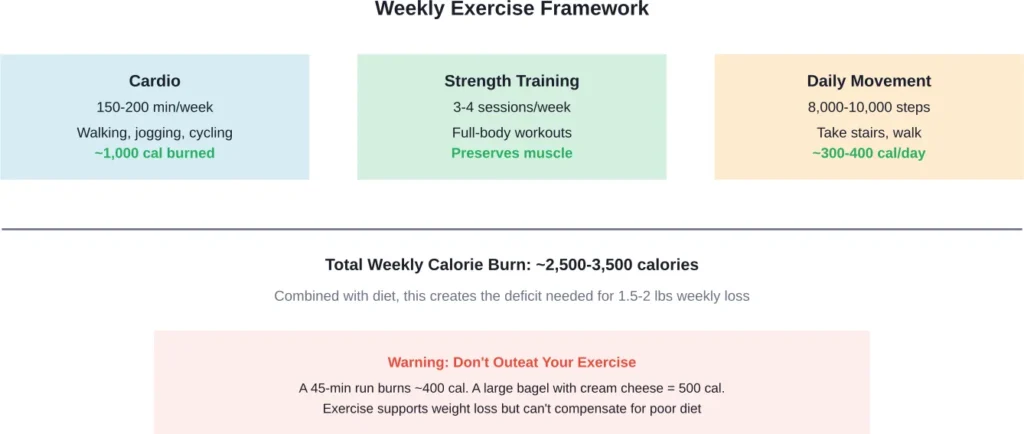
Exercise accelerates weight loss, but not as dramatically as most people expect. A 45-minute run burns approximately 400 calories—easily offset by a single large muffin.
The CDC recommends at least 150 minutes of moderate-intensity aerobic activity weekly, or 75 minutes of vigorous activity. For weight loss specifically, 200-300 minutes weekly shows better results. That breaks down to 30-45 minutes most days of the week.
But cardio alone isn’t optimal. Resistance training preserves muscle mass during calorie restriction, keeping metabolism higher and improving body composition. NIH research confirms that combining strength training with aerobic exercise produces better fat loss outcomes than cardio alone.
The Step Count Question
Walking doesn’t feel like exercise, but it contributes meaningfully to daily calorie burn. Someone who averages 8,000-10,000 steps daily burns an extra 300-400 calories compared to someone who manages only 3,000 steps.
That difference alone—maintained consistently—accounts for nearly a pound of additional weekly weight loss without structured workouts.
Sleep and Stress: The Overlooked Factors
Sleep deprivation sabotages weight loss in multiple ways. Research shows that insufficient sleep increases ghrelin (hunger hormone), decreases leptin (satiety hormone), and impairs insulin sensitivity. People who sleep less than 7 hours nightly lose less fat and more muscle during calorie restriction.
The CDC emphasizes sleep as a critical component of healthy weight management. Aiming for 7-9 hours nightly supports hormonal balance, energy levels, and recovery from exercise.
Chronic stress produces similar problems. Elevated cortisol promotes fat storage, particularly around the midsection, and triggers cravings for high-calorie comfort foods. Stress management techniques—meditation, walking, adequate downtime—aren’t optional extras but core components of successful weight loss.
What Derails Progress (And How to Avoid It)
Plateaus happen. Sometimes weight loss stalls for 2-3 weeks despite consistent effort. NIH research on metabolic adaptation shows that bodies reduce energy expenditure during calorie restriction, sometimes by 10-15% beyond what the weight loss alone would predict.
This doesn’t mean weight loss becomes impossible—it means adjustments are needed. Options include:
- Further reducing calorie intake by 100-200 calories
- Adding 30-45 minutes of weekly activity
- Incorporating periodic refeed days (eating at maintenance calories)
- Ensuring adequate protein intake to minimize muscle loss
Social situations create another challenge. Restaurant meals, family gatherings, and work events all introduce high-calorie foods and social pressure to indulge. Planning ahead—eating lighter earlier in the day, choosing protein-forward options, limiting alcohol—helps navigate these situations without derailing progress.
Tracking Accurately
Most people underestimate calorie intake. Eyeballing portions, forgetting cooking oils, and not accounting for beverages all contribute to this gap. Food tracking apps improve accuracy, but only when used consistently and honestly.
Weighing food provides precision that volume measurements can’t match. Portion estimation errors can easily add 100+ calories to daily intake.
Realistic Expectations by Week
Weight loss isn’t linear. Water retention, hormonal fluctuations, and digestive contents all influence daily weight. The scale might drop three pounds one week and stay flat the next, even with perfect adherence.
A realistic 12-week progression might look like:
| Week | Weight Loss | Cumulative Total | Notes |
|---|---|---|---|
| 1-2 | 3-5 lbs | 3-5 lbs | Initial water weight loss |
| 3-4 | 1-2 lbs | 5-7 lbs | Rate normalizes |
| 5-8 | 1.5-2 lbs weekly | 11-15 lbs | Consistent phase |
| 9-10 | 0.5-1 lb | 12-16 lbs | Potential plateau |
| 11-12 | 1-2 lbs weekly | 14-20 lbs | Push through to goal |
Some weeks deliver no scale movement despite doing everything right. That’s normal, not failure. Bodies retain water during muscle repair, hormonal shifts affect fluid balance, and high-sodium meals can mask fat loss for days.
Who Might Struggle to Hit 20 Pounds in 3 Months
Starting weight matters. Someone who weighs 250 pounds will lose weight faster than someone who weighs 160 pounds, even with identical calorie deficits. Larger bodies burn more calories at rest and during activity.
For someone with less than 40 pounds to lose total, 20 pounds in 3 months becomes aggressive. A 150-pound person trying to reach 130 pounds will experience slower progress than a 220-pound person targeting 200 pounds.
Age also influences rate. Metabolic rate decreases with age, and muscle mass naturally declines without resistance training. A 50-year-old will typically lose weight more slowly than a 25-year-old with identical diet and exercise.
Maintaining the Loss After 12 Weeks
Reaching 20 pounds down means nothing if 25 pounds return within six months. CDC data on weight maintenance shows that people who successfully maintain weight loss share common behaviors:
- Continued monitoring (weighing regularly, tracking food intermittently)
- Sustained physical activity (200-300 minutes weekly)
- Eating breakfast regularly
- Limiting high-calorie foods and large portions
- Catching small regains early (addressing 3-5 pound increases immediately)
A key finding from weight loss research: people who lose weight and maintain weight loss continue to eat a diet with fewer calories than their pre-weight loss diet. Maintenance isn’t returning to pre-diet eating patterns—it requires sustaining the habits that created the loss in the first place, with slightly more flexibility.
Transitioning from weight loss to maintenance means gradually increasing calories by 100-200 weekly until weight stabilizes. For someone who lost weight eating 1,500 calories, maintenance might land around 1,900-2,100 calories—still below what they ate before the diet, but more sustainable long-term.
Frequently Asked Questions
Most people can achieve this goal if they have sufficient weight to lose and maintain consistency. According to the CDC, losing 1-2 pounds weekly is safe and achievable for most adults. However, individuals with less than 30-40 pounds of total excess weight may find 20 pounds in 3 months overly aggressive. Those with certain medical conditions should consult healthcare providers before starting any weight loss program.
Generally speaking, women shouldn’t consume fewer than 1,200 calories daily, and men should stay above 1,500 calories, unless under medical supervision. Very low-calorie diets can lead to nutrient deficiencies, muscle loss, and metabolic slowdown. The NIH emphasizes that moderate calorie restriction—creating deficits of 500-750 calories—produces better long-term results than aggressive restriction.
Some muscle loss typically accompanies fat loss during calorie restriction, but adequate protein intake and resistance training minimize this effect. Research shows that consuming 0.7-1.0 grams of protein per pound of body weight and performing strength training 3-4 times weekly helps preserve lean mass. The faster the weight loss, the greater the risk of muscle loss—another reason moderate pacing works better than crash dieting.
Plateaus lasting 2-3 weeks are common and don’t necessarily require changes. If weight remains stuck for 3-4 weeks, try reducing calories by 100-200 daily, adding 30-60 minutes of weekly activity, or incorporating a refeed day at maintenance calories. Ensure tracking accuracy—most plateaus result from gradual increases in portion sizes or uncounted calories rather than true metabolic adaptation.
Research from the NIH shows that both approaches can work, but moderate-paced weight loss (1-2 pounds weekly) tends to preserve more muscle mass and proves more sustainable. Rapid weight loss often leads to quicker regain. That said, some studies suggest initial rapid loss improves motivation—the key is transitioning to sustainable habits rather than maintaining aggressive restriction indefinitely.
No specific foods or food groups need elimination for weight loss. Total calorie intake matters most. That said, reducing refined carbohydrates, sugary beverages, and highly processed foods makes creating a calorie deficit easier since these foods provide lots of calories without much satiety. The DASH eating plan recommended by the NIH emphasizes vegetables, fruits, whole grains, lean proteins, and healthy fats—a balanced approach that supports both weight loss and overall health.
Studies show that people who track food intake lose more weight than those who don’t, primarily because tracking reveals hidden calories and portion creep. Food tracking doesn’t need to continue forever, but during active weight loss, it significantly improves accuracy and accountability. Even occasional tracking—a few days each week—provides valuable feedback about actual versus perceived intake.
The Bottom Line on Losing 20 Pounds in 3 Months
It’s absolutely possible. The CDC-recommended rate of 1-2 pounds weekly puts 20 pounds in 12 weeks within reach for most people who commit to the process.
But possible doesn’t mean easy. It requires consistent calorie restriction, regular physical activity, adequate sleep, and honest tracking. Weeks will bring frustrating plateaus, social situations will test resolve, and the scale will occasionally refuse to budge despite perfect effort.
The people who succeed don’t rely on motivation—they build systems. They plan meals in advance, schedule workouts like appointments, and address small slip-ups before they become major derailments. They focus on process over outcome, trusting that consistent behaviors eventually produce results.
Real talk: 20 pounds in 3 months won’t transform someone from overweight to athletic. But it will improve blood pressure, reduce joint stress, boost energy levels, and prove that change is possible. For many people, that initial success becomes the foundation for continued progress—not because they become superhuman, but because they finally understand what actually works.
Ready to start? Calculate maintenance calories, subtract 500-750 to create a deficit, plan tomorrow’s meals tonight, and schedule the first workout of the week. Don’t wait for Monday, the first of the month, or the perfect moment. Start now, adjust as needed, and track progress weekly rather than daily. Twelve weeks pass whether action is taken or not—might as well use them productively.