
Quick Summary: Vision improvement depends on the underlying cause. Refractive errors like nearsightedness and farsightedness can be corrected with glasses, contacts, or surgery like LASIK, but these don’t ‘improve’ the eye itself—they compensate for its shape. Healthy lifestyle habits can protect vision and prevent decline, but cannot reverse structural problems or restore lost vision from conditions like cataracts or macular degeneration.
Almost everyone knows someone who wears glasses or contact lenses. According to the National Institutes of Health, nearly 93 percent of people over 70 wear lenses. That statistic alone shows how common vision challenges become as people age.
But can eyesight actually get better? The answer isn’t simple.
Some people hope their vision can change with simple habits or exercises. Others wonder if modern medical treatments offer real solutions. This article cuts through the myths and explains what’s medically proven to work.
Understanding How Vision Problems Happen
Most vision problems stem from refractive errors. According to the National Eye Institute, refractive errors happen when the shape of the eye keeps light from focusing correctly on the retina—a light-sensitive layer of tissue at the back of the eye.
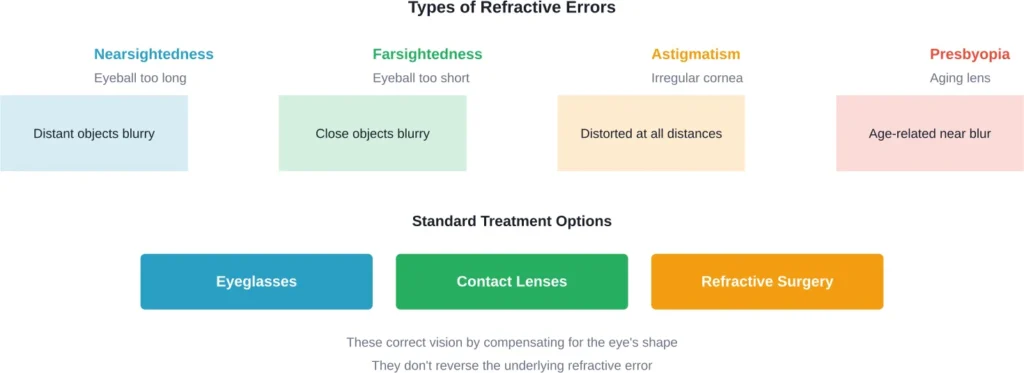
The four main types include:
- Nearsightedness (myopia) — distant objects appear blurry
- Farsightedness (hyperopia) — close objects appear blurry
- Astigmatism — distorted vision at all distances
- Presbyopia — age-related difficulty focusing on close objects
These conditions develop because of the eye’s physical structure. The eyeball might be too long or too short, or the cornea might have an irregular curve.
Here’s the thing though—these structural issues can’t be reversed through exercises or diet. The eye’s shape is determined by genetics and physical development.
What Medical Treatments Actually Work
The National Eye Institute confirms that refractive errors are diagnosed through eye exams and treated with eyeglasses, contact lenses, or surgery. These methods don’t heal the eye—they compensate for its imperfections.
Corrective Lenses
Glasses and contacts work by bending light rays to focus properly on the retina. When wearing them, vision becomes clear. Remove them, and the original problem returns.
That’s not a failure. It’s how corrective lenses are designed to function.
Refractive Surgery Options
Several surgical procedures can permanently reshape the cornea to correct vision. Recent medical research has examined the effectiveness of different approaches.
LASIK (Laser-Assisted In Situ Keratomileusis) remains one of the most common procedures. Research comparing LASIK and PRK outcomes has been published in peer-reviewed literature examining clinical outcomes, with findings noting that LASIK showed less corneal haze at 1 to 3 months after surgery.
Research on wavefront-guided LASIK and PRK procedures has been conducted examining safety and efficacy outcomes for correcting myopia and compound myopic astigmatism. A 2025 prospective study on Ray-Tracing Guided LASIK examined refractive outcomes and visual quality measures.
Research on PRK outcomes across different myopia levels showed successful results for low, moderate, and high myopia correction. Research has compared quality of vision outcomes across LASIK, PRK, and SMILE procedures in the peer-reviewed literature.
| Procedure | Method | Recovery Time | Best For |
|---|---|---|---|
| LASIK | Flap created, laser reshapes cornea | 1-2 days | Moderate refractive errors |
| PRK | Surface ablation, no flap | 3-5 days | Thin corneas, active lifestyles |
| SMILE | Small incision lenticule extraction | 1-2 days | Myopia, minimal dry eye risk |
But wait. These surgeries permanently alter corneal shape. They’re effective, but they carry risks and aren’t suitable for everyone.
Can Lifestyle Changes Improve Eyesight?
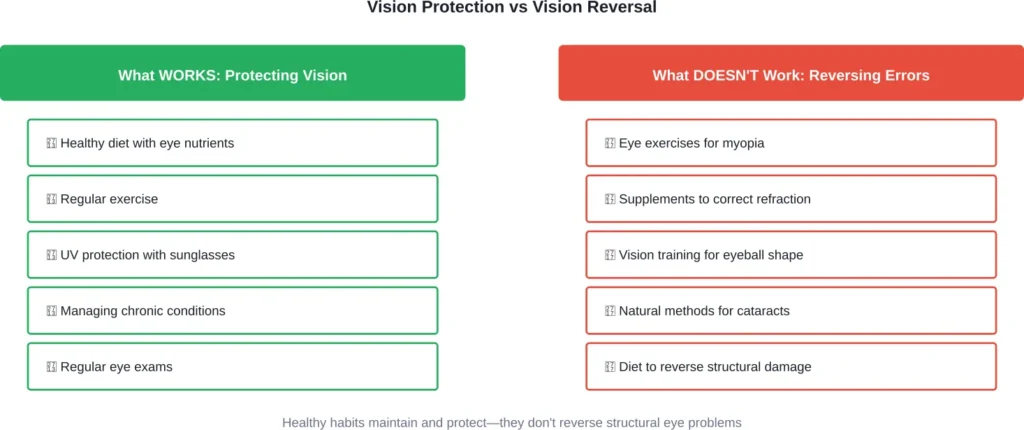
Healthy habits can’t reverse refractive errors, but they play a crucial role in protecting vision and preventing age-related decline.
Diet and Eye Health
Certain nutrients support eye health. Many experts suggest that diets rich in omega-3 fatty acids, lutein, zinc, and vitamins C and E may help ward off age-related vision problems.
Regular physical activity also matters. Exercise lowers the risk of obesity, type 2 diabetes, high blood pressure, and high cholesterol—all conditions that can cause vision problems and loss.
Protecting Eyes From Damage
Prevention strategies include:
- Wearing sunglasses that block UV rays
- Taking breaks during prolonged screen use
- Avoiding tobacco smoke
- Managing chronic health conditions like diabetes
- Wearing protective eyewear during activities with injury risk
These habits won’t make nearsightedness disappear. They can, however, maintain current vision quality and reduce the risk of future problems.
Childhood Myopia Control
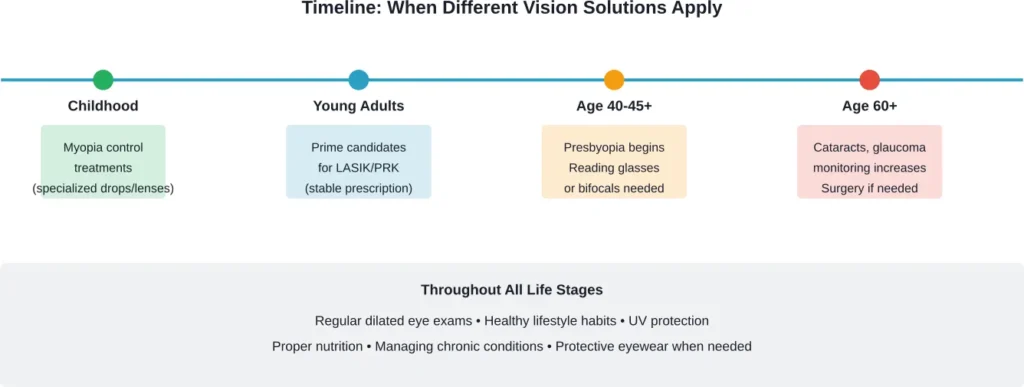
For children, specific interventions may slow myopia progression. The American Academy of Ophthalmology notes that treatments include atropine eyedrops, specialized glasses like Essilor Stellest, and MiSight contact lenses.
Results have been mixed. A recent clinical trial of low-dose (0.01%) atropine eyedrops that were approved in Europe did not get endorsed by the FDA in United States. Another trial in Europe and North America found that 0.01% atropine drops were slightly helpful, but 0.02% drops were not.
These interventions aim to slow progression in developing eyes, not reverse existing myopia.
Age-Related Vision Conditions
Some vision problems develop with age and require different approaches than refractive errors.
Cataracts
According to the National Eye Institute, cataracts create a cloudy area in the eye’s lens. More than half of all Americans age 80 or older either have cataracts or have had surgery to remove them.
Early cataracts may cause no symptoms. Later stages bring blurry vision, faded colors, light sensitivity, trouble seeing at night, and double vision.
The only treatment is surgery. No exercises, supplements, or lifestyle changes can clear a cataract once it forms.
Dry Eye
The National Eye Institute explains that dry eye happens when eyes don’t make enough tears or when tears don’t work correctly. Symptoms include burning, dryness, scratchiness, blurry vision, and redness.
Treatment typically involves eye drops, lifestyle changes, or medication. This condition can often be managed effectively with proper care.
The Importance of Regular Eye Exams
A dilated eye exam is the most effective way to safeguard vision. According to the National Eye Institute, it’s the only way to check for eye diseases early on, when they’re easier to treat—before they cause vision loss.
During the exam, an eye doctor checks for vision problems like nearsightedness or farsightedness. Then special drops dilate the pupil so the doctor can examine the eye for diseases.
Many eye diseases have no early symptoms. Regular exams catch problems before they become serious.
What About Natural Vision Improvement Programs?
Various programs and methods claim to improve eyesight naturally through exercises or training. Community discussions often share personal experiences with these approaches.
Real talk: no peer-reviewed medical evidence supports the claim that eye exercises can correct refractive errors or reverse structural vision problems.
These programs may help with eye strain or focusing flexibility in specific situations. They don’t reshape the eyeball or alter how light focuses on the retina.
When someone reports improved vision after exercise programs, several factors might explain the experience:
- Reduced eye strain from better habits
- Placebo effect from heightened attention to vision
- Natural fluctuations in vision throughout the day
- Improved focusing ability (not actual eyesight improvement)
Eyesight improvement and reduced eye fatigue aren’t the same thing.
When Surgery Isn’t an Option
Not everyone qualifies as a candidate for refractive surgery. Factors that might prevent surgical correction include:
- Thin corneas
- Unstable vision prescription
- Certain autoimmune conditions
- Unrealistic expectations
- Severe refractive error beyond treatable range
For people who can’t have surgery, corrective lenses remain the gold standard. Modern lenses offer excellent vision correction with minimal inconvenience.
Managing Expectations About Vision Changes
Vision naturally changes over time. Some changes are normal, while others signal problems that need attention.
Presbyopia, for example, affects almost everyone around age 40-45. The lens loses flexibility, making close-up focus difficult. Reading glasses or bifocals compensate effectively.
Sudden vision changes, however, require immediate medical attention. Warning signs include:
- Sudden vision loss
- Flashes of light or new floaters
- Severe eye pain
- Double vision
- Curtain-like shadow over visual field
These symptoms could indicate serious conditions requiring urgent treatment.
Risk Factors Beyond Personal Control
Some vision risk factors can’t be changed. Family history plays a significant role in many eye conditions. Knowing relatives’ eye health history helps doctors assess personal risk.
Age is another unchangeable factor. The risk of cataracts, glaucoma, and macular degeneration increases significantly after age 60.
Certain chronic health conditions affect eye health. Diabetes, high blood pressure, and autoimmune diseases can all lead to vision complications. Managing these conditions effectively reduces vision-related risks.
The Bottom Line on Vision Improvement
So, is it possible to improve eyesight? The answer depends on what “improve” means.
Correcting vision with glasses, contacts, or surgery? Absolutely possible. These options work remarkably well for most refractive errors.
Reversing the underlying structural problems causing refractive errors through natural methods? No credible medical evidence supports this possibility.
Protecting vision and preventing future decline? Yes, through healthy lifestyle choices and regular eye care.
Restoring vision lost to conditions like cataracts? Sometimes, through surgical intervention.
The key is matching expectations with reality. Modern medicine offers excellent solutions for most vision problems, but those solutions work by compensation or surgical correction—not by reversing the eye’s fundamental structure through exercises or supplements.
Frequently Asked Questions
No medical evidence supports the claim that eye exercises can correct nearsightedness. Myopia results from the eyeball being too long, which exercises cannot change. Glasses, contacts, or refractive surgery remain the proven correction methods. Some exercises may help with eye strain or focusing fatigue, but they don’t alter the structural cause of refractive errors.
Most people experience initial vision improvement within 24 hours of LASIK surgery. Full stabilization typically occurs within 1-2 days, though some patients need a few weeks for optimal results. Recovery varies by individual factors and the specific procedure used. PRK has a slightly longer recovery period of 3-5 days for initial healing.
Many experts suggest that vitamins C and E, along with omega-3 fatty acids, lutein, and zinc, support eye health. These nutrients appear in studies examining age-related vision problems. A balanced diet rich in leafy greens, fish, nuts, and citrus fruits provides these nutrients naturally. However, supplements cannot reverse existing refractive errors or structural eye problems.
Presbyopia, the age-related difficulty focusing on close objects, typically begins around age 40-45. This happens when the eye’s lens loses flexibility naturally with aging. Reading glasses or bifocals effectively compensate for this change. Everyone eventually experiences presbyopia—it’s a normal part of aging, not a disease.
According to the National Eye Institute, adults should get dilated eye exams regularly, with frequency depending on age and risk factors. People with diabetes, family history of eye disease, or other risk factors may need more frequent exams. A dilated exam is the only way to detect many eye diseases before they cause vision loss.
While healthy habits like wearing UV-protective sunglasses, avoiding smoking, and maintaining good nutrition may reduce cataract risk, they cannot prevent cataracts entirely. According to the National Eye Institute, more than half of Americans over 80 develop cataracts regardless of lifestyle. When cataracts impair vision significantly, surgery is the only effective treatment.
LASIK permanently reshapes the cornea, and for most people, results last indefinitely. However, eyes can still change with age. Presbyopia will still develop around age 40-45, potentially requiring reading glasses even after successful LASIK. Some patients may experience minor prescription changes years after surgery, though most maintain stable vision correction.
Taking Action for Long-Term Eye Health
Vision care isn’t about finding miracle cures or overnight fixes. It’s about making informed decisions based on medical evidence.
For refractive errors, corrective lenses or surgery provide effective solutions. For age-related conditions, early detection through regular exams makes treatment more successful. For overall eye health, consistent protective habits make a real difference.
The most important step? Schedule that dilated eye exam. It’s the single most effective action for protecting vision and catching problems early when treatment works best.
Understanding what’s possible—and what isn’t—helps set realistic expectations. Vision care technology has advanced dramatically, offering solutions that would have seemed impossible decades ago. But those solutions work through proven medical interventions, not wishful thinking about natural reversal.
Healthy eyes deserve evidence-based care. Start with a conversation with an eye care professional about personal risk factors, family history, and the most appropriate preventive measures. That’s where real vision protection begins.