

Quick Summary: Starting a business with no money is possible through strategic planning and resourcefulness. By leveraging free tools, starting service-based or freelance businesses, bartering skills, and accessing low-cost funding options like SBA microloans (up to $50,000), entrepreneurs can launch ventures without significant capital. The key is choosing low-overhead business models and maximizing free resources.
The question comes up constantly in entrepreneur communities: is it actually possible to start a business when the bank account reads zero?
The short answer? Absolutely.
But here’s the thing—it won’t look like the venture-backed startup stories splashed across tech news. Starting a business with little or no money requires a different playbook entirely. One built on resourcefulness rather than resources. On sweat equity instead of investor checks.
Thanks to the abundance of free and low-cost resources available today, thousands of business applications are submitted annually in the U.S. as entrepreneurs launch ventures from their kitchen tables each year. No fancy office space. No investor pitch decks. Just a solid idea, strategic thinking, and the willingness to hustle.
This guide breaks down exactly how to turn a business idea into reality when traditional startup capital isn’t an option.
The Reality of Zero-Budget Business Launches
Starting a business costs money. That’s the reality according to the U.S. Small Business Administration.
Funding decisions shape how businesses get structured and run. Every business has different needs, and no financial solution is one-size-fits-all. Personal financial situations and visions for the business ultimately shape its financial future.
But—and this is crucial—there’s a massive difference between “costs money” and “requires massive upfront capital.”
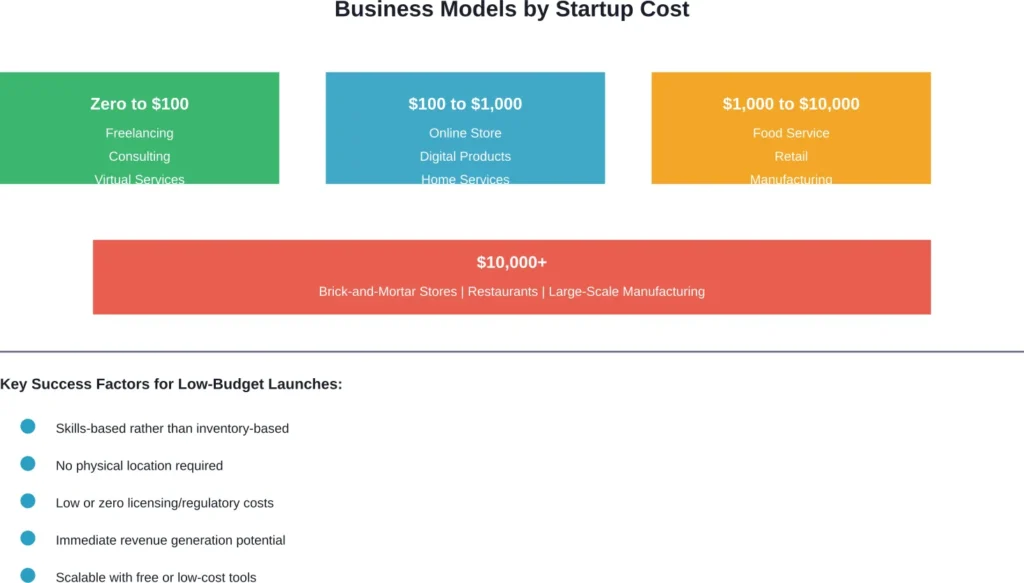
Some business models demand significant startup costs. Manufacturing companies need equipment and inventory. Restaurants need commercial kitchen space and licensing. Retail stores need physical locations and stock.
Other business models? They can launch with essentially nothing but time and effort.
The key is understanding which type of business can realistically start on a shoestring budget. Community discussions from entrepreneurs who’ve walked this path reveal a pattern: service-based businesses, freelancing, and certain types of online businesses offer the lowest barriers to entry.
Business Types That Actually Work With Zero Capital
Not all business ideas are created equal when starting broke. Some require substantial upfront investment. Others can launch immediately with nothing but skills and determination.
Freelancing and Service-Based Businesses
Freelancing represents one of the most accessible entry points for cash-strapped entrepreneurs. The model is straightforward: sell skills directly to clients who need them.
Writers, designers, developers, consultants, virtual assistants, bookkeepers, social media managers—these businesses can start today. Right now. The only requirement is demonstrable skill in something people will pay for.
The overhead? Practically nonexistent. A computer and internet connection are typically the only hard requirements. Many entrepreneurs already own both.
Real talk: the challenge isn’t startup costs. It’s landing those first few clients to build momentum and testimonials.
Online Businesses and E-Commerce
E-commerce has evolved dramatically. The traditional model—buy inventory, store it, ship it—requires capital. But newer models have changed the game entirely.
Dropshipping eliminates inventory costs. Print-on-demand removes manufacturing expenses. Digital products (courses, templates, ebooks) have zero per-unit costs after creation.
Affiliate marketing requires no product creation at all—just the ability to drive traffic and recommendations.
These models aren’t get-rich-quick schemes. They require work, strategy, and patience. But they don’t require money upfront.
Service-Area and Home-Based Businesses
Service-area businesses—those that travel to customers rather than requiring a physical location—offer another low-cost path.
House cleaning, lawn care, dog walking, mobile car detailing, handyman services. These businesses need basic tools (which many people already own) and transportation.
The business starts small. Maybe one client. Then two. Revenue from early clients funds any additional equipment needed as the business grows.
Office space costs money—a lot of it. According to data from SCORE, the average rent for office space in some cities, such as Tampa, Florida, can exceed $31 per square foot. Avoiding this overhead by running a home-based or mobile business keeps expenses minimal during crucial early stages.
Proven Strategies for Launching Without Capital
Choosing the right business type is step one. Actually launching it without money requires specific strategies that maximize free resources while minimizing expenses.
Master the Art of Bartering
Bartering—exchanging services without money changing hands—becomes incredibly powerful when cash is tight.
Need a logo? Trade web design services with a graphic designer. Need legal advice? Offer marketing services to an attorney. Need office furniture? Trade consulting hours for used equipment.
The barter economy thrives in small business communities. Many entrepreneurs face the same cash-flow challenges, making them open to creative exchange arrangements.
Document everything. Even barter arrangements should have clear agreements outlining what each party provides and when.
Leverage Free Tools and Resources
The explosion of free business tools has transformed what’s possible without money. Software that once cost thousands now has robust free tiers.
Project management? Trello, Asana, and Monday.com offer free plans. Communication? Slack and Microsoft Teams have free versions. Design? Canva provides professional-quality templates at no cost. Website? WordPress, Wix, and Squarespace offer free starter options.
Accounting software, email marketing platforms, social media scheduling tools—nearly every business function has free alternatives.
Libraries deserve special mention. Public libraries provide free access to research databases, business planning software, meeting rooms, and educational resources. Many offer free business workshops and one-on-one counseling.
The SCORE organization provides free mentoring and workshops for entrepreneurs nationwide.
Start Small and Bootstrap
Bootstrapping means funding business growth exclusively through revenue rather than external funding. It’s not glamorous. But it works.
The approach is simple: start impossibly small. One client. One project. One sale. Use that revenue to reinvest. Then repeat.
This organic growth model avoids debt and maintains complete control. Progress feels slow initially. But businesses built this way develop strong foundations because they must be profitable from day one.
No runway of investor cash means no cushion for mistakes. That constraint forces discipline, creative problem-solving, and laser focus on what actually generates revenue.
The Pay-It-Forward Pitch
When asking for help—whether advice, introductions, or services—the pay-it-forward approach works remarkably well.
Instead of asking for free help with nothing in return, offer future reciprocation. “I’m just starting out and can’t pay for this service right now, but I’d love to work with you. Once revenue starts flowing, I’ll pay your full rate. And I’ll refer every client I can your way.”
Many established business owners remember their own early struggles. A sincere pitch that acknowledges value and commits to future reciprocation often opens doors that would otherwise stay closed.
Keep the Day Job (Initially)
This strategy isn’t exciting. It doesn’t fit the “quit your job and follow your dreams” narrative popular in entrepreneur culture.
But it works. Keeping current employment while building a business on nights and weekends provides financial stability during the critical early phase.
The paycheck covers living expenses. The side business has time to find its footing, land clients, and generate consistent revenue before becoming the primary income source.
The transition happens when side-business revenue consistently matches or exceeds the day-job salary. At that point, going full-time becomes a calculated decision rather than a leap of faith.
Managing Essential Costs on a Tight Budget
Even the leanest businesses have some costs. The goal isn’t eliminating all expenses—it’s ruthlessly minimizing them while maximizing value.
Create a Budget and Actually Use It
Cash flow problems represent the #1 reason small businesses fail. That reality makes budgeting non-negotiable.
Track every dollar. Know exactly where money goes. Distinguish between essential expenses and nice-to-haves.
Free budgeting tools make this manageable. Spreadsheets work perfectly fine for most startups. The tool matters less than the discipline of actually using it.
According to SCORE research, a significant percentage of small businesses do not track inventory or assets properly, relying on manual processes. Don’t become part of those statistics.
Shop Around for Everything
Never accept the first price for any business service or tool. Shop around. Compare options. Negotiate.
Business insurance quotes can vary by hundreds of dollars for identical coverage. Web hosting prices differ dramatically between providers. Merchant account fees are almost always negotiable.
Spending an extra hour researching options can save thousands annually. When resources are tight, that’s time well spent.
Maximize Free Trials Strategically
Nearly every software service offers free trials. Use them strategically.
Need email marketing for a product launch? Sign up for the free trial timed to the launch date. Need advanced analytics for a specific project? Use the trial period to gather needed data.
Set calendar reminders before trials end. Cancel before charges hit if the tool isn’t essential. Only convert to paid plans for tools that directly generate revenue or save significant time.
Explore Cost-Sharing Opportunities
Co-working spaces, shared office hours, group purchasing arrangements—cost-sharing spreads expenses across multiple businesses.
A virtual assistant might be unaffordable solo. But splitting the cost with two other businesses makes it viable. Same with professional services, software subscriptions, or equipment.
Connect with other entrepreneurs in similar situations. The collaboration often reveals creative cost-sharing arrangements that benefit everyone involved.
Alternative Funding Options When You Need Capital
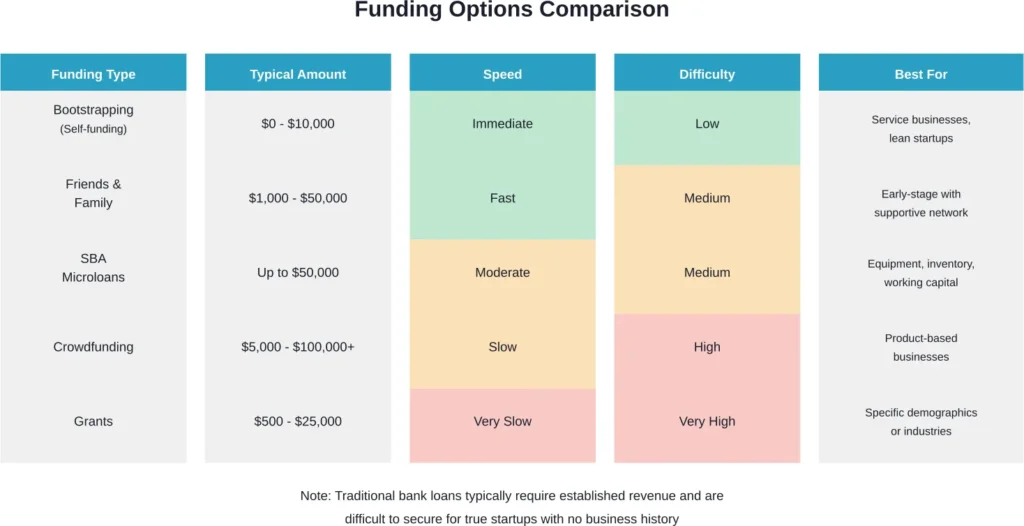
Sometimes a business idea genuinely requires some startup capital. Even minimal amounts. When that’s the case, several funding options exist beyond traditional bank loans.
Microloans for Small Businesses
The U.S. Small Business Administration operates a microloan program specifically designed for small businesses and certain nonprofits starting or expanding operations.
According to the SBA, microloans provide up to $50,000 in funding. These loans are funded by the SBA but administered through designated nonprofit community lenders across the country.
The amounts are typically under $50,000 and can be used for equipment purchases, inventory, supplies, and working capital. The SBA works with intermediary lenders who understand the challenges facing new businesses without extensive revenue history.
For startups with little to no business history, personal creditworthiness becomes the key factor lenders evaluate. Personal credit reports and credit scores become the primary tools for assessing loan eligibility.
Friends and Family Funding
Borrowing from friends and family carries risks. But it remains one of the most common early funding sources for businesses.
The key? Treat it professionally. Draft formal loan agreements. Specify repayment terms. Communicate regularly about business progress.
Never borrow from someone who can’t afford to lose the money. Never let personal relationships pressure business decisions. Clear boundaries and documentation protect both the business and the relationship.
Crowdfunding Platforms
Kickstarter, Indiegogo, GoFundMe—crowdfunding platforms connect entrepreneurs with potential customers willing to fund product development.
The model works best for tangible products with clear value propositions. Backers essentially pre-purchase products before they exist, funding production.
Success requires significant marketing effort. Campaigns don’t fund themselves. But for the right product with the right pitch, crowdfunding can generate substantial capital without debt or giving up equity.
Local Resources and Grants
Many cities and states offer small business resources, including grants, low-interest loans, and free support services.
Important clarification from the SBA: they don’t provide grants for starting and expanding businesses. SBA grants go to nonprofits, resource partners, and educational organizations that support entrepreneurship through counseling and training programs.
But local economic development agencies, chambers of commerce, and community foundations often have grant programs for specific business types or demographics.
Research local resources thoroughly. Free money exists, but finding it requires digging through less-obvious channels.
Building Business Credit From Scratch
Personal credit matters for startups. That’s reality. But separating business finances from personal finances should happen early.
Register the business as a legal entity. Open a dedicated business bank account. Obtain an Employer Identification Number (EIN) from the IRS—it’s free.
Apply for a business credit card even if the limit is small initially. Use it exclusively for business expenses. Pay it off completely each month.
Work with vendors who report to business credit bureaus. Even small accounts help establish business credit history separate from personal credit.
This separation protects personal assets and improves access to better financing terms as the business grows.
Critical Planning Steps That Cost Nothing
Planning doesn’t require money. It requires time and thought. But as SCORE emphasizes, every business deserves proper planning.
Good planning doesn’t require a massive formal document. It requires managing strategy, tactics, milestones, and essential business numbers effectively.
Research the Market Thoroughly
Market research sounds expensive. But most critical information is freely available.
Google Trends shows search volume patterns. Social media reveals customer conversations. Competitor websites display positioning and pricing. Industry reports often have free versions or summaries.
Talk to potential customers. Ask questions. Listen carefully to their problems and what they’d pay to solve them.
The goal isn’t perfect information. It’s sufficient understanding to avoid obvious mistakes and validate core assumptions.
Create a Lean Business Plan
Traditional business plans run 30-40 pages. Nobody needs that initially.
A lean business plan fits on one page. It covers the essentials: what problem gets solved, for whom, how money gets made, what resources are needed, and how success gets measured.
The document should be living, not static. Well-run businesses review progress monthly, identify problems and opportunities, and revise strategy and tactics as needed.
That hour or two per month reviewing and adjusting keeps the business aligned with reality rather than outdated assumptions.
Test Assumptions Before Committing
Successful entrepreneurs emphasize learning from structured activity designed to test assumptions.
Don’t build the entire business before validating core assumptions. Test them incrementally.
Will people actually pay? Test with a small offer. Does the marketing message resonate? Test with a small audience. Can the service be delivered profitably? Test with one client.
Each test provides real data that informs the next decision. Failed tests cost less when they’re small.
Common Pitfalls to Avoid
Starting a business with no money amplifies certain risks. Awareness helps avoid them.
Underestimating Time Investment
No money doesn’t mean no cost. It means paying with time instead of cash.
Building a website from scratch takes longer than paying someone. Learning bookkeeping takes longer than hiring a bookkeeper. DIY marketing takes longer than hiring an agency.
That trade-off makes sense when cash is nonexistent. But be realistic about the time required. Underestimating leads to burnout and missed deadlines.
Neglecting Legal and Tax Requirements
Business registration, licenses, permits, tax obligations—these requirements don’t disappear because money is tight.
Ignoring them creates much bigger problems later. Fines, penalties, and legal issues cost far more than proper setup.
Many requirements have minimal or zero costs. EINs are free. Some business structures require only filing fees. Research specific obligations for the business type and location, then handle them properly from the start.
Trying to Do Everything Alone
Entrepreneurship can feel isolating, especially when starting broke. But going it entirely alone makes everything harder.
Connect with other entrepreneurs. Join local business groups. Participate in online communities. Seek mentorship through programs like SCORE.
The hustle of social capital—building relationships and connections—becomes critical when financial capital is absent. Research on entrepreneurship shows that having mentors and making connections proves essential for entrepreneurs facing resource constraints.
Scaling Beyond Zero
Starting with no money is one challenge. Growing beyond that initial stage presents different ones.
The first revenue feels incredible. But sustainable growth requires reinvestment.
Determine what percentage of revenue gets reinvested versus withdrawn. Early-stage businesses typically reinvest aggressively—50% to 80% of revenue going back into the business isn’t uncommon.
That reinvestment funds better tools, marketing that reaches more people, hiring help for time-consuming tasks, and inventory for product businesses.
The bootstrapping mindset that worked at zero still applies. Spend strategically. Measure return on every investment. Cut what doesn’t work. Double down on what does.
Eventually, the business may reach a point where outside funding makes sense—not because it’s necessary for survival, but because it accelerates growth in ways that create more value than the cost of capital.
That’s a completely different decision than scrambling for funding to launch. Make it from a position of strength rather than desperation.
Frequently Asked Questions
Yes, but business type matters enormously. Service-based businesses, freelancing, and certain online businesses can genuinely launch with zero capital beyond a computer and internet connection. Product-based businesses and those requiring inventory, equipment, or physical locations need at least some startup capital. The key is choosing a business model that matches available resources.
For startups with no revenue history, personal creditworthiness becomes the primary factor lenders evaluate. SBA microloans provide up to $50,000 for qualifying small businesses through nonprofit intermediary lenders. Friends and family funding, crowdfunding for product-based businesses, and local grant programs offer additional options. Bootstrapping through initial clients and reinvesting revenue remains the most accessible path for most entrepreneurs.
Freelance services (writing, design, programming, consulting), virtual assistance, social media management, tutoring, pet sitting, house cleaning, lawn care, and dropshipping businesses can all start with $100 or less. Digital product businesses like online courses or printables also fit this budget. The common thread: skills-based rather than inventory-based models with minimal equipment requirements.
Timeline varies dramatically by business type and effort invested. Service-based businesses can generate first revenue within days or weeks of launching—as soon as the first client is secured. Product-based businesses typically take longer due to development and marketing requirements. Most zero-budget businesses should aim for first revenue within 30-90 days. Consistent, sustainable income usually takes 6-12 months to establish.
Legal requirements don’t disappear because of limited funds. Business license requirements vary by location, business type, and structure. Many locations require basic business licenses regardless of revenue. Some professional services need specific licensing. Research requirements for the specific business type and location, as operating without proper licensing creates legal and financial risks that far exceed the cost of proper registration.
Generally speaking, keeping current employment while building a business on the side provides crucial financial stability during the early phase. The paycheck covers living expenses while the business finds its footing. Consider transitioning to full-time entrepreneurship only after side-business revenue consistently matches or exceeds the day-job salary for at least three consecutive months. This approach reduces risk substantially.
The most common mistake is choosing a business model that inherently requires capital while having none. Attempting to launch a restaurant, retail store, or manufacturing business with zero money leads to frustration and failure. The second biggest mistake is neglecting proper planning—assuming resourcefulness alone substitutes for strategy. Successful zero-budget businesses combine the right low-capital business model with solid planning and execution.
Taking the First Step
Starting a business with no money isn’t a fantasy. It’s a proven path thousands of entrepreneurs have walked successfully.
But it requires honesty about what’s actually possible. Not every business idea works without capital. Some genuinely need funding to launch.
The entrepreneurs who succeed starting broke share common traits: they choose business models that match their resources, maximize free tools and resources ruthlessly, build revenue before expenses, and remain intensely focused on what actually generates income.
They don’t wait for perfect conditions. They start with what they have, where they are, doing what they can.
That first step—deciding on a specific, actionable business idea that requires minimal capital—matters more than perfect planning. The business plan can be refined as real-world feedback arrives. The website can be improved over time. The services can be expanded gradually.
None of that happens without starting.
Resources exist to support this journey. The U.S. Small Business Administration provides free counseling, training programs, and funding information. SCORE offers free mentoring from experienced business owners. Local libraries provide free access to business resources and research tools.
Community matters too. Connect with other entrepreneurs facing similar challenges. Join online forums. Attend local business meetups. The collective knowledge and support available in entrepreneur communities proves invaluable when tackling obstacles alone.
The question isn’t whether it’s possible to start a business with no money. It demonstrably is. The real question is whether the commitment exists to do what it takes—the research, the planning, the hustle, the long hours, the creative problem-solving.
For those willing to put in that work, lack of money doesn’t have to be a barrier. It’s just a different starting point.