

Quick Summary: Earth cannot lose gravity for 7 seconds or any duration. Gravity is a fundamental property determined by Earth’s mass and would only cease if the planet itself ceased to exist. Viral conspiracy theories claiming NASA predicted a gravitational loss event are completely fabricated, with no scientific basis whatsoever.
Social media exploded in late 2024 with a bizarre claim: Earth would lose gravity for seven seconds in August 2026, causing catastrophic consequences. The viral posts referenced a supposedly leaked NASA document about “Project Anchor,” a secret initiative to prepare for this gravitational anomaly.
None of it’s real. But the panic spread fast enough that NASA had to issue public statements debunking the whole thing.
So what’s the actual science here? Can Earth lose gravity at all? And what would it take for that to happen?
Understanding How Gravity Actually Works
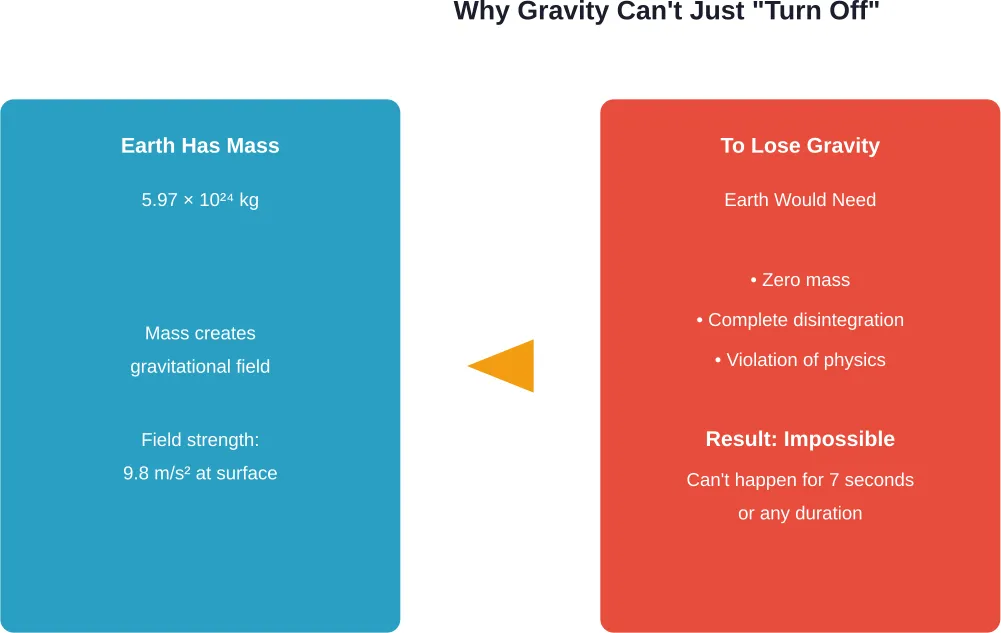
Gravity isn’t something Earth “has” like an atmosphere or magnetic field that could potentially fail. According to MIT’s physics courses on universal gravitation, gravity is a fundamental force that emerges from mass itself. Earth’s gravity exists because Earth has mass—approximately 5.97 × 10²⁴ kilograms of it.
The relationship is described by Newton’s universal law of gravitation. Every object with mass attracts every other object with mass. The strength depends on how much mass you’re dealing with and how far apart the objects are.
For Earth to “lose” gravity, even temporarily, the planet would need to lose its mass. That’s not how physics works.
The Project Anchor Conspiracy Theory Explained
The viral conspiracy claimed that a leaked NASA document revealed “Project Anchor”—an alleged initiative to prepare Earth for a seven-second gravitational failure on August 12, 2026. According to the fabricated narrative, this event would result from black hole interactions or planetary alignments.
NASA explicitly denied the existence of any such project or document. The space agency doesn’t have secret warnings about gravity failures for a simple reason: such an event is physically impossible under our current understanding of physics.
The conspiracy theory follows a familiar pattern. Create a specific date. Reference a legitimate organization. Add technical-sounding jargon. Watch it spread.
What Would Happen If Earth Actually Lost Gravity
Let’s entertain the hypothetical for a moment. If gravity somehow stopped working for five seconds, the results wouldn’t be subtle.
Everything not secured would lift off the ground. Not dramatically—you’d rise maybe a few feet as Earth’s rotation continued beneath you at about 1,000 mph at the equator. But gravity isn’t just holding you down.
Earth’s atmosphere is held in place by gravity. Without it, atmospheric gases would begin escaping into space. Ocean water would lift from its basins. The planet’s structure itself relies on gravitational compression—remove that and you’re looking at fundamental geological instability.
Here’s what the Union University Science Guys point out: even astronauts in orbit aren’t experiencing zero gravity. They’re in continuous freefall, still very much under Earth’s gravitational influence. The Space Shuttle orbited at about 125 miles up, where Earth’s gravity is still roughly 90% as strong as on the surface.
Common Scenarios That Don’t Actually Eliminate Gravity
Community discussions often confuse different scenarios with actual gravity loss. Let’s clear those up.
| Scenario | What’s Actually Happening | Gravity Present? |
|---|---|---|
| Astronauts in orbit | Continuous freefall around Earth | Yes (90% of surface strength) |
| Zero-G aircraft flights | Parabolic trajectory creating brief weightlessness | Yes (gravity unchanged) |
| Planetary alignment | Negligible combined gravitational effect | Yes (Earth’s gravity dominant) |
| Black hole proximity | Would increase gravity, not decrease | Yes (dramatically more) |
The Real Science of Gravitational Variations
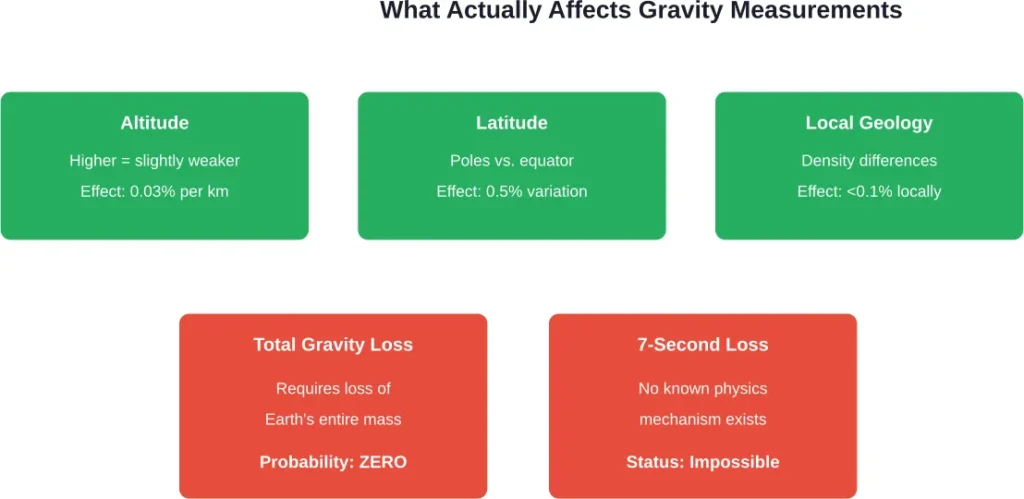
Earth’s gravity does vary slightly across its surface. But we’re talking tiny fluctuations—about 0.5% difference between the equator and poles. These variations come from Earth’s oblate shape and density differences in the crust.
NASA uses precise gravitational measurements for practical purposes. The gravity assist technique, fundamental to space exploration since the 1970s, relies on using planets’ gravitational fields to alter spacecraft trajectories. These maneuvers prove how consistent and predictable gravity remains.
According to Georgia State University’s HyperPhysics resources, Earth’s escape velocity is approximately 11.2 kilometers per second (approximately 6.9 miles per second). This value represents the speed needed to break free from Earth’s gravitational pull and hasn’t changed—nor will it change—unless Earth’s mass fundamentally changes.
Why These Conspiracy Theories Gain Traction
The gravity loss hoax isn’t unique. Similar viral claims pop up regularly, often tied to specific dates that come and go without incident.
These theories exploit genuine scientific concepts—black holes, gravitational waves, planetary mechanics—and twist them into fictional scenarios. Add a legitimate organization like NASA for credibility, create urgency with a specific date, and the formula spreads effectively across social platforms.
The 2026 gravity loss claim gained particular momentum because it came with detailed (fabricated) documentation and technical terminology. People shared it not necessarily because they believed it, but because they wanted others to debunk or confirm it.
Frequently Asked Questions
No. This claim is completely fabricated. Earth’s gravity is determined by its mass and cannot temporarily shut off. NASA has explicitly debunked this conspiracy theory, confirming no such event is possible or predicted.
If gravity somehow ceased, everything not anchored would begin lifting off as Earth’s rotation continued. The atmosphere would start escaping into space, oceans would rise from their basins, and geological structures would become unstable. However, this scenario violates fundamental physics.
Not exactly. Astronauts in orbit experience weightlessness because they’re in continuous freefall around Earth. At Space Shuttle altitudes (approximately 125 miles), Earth’s gravity is still approximately 90% as strong as on the surface. They’re not escaping gravity—they’re falling around the planet.
No. A black hole close enough to affect Earth would increase gravitational forces, not decrease them. Black holes don’t “cancel out” gravity—they’re regions of extremely intense gravitational pull. Any black hole interaction would be catastrophic for entirely different reasons.
Yes, but minimally. Gravity varies by about 0.5% between the equator and poles due to Earth’s oblate shape and rotational effects. Local variations also occur based on altitude and geological density differences, but these changes are tiny and constant—not sudden disappearances.
Never. NASA has no projects, documents, or predictions regarding Earth losing gravity. The “Project Anchor” document referenced in viral posts is completely fabricated. NASA’s actual gravitational research focuses on understanding gravitational waves, planetary mechanics, and using gravity assists for spacecraft navigation.
There isn’t any. The viral claims misuse scientific terminology without actual scientific basis. Gravity emerges from mass according to well-understood physical laws. No known mechanism in physics allows for temporary gravitational shutdown without the complete disappearance of the mass creating that gravity.
The Bottom Line on Earth Losing Gravity
Earth isn’t losing gravity in 2026, 2027, or any other year. Gravity isn’t a feature that can fail or switch off—it’s a fundamental consequence of mass existing in spacetime.
The viral conspiracy theories demonstrate how easily scientific-sounding claims can spread, especially when tied to specific dates and legitimate organizations. But the physics is clear and unchanging: Earth’s gravity will continue functioning exactly as it has for billions of years.
When you encounter similar claims in the future—and you will—remember the basic principle: gravity exists because mass exists. For Earth to lose its gravitational field, Earth itself would have to cease existing. That’s not happening in seven seconds or seven billion years of normal planetary evolution.
Stay skeptical of viral scientific claims, especially those predicting specific catastrophic dates. Real scientific discoveries don’t leak through fabricated documents—they’re published in peer-reviewed journals and announced through official channels.