

Quick Summary: Yes, naturally occurring black hair is real and exists in approximately 90% of the world’s population. What appears as “true black” hair is technically a very dark brown containing high concentrations of eumelanin pigment, but this doesn’t make it any less legitimate as black hair—it’s determined by genetics, specifically the MC1R gene inherited from both parents.
Walk down any street and you’ll notice that black hair dominates human hair color worldwide. But here’s where things get interesting—there’s ongoing debate about whether “true” black hair actually exists or if it’s just an extremely dark shade of brown.
The answer involves genetics, melanin chemistry, and how light interacts with hair pigments. And yes, black hair is absolutely possible and entirely natural.
The Genetics Behind Black Hair
Hair color isn’t random. It’s coded into your DNA through specific genes passed down from your parents.
According to research on human hair pigmentation, this trait is one of the most visible and heritable phenotypes. The genetic basis underlying normal variation in pigmentary traits has been extensively studied to understand the diversity seen both between and within human populations.
The MC1R gene plays the starring role here. About 90% of the total world population carries this gene, which is why black and brown hair dominate globally. To have black hair, you must inherit this gene from both parents. When inherited from only one parent, brown hair typically results instead.
But the MC1R gene doesn’t work alone. Multiple genes interact to determine your final hair color, including variations in the melanocyte-stimulating hormone receptor gene that influence pigmentation patterns.
How Inheritance Actually Works
Hair color genetics follow a somewhat predictable pattern, though it’s more complex than the simple dominant-recessive model you might remember from high school biology.
Black hair is generally dominant over lighter colors. If both parents carry genes for black hair, their children will almost certainly have black hair. However, if one parent has black hair and the other has a lighter shade, the outcome depends on which specific gene variants each parent carries.
Research shows that country of sampling explains approximately 35% of variation in skin pigmentation and 31% of variation in hair pigmentation, demonstrating how genetics are stratified along axes of geographic differentiation.
The Science of Hair Pigmentation
Now here’s where the chemistry comes in. Hair color depends entirely on melanin—the same pigment that colors your skin.
According to NIH research on human hair melanins, melanocytes produce two distinct types of melanin pigment: brown to black eumelanin and yellow to reddish brown pheomelanin. Hair color diversity arises mostly from the quantity and ratio of these two melanin types.
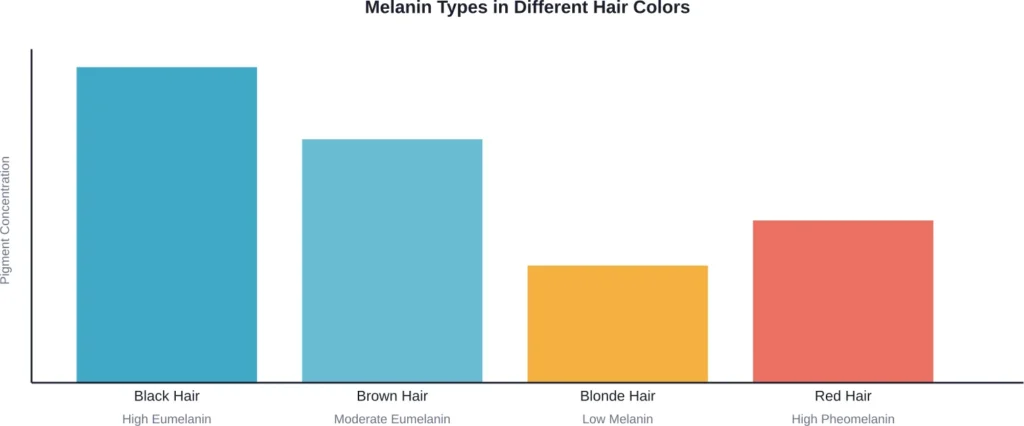
Black hair contains overwhelmingly high concentrations of eumelanin with minimal pheomelanin. Brown hair has moderate eumelanin levels. Red hair flips the script with high pheomelanin and low eumelanin. Blonde hair has the least total melanin of all natural colors.
Where Melanin Gets Made
Melanin production happens in specialized cells called melanocytes located in hair follicles. According to NIH research on hair follicle pigmentation, hair bulb melanocytes are activated cyclically, with melanogenesis being tightly coupled to the hair growth cycle.
Hair grows throughout anagen phase (approximately 3-5 years on average in human scalp), followed by a brief regression phase. During active growth, melanocytes synthesize melanin and transfer it to keratinocytes—the cells that form the actual hair shaft.
This creates a permanent record. Once melanin is deposited into the growing hair shaft, it stays there until that hair falls out naturally.
Does “True” Black Hair Actually Exist?
Here’s the controversy: some argue that what we call “black” hair is technically just very dark brown.
They’re not entirely wrong from a pure optics standpoint. When examined under intense light or microscopy, the darkest human hair often reveals deep brown tones rather than absolute black. The darkest possible shade of brown can appear black under normal lighting conditions.
But does that semantic distinction really matter? Not practically speaking.
From a biological and genetic perspective, “black hair” is a legitimate classification. The genes that produce it are distinct from those that produce lighter brown shades. The visible appearance to the human eye is black, not brown. Culturally and scientifically, black hair is recognized as its own category.
Real talk: calling black hair “just dark brown” is like saying navy isn’t blue—it’s technically accurate under specific conditions but misses the practical reality.
Global Distribution of Black Hair
Black hair dominates worldwide for evolutionary reasons. According to NIH research on melanin pigmentation, melanin protects skin and hair from damaging effects of ultraviolet radiation. Eumelanin specifically provides photoprotective benefits, whereas pheomelanin can actually generate free radicals upon UV exposure.
This explains why populations from regions with intense sun exposure—Africa, Asia, the Middle East, the Americas, and Southern Europe—overwhelmingly have black or very dark brown hair.
| Region | Predominant Hair Color | Genetic Factors |
|---|---|---|
| East Asia | Black | High MC1R gene prevalence |
| South Asia | Black to dark brown | High eumelanin production |
| Africa | Black | Maximum UV protection adaptation |
| Southern Europe | Dark brown to black | Mediterranean genetic variants |
| Middle East | Black to dark brown | High eumelanin synthesis |
| Indigenous Americas | Black | Ancient Asian migration genetics |
Lighter hair colors emerged through mutations and became prevalent only in specific populations—primarily Northern European groups where intense sun protection offered less survival advantage.
Black Hair vs Dark Brown Hair
So what’s the actual difference between black and dark brown hair?
It comes down to eumelanin concentration. Black hair contains the maximum possible amount of eumelanin that human genetics can produce. Dark brown hair contains slightly less, allowing more light to reflect and reveal warm brown tones.
Under natural daylight, black hair appears as a deep, cool-toned black with possibly slight blue or purple undertones when light hits it directly. Dark brown hair shows warmer chocolate or coffee tones even in moderate lighting.

Genetically, the distinction matters for heredity predictions. Two parents with true black hair will virtually always have black-haired children. Two parents with dark brown hair have more variable outcomes depending on their specific gene variants.
Why Hair Color Changes Over Time
That jet-black hair you were born with might not stay that way forever.
According to NIH research on aging of the hair follicle pigmentation system, melanocyte function declines with age. The hair follicle pigmentation system contains some of the most highly proliferative tissues in the human body, but this activity decreases over time.
Just why human scalp hair is so luxuriant and pigmented in youth is unclear but may have had important evolutionary selective pressure, a trait unique among primates.
As melanocytes produce less melanin or stop functioning entirely, hair turns gray or white. This process can start as early as the 20s or not until the 60s depending on genetics. Some people maintain deeply pigmented black hair well into old age, while others gray prematurely.
Can You Change Your Hair to Black?
If you weren’t born with black hair, you’ve got options—though none will change your actual genetics.
Hair dye containing oxidative colorants can deposit black pigment into the hair shaft, creating jet black results that often appear even darker than natural black hair. These chemical processes open the hair cuticle and deposit synthetic pigments that replace or mask natural melanin.
Temporary and semi-permanent dyes coat the hair shaft exterior without significantly penetrating. Permanent dyes use ammonia or similar agents to open the cuticle and deposit color deeply within the cortex.
But here’s the thing: dyed black hair behaves differently than natural black hair. It may appear flat or overly intense under certain lighting. It requires maintenance as roots grow out. And it won’t pass down to your children—genetics don’t care about your dye job.
Common Myths About Black Hair
Let’s clear up some widespread misconceptions.
Myth: Black hair is always straight. Wrong. Hair texture and hair color are controlled by completely different genetic mechanisms. Black hair can be straight, wavy, curly, or coily. East Asians typically have straight black hair, while many African populations have tightly coiled black hair.
Myth: Black hair can’t be damaged by the sun. While eumelanin does provide UV protection, prolonged sun exposure can still degrade hair proteins and fade even the darkest black hair to a reddish-brown tone.
Myth: Everyone with black hair has dark eyes. Eye color and hair color genes overlap but aren’t identical. Some people have black hair with light brown, hazel, or even green eyes, though dark eyes are more common with black hair.
Myth: Black hair doesn’t need conditioning. All hair types need moisture and protection regardless of color. Black hair texture varieties often require intensive conditioning, especially if tightly coiled.
Frequently Asked Questions
Black is a legitimate natural hair color caused by maximum eumelanin concentration. While it may reveal dark brown undertones under intense light microscopy, it’s genetically and visibly distinct from brown hair under normal conditions.
Approximately 90% of the world’s population carries the MC1R gene that produces black or brown hair, with the vast majority having black hair as the dominant shade across Asia, Africa, the Americas, and parts of Europe.
It’s extremely rare but theoretically possible if both parents carry recessive genes for lighter colors. The child would need to inherit the recessive variant from both parents, which becomes more likely if the parents have ancestors with lighter hair.
High concentrations of eumelanin can create subtle light interference effects that produce blue or purple iridescence when light hits the hair shaft at certain angles—similar to how raven feathers appear iridescent.
No evidence suggests black hair grays faster than other colors. The age at which graying begins is genetically determined and varies by individual regardless of natural hair color. Gray hair may appear more noticeable against black hair due to higher contrast.
Not through any natural method. Hair color is determined during hair formation in the follicle. Once the hair shaft emerges, its melanin content is fixed. You can only chemically dye hair darker—you cannot naturally increase melanin in existing hair strands.
Hair color doesn’t determine hair health. Health depends on factors like moisture retention, protein structure, mechanical damage, and care practices. However, the melanin in darker hair does provide more natural UV protection than lighter shades.
The Bottom Line on Black Hair
So is it possible to have black hair? Absolutely—and it’s the most common hair color on Earth.
Black hair results from specific genetic inheritance, primarily the MC1R gene passed from both parents, which triggers maximum eumelanin production in hair follicles. This creates the deep, dark color that approximately 90% of humanity carries.
Whether you want to call it “true black” or “the darkest possible brown” comes down to semantics. The genetics are clear. The visual appearance is unmistakable. The cultural and scientific recognition is universal.
Black hair is real, natural, and beautifully diverse in its own right—appearing across countless ethnicities and combining with every hair texture imaginable. The science confirms what millions of people see in the mirror every day.
Understanding your hair’s genetic foundation doesn’t just satisfy curiosity—it helps you make informed decisions about care, styling, and what to expect for future generations. Whether you were born with black hair or choose to dye it that shade, you’re participating in humanity’s most common and historically significant hair color trait.