

Quick Summary: Most pregnant women feel their baby move for the first time between 18-24 weeks. While babies do move at 12 weeks, they’re typically too small for mothers to feel these movements. Second-time mothers may detect movement slightly earlier than first-time moms, but feeling distinct fetal movement at 12 weeks is extremely uncommon.
The question comes up constantly in pregnancy forums and community discussions. Women at 12 weeks pregnant report feeling what they believe are fetal movements, describing flutters, bubbles, or tiny sensations exactly where their uterus sits.
So what’s actually happening?
What Science Says About Fetal Movement at 12 Weeks
Here’s the thing—babies do move at 12 weeks. According to the American College of Obstetricians and Gynecologists (ACOG), the embryo stage ends at 8 weeks, transitioning to the fetal stage. By week 12, the fetus has developed enough to make movements.
But movement happening and mothers feeling that movement are two entirely different matters.
Research published in medical journals shows that the onset of maternal perception of fetal movements typically occurs in the second trimester. This timing can be delayed by several factors including higher maternal age, increased body mass index, first pregnancy (nulliparity), and anterior placental position.
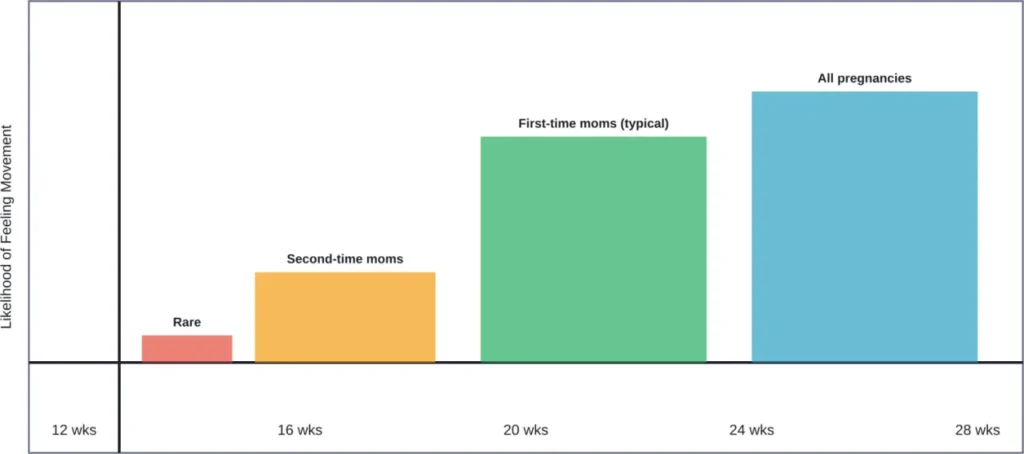
The Royal College of Obstetricians and Gynaecologists notes that first-time mothers typically feel movements between 18-24 weeks, while women in their second or subsequent pregnancies may notice them earlier.
That’s still several weeks away from the 12-week mark.
Why 12 Weeks Is Too Early for Most Women
At 12 weeks, the fetus is approximately half an inch long, having grown significantly from earlier weeks. The movements are happening, but they’re incredibly subtle.
Think about it this way: the baby is about the size of a plum, floating in amniotic fluid, with layers of uterine muscle, abdominal tissue, and skin between them and the outside world. Those tiny limb movements simply don’t generate enough force to be perceived.
WebMD acknowledges that while not common, some women do report sensations at 12 weeks. The medical consensus? It’s possible but extremely rare.
What You’re Actually Feeling
Community discussions reveal common experiences at 12 weeks that feel like fetal movement but typically aren’t:
- Gas bubbles moving through the intestines
- Digestive processes and bowel movements
- Abdominal muscle twitches
- Uterine stretching and ligament sensations
- Blood flow changes in the pelvic region
These sensations concentrate in the lower abdomen, exactly where the uterus sits at 12 weeks. No wonder they feel convincing.
The Difference Between Movement and Quickening
Quickening—the medical term for first perceived fetal movements—has specific characteristics that distinguish it from other abdominal sensations.
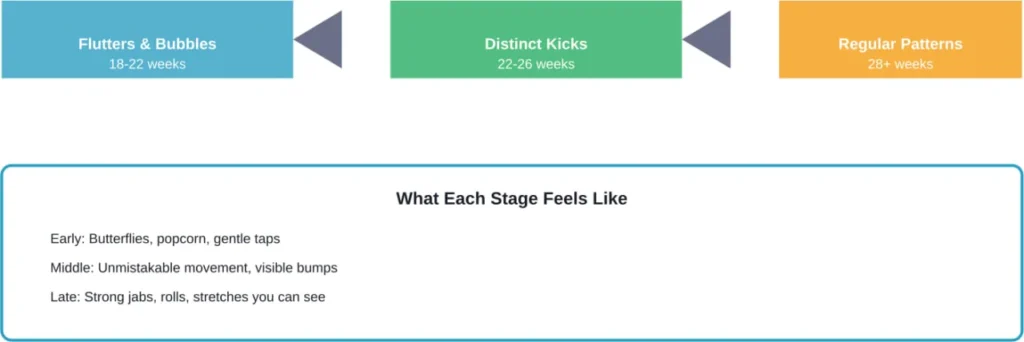
Quickening is described as feeling like flutters, bubbles, or tiny pulses. Women describe it as butterflies, popcorn popping, or gentle taps from the inside.
But here’s what makes quickening distinct: it becomes more frequent, stronger, and eventually develops into recognizable patterns.
Second Pregnancies: The Exception That Proves the Rule
Second-time mothers may have an advantage due to experience recognizing movement sensations, and the uterine muscle may be more easily stretched, potentially allowing earlier detection. Some experienced mothers report feeling movement as early as 14-15 weeks in subsequent pregnancies.
BabyCenter community discussions include reports of obstetricians validating early movement claims for second-time mothers, though such cases remain uncommon.
But even for experienced mothers, 12 weeks pushes the absolute earliest boundary of possibility.
Factors That Affect When You Feel Movement
Medical research identifies several variables that influence quickening timing:
| Factor | Effect on Movement Detection |
|---|---|
| Pregnancy number | Subsequent pregnancies may detect movement earlier than first pregnancies |
| Body mass index | Higher BMI delays detection |
| Placental position | Anterior placenta acts as cushion, delays feeling |
| Maternal age | Increased maternal age may affect timing of movement detection |
| Amniotic fluid levels | Normal levels allow earlier detection |
Placental position deserves special attention. An anterior placenta (attached to the front uterine wall) creates a cushioning layer between baby and abdominal wall. Women with anterior placentas often don’t feel movement until 20-22 weeks or later.
Conversely, a posterior placenta (back wall) removes this barrier, potentially allowing slightly earlier detection.
What Actually Happens at 12 Weeks
According to ACOG’s developmental timeline, significant growth occurs during week 12:
- The brain and nervous system continue rapid development
- Facial features become more defined
- Limbs can flex and extend
- Reflexive movements begin
- The fetus can move if poked (though nobody’s doing that)
These movements exist. Ultrasound technology captures them clearly. During a 12-week ultrasound, many parents see their baby moving, turning, or even appearing to wave.
The disconnect isn’t about whether movement happens—it’s about whether that movement generates enough sensation to be perceived through multiple tissue layers.
When to Expect Real Fetal Movement
The Royal College of Obstetricians and Gynaecologists provides clear guidance: most women feel their baby move between 18-24 weeks.
Initial movements feel subtle—flutters, bubbles, or gentle rolling sensations. As pregnancy progresses, movements become unmistakable kicks, jabs, and rolls.
By the third trimester, fetal movement develops patterns. Studies indicate babies have sleep periods that mostly last between 20 and 40 minutes, and are rarely longer than 90 minutes, during which movement stops.
Why This Matters for Pregnancy Health
Fetal movement monitoring becomes important later in pregnancy. The Royal College of Obstetricians and Gynaecologists emphasizes that changes in movement patterns warrant medical attention.
But at 12 weeks? Movement isn’t yet a reliable health indicator simply because most women can’t feel it.
The focus at 12 weeks centers on other markers: ultrasound measurements, fetal heart rate, and nuchal translucency screening. These provide meaningful information about fetal development and health.
Once quickening begins—whenever that happens for your individual pregnancy—paying attention to movement patterns becomes valuable. Decreased movement or significant changes should prompt contact with healthcare providers.
Frequently Asked Questions
Extremely rarely. Research shows first-time mothers typically feel movement between 18-24 weeks. While babies do move at 12 weeks, they’re usually too small for first-time mothers to detect these movements through uterine and abdominal walls.
Ultrasound at 12 weeks often shows the fetus moving limbs, changing position, and making reflexive movements. These movements are visible on screen but generally not strong enough for mothers to feel them internally.
Most sensations at 12 weeks are gas bubbles, digestive activity, abdominal muscle twitches, or sensations from the uterus stretching. These commonly occur in the lower abdomen where the uterus sits, making them feel like they could be baby movement.
Not necessarily earlier, but potentially more frequently once quickening begins. Twin pregnancies follow similar timelines for first movements—typically 18-20 weeks for first pregnancies, possibly 16-18 weeks for subsequent pregnancies.
Absolutely not. The vast majority of healthy pregnancies don’t have perceptible movement at 12 weeks. According to medical research, average quickening occurs in the second trimester, with normal variation depending on individual factors.
Once regular movement is established (typically after 24-28 weeks), contact your healthcare provider if you notice a significant decrease in movement, a sudden change in pattern, or if movement stops. At 12 weeks, movement isn’t yet a monitoring tool.
An anterior placenta can delay movement detection, but since most women don’t feel movement at 12 weeks regardless of placental position, it’s not the primary factor at this stage. The cushioning effect becomes more relevant around 18-22 weeks when movement typically becomes detectable.
The Bottom Line
Can you feel your baby move at 12 weeks? Medical evidence and research indicate it’s extremely uncommon, though not absolutely impossible.
Babies do move at 12 weeks—ultrasounds prove that clearly. But feeling those movements requires the fetus to be large enough and strong enough to create sensations that travel through amniotic fluid, uterine muscle, and abdominal tissue.
For most pregnant women, that threshold arrives between 18-24 weeks. Second-time mothers may detect movement a few weeks earlier thanks to experience and previous uterine stretching.
If you’re experiencing sensations at 12 weeks, they’re most likely digestive, muscular, or related to normal pregnancy changes. That doesn’t make them less real or meaningful—pregnancy brings countless new physical experiences.
The first unmistakable flutter will come. And when it does, you’ll know. Until then, trust that your 12-week ultrasound and other prenatal monitoring provide the reassurance you need about your baby’s development and wellbeing.