

Quick Summary: While true fat gain of 5 pounds in a single day is physiologically impossible (it would require consuming roughly 17,500 excess calories), seeing this number on the scale is completely normal and almost always reflects temporary water retention, sodium intake, food volume, digestive contents, or hormonal fluctuations—not actual fat gain.
Stepping on the scale and seeing a 5-pound increase from yesterday can trigger instant panic. Your first thought might be: How is this even possible? Did I really undo weeks of progress in 24 hours?
Here’s the thing though—that dramatic number isn’t telling the full story. Body weight fluctuates constantly throughout the day and from day to day. Sometimes dramatically.
According to HealthPartners, daily body weight can fluctuate by as much as five or six pounds in a single day depending on various factors including diet, movement, stress levels, and more. But that doesn’t mean all those pounds are fat.
Let’s break down what’s actually happening when the scale shows a sudden jump.
The Math Behind Real Fat Gain
To understand why gaining 5 pounds of actual fat in one day is essentially impossible, we need to talk numbers.
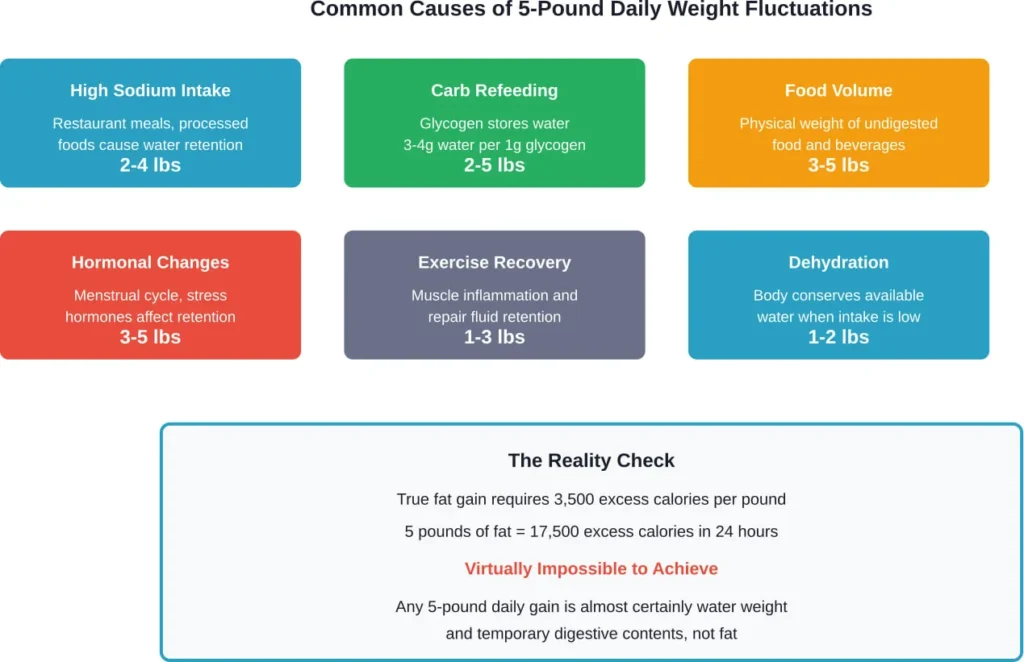
One pound of body fat contains approximately 3,500 calories. That’s the energy stored in adipose tissue. So to gain 5 pounds of pure fat in 24 hours, someone would need to consume roughly 17,500 calories above their maintenance level.
Let’s put that in perspective. According to the National Research Council, under normal circumstances, more than 95% of food energy is digested and absorbed from the gastrointestinal tract. When more energy is consumed than needed for metabolism and physical activity, the excess is stored primarily as adipose tissue.
For most people, maintenance calories vary based on age, sex, activity level, and body composition. Adding 17,500 calories on top of that means consuming somewhere between 19,000 and 20,000 total calories in a single day.
Real talk: That’s physically difficult to achieve even if someone tried deliberately.
What Actually Causes Overnight Weight Gain
So if it’s not fat, what’s causing that 5-pound jump on the scale? Several factors contribute to temporary weight fluctuations that have nothing to do with actual fat gain.
Water Retention and Sodium Intake
Sodium is one of the biggest culprits behind sudden scale increases. When sodium intake spikes—from restaurant meals, processed foods, or salty snacks—the body retains extra water to maintain proper sodium-to-water balance.
Excess sodium consumption causes the body to retain water to maintain proper sodium-to-water balance. Restaurant meals typically contain high amounts of sodium, which is more than double the recommended daily intake.
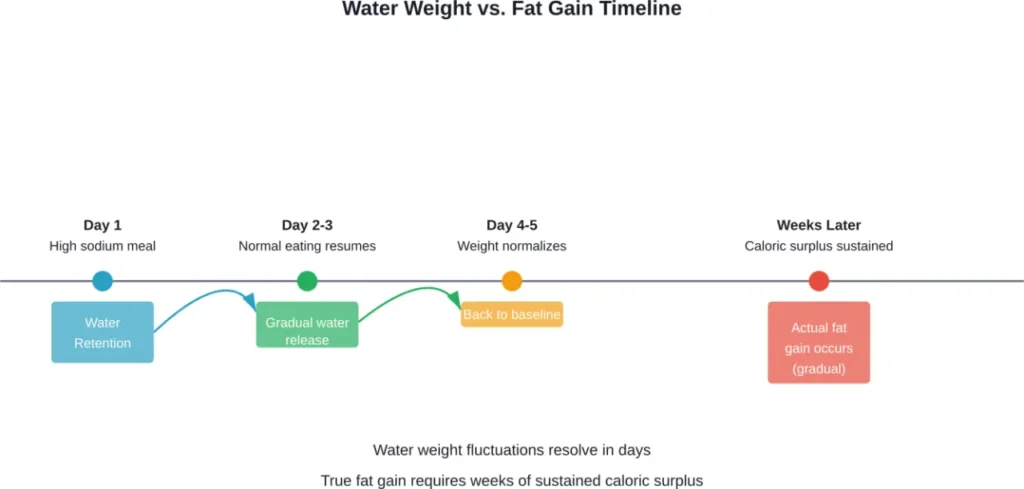
That water weight shows up immediately on the scale. But it’s temporary. Once sodium levels normalize over the next day or two, that excess water is released.
Carbohydrate Storage and Glycogen
Carbohydrates don’t just provide energy—they also influence water balance. When carbohydrates are consumed, they’re stored in muscles and liver as glycogen. Carbohydrates are stored as glycogen with associated water retention.
After a high-carb meal or refeed day, glycogen stores increase, bringing significant water along for the ride. This explains why people following low-carb diets often see dramatic initial weight loss—they’re depleting glycogen and its associated water, not burning fat at superhuman speed.
Food Volume and Digestive Contents
This might seem obvious, but it’s worth stating: the actual weight of food and beverages consumed adds temporary weight until fully digested and eliminated.
A large dinner with appetizers, entree, dessert, and drinks can easily weigh 3-5 pounds on its own. That physical mass shows up on the scale the next morning because it’s still moving through the digestive system.
According to Mayo Clinic, about 10% of calories eaten are used for digesting food and taking in nutrients—a process that takes hours or even days depending on the meal’s composition.
Hormonal Fluctuations
Hormones play a significant role in water retention and weight fluctuations, particularly for women. During the luteal phase of the menstrual cycle (the two weeks before menstruation), progesterone levels rise, causing the body to retain more fluid.
Women may experience water weight gain in the week leading up to their period due to hormonal changes. This resolves naturally once menstruation begins and hormone levels shift again.
Exercise and Muscle Inflammation
Intense workouts, especially strength training or new exercise routines, cause microscopic tears in muscle fibers. That’s how muscles grow stronger. But the repair process involves inflammation and increased fluid in the affected tissues.
After a particularly hard training session, temporary water retention around damaged muscle fibers can add to scale weight temporarily. This is actually a sign the body is recovering and adapting, not a problem to worry about.
Dehydration Paradox
Counterintuitively, dehydration can actually cause water retention. When the body doesn’t get adequate fluids, it holds onto available water as a protective mechanism.
Proper hydration—drinking enough water consistently—actually helps reduce water retention and promotes a more stable scale weight.
When Weight Gain Becomes a Medical Concern
While daily fluctuations are normal, certain patterns of rapid weight gain warrant medical attention. Cleveland Clinic recommends seeing a healthcare provider if weight gain reaches specific thresholds.
According to Cleveland Clinic guidelines, individuals should consult their provider if they gain 2 to 3 pounds per day, 5 pounds in a week, or 5% or more of total body weight in a month. This type of unexpected weight gain may signal an underlying health condition.
Medical Conditions That Cause Rapid Weight Gain
Several health conditions can lead to genuinely rapid weight accumulation:
- Heart failure: When the heart doesn’t pump efficiently, fluid accumulates in tissues, particularly in the legs, abdomen, and lungs
- Kidney disease: Impaired kidney function reduces the body’s ability to eliminate excess fluid and sodium
- Thyroid disorders: Hypothyroidism slows metabolism and causes fluid retention
- Cushing’s syndrome: Excess cortisol production leads to fat accumulation, particularly in the face, neck, and abdomen
- Polycystic ovary syndrome (PCOS): Hormonal imbalances can cause weight gain and difficulty losing weight
Certain medications can also contribute to weight gain. According to Mayo Clinic, beta blockers—commonly prescribed for heart conditions and high blood pressure—can cause weight gain as a side effect, with average gains of about 2.6 pounds over six months or more.
How to Manage Daily Weight Fluctuations
Understanding that weight naturally fluctuates helps reduce the anxiety that comes from daily weigh-ins. But there are also practical strategies to minimize dramatic swings and get a more accurate picture of actual trends.
Establish Consistent Weigh-In Conditions
For the most reliable data, weigh at the same time each day under identical conditions. The best time is typically first thing in the morning after using the bathroom and before eating or drinking.
This minimizes variables like food weight, hydration status, and clothing differences. Consistency matters more than the specific time chosen.
Track Trends, Not Individual Data Points
A single weigh-in provides limited information. What matters is the trend over weeks and months, not day-to-day changes.
Many find it helpful to calculate a weekly average weight rather than obsessing over daily numbers. This smooths out natural fluctuations and reveals the actual direction of change.
Control Sodium Intake
Moderating sodium consumption helps reduce water retention fluctuations. This doesn’t mean eliminating salt entirely—sodium is an essential nutrient. But being mindful of high-sodium processed foods, restaurant meals, and excessive added salt can stabilize scale weight.
Stay Adequately Hydrated
Drinking sufficient water throughout the day prevents the water retention that comes from dehydration. It also supports proper kidney function and helps the body eliminate excess sodium.
Consider Ditching the Daily Weigh-In
For some people, daily weighing provides useful data and helps maintain awareness. For others, it creates unnecessary stress and anxiety.
Weekly weigh-ins can provide trend information without the emotional rollercoaster of daily fluctuations. There’s no universal right answer—the best frequency depends on individual psychology and goals.
| Weight Change Pattern | Typical Cause | Time to Resolve | Action Needed |
|---|---|---|---|
| 1-5 lbs overnight | Water retention, food volume, sodium | 1-3 days | None, normal fluctuation |
| 2-3 lbs per day consistently | Possible medical condition | Does not resolve on its own | See healthcare provider |
| 5+ lbs in one week | Possible fluid retention or medical issue | Variable | Consult doctor |
| 5% body weight in one month | Underlying health condition likely | Requires medical evaluation | Schedule appointment immediately |
| Post-workout increase | Muscle inflammation, glycogen replenishment | 2-4 days | None, sign of recovery |
| Premenstrual gain | Hormonal water retention | Resolves with menstruation | None, normal cycle |
The Role of Calorie Timing and Metabolism
Recent research has explored whether when calories are consumed affects weight gain beyond just the total calorie count. According to NIH research on meal timing and metabolism, eating burns more energy when restricted to certain times of the day.
Studies have found that timing of eating can affect metabolism and weight gain patterns. Research published in Cell Metabolism examined how timing of daily calorie intake affects appetite and hunger responses in subjects with obesity, finding that morning-loaded calorie intake has been advocated as a dietary strategy to improve weight loss.
However, these effects relate to long-term weight management strategies, not the question of gaining 5 pounds in a single day. The metabolic differences from meal timing are measured in percentages of total energy expenditure, not dramatic overnight changes.
Understanding True Weight Management
Mayo Clinic emphasizes that despite all the diet trends and theories, weight management fundamentally comes down to energy balance—calories consumed versus calories burned through activity and metabolism.
According to Mayo Clinic guidance on metabolism and weight loss, resting metabolic rate (the amount of energy the body uses at rest) makes up the largest portion of daily calorie burn. For most individuals, their basal metabolic rate should account for 60-70% of daily calories, as noted by HealthPartners. So if total intake is 2,000 calories, approximately 1,200-1,400 calories go toward basic body functions.
The Physical Activity Guidelines for Americans recommends at least 150 minutes of moderate-intensity physical activity per week for adults to support weight maintenance and overall health benefits.
But here’s what’s important: these guidelines address long-term patterns, not single-day events. Sustainable weight management happens over weeks and months, not in 24-hour periods.
Psychological Impact of Scale Obsession
The emotional response to seeing a 5-pound increase can be more damaging than the weight itself. For people working toward health goals, dramatic scale fluctuations can trigger discouragement, anxiety, and abandonment of otherwise effective strategies.
Understanding the science behind weight fluctuations provides psychological protection against this response. When someone knows that an overnight gain is physiologically impossible to be fat, they can avoid the spiral of negative thoughts and restrictive behaviors that often follow.
Some individuals benefit from focusing on non-scale metrics entirely: how clothes fit, energy levels, strength improvements, endurance gains, or body measurements. These indicators often provide more meaningful feedback about health progress than daily scale weight.
Frequently Asked Questions
No, gaining 5 pounds of actual fat in one day is physiologically impossible. It would require consuming approximately 17,500 calories above maintenance level in 24 hours—an amount extremely difficult to achieve even intentionally. Any 5-pound overnight gain reflects water retention, food volume, sodium intake, or hormonal fluctuations, not fat accumulation.
According to HealthPartners, daily body weight can fluctuate by as much as five or six pounds depending on factors like food intake, sodium consumption, hydration status, exercise, hormonal changes, and digestive contents. These fluctuations are completely normal and don’t indicate actual fat gain or loss.
Cleveland Clinic recommends seeing a healthcare provider if there’s a gain of 2 to 3 pounds per day consistently, 5 pounds in one week, or 5% or more of total body weight in one month. These patterns may indicate underlying medical conditions such as heart failure, kidney disease, thyroid disorders, or medication side effects that require professional evaluation.
Exercise, particularly strength training or intense workouts, causes microscopic tears in muscle fibers as part of the normal adaptation process. The body responds with inflammation and increased fluid retention in affected tissues to facilitate repair. This temporary water weight typically resolves within 2-4 days and is actually a sign of healthy recovery and muscle building.
Yes, adequate hydration actually helps reduce water retention. When the body is dehydrated, it conserves available water as a protective mechanism. Drinking sufficient water consistently signals that fluid is readily available, allowing the body to release excess stored water and eliminate sodium more efficiently.
Water weight from high sodium intake, carbohydrate refeeding, or hormonal fluctuations typically resolves within 1-4 days once normal eating patterns resume and the body rebalances its fluid levels. Exercise-related water retention from muscle inflammation may take slightly longer, usually 2-4 days depending on workout intensity.
Whether to weigh daily depends on individual psychology and goals. For some people, daily data provides useful trend information and helps maintain awareness without causing stress. For others, daily fluctuations create anxiety and discouragement. Weekly weigh-ins can provide sufficient trend data while minimizing the emotional impact of normal daily variations. Choose the frequency that supports mental health and long-term adherence to healthy habits.
The Bottom Line on Daily Weight Fluctuations
Seeing a 5-pound increase on the scale overnight can be alarming, but it’s almost never cause for panic. The mathematics of fat storage make it clear that gaining 5 pounds of actual fat in 24 hours is virtually impossible under normal circumstances.
What looks like dramatic weight gain is typically a combination of water retention from sodium intake, glycogen storage with its associated water, the physical weight of undigested food, hormonal fluctuations, or exercise-related inflammation. These factors are temporary and resolve naturally within days.
The key is understanding the difference between scale weight and body composition. Scale weight includes everything—bones, organs, muscle, fat, water, and digestive contents. Body composition focuses on the ratio of fat to lean tissue, which changes much more gradually.
For those tracking weight as part of health goals, focusing on weekly trends rather than daily numbers provides a more accurate picture of actual progress. Better yet, combining scale data with other metrics like measurements, progress photos, fitness performance, and how clothes fit creates a comprehensive view that isn’t derailed by normal fluctuations.
But if weight gain follows the concerning patterns Cleveland Clinic outlines—consistent daily gains, 5 pounds in a week, or significant percentage increases in a month—medical evaluation is warranted to rule out underlying conditions.
Otherwise, that overnight 5-pound jump is just the body doing what bodies do: fluctuating in response to food, fluids, activity, and hormones. Give it a few days, stay consistent with healthy habits, and watch it normalize.