

Quick Summary: Working 80 hours a week is technically possible and legal in most jurisdictions, but it comes with significant health risks and sustainability challenges. According to WHO research, working 55+ hours weekly is associated with a 35% higher risk of stroke and 17% higher risk of dying from ischemic heart disease compared to 35-40 hour weeks. While some professionals in demanding fields temporarily work these hours, it’s rarely sustainable long-term without serious consequences to physical health, mental wellbeing, and relationships.
The 80-hour work week sounds like a badge of honor in hustle culture. Startup founders brag about it. Medical residents endure it. Investment bankers wear it like armor.
But here’s the thing—just because something’s possible doesn’t make it sustainable. Or safe. Or even as productive as people think.
So is working 80 hours a week actually possible? The short answer: yes, physically it can be done. People do it. The better question is whether anyone should, and what the real costs look like when they do.
What Does an 80-Hour Work Week Actually Look Like?
Before diving into whether it’s advisable, let’s break down what 80 hours means in practical terms.
Spread across a traditional 5-day work week, that’s 16 hours per day. Wake up at 6 AM, start work by 7 AM, finish at 11 PM. Factor in commute time, and there’s barely room for eating, much less sleeping.
Most people working these hours shift to 6 or 7-day weeks instead. On a 6-day schedule, that’s roughly 13-14 hours daily. A 7-day week brings it down to about 11.5 hours per day, which sounds more manageable until you realize there are zero days off.
| Work Days per Week | Hours per Day | Available Non-Work Hours |
|---|---|---|
| 5 days | 16 hours | 8 hours (sleep impossible) |
| 6 days | 13-14 hours | 10-11 hours |
| 7 days | 11-12 hours | 12-13 hours (no rest days) |
Community discussions reveal that people working over 60 hours sleep over an hour less on average than those with standard schedules. At 80 hours, sleep deprivation becomes nearly unavoidable.
Is Working 80 Hours a Week Legal?
The legal landscape around extreme work hours is surprisingly permissive in many countries, though protections exist in others.
In the United States, the Fair Labor Standards Act (FLSA) establishes minimum wage and overtime requirements but doesn’t cap maximum work hours for most employees. According to the Department of Labor, non-exempt workers must receive overtime pay (1.5 times regular rate) after 40 hours weekly, but there’s no federal prohibition on working 80 hours.
Certain industries have specific limitations. The Department of Veterans Affairs Health Care Personnel Enhancement Act of 2004 encourages limiting nurses to 12 consecutive hours or 60 hours in a 7-day period (except emergency care), but this is guidance rather than hard law for most healthcare settings.
The United Kingdom takes a stricter approach through the Working Time Regulations, setting a 48-hour average over 17 weeks unless workers opt out. Many EU countries have similar protections.
| Jurisdiction | Maximum Hours | Overtime Rules |
|---|---|---|
| United States (Federal) | No cap | 1.5x pay after 40 hrs (non-exempt) |
| United Kingdom | 48-hour average (opt-out allowed) | Varies by contract |
| European Union | 48-hour average | Country-specific rules |
Real talk: just because something’s legal doesn’t mean employers should push it. OSHA requires workplaces free from recognized hazards likely to cause death or serious harm—and as we’ll see, extended hours create exactly those risks.
The Health Consequences Nobody Talks About Enough
This is where the rubber meets the road. Working extreme hours isn’t just tiring—it’s medically dangerous.
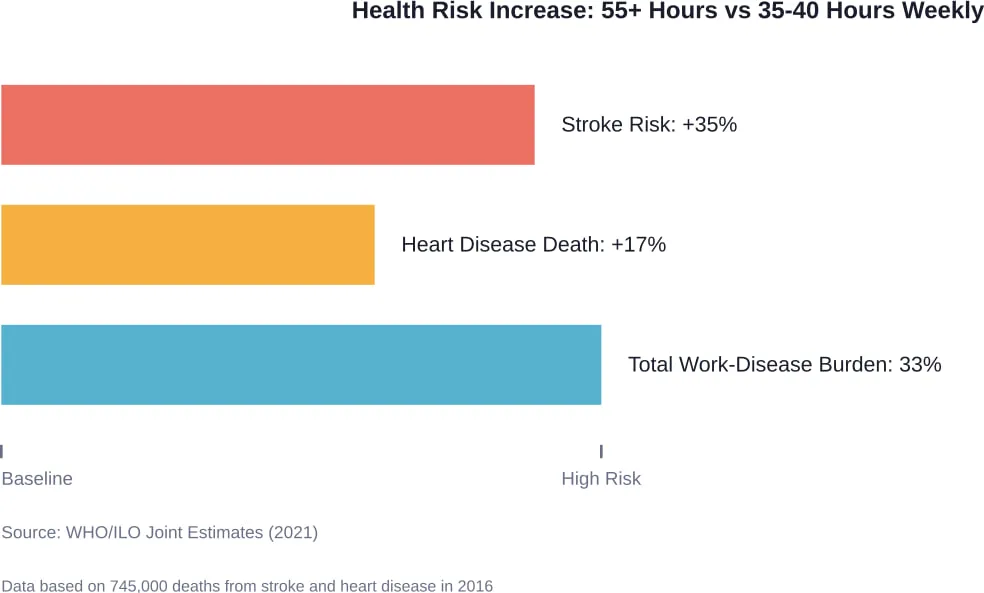
In 2021, the World Health Organization and International Labour Organization released joint estimates showing that working 55 or more hours weekly led to 745,000 deaths from stroke and ischemic heart disease in 2016—specifically 398,000 from stroke and 347,000 from heart disease. This represented a 29% increase since 2000.
The WHO study found that working 55+ hours per week is associated with a 35% higher risk of stroke and 17% higher risk of dying from ischemic heart disease compared to 35-40 hour weeks. Most deaths occurred in people aged 60-79 who had worked long hours between ages 45-74.
Long working hours now account for about one-third of the total estimated work-related disease burden, making it the occupational risk factor with the largest disease burden globally.
A 2019 meta-analysis covering studies from 1998 to 2018 found an overall odds ratio of 1.245 between long working hours and poor occupational health, affecting physiological health, mental health, and health behaviors.
Worker fatigue from extended hours has been a factor in catastrophic industrial disasters including the 2005 Texas City BP oil refinery explosion, the 2009 Colgan Air Crash, and the Chernobyl nuclear accident, according to OSHA documentation.
Mental Health Takes a Hit Too
The World Health Organization estimates that 15% of working-age adults had a mental disorder in 2019, with poor working environments—including excessive workloads—posing significant risks.
Depression and anxiety cost the global economy approximately 12 billion working days annually, translating to $1 trillion per year in lost productivity. Extended work hours contribute substantially to this burden.
Who Actually Works 80 Hours a Week?
These schedules aren’t theoretical. Real professionals hit these numbers, at least temporarily.
Medical residents historically work extended hours as part of training, though this practice faces ongoing scrutiny and some regulatory reforms have introduced limitations. Investment banking analysts, especially at top firms, regularly report 80-100 hour weeks during busy periods. Management consultants traveling to client sites often face similar demands.
Startup founders and entrepreneurs frequently cite 80+ hour weeks while building businesses. Tech sector workers at high-growth companies sometimes hit these numbers during product launches or critical development phases.
Here’s what’s interesting though—community discussions suggest that many people claiming 80-hour weeks aren’t accurately tracking time. When forced to log hours precisely, the actual working time (excluding breaks, meals, and unproductive periods) often falls closer to 60-70 hours.
The Productivity Paradox
Okay, so what about results? Surely working twice as much produces twice as much output?
Not even close.
Research consistently shows that productivity per hour drops dramatically as work hours extend. Someone working 80 hours doesn’t produce twice what they’d produce in 40 hours—cognitive function declines, mistakes increase, and decision-making quality deteriorates.
After certain thresholds, additional hours may produce negative value. The errors, rework, and poor decisions made while exhausted can undo productive work from earlier in the week.
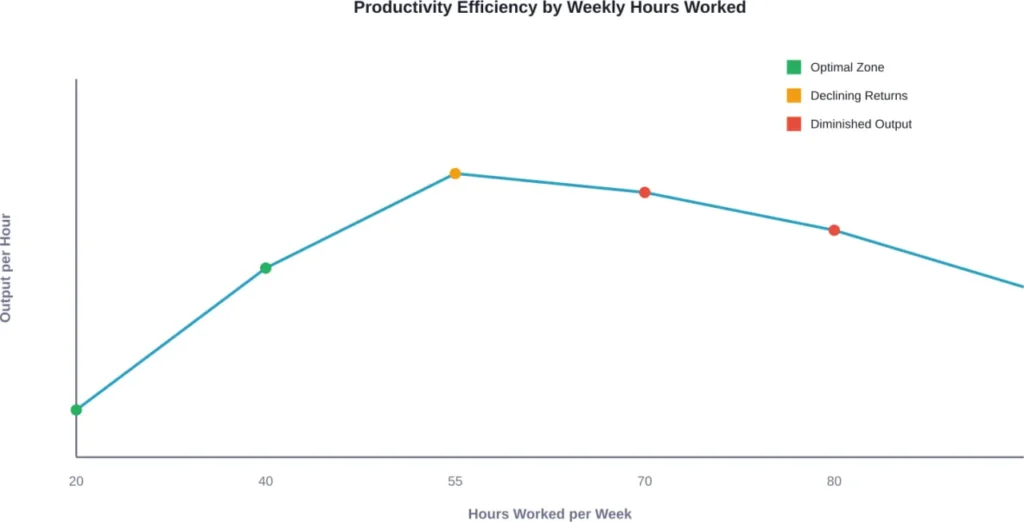
This explains why many high-performing companies in competitive industries increasingly reject long-hour cultures. They’ve realized that well-rested teams working 45-50 focused hours outperform exhausted teams grinding 80 hours.
When 80-Hour Weeks Make Sense (If Ever)
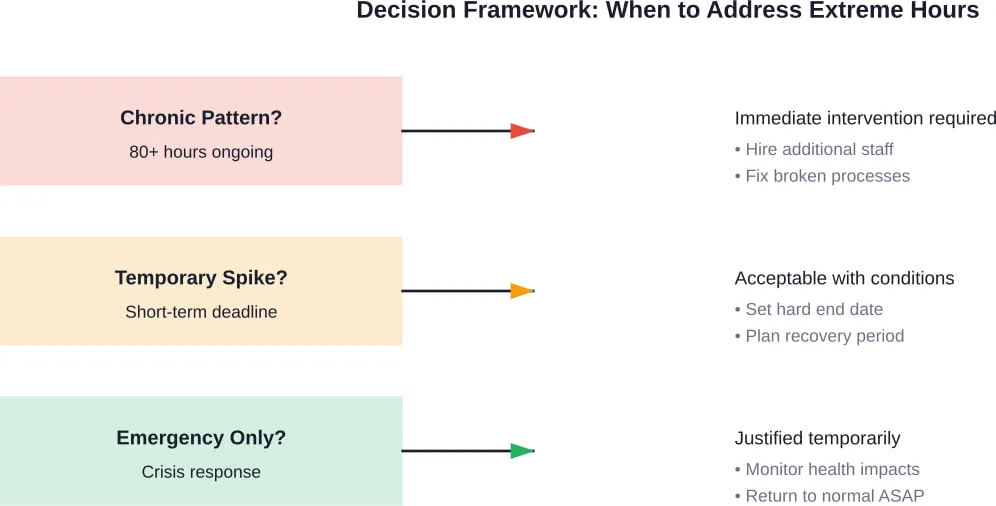
That said, some situations may temporarily justify extreme hours.
Entrepreneurs in the early stages of launching a business often work extreme hours because they’re building something from nothing. The difference: they’re choosing this trade-off with clear understanding of the costs and (hopefully) an exit strategy.
Medical residents historically work extended hours as part of training, though this practice faces ongoing scrutiny and some regulatory reforms have introduced limitations. Crisis response situations—natural disasters, critical infrastructure failures, emergency medical situations—sometimes demand temporary extreme hours to address immediate threats.
Critical project deadlines in consulting, software development, or deal-making occasionally require short-term sprints. The key word: short-term.
Even in these scenarios, smart organizations build in recovery periods. A few weeks of 80-hour sprints followed by lighter schedules for recovery. Continuous 80-hour weeks for months on end? That’s not strategy—it’s organizational dysfunction.
Survival Strategies If You’re Already Working These Hours
Maybe the philosophy doesn’t matter right now because you’re in the thick of it. What then?
Protect Sleep Above All Else
Sleep deprivation compounds every other problem. Community reports indicate people working over 60 hours sleep significantly less, creating a downward spiral of declining performance and health.
Aim for minimum 6-7 hours nightly, even if it means other things get dropped. Sleep isn’t negotiable—it’s when the brain processes information, consolidates memory, and repairs cellular damage.
Optimize Every Non-Work Hour
With only 88 non-work hours in a week (and that’s with zero days off), efficiency matters everywhere else. Meal prep on less-busy days. Keep healthy ready-to-eat food available. Cut commute time if possible—remote work, temporary relocation closer to the office, or adjusted hours to avoid traffic.
Batch personal tasks. One focused hour handling bills, appointments, and household management beats scattered attempts throughout the week.
Set a Hard End Date
Open-ended extreme hours are psychologically devastating. If working 80 hours toward a specific goal (product launch, business milestone, exam period), put the end date on the calendar and commit to recovery time afterward.
Without an end date, there’s no light at the end of the tunnel—just a tunnel that keeps extending.
Monitor Your Health Actively
Given the WHO findings on cardiovascular risks, anyone working extreme hours should monitor blood pressure, manage stress where possible, and watch for warning signs like chest pain, severe headaches, or unusual fatigue beyond normal tiredness.
This isn’t being dramatic—the research shows real health consequences. Catching problems early matters.
Alternatives to the 80-Hour Trap
For employers and managers designing work schedules, consider these approaches instead of defaulting to extreme hours:
Strategic staffing: Most 80-hour situations result from understaffing. Hiring additional team members costs money upfront but prevents burnout, turnover, medical leave, and the quality problems from overworked staff.
Temporary contract workers: During predictable busy periods, bring in contractors or temp workers rather than crushing permanent staff with unsustainable hours.
Realistic project timelines: Many extreme-hour situations stem from artificially aggressive deadlines. Building realistic timelines from the start prevents crisis mode from becoming the default.
Process improvement: Before adding hours, examine whether inefficient processes, poor tools, or organizational dysfunction are creating unnecessary work. Fixing the system often eliminates the need for extreme hours.
What Current Workers Should Know
If considering a position that requires 80-hour weeks, go in with eyes open.
Ask pointed questions during interviews: Is this temporary or expected ongoing? What percentage of people in this role work these hours? How long do people typically maintain this schedule? What support does the organization provide?
Understand the trade-offs clearly. An 80-hour week leaves virtually no time for relationships, hobbies, health maintenance, or personal development outside work. That might be acceptable for a defined period toward a specific goal, but not as a lifestyle.
According to WHO/ILO estimates, 488 million people worldwide work long hours (55+), with some countries like South Korea seeing 25.2% of employees working at least 50 hours per week, compared with an average of 11% in OECD member countries. These patterns are increasing rather than decreasing, particularly as remote work blurs boundaries between work and personal time.
Frequently Asked Questions
Working 80 hours weekly carries substantial health risks according to WHO research, including 35% higher stroke risk and 17% higher heart disease risk at just 55+ hours. Short-term periods may be manageable with proper sleep and recovery, but sustained 80-hour weeks are not medically safe for most people.
Spread across 6 days, 80 hours leaves approximately 10-11 non-work hours daily for sleep, meals, commute, and everything else. Realistically, this typically results in 5-6 hours of sleep, which is below the recommended 7-9 hours and contributes to cognitive decline and health problems.
For non-exempt workers, overtime pay (1.5x after 40 hours under FLSA) can make 80-hour weeks financially significant in the short term. However, health costs, reduced productivity per hour, and career burnout often negate financial gains over time. Exempt salary workers get no additional pay for extra hours.
Investment banking analysts, management consultants, medical residents (historically), startup founders, and some legal associates regularly face 80+ hour weeks, particularly during busy periods. However, many organizations in these fields are reconsidering these practices due to health concerns and retention problems.
Most people cannot sustain 80 hours for more than a few weeks or months before experiencing serious health consequences, productivity collapse, or burnout. Even those who believe they’re managing well often show measurable cognitive decline, increased errors, and health markers indicating stress damage.
Community discussions suggest significant exaggeration—many claiming 80-hour weeks aren’t accurately tracking time. When forced to log hours precisely, actual focused work time often measures 60-70 hours including breaks and unproductive time. Some genuinely do work 80+ hours during crisis periods, but sustained patterns are rarer than claimed.
In the United States, there’s no federal cap on maximum hours, though non-exempt workers must receive overtime pay after 40 hours. The UK and EU countries limit work to 48-hour averages with opt-out provisions. OSHA requires employers to maintain workplaces free from recognized hazards, which includes fatigue-related risks from extended hours.
The Bottom Line
So is it possible to work 80 hours a week? Sure. People do it.
Is it sustainable, healthy, or even particularly productive? The evidence says no.
The WHO research is unambiguous: working 55+ hours increases serious health risks, and 80 hours amplifies those dangers substantially. OSHA documentation links extended hours to industrial disasters and workplace fatalities. Productivity research shows diminishing and eventually negative returns beyond certain hour thresholds.
For individuals already facing these demands: protect sleep, set end dates, monitor health actively, and recognize this isn’t sustainable long-term. Start planning exit strategies whether that means role transitions, business maturity, or career changes.
For employers: recognize that chronic 80-hour weeks indicate organizational problems—understaffing, poor processes, unrealistic timelines, or dysfunctional culture. Fixing those root causes produces better outcomes than grinding people into the ground.
Work matters. Careers matter. Ambition matters. But none of it matters if the person doing the work ends up dead at 65 from a stroke that was 35% more likely because they spent years working unsustainable hours.
The 80-hour work week is possible. But just because something’s possible doesn’t mean it’s wise.