

Quick Summary: Yes, it is possible to break your penis, though it contains no bones. A penile fracture occurs when trauma to an erect penis tears the tunica albuginea, the fibrous tissue surrounding erectile chambers. This rare but serious injury most commonly happens during sexual intercourse and requires immediate surgical treatment for best outcomes.
The idea of breaking your penis sounds like an urban legend. After all, there’s no bone in there to fracture, right?
Here’s the thing though—penile fractures are very real. And while they’re uncommon, they represent a genuine medical emergency that demands immediate attention.
This injury happens when the tunica albuginea—a fibrous tissue sheath surrounding the erectile chambers—tears during trauma to an erect penis. Research shows penile fractures typically occur during sexual activity when sudden, forceful bending damages this protective layer.
What Exactly Is a Penile Fracture?
A penile fracture isn’t a broken bone. The penis contains no skeletal structure.
Instead, this injury involves rupture of the tunica albuginea, the tough membrane encasing the corpora cavernosa—two cylindrical chambers that fill with blood during erection. When an erect penis experiences blunt trauma or sudden bending, pressure inside these chambers can spike dramatically.
If that pressure exceeds what the tunica albuginea can handle, it tears. That’s a penile fracture.
The tunica albuginea is remarkably strong under normal circumstances. But during erection, it stretches thin—from about 2mm to 0.5mm thick. This makes it vulnerable to rupture if hit or bent forcefully.
How Do Penile Fractures Happen?
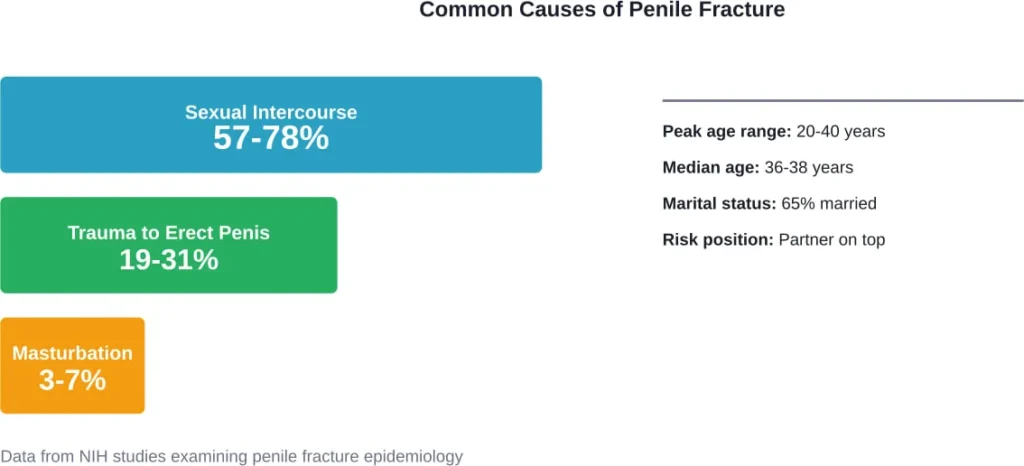
Sexual intercourse causes most penile fractures. Research found that 57.2% of confirmed penile fractures resulted from direct blunt trauma to the erect penis during intercourse.
The typical scenario? The penis slips out during thrusting and strikes the partner’s pelvis or perineum. Certain positions carry higher risk—particularly when the partner is on top, which reduces the man’s control over thrust depth and angle.
Other causes include:
- Rolling over onto an erect penis during sleep
- Forceful masturbation
- Bending an erection to make it subside
- Sports injuries or direct blows to an erect penis
One study examining 86 penile fracture cases found that 68% (34) of patients were between ages 20 and 40, with the remaining 32% outside this range. The median age across multiple studies ranges from 36-38 years, with one study reporting median age of 38 years and another reporting mean age of 36.74 years.
Recognizing the Symptoms
Research indicates this condition typically causes distress and significantly affects sexual health.
The most common signs include:
- Audible crack or pop: Many patients report hearing a snapping sound at the moment of injury
- Immediate loss of erection: The penis rapidly becomes flaccid
- Severe pain: Intense discomfort develops immediately
- Swelling and bruising: The penis swells substantially, often developing dark purple or black discoloration (the “eggplant deformity”)
- Abnormal angle: The penis may bend or curve abnormally
All operated cases reported pain and subsequent swelling of the penis, with all patients experiencing loss of erection. Blood may appear at the urethral opening if the urethra is also damaged—this happens in 1-38% depending on geographic region.
Real talk: if you hear a crack during sex followed by immediate pain and rapid swelling, don’t wait to see if it improves. This is an emergency.
Why Immediate Medical Care Matters
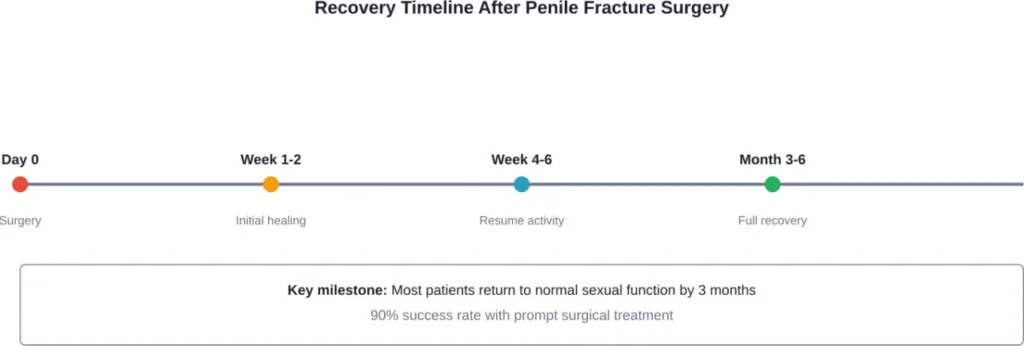
The timing of treatment directly impacts outcomes. Studies show that up to 90% of patients regain normal erectile function when treated promptly with surgery.
Delayed treatment increases complications significantly. Patients who wait develop higher rates of:
- Erectile dysfunction
- Permanent penile curvature
- Painful erections
- Urethral complications
One study found that 50% of patients presented within 6 hours of injury, while the remaining 50% presented between 3-6 weeks after injury. Those who delayed treatment experienced substantially worse outcomes.
The short answer? Get to an emergency department immediately. Don’t ice it, don’t “wait and see,” don’t try to sleep it off.
Diagnosis and Treatment
Diagnosis typically relies on clinical history and physical examination. The classic presentation—trauma during sex, audible crack, immediate detumescence, and eggplant deformity—makes the diagnosis fairly straightforward.
Some physicians order ultrasound or MRI to locate the tear precisely, though many proceed directly to surgery based on clinical findings alone.
Surgical Repair
Surgery is the gold standard treatment. The surgical procedure involves locating and closing the tear with sutures under anesthesia, as well as checking for urethral damage and repairing if necessary.
Surgical repair proves highly effective, with up to 90% of patients regaining normal erectile function when treated promptly.
Most patients stay overnight for observation. Recovery involves several weeks of abstinence from sexual activity—typically 4-6 weeks minimum.
Non-Surgical Approaches
Some older studies explored conservative management using compression bandages, splints, and anti-inflammatory medications. However, research consistently shows this approach results in worse outcomes.
Non-surgical treatment leads to higher rates of permanent curvature, erectile dysfunction, and painful erections. That’s why current medical consensus strongly favors immediate surgical repair.
| Treatment Approach | Success Rate | Complication Risk | Recovery Time |
|---|---|---|---|
| Immediate Surgery | 90% normal function | Low | 4-6 weeks |
| Delayed Surgery | 60-70% normal function | Moderate | 6-8 weeks |
| Non-Surgical | 30-50% normal function | High | 8-12 weeks |
Long-Term Outcomes and Sexual Function
Now, this is where it gets interesting. What happens to sexual function after penile fracture repair?
Research examining sexual outcomes found that 83% (13 of 16) of patients were mostly satisfied or very satisfied with their sex life following surgical repair. No patients reported insufficient erection for penetration (EHGS: 1 or 2) in that surgical series.
But wait. Outcomes depend heavily on several factors:
- Time to surgery: Shorter delays mean better results
- Extent of injury: Larger tears or urethral involvement increase complication risk
- Surgical technique: Experienced surgeons achieve better outcomes
- Age and baseline health: Younger, healthier patients recover better
One study analyzing 62 cases with long-term follow-up found the median age was 38 years. Sexual intercourse caused 66.1% of cases, while 30.6% resulted from turning in bed or other trauma to an erect penis.
Prevention Strategies
Can penile fractures be prevented? Generally speaking, awareness reduces risk.
Consider these protective measures:
- Maintain control during vigorous sexual activity
- Use caution with positions where the partner is on top
- If the penis slips out during intercourse, reposition carefully rather than thrusting
- Avoid forceful bending of an erection
- Don’t manipulate an erection to make it subside
Some cultural practices contribute to higher rates. Research examining penile fractures in Iran found certain regions have considerably higher incidence due to specific practices like forceful penile manipulation.
When to Seek Emergency Care
Seek immediate medical attention if experiencing:
- Cracking or popping sound during sexual activity or penile trauma
- Sudden loss of erection with severe pain
- Rapid swelling and bruising of the penis
- Abnormal penile shape or angle
- Blood at the urethral opening
- Difficulty urinating after penile trauma
Don’t let embarrassment delay treatment. Emergency department staff handle these injuries professionally, and early intervention dramatically improves outcomes.
Frequently Asked Questions
Penile fractures are uncommon but not extremely rare. Studies show stable incidence rates in emergency departments, with approximately one quarter of patients undergoing immediate surgical repair. The exact incidence varies by region and reporting practices.
While conservative management exists, surgery represents the gold standard. Research consistently demonstrates that surgical repair achieves better outcomes—up to 90% of patients regain normal erectile function compared to 30-50% with non-surgical approaches.
Yes. Most patients resume normal sexual activity after healing. Studies found that 83% of surgically treated patients reported satisfaction with their sex life within months of recovery. Physicians typically recommend waiting 4-6 weeks minimum before resuming sexual activity.
This term describes the characteristic appearance of a fractured penis—severe swelling combined with dark purple or black bruising that makes the organ resemble an eggplant. This distinctive presentation helps physicians diagnose the injury quickly.
No. Urethral injury accompanies penile fracture in 1-38% depending on geographic region. When present, it requires additional surgical repair. Blood at the urethral opening suggests possible urethral involvement.
Potential complications include erectile dysfunction, penile curvature, painful erections, and urethral stricture. However, prompt surgical treatment minimizes these risks significantly. Complication rates differ significantly between immediate surgical intervention and delayed or non-surgical approaches.
Yes. Physicians typically schedule follow-up appointments at 3 months and 6 months post-surgery to assess healing and erectile function. Some patients may need longer monitoring depending on injury severity and complications.
Final Thoughts
So yes, it’s absolutely possible to break your penis despite the absence of bones. A penile fracture represents a genuine medical emergency requiring immediate surgical intervention.
The good news? With prompt treatment, outcomes are excellent. Research demonstrates that 90% of patients achieve normal erectile function when surgery happens quickly.
The key is recognition and rapid response. If trauma occurs during sexual activity followed by a crack, immediate pain, and rapid swelling—don’t wait. Get to an emergency department immediately.
If experiencing symptoms of penile fracture, seek emergency medical care now. Time matters for optimal recovery and long-term sexual function.