

Quick Summary: Yes, surviving a plane crash is not only possible but statistically likely. According to data, more than half of passengers survive takeoff-related accidents, and landing crashes have high survival rates when proper safety measures are followed. Most modern aircraft accidents are survivable, especially during takeoff and landing phases.
The thought of a plane crash terrifies most travelers. But here’s something that might surprise anyone who’s gripped their armrest during turbulence: surviving a plane crash isn’t just possible—it’s actually the most common outcome in aviation accidents.
The reality contradicts what Hollywood has taught us. Most airplane crashes don’t end with total destruction. Many are survivable events where passengers walk away with minor injuries or no injuries at all.
So what does the data actually say? And what factors determine whether passengers survive?
The Reality of Airplane Crash Survival Rates
Aviation accidents get sensationalized in media coverage, creating a distorted perception of survivability. The actual numbers tell a different story.
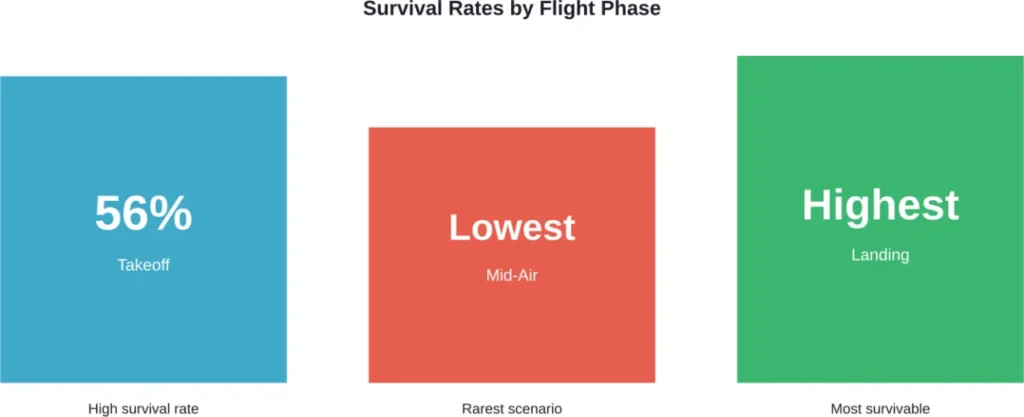
Studies show that more than half—specifically 56%—of passengers survive takeoff-related accidents. Most takeoff crashes happen on or near the runway, meaning emergency responders can often get to survivors quickly.
The National Transportation Safety Board (NTSB) maintains comprehensive aviation accident data from 1962 onward, tracking civil aviation accidents and selected incidents within the United States and international waters. This database reveals patterns that aviation safety experts use to improve aircraft design and emergency protocols.
According to aviation medicine research, in-flight medical impairment of pilots has been associated with commercial airline accidents, though this represents a probability of approximately 4% of in-flight medical events. The data demonstrates that mechanical failures and human error are survivable when aircraft are designed with crashworthiness in mind.
Survival Odds Across Different Flight Phases
Not all moments during flight carry equal risk. The phase of flight dramatically impacts both crash likelihood and survival chances.
Takeoff: High Risk, But Survivable
Takeoff represents one of the most critical moments. Aircraft are heavy with fuel, climbing at steep angles, and haven’t yet reached cruising altitude.
When takeoff accidents occur, they typically happen at lower speeds and altitudes compared to other flight phases. This proximity to the ground—paradoxically—can work in passengers’ favor. Emergency services are immediately available at airports, and evacuation can begin within seconds.
The 56% survival rate for takeoff accidents reflects these factors. Passengers have successfully evacuated through emergency exits even when aircraft have sustained significant damage during aborted takeoffs or runway overruns.
Mid-Air: The Rarest Scenario
Mid-air incidents are extraordinarily rare but carry the highest risk. At cruising altitude—typically 30,000 to 40,000 feet—aircraft face different challenges.
Structural failures, severe turbulence, or catastrophic mechanical issues at altitude leave less margin for recovery. The distance from the ground means longer descent times, but also means pilots have more time to attempt emergency procedures.
That said, mid-air emergencies don’t always end in crashes. Pilots have successfully landed aircraft after engine failures, decompression events, and electrical system malfunctions. The aviation industry’s emphasis on redundant systems exists precisely to handle these scenarios.
Landing: Most Common, Most Survivable
Landing represents the phase where most accidents occur—and where survival rates are highest. Aircraft are traveling at lower speeds, closer to emergency services, and pilots have maximum control authority.
Hard landings, runway overshoots, and landing gear failures happen with some regularity. Most result in minor injuries or no injuries at all. Modern aircraft are designed with crumple zones, reinforced passenger compartments, and fire-resistant materials specifically to protect occupants during landing accidents.
The proximity to airports means firefighting equipment and medical personnel can respond within minutes, dramatically improving survival outcomes.
Design Features That Improve Survivability
Modern aircraft incorporate numerous safety features specifically designed to protect passengers during crashes. These aren’t accidents—they’re the result of decades of accident investigation and engineering improvements.
The FAA’s Rotorcraft Safety Promotion Concept identifies voluntary design and equipment features that enhance safety. While this focuses on helicopters, similar principles apply to fixed-wing aircraft: crashworthy fuel systems, energy-absorbing seats, and reinforced structures all improve occupant survivability.
Seats are engineered to withstand significant impact forces. Overhead bins are designed to stay closed during impacts. Floor lighting leads to exits even when cabin lights fail. Fire-blocking seat materials slow the spread of flames.
According to aviation safety research, these design improvements have contributed to steadily improving survival rates over the past several decades.
Factors That Determine Your Survival Chances
Beyond aircraft design and flight phase, several factors influence whether passengers walk away from accidents.
Seat Location Matters
Community discussions and anecdotal evidence suggest that seats near emergency exits offer advantages during evacuations. Passengers seated within five rows of an exit can typically reach it faster during evacuations when every second counts.
Rear seats have shown better survival statistics in some accident analyses, though this varies by accident type. The key isn’t necessarily finding the “safest seat” but understanding evacuation routes from wherever passengers sit.
Passenger Preparedness
Knowing where emergency exits are located increases survival odds. Passengers who identify and count seat rows to the nearest emergency exit can navigate smoke-filled cabins more effectively.
Understanding how to operate emergency exit doors, inflate life vests, and adopt brace positions—these aren’t just airline requirements. They’re practical skills that save lives during actual emergencies.
Speed of Evacuation
Fire and smoke pose the greatest post-crash threats. Aircraft are designed with rapid evacuation capability, even with exits compromised.
Passengers who hesitate to leave carry-on bags, who struggle with seatbelts, or who block aisles reduce everyone’s survival chances. The FAA’s Basic Survival Skills for Aviation training emphasizes immediate evacuation as critical to post-crash survival.
| Survival Factor | Impact Level | Key Actions |
|---|---|---|
| Seat Location | Moderate | Choose seats near exits when possible |
| Pre-Flight Awareness | High | Review safety card, locate exits, plan evacuation route |
| Brace Position | High | Learn and practice proper brace position |
| Evacuation Speed | Critical | Leave belongings, move quickly, assist others |
| Post-Crash Actions | Critical | Move away from aircraft immediately, avoid fuel spills |
Real-World Survival Examples
Recent incidents demonstrate that survival isn’t just theoretical. In a recent Air India crash, one passenger survived despite the aircraft reaching at least 600 feet before losing contact. Reports indicated this survivor was seated in an emergency exit seat and used the door to escape.
This case illustrates several survival principles: seat location near exits, quick decision-making, and immediate evacuation. While 242 others perished (out of 243 total passengers), the fact that survival was possible even in such catastrophic circumstances underscores that crashes aren’t universally fatal.
The NTSB database contains thousands of accidents where all or most passengers survived. These don’t make headlines, but they represent the statistical reality of modern aviation safety.
Medical Aspects of Crash Survival
Aviation medicine research has identified physiological factors that affect crash survivability. According to medical research on flight stressors, understanding physical gas laws is essential for comprehending stress experienced by the human body during flight.
Breathing air consists of approximately 78% nitrogen, 21% oxygen, and 1% inert gases. At mean sea level, pressure changes during rapid descents or cabin decompression can cause medical emergencies that complicate crash scenarios.
Research on aeromedical trauma patients has shown that in-flight deterioration occurs early, with a significant plateau in cumulative risk observed after approximately 50 minutes. This data helps emergency medical services prepare for aviation accidents.
Injuries during survivable crashes typically include blunt force trauma, smoke inhalation, and burns. Modern crashworthiness standards aim to minimize these through seat design, fire suppression systems, and rapid-evacuation protocols.
Frequently Asked Questions
More than half of aviation accidents are survivable, with takeoff accidents showing a 56% survival rate. Landing accidents tend to have even higher survival rates due to lower speeds and proximity to emergency services. The specific survivability depends on crash type, impact forces, and fire risk.
Seats within five rows of emergency exits offer evacuation advantages. Some data suggests rear seats have better survival statistics in certain accident types, though no single seat location guarantees safety. The most important factor is knowing your nearest exit and having an evacuation plan.
Mid-air catastrophic failures are the rarest and most dangerous scenarios. However, many mid-air emergencies don’t result in crashes—pilots successfully land aircraft after engine failures, decompression, and system malfunctions. Survival depends on the nature of the emergency and altitude when it occurs.
Aircraft are designed with rapid evacuation capability, even with exits compromised. Fire and smoke spread rapidly, making immediate evacuation critical. Passengers should leave all belongings and move quickly to the nearest usable exit.
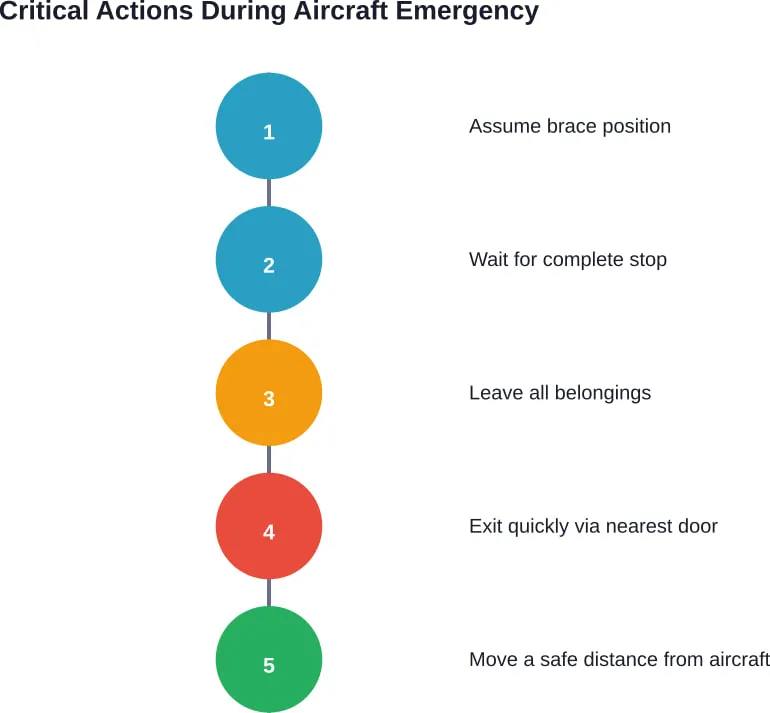
Before flight: review the safety card, locate emergency exits, and identify the nearest exits. During emergencies: adopt the brace position, wait for complete stop, leave all belongings, evacuate immediately via the nearest exit, and move a safe distance from the aircraft to avoid fire and explosion risks.
Yes. Modern aircraft incorporate crashworthy fuel systems, fire-resistant materials, reinforced passenger compartments, and energy-absorbing seats. The NTSB’s aviation accident database shows improving survival trends as these safety features have become standard. Pilot training and air traffic control systems have also advanced significantly.
Aircraft design is critical to survivability. The FAA and aviation safety organizations promote design features that enhance occupant protection: seats that withstand significant impact forces, overhead bins that stay closed during impacts, floor lighting systems that function during power loss, and materials that resist fire spread. These aren’t optional—they’re the result of decades of accident investigation and engineering improvements.
The Bottom Line on Plane Crash Survival
Surviving a plane crash is not only possible—it’s the most likely outcome in many accident scenarios. The data contradicts popular perception shaped by sensationalized media coverage of catastrophic accidents.
More than half of takeoff accidents are survivable. Landing accidents, which represent the most common accident phase, offer even better odds. Modern aircraft design, emergency response protocols, and pilot training all work together to protect passengers.
The key factors remain consistent: seat location near exits helps, pre-flight awareness of evacuation routes is critical, immediate evacuation saves lives, and leaving belongings behind isn’t optional—it’s survival strategy.
Aviation continues to be one of the safest forms of transportation precisely because the industry learns from every accident. The NTSB’s comprehensive accident database, combined with ongoing research into aviation medicine and crash survivability, drives continuous improvements in aircraft design and safety protocols.
So the next time anxiety creeps in during boarding, remember: pilots train extensively for emergencies, aircraft are engineered for crashworthiness, and survival is not just possible—it’s probable when passengers know what to do.