

Quick Summary: Research shows IQ can improve through targeted cognitive training, lifestyle changes, and sustained mental stimulation. While genetics play a role, brain plasticity allows for measurable gains at any age, though increases typically range from 3-10 points rather than dramatic jumps.
For decades, intelligence was considered fixed—something inherited from parents and unchangeable throughout life. The Intelligence Quotient (IQ) test, which has been around for nearly a century, reinforced this notion by treating cognitive ability as a static measure.
But here’s the thing: neuroscience has rewritten that script entirely.
The brain is far more adaptable than researchers once believed. Brain plasticity—the capacity for neural connections to reorganize and strengthen—remains active throughout life. This discovery has profound implications for anyone wondering whether intelligence can actually be improved.
What IQ Actually Measures (And What It Doesn’t)
Before exploring whether IQ can increase, understanding what these tests measure matters.
IQ tests assess two primary types of intelligence: fluid intelligence and crystallized intelligence. Fluid intelligence involves problem-solving, pattern recognition, and reasoning with new information. Crystallized intelligence reflects accumulated knowledge and skills developed through experience and education.
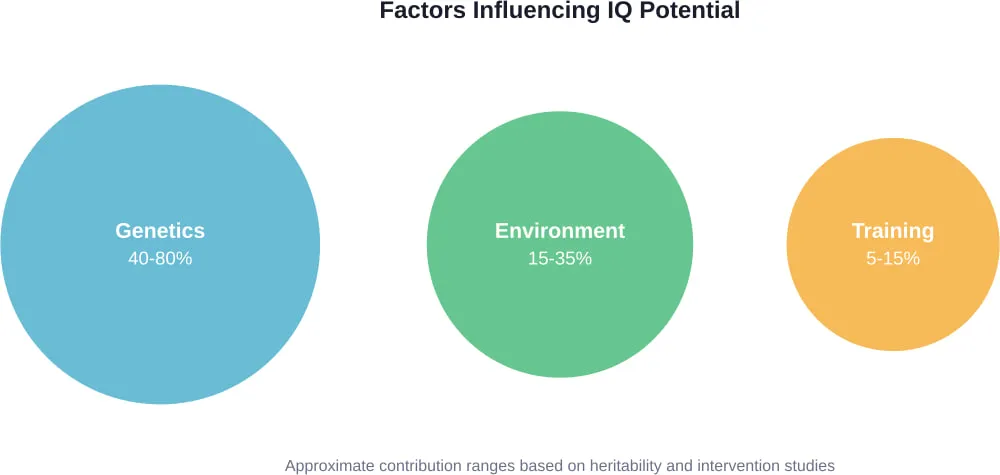
About 40-50% of the variability in cognitive test scores is due to general intelligence (g), which reflects the positive correlation among individuals’ scores on diverse cognitive ability tests. Twin studies have shown that heritability of intelligence can reach estimates of 50-80%, with some research reporting 86% for verbal IQ.
But that doesn’t mean intelligence is predetermined.
Heritability describes variation within a population, not individual potential. Environmental factors, education, nutrition, and mental stimulation all influence cognitive development. The paradox of intelligence is that heritability and malleability coexist—genetics set a range, but experience determines where someone falls within that range.
The Science Behind Brain Plasticity and Cognitive Enhancement
Neuroplasticity forms the biological foundation for cognitive improvement. The brain constantly reorganizes neural pathways based on experience, learning, and environmental demands.
Research on brain plasticity demonstrates that cognitive training programs produce measurable changes in brain structure and function. Studies examining plasticity-based adaptive cognitive training (such as the IMPACT study) found improvements in memory and attention among older adults, with gains transferring to untrained cognitive measures.
The aging brain retains capacity for both neuronal and cognitive plasticity. Even late in life, the brain can develop new neural connections and strengthen existing pathways through targeted mental exercises.
One particularly interesting finding involves dietary restriction. Research has shown that in a large range of species, dietary restriction has been observed to extend lifespan by 20-40% and appears to enhance cognitive function by promoting neuronal health.
Evidence From Real-World IQ Improvement Studies
Theory is one thing. Measurable results are another.
One landmark experiment conducted by R. Kvashchev in former Yugoslavia reported IQ increases of seven points following training in creative problem-solving. The study involved systematic cognitive training over extended periods, with participants showing improvements in both fluid and crystallized intelligence measures.
A large-scale online randomized controlled trial with 4,715 fully evaluable participants examined comprehensive cognitive training. Participants completed approximately 15-minute sessions at least 5 days per week for 10 weeks. Those assigned to the treatment group showed significant improvements on cognitive assessments compared to controls.
Brain training games have also demonstrated positive impact on cognitive function. Research involving 72 subjects (mean age 24.6±7.8 years in the active group) found that brain training games enhanced attention and memory functions compared to baseline measurements.
The key finding across studies? Improvement happens, but it requires sustained effort and appropriate training methods.
Practical Strategies That Actually Work
So what does evidence-based IQ improvement look like in practice?
Targeted Cognitive Training
Not all mental exercises produce equal results. Programs based on principles of brain plasticity show the strongest effects. These involve adaptive difficulty that adjusts to performance level, ensuring constant challenge without overwhelming frustration.
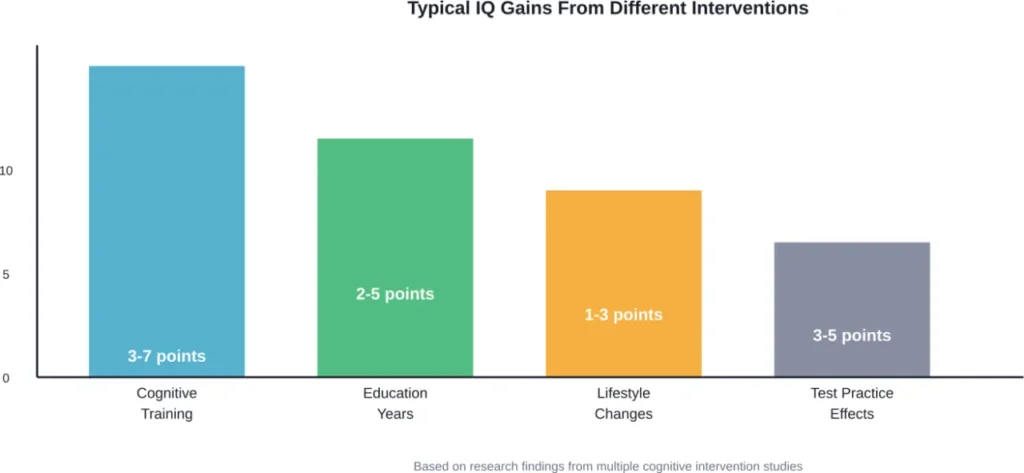
Effective cognitive training targets specific abilities: working memory, processing speed, attention control, and executive function. Training sessions typically last 15-30 minutes and require consistency—most studies showing results involve 5+ sessions weekly over 8-12 weeks.
Lifelong Learning and Education
Formal education correlates strongly with IQ scores, but learning doesn’t stop after school. Adults who engage in lifelong learning, mental training, and intellectually demanding activities maintain or improve cognitive abilities over time.
Learning genuinely new skills—not just consuming information—appears most beneficial. Acquiring a foreign language, mastering a musical instrument, or developing complex technical skills all demand the type of sustained cognitive effort that strengthens neural pathways.
Physical Exercise and Cognitive Function
The brain-body connection influences intelligence more than many realize. Cardiovascular exercise increases blood flow to the brain, promotes neurogenesis, and supports cognitive function.
Exercise also appears to slow cognitive aging. Research on aging and neuroplasticity suggests that delaying cognitive decline by just 5 years could reduce Alzheimer’s disease prevalence by half—physical activity represents one accessible intervention.
Nutrition and Brain Health
Dietary factors influence cognitive performance. Omega-3 fatty acids, antioxidants, and nutrients supporting mitochondrial function all contribute to brain health. Conversely, high-fat diets may impair cognitive function according to studies examining dietary effects on cognition.
| Strategy | Time Commitment | Expected Impact | Evidence Level |
|---|---|---|---|
| Adaptive cognitive training | 15-30 min daily | 3-7 point gain | Strong |
| Learning new complex skills | 5-10 hours weekly | 2-5 point gain | Moderate |
| Regular cardiovascular exercise | 30 min, 3-5x weekly | 2-4 point gain | Moderate |
| Optimal nutrition | Ongoing lifestyle | 1-3 point gain | Moderate |
| Quality sleep optimization | 7-9 hours nightly | 2-4 point gain | Moderate |
The Flynn Effect: Population-Level IQ Changes
Individual improvement potential becomes even clearer when examining population-level trends. The Flynn Effect describes the observation that average IQ scores have increased throughout the 20th century across developed nations.
Environmental improvements—better nutrition, increased educational access, reduced childhood disease, and more cognitively demanding environments—likely drove these gains. The effect demonstrates that intelligence responds to environmental conditions.
Recent evidence suggests the Flynn Effect may be reversing in some countries, with average scores plateauing or declining. This reversal reinforces that intelligence is malleable—environmental and lifestyle factors matter enormously.
Limitations and Realistic Expectations
Now for some real talk about what’s actually achievable.
Dramatic IQ increases—like jumping from average (100) to genius level (140+)—don’t happen through training alone. Genetics establish a range of potential, and while that range may be broader than once thought, boundaries exist.
Most cognitive training studies report improvements in the 3-10 point range. That’s meaningful—it could move someone within a meaningful range, though not fundamentally transformative.
Test familiarity also inflates scores. Taking multiple IQ tests typically improves scores by 3-5 points simply through practice effects. This doesn’t reflect genuine intelligence increases, just better test-taking skills.
Transfer effects present another challenge. Training often improves specific trained abilities without generalizing to broader intelligence. The most effective interventions show some transfer to untrained cognitive domains, but not universal enhancement.
Age Matters: When Improvement Is Easiest
Brain plasticity operates throughout life, but age influences improvement potential.
Childhood and adolescence represent peak plasticity periods. Mechanisms of learning and plasticity during these developmental stages allow for substantial cognitive gains. Early interventions produce the largest effects.
That doesn’t mean adults can’t improve. Studies of cognitive training in older adults consistently show gains, though rates of improvement may depend more heavily on lifestyle and consistency. A single test of general intelligence taken at age 11 correlated highly with the results of the test at the age of 90, demonstrating stability—but individual trajectories vary considerably.
The aging mind retains neuroplastic capacity. Older adults who maintain cognitively demanding activities, social engagement, and physical fitness show better cognitive preservation than sedentary peers.
Common Misconceptions About IQ Enhancement
Several myths about intelligence improvement deserve addressing.
Myth: Brain training apps alone boost IQ significantly. Most commercial brain training programs show limited transfer to general intelligence. While they may improve trained tasks, broad cognitive enhancement requires more comprehensive approaches.
Myth: IQ is completely fixed by genetics. Heritability estimates don’t mean individual outcomes are predetermined. Environmental enrichment, education, and training all influence cognitive development within genetic ranges.
Myth: High IQ guarantees success. Intelligence represents just one factor in achievement. Personality traits, motivation, emotional regulation, and opportunity all matter enormously. Some research even suggests that extremely high IQ may correlate with certain vulnerabilities.
Myth: One type of activity boosts all cognitive abilities. Different cognitive functions—working memory, processing speed, verbal ability, spatial reasoning—respond to different training. Comprehensive improvement requires diverse mental challenges.
Should You Even Try to Increase IQ?
Here’s where the conversation gets philosophical.
Critics rightfully warn against fixating on a single number. IQ tests measure certain cognitive abilities well but miss others entirely—creativity, practical problem-solving, social intelligence, and emotional awareness don’t show up on standard IQ assessments.
Chasing higher IQ scores as an end goal misses the point. The real value lies in developing cognitive capabilities that improve quality of life: better memory, sharper focus, faster learning, clearer reasoning.
Community discussions reflect this tension. Many recognize that while IQ might be somewhat malleable, obsessing over incremental gains creates unnecessary anxiety. Developing specific skills relevant to personal goals often proves more valuable than generic intelligence enhancement.
The healthiest approach? Engage in cognitively stimulating activities because they’re enriching and enjoyable, not solely to boost test scores. Learn new skills, stay curious, challenge assumptions, and maintain mental flexibility. If IQ improves along the way, that’s a bonus rather than the primary objective.
Frequently Asked Questions
Adults can increase IQ through targeted cognitive training, learning new complex skills, and lifestyle optimization. While childhood represents a peak plasticity period with greater potential for change, adult brains retain neuroplastic capacity. Studies show adults can achieve 3-7 point gains through sustained effort, though improvement may require more consistency than during developmental years.
Most research showing measurable IQ gains involves 8-12 weeks of consistent training, with sessions 5+ days weekly lasting 15-30 minutes. Some participants show improvements within 4-6 weeks, but sustained practice produces the most reliable results. Effects tend to fade without continued cognitive stimulation, suggesting ongoing engagement matters more than short-term intensive training.
Transfer effects vary considerably. The most effective interventions—comprehensive cognitive training programs based on brain plasticity principles—show some transfer to untrained cognitive domains and real-world tasks. However, many brain training programs improve only the specific trained abilities without generalizing broadly. Programs emphasizing diverse cognitive challenges and adaptive difficulty show stronger transfer than single-task training.
Crystallized intelligence—accumulated knowledge and skills—typically responds more readily to intervention since it builds directly through learning and experience. Fluid intelligence—abstract reasoning and novel problem-solving—proves harder to enhance but can improve through specific training targeting working memory and processing speed. Most people find knowledge acquisition easier than fundamental reasoning enhancement, though both show plasticity.
Lifestyle factors—regular cardiovascular exercise, optimal nutrition, quality sleep, stress management—support cognitive function and may produce modest IQ gains of 2-4 points. These interventions work best when combined with mental stimulation. Physical health creates conditions for cognitive performance, but challenging mental activities appear necessary for substantial intelligence enhancement. The combination produces better results than either approach alone.
The primary risk involves psychological rather than biological harm. Obsessing over IQ scores can create anxiety and reduce self-worth when gains don’t meet expectations. Some people neglect other valuable qualities—creativity, emotional intelligence, practical skills—while fixating on narrow cognitive metrics. The healthiest approach treats cognitive enhancement as one aspect of overall development rather than an all-consuming goal.
Realistic expectations involve gains of 3-10 points through comprehensive interventions combining cognitive training, education, physical exercise, and lifestyle optimization. Some experimental programs report larger increases, but typical results fall in this range. Improvements move individuals within their genetic potential range rather than transcending biological limits. A 5-7 point gain might shift someone within a meaningful range—meaningful but not transformative.
The Bottom Line on IQ Enhancement
So is it possible to increase IQ? Absolutely. Research conclusively demonstrates that intelligence is malleable, not fixed.
Brain plasticity allows for cognitive enhancement through targeted training, sustained learning, and lifestyle optimization. The most effective approaches combine adaptive cognitive exercises, acquisition of complex new skills, regular physical activity, proper nutrition, and quality sleep.
Realistic gains typically range from 3-10 points rather than dramatic transformations. That’s enough to make a measurable difference in cognitive performance and quality of life without fundamentally altering someone’s intellectual capacity.
The bigger picture matters more than the numbers. Developing sharper thinking, better memory, improved focus, and faster learning enriches life regardless of test scores. Mental fitness—like physical fitness—requires ongoing effort rather than one-time interventions.
Stop worrying about hitting some arbitrary IQ target. Instead, commit to lifelong learning, embrace intellectual challenges, and maintain curiosity. Keep the brain active, the body healthy, and the mind engaged. Intelligence will take care of itself.