

Quick Summary: Breaking a lease means terminating your rental agreement before it expires, which typically results in financial penalties including forfeiture of your security deposit, responsibility for rent until a new tenant is found, and potential early termination fees. Tenants may legally break a lease without penalty in specific circumstances like active military duty, uninhabitable conditions, or landlord harassment. Understanding your rights and the proper procedures can minimize financial consequences.
Life doesn’t always follow the timeline set by rental agreements. Job relocations happen. Relationships change. Health issues arise. Sometimes breaking a lease becomes necessary, even when it’s not ideal.
But what actually happens when you break a lease? The consequences vary widely depending on state laws, lease terms, and the reason for termination. Some situations carry hefty penalties. Others allow termination with minimal impact.
This guide breaks down the financial implications, legal considerations, and strategies for minimizing damage when ending a rental agreement early.
Understanding Lease Agreements and Termination
A lease is a legally binding contract between landlord and tenant. It specifies the rental period, monthly payment amount, and conditions under which either party can terminate.
Most residential leases run for 12 months, though six-month and month-to-month arrangements exist. The agreement obligates tenants to pay rent for the entire term, regardless of whether they continue occupying the property.
Breaking a lease means ending this contract before the specified expiration date. This differs from simply moving out at lease end or transitioning to a month-to-month arrangement after the initial term concludes.
The Legal Foundation
Lease agreements fall under contract law. When one party fails to fulfill contractual obligations, the other party may seek compensation for damages.
For landlords, these damages typically include lost rent and costs associated with finding new tenants. However, landlords also have legal obligations to mitigate damages by making reasonable efforts to re-rent the property.
State laws govern the specifics of landlord-tenant relationships, creating significant variation in how lease termination works across different jurisdictions.
Financial Consequences of Breaking a Lease
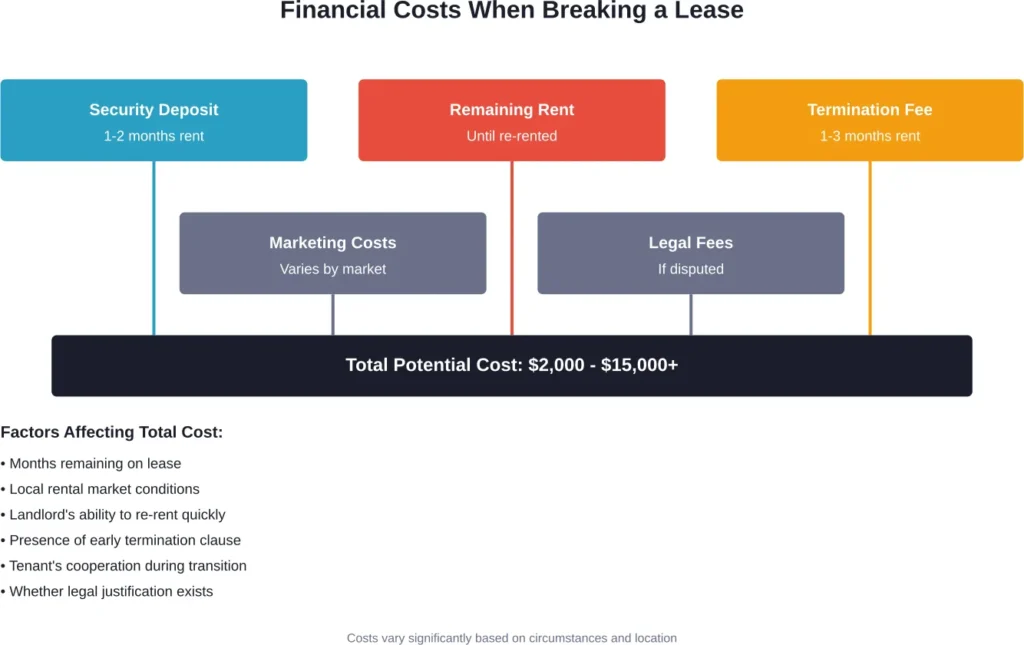
The financial impact of breaking a lease depends on several factors: remaining lease duration, local rental market conditions, and whether valid legal justifications exist.
Here’s what tenants typically face when terminating early without legal cause.
Loss of Security Deposit
Security deposits exist partly to protect landlords against lease violations. Breaking a lease often results in forfeiture of the entire deposit.
In Pennsylvania, landlords may collect up to two months’ rent as security deposit during the first year, dropping to one month’s rent for subsequent years. Within 30 days of lease termination, landlords must return deposits minus any legitimate deductions.
Early termination typically qualifies as grounds for retaining deposits to cover unpaid rent and re-renting costs.
Remaining Rent Obligations
The most significant financial consequence is responsibility for rent through the original lease end date. If six months remain on your lease at $1,200 monthly, you could owe $7,200.
However, landlords cannot simply collect this amount while the property sits vacant. They must make reasonable efforts to find replacement tenants—a concept called “duty to mitigate damages.”
Once a new tenant moves in, your obligation ends. In competitive rental markets, landlords may re-rent quickly, minimizing your liability. In slower markets, properties may remain vacant longer.
Early Termination Fees
Many modern leases include early termination clauses specifying fees for breaking the agreement. These fees typically range from one to three months’ rent.
While these fees seem expensive, they can actually benefit tenants by capping liability. Without such clauses, tenants might owe rent for the entire remaining term.
Early termination clauses create predictability for both parties, allowing tenants to exit with defined costs rather than open-ended obligations.
Additional Costs
Beyond rent and fees, tenants may face:
- Advertising costs for finding replacement tenants
- Administrative fees for processing early termination
- Legal fees if landlords pursue court action
- Credit score damage if unpaid amounts go to collections
The Federal Trade Commission has increased scrutiny of rental housing fees, with recent enforcement actions against major property managers for deceptive fee practices. As of March 12, 2026, the FTC is seeking public comment on proposed rulemaking regarding unfair rental housing fees.
Legal Reasons to Break a Lease Without Penalty
Not all lease terminations carry financial consequences. Federal and state laws recognize specific situations where tenants may break leases without penalty.
Active Military Duty
The Servicemembers Civil Relief Act (SCRA) protects military personnel who receive deployment orders or permanent change of station orders.
This federal protection allows service members to terminate leases by providing written notice and a copy of military orders. Termination typically takes effect 30 days after the next rent payment date.
Protection begins once duty starts and generally continues 30 to 90 days after discharge. The law applies to all 50 states, providing uniform protection regardless of local regulations.
Uninhabitable Living Conditions
Landlords must maintain properties in habitable condition, meeting basic health and safety standards. Severe violations of this obligation may justify lease termination.
Uninhabitable conditions include:
- Lack of heat, water, or electricity
- Serious pest infestations
- Structural hazards like collapsing ceilings or floors
- Toxic mold or lead paint exposure
- Non-functioning plumbing or sewage issues
Tenants cannot simply leave when problems arise. Proper procedure requires notifying landlords in writing, allowing reasonable time for repairs, and potentially involving local housing authorities.
If landlords fail to address serious habitability issues after proper notice, tenants may have legal grounds for termination without penalty.
Landlord Harassment or Privacy Violations
Tenants have legal rights to quiet enjoyment of rental properties. Landlords who repeatedly violate these rights through harassment, unauthorized entry, or other intrusive behavior may give tenants grounds for lease termination.
Examples include entering the property without proper notice, shutting off utilities to force tenants out, or making repeated threats.
Documentation is critical. Tenants should keep records of incidents, communications, and any police reports filed.
Domestic Violence Protections
Many states now provide lease termination rights for domestic violence victims. Washington state law, for example, allows tenants who notify landlords in writing about being victims of domestic violence, sexual assault, stalking, or unlawful harassment to terminate leases early.
These protections recognize that remaining in a lease may endanger victims’ safety. Tenants typically must provide documentation such as police reports, protective orders, or statements from qualified third parties.
Illegal Lease Terms
Leases containing illegal provisions may be voidable. If a landlord includes terms that violate state or federal law, tenants may have grounds for penalty-free termination.
Illegal provisions might include waiving tenants’ rights to habitable housing, prohibiting tenants from calling police, or imposing discriminatory restrictions.
| Reason for Breaking Lease | Legal Protection | Documentation Required | Notice Period |
|---|---|---|---|
| Active military duty | Federal SCRA | Written notice plus military orders | 30 days after next rent date |
| Uninhabitable conditions | State habitability laws | Written complaints, photos, inspection reports | Varies by jurisdiction |
| Landlord harassment | Quiet enjoyment rights | Incident log, communications, police reports | Depends on severity |
| Domestic violence | State-specific statutes | Police reports, protective orders, advocate statements | Typically immediate to 30 days |
| Illegal lease terms | Contract law | Lease agreement showing violations | Varies |
Minimizing Financial Impact When Breaking a Lease
Even without legal justification, tenants can take steps to reduce costs when breaking leases.
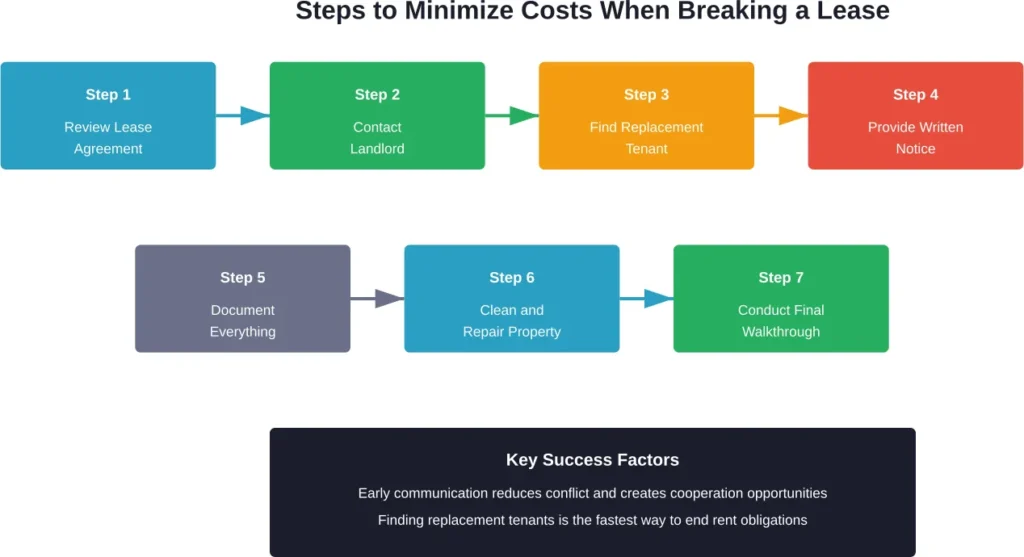
Review the Lease Agreement
Start by carefully reading the lease. Look for:
- Early termination clauses and associated fees
- Subletting or assignment provisions
- Notice requirements
- Landlord’s obligations regarding re-renting
Understanding contractual terms provides clarity about options and obligations.
Communicate With Your Landlord
Open communication sometimes leads to mutually beneficial solutions. Landlords may prefer cooperative termination over contentious disputes.
Approach the conversation professionally. Explain the situation honestly, acknowledge the inconvenience, and propose solutions like helping find replacement tenants or paying partial termination fees.
Some landlords agree to reduced penalties in exchange for cooperation and proper notice.
Find a Replacement Tenant
Finding a qualified replacement tenant is perhaps the most effective way to minimize costs. If a new tenant moves in immediately, rent obligations cease.
Steps for finding replacement tenants:
- Ask the landlord’s permission and preferences
- List the property on rental websites
- Conduct showings (with landlord approval)
- Pre-screen applicants for landlord consideration
- Cover any advertising costs
Landlords typically retain final approval over new tenants but appreciate tenants who facilitate the process.
Consider Subletting
If the lease permits, subletting allows another person to occupy the property and pay rent for the remaining term. The original tenant remains responsible to the landlord, but the subtenant pays the original tenant.
This arrangement carries risks—if the subtenant doesn’t pay or damages the property, the original tenant remains liable. Careful screening and written sublease agreements help mitigate these risks.
Many leases prohibit subletting or require landlord approval. Violating subletting restrictions can lead to eviction and additional penalties.
Provide Proper Notice
Even when breaking a lease, provide proper written notice. This demonstrates good faith and may influence how landlords respond.
Include the intended move-out date, reasons for leaving if appropriate, and willingness to cooperate during the transition. Keep copies of all communications.
Document Everything
Maintain thorough documentation of:
- All communications with landlords
- Property condition at move-out (photos and videos)
- Copies of lease agreements and notices
- Receipts for rent payments and deposits
- Any maintenance requests or complaints
Strong documentation proves invaluable if disputes arise over deposits, damages, or unpaid rent.
Long-Term Consequences Beyond Immediate Costs
Breaking a lease can create ripple effects extending beyond initial financial penalties.
Credit Score Impact
Unpaid rent or fees sent to collections agencies will damage credit scores. These negative marks can remain on credit reports for up to seven years.
According to the Federal Trade Commission, landlords using consumer reporting companies to run tenant background checks must comply with the Fair Credit Reporting Act (FCRA). Landlords who report lease violations must ensure accuracy of reported information.
Lower credit scores affect future rental applications, mortgage approvals, and even employment opportunities in some fields.
Rental History Challenges
Future landlords typically request rental history and contact previous landlords. A broken lease creates a negative reference that may complicate securing housing.
Some landlords reject applicants with lease-breaking history outright. Others may require larger security deposits or co-signers.
Being honest about circumstances and demonstrating financial responsibility afterward can mitigate these concerns, but the mark remains.
Legal Records
If landlords pursue legal action for unpaid rent, court judgments become public records. These appear in background checks and tenant screening reports.
Eviction proceedings—even those settled before judgment—often appear in rental background checks. This creates significant barriers to future housing.
State-Specific Considerations
Lease termination rules vary significantly by state. Understanding local laws is essential.
Pennsylvania Example
Pennsylvania lacks specific statutes addressing early lease termination for most situations. The state follows general contract law principles, meaning lease agreements typically govern.
Pennsylvania landlords must accept rental assistance that covers full rent balances without conditions. Security deposit rules are clearly defined: two months’ rent maximum in year one, one month thereafter, with 30-day return requirements.
For active military members, federal SCRA protections apply regardless of state law.
Washington State Protections
Washington provides more extensive tenant protections. State law allows lease termination for domestic violence victims who provide proper notice and documentation.
Washington also requires landlords to make reasonable efforts to re-rent properties, explicitly recognizing the duty to mitigate damages.
The Importance of Local Research
Before breaking a lease, research state and local laws. Many cities impose additional requirements beyond state statutes.
Local tenant rights organizations, legal aid societies, and housing authorities provide valuable guidance specific to jurisdictions.
When Breaking a Lease Makes Financial Sense
Sometimes paying penalties to break a lease proves financially advantageous compared to alternatives.
Job Relocation With Salary Increases
A job opportunity requiring relocation might justify lease-breaking costs if compensation increases significantly offset penalties.
Calculate total costs: early termination fees, moving expenses, and potential overlap in housing payments. Compare against salary increases and career advancement benefits.
Buying a Home
Breaking a lease to purchase a home represents a common scenario. The financial calculus depends on several factors:
- Current monthly rent versus projected mortgage payments
- Lease-breaking penalties
- Home equity accumulation
- Tax benefits of homeownership
- Long-term housing cost stability
In strong real estate markets, home price appreciation may outpace lease-breaking costs, making early purchase advantageous despite penalties.
Unsafe Living Situations
Personal safety always takes priority over financial considerations. If living conditions pose genuine threats—whether from structural hazards, crime, or domestic situations—leaving quickly often outweighs financial penalties.
In these cases, documenting problems and pursuing legal termination paths helps, but immediate safety concerns should drive decisions.
Alternatives to Breaking a Lease
Before committing to lease termination, consider alternatives.
Lease Transfer
Some landlords allow formal lease transfers where a new tenant assumes the entire lease, replacing the original tenant completely. This differs from subletting because responsibility transfers entirely.
Lease transfers require landlord approval but provide clean breaks without ongoing liability.
Negotiating Lease Modifications
Landlords sometimes agree to shorten lease terms in exchange for modest fees or immediate payment of remaining rent at discounted rates.
This approach works best when presented professionally with clear reasoning and fair proposals.
Temporary Subletting
If circumstances are temporary—like extended work assignments—subletting for specific periods allows keeping the lease while avoiding double rent payments.
When original circumstances resolve, tenants can return without having broken leases.
Working With Landlords: Communication Strategies
How tenants communicate about breaking leases significantly impacts outcomes.
Timing Matters
Inform landlords as early as possible. More notice provides more time to find replacement tenants, reducing everyone’s costs.
Last-minute notices eliminate opportunities for cooperation and may antagonize landlords.
Be Professional and Honest
Approach conversations professionally. Explain circumstances honestly without oversharing personal details.
Acknowledge the inconvenience and express willingness to minimize landlord’s burden. This tone encourages cooperation rather than confrontation.
Propose Solutions
Come to conversations with proposals: offering to help find replacements, paying partial fees, or extending move-out dates if that helps.
Solutions-oriented approaches demonstrate good faith and often lead to better outcomes than simply announcing departure.
Get Everything in Writing
Any agreements reached must be documented in writing. Verbal agreements create ambiguity and potential disputes.
Written agreements should specify move-out dates, financial obligations, deposit handling, and any conditions agreed upon.
What Landlords Cannot Do
Understanding landlord limitations helps tenants protect their rights.
Landlords cannot:
- Charge excessive or arbitrary fees beyond lease terms
- Retain security deposits without itemized justification
- Refuse to mitigate damages by leaving properties vacant
- Harass or threaten tenants
- Lock tenants out or shut off utilities
- Report false information to credit agencies
The FTC has taken enforcement action against major landlords for deceptive practices. On September 24, 2024, Invitation Homes agreed to pay $48 million for deceiving renters, charging junk fees, withholding security deposits, and employing unfair eviction practices.
On December 2, 2025, Greystar paid $24 million to settle charges of deceptive advertising practices regarding rent prices. These actions demonstrate increasing regulatory scrutiny of landlord practices.
Frequently Asked Questions
Job loss alone typically does not provide legal grounds for penalty-free lease termination. However, communicating with landlords about financial hardship sometimes leads to negotiated settlements or payment plans. Some landlords prefer cooperative arrangements over pursuing unpaid rent through legal channels. Documentation of job loss and genuine financial hardship may encourage landlord flexibility, though they’re not legally obligated to accommodate.
Costs vary widely based on lease terms, remaining duration, and local laws. Typical expenses include forfeiture of security deposits (one to two months’ rent), early termination fees if specified in the lease (typically one to three months’ rent), and responsibility for rent until the property is re-rented. Total costs might range from $2,000 to over $15,000 depending on circumstances. Finding replacement tenants quickly can minimize costs substantially.
Breaking a lease itself doesn’t directly impact credit scores. However, unpaid rent or fees sent to collections will damage credit significantly. Negative marks can remain on credit reports for up to seven years. Landlords may also report lease violations to tenant screening services, affecting future rental applications even if credit scores aren’t impacted. Paying all agreed-upon fees prevents credit damage.
Serious habitability issues may justify lease termination, but proper procedures must be followed. Document problems thoroughly with photos and written descriptions. Notify landlords in writing, allowing reasonable time for repairs. If landlords fail to address serious health or safety violations, tenants may have legal grounds for termination. Minor inconveniences or aesthetic issues typically don’t qualify. Consulting local housing authorities or tenant rights organizations helps determine whether specific problems justify termination.
Abandoning a rental without notice creates maximum liability and legal complications. Landlords can pursue full rent for the remaining lease term, charge fees, retain deposits, and potentially sue for damages. Courts generally rule against tenants who abandon properties. Credit damage, collection actions, and difficulty securing future housing are likely consequences. Even when breaking a lease, proper notice and communication minimize financial and legal repercussions.
Subletting is possible if the lease permits it or the landlord approves. Review lease language carefully—many agreements prohibit subletting or require landlord consent. When allowed, subletting lets another person occupy the property and pay rent while the original tenant remains responsible to the landlord. Screen subtenants carefully since original tenants remain liable for damages or unpaid rent. Written sublease agreements protect all parties by clarifying terms and responsibilities.
Yes. The federal Servicemembers Civil Relief Act protects active duty military personnel who receive deployment or permanent change of station orders. Service members can terminate leases by providing written notice and copies of military orders. Termination takes effect 30 days after the next rent payment date. This federal protection applies nationwide regardless of state laws or lease terms. Protection typically continues 30 to 90 days after discharge from active duty.
Taking Action: Next Steps
Breaking a lease creates complications, but understanding rights and obligations helps navigate the process effectively.
Start by reviewing lease agreements thoroughly, understanding state and local laws, and assessing whether legal justifications exist for penalty-free termination.
Communicate early and professionally with landlords. Many disputes stem from poor communication rather than irreconcilable differences. Landlords often appreciate tenants who provide notice, cooperate in finding replacements, and fulfill agreed-upon obligations.
Document everything. Written records of communications, property conditions, and agreements protect everyone’s interests if disputes arise.
Consider consulting tenant rights organizations or legal aid services, especially when dealing with habitability issues, harassment, or complex situations. Many jurisdictions offer free resources for tenants navigating lease disputes.
Breaking a lease carries consequences, but those consequences vary dramatically based on circumstances and approach. Legal protections exist for specific situations. Even without legal justification, cooperative termination often reduces costs substantially compared to contentious departures.
The key is balancing legal rights with practical realities, communicating effectively, and making informed decisions based on complete understanding of obligations and options.