

Quick Summary: Smoking regular paper releases toxic chemicals from ink, bleach, and industrial additives that can damage your lungs and respiratory system. Rolling papers are specifically designed for smoking with minimal additives, while notebook or printer paper contains chlorine, heavy metals, and other harmful substances. The risks include respiratory irritation, toxic chemical exposure, and potential long-term lung damage.
The question comes up more often than most people think. Whether out of curiosity, desperation, or just an experiment gone wrong, thousands search for answers about smoking paper every month.
And the answer isn’t as simple as yes or no.
Here’s the thing though—not all paper is created equal. The notebook page sitting on your desk is vastly different from a rolling paper, and understanding that difference could literally save your lungs.
This guide breaks down exactly what happens when paper burns in your lungs, which types pose the biggest risks, and why rolling papers exist in the first place.
What Actually Happens When You Smoke Paper
When any paper burns, it undergoes combustion—a chemical process that breaks down cellulose and releases various compounds into the air. What you inhale depends entirely on what was in that paper to begin with.
Research on cellulose combustion shows that the burning process releases particulate matter, carbon monoxide, and various organic compounds. Research on biomass combustion shows that under favorable combustion conditions, emissions are dominated by inorganic ash particles such as alkali salts, while incomplete combustion creates a more dangerous mix.
The problem? Most paper you encounter daily wasn’t designed for complete, clean combustion.
When any paper burns, it undergoes combustion that can release fine particulate matter among other compounds:
- Fine particulate matter and ash particles are released
- Chemical additives vaporize and enter your respiratory system
- Bleaching agents and their byproducts become airborne
- Ink particles (if present) release heavy metals and synthetic compounds
- Adhesives and sizing agents decompose into toxic fumes
Your lungs aren’t designed to filter out these microscopic particles effectively. The respiratory tract can handle some environmental pollutants, but concentrated smoke from burning paper delivers a concentrated dose directly to sensitive lung tissue.
The Dangerous Difference: Rolling Paper vs Regular Paper
This is where things get critical. Rolling papers and notebook paper are fundamentally different products, manufactured for completely different purposes.
| Feature | Rolling Paper | Notebook/Printer Paper |
|---|---|---|
| Base Material | Hemp, rice, or unbleached wood pulp | Bleached wood pulp (industrial grade) |
| Bleaching Process | None or food-safe methods | Chlorine or chlorine dioxide treatment |
| Additives | Minimal (natural gum, sometimes calcium carbonate) | Optical brighteners, sizing agents, coating chemicals |
| Ink Content | None | Often printed with petroleum-based inks |
| Burn Rate | Controlled, designed for even combustion | Uncontrolled, produces harsh smoke |
| Thickness | 13-18 GSM (very thin) | 70-100 GSM (much thicker) |
Rolling papers are classified as smoking accessories and are manufactured with combustion in mind. They contain minimal chemical processing and use food-grade materials.
Regular paper? That’s manufactured for writing, printing, and durability—not for inhaling.
What Makes Notebook Paper Particularly Harmful
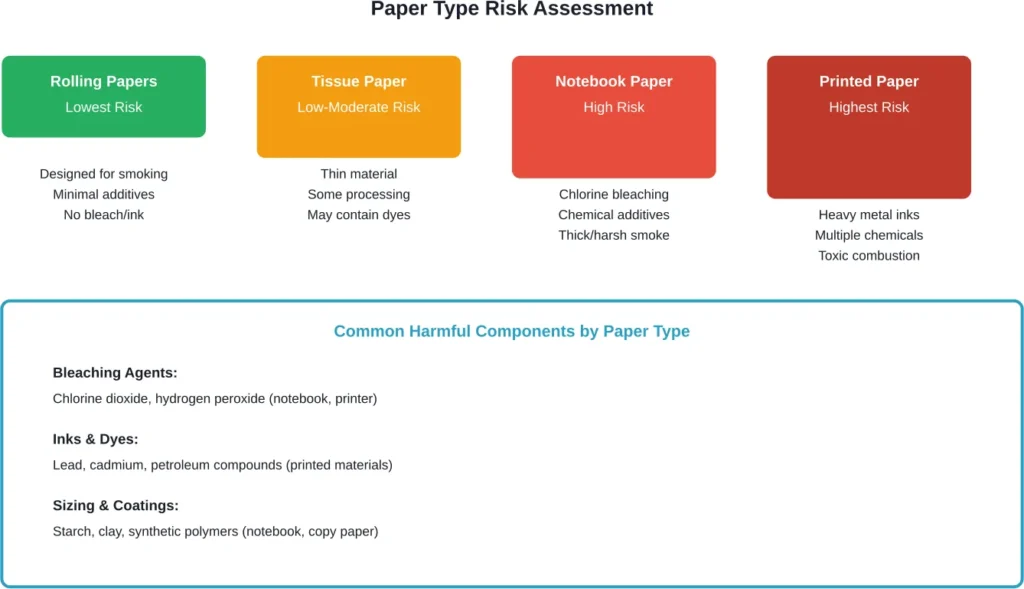
Notebook and printer paper undergoes extensive chemical treatment. The bleaching process typically uses chlorine compounds that leave residual chemicals in the paper fibers.
When burned, these chlorine compounds can form dioxins and furans—highly toxic substances linked to serious health problems. The paper also contains:
- Optical brightening agents (to make paper appear whiter)
- Sizing chemicals (to control ink absorption)
- Filler materials like clay and calcium carbonate
- Coating agents for texture and finish
None of these were designed to be heated to combustion temperatures and inhaled.
The thickness alone creates problems. Notebook paper requires more heat to burn, producing more smoke and incomplete combustion byproducts. This means more tar-like substances and particulate matter entering your lungs.
Health Risks From Smoking Non-Designated Papers
Research on smoke inhalation consistently shows that burning materials not intended for smoking poses significant respiratory risks. Studies on wood smoke particles demonstrate that combustion conditions and particle properties directly impact health effects.
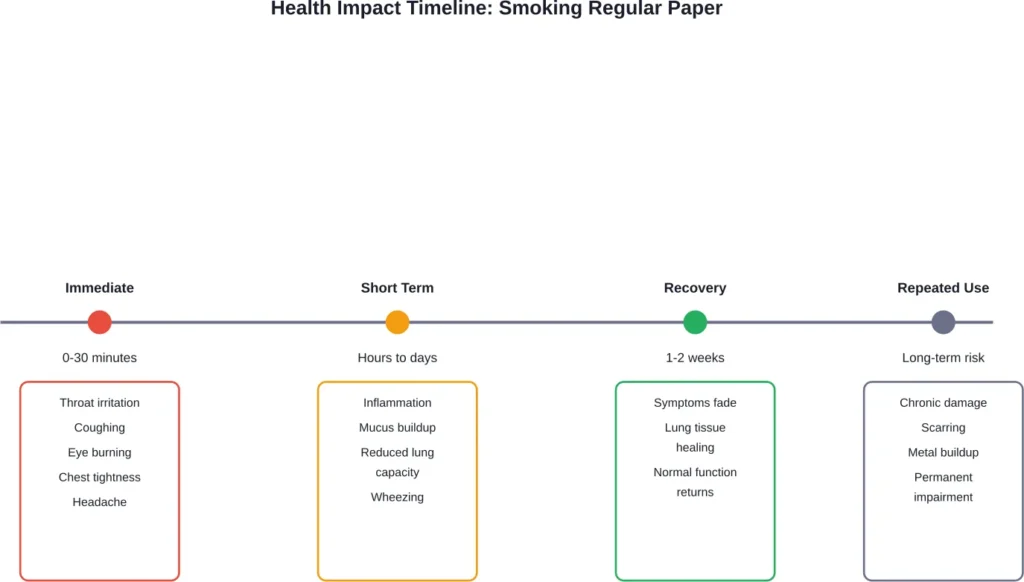
When you smoke regular paper, potential health effects include:
Immediate effects:
- Throat and airway irritation
- Coughing and difficulty breathing
- Chest tightness
- Headaches from carbon monoxide exposure
- Eye irritation
Repeated exposure risks:
- Chronic respiratory inflammation
- Reduced lung function over time
- Increased susceptibility to respiratory infections
- Potential exposure to carcinogenic compounds
- Accumulation of heavy metals in lung tissue
The particulate matter from paper smoke is particularly concerning. These fine particles can penetrate deep into the lungs and even enter the bloodstream, potentially affecting cardiovascular health.
The Heavy Metal Problem
One often-overlooked risk involves heavy metals. Inks used in printed paper often contain metals like lead, cadmium, and chromium. When heated, these metals can become airborne and be inhaled.
Heavy metal exposure through inhalation poses potential health risks, with accumulation in tissues being a concern with repeated exposure. While a single exposure might not cause immediate harm, repeated exposure increases the toxic load.
Understanding Rolling Paper Composition
So what makes rolling papers different? It comes down to intentional design and minimal processing.
Most quality rolling papers use one of three base materials:
Hemp papers: Made from hemp fiber, these are naturally thin and burn slowly. Hemp requires minimal processing and no bleaching to achieve a light color. The material is inherently low in additives.
Rice papers: Extremely thin and light, rice papers produce minimal ash. They burn slowly and evenly with a neutral taste. Rice paper is processed without harsh chemicals.
Wood pulp papers: When made specifically for smoking, these use unbleached or naturally bleached pulp. The manufacturing process avoids chlorine and focuses on creating a thin, even product.
The key difference is what’s NOT in rolling papers. Manufacturers deliberately exclude:
- Chlorine bleaching compounds
- Optical brighteners
- Heavy coating agents
- Synthetic sizing chemicals
- Petroleum-based additives
According to general industry standards, most rolling paper products use natural gum as the adhesive strip—the same food-safe material used in postage stamps and food packaging.
Are Rolling Papers Completely Safe?
Here’s where honesty matters. Rolling papers are safer than regular paper, but that doesn’t make them completely harmless.
Any combustion process produces smoke, and inhaling smoke of any kind carries risks. Research on various smoke sources indicates that particulate matter from combustion can affect respiratory health.
But the risk profile is different. Rolling papers are designed to minimize toxic byproducts, while regular paper actively introduces harmful chemicals into the combustion process.
Think of it this way: both involve fire and smoke, but one is engineered to reduce harm while the other wasn’t designed for this use at all.
Types of Paper and Their Smoking Risks
Not all paper poses the same level of risk. Understanding the differences helps clarify why some materials are more dangerous than others.
Specialty Papers to Avoid
Some papers are particularly dangerous to smoke:
Wax paper: Contains a paraffin or soy wax coating. When burned, wax produces heavy smoke and potentially toxic fumes. The wax can also melt and cause burns.
Parchment paper: Treated with silicone or other non-stick coatings. These coatings break down into harmful compounds when exposed to direct flame.
Glossy magazine paper: Contains heavy amounts of clay coating and colored inks with high metal content. Extremely toxic when burned.
Newspaper: Uses cheap ink that often contains solvents and heavy metals. The paper itself is low-quality with many chemical additives.
Receipt paper: Some receipts use thermal paper with chemical coatings that may have health effects when exposed to high temperatures.
The rule is simple: if the paper has any coating, printing, or special treatment, it shouldn’t be smoked under any circumstances.
What to Do If You’ve Smoked Regular Paper
Accidents happen. Community discussions show that many people have experimented with smoking paper out of curiosity or necessity and later worried about the consequences.
If you’ve smoked notebook paper or another non-designated paper once or twice, the good news is that a single exposure is unlikely to cause permanent damage in otherwise healthy individuals.
Here’s what to do:
Immediately after:
- Get fresh air and breathe deeply
- Drink plenty of water to help your body flush toxins
- Avoid further smoke exposure for at least 24-48 hours
- Monitor for severe symptoms like difficulty breathing or chest pain
In the following days:
- Watch for persistent coughing or respiratory symptoms
- Give your lungs time to clear out particulate matter
- Stay hydrated and consider using a humidifier
- Avoid strenuous exercise if breathing feels uncomfortable
Seek medical attention if you experience:
- Severe difficulty breathing
- Persistent chest pain
- Coughing up blood
- Symptoms that worsen over 2-3 days rather than improving
- Fever combined with respiratory symptoms
Most symptoms from a one-time exposure will resolve within a few days as your respiratory system clears the irritants.
Why Rolling Papers Are Legal and Regulated
Rolling papers are classified as smoking accessories and are legal to purchase and sell in multiple countries. They’re classified separately from tobacco or controlled substances.
The legality stems from their intended use and manufacturing standards. Rolling papers must meet certain safety criteria:
- Food-grade materials for components
- Limited chemical processing
- No toxic additives
- Proper labeling and safety information
Manufacturers of quality rolling papers follow industry standards that minimize health risks. While regulations vary by country, reputable brands typically use materials that have been tested for combustion safety.
This is why purchasing actual rolling papers is always safer than improvising with household paper products.
Safer Alternatives for Smoking
If someone finds themselves without rolling papers, what are the actual options? Real talk: the safest alternative is to wait until proper materials are available.
But in practice, some alternatives are less harmful than others:
| Alternative | Risk Level | Notes |
|---|---|---|
| Corn husk | Low-Moderate | Natural, minimal processing, but can be harsh |
| Rose petals (dried) | Moderate | Natural but may contain pesticides if not organic |
| Tobacco leaf wrapper | Moderate | Natural but adds nicotine exposure |
| Bible/dictionary paper | Moderate-High | Thin but still chemically processed and often inked |
| Gum wrapper (foil removed) | High | Contains adhesives and coatings |
None of these are recommended alternatives. They’re simply less immediately harmful than smoking notebook or printer paper.
The reality is that any improvised smoking material carries unknown risks. Combustion chemistry is complex, and materials not designed for this purpose will produce unpredictable compounds.
The Science of Paper Combustion
Understanding what happens at a chemical level helps explain why different papers pose different risks.
When cellulose burns, it undergoes thermal decomposition. Cellulose combustion can produce various compounds including carbon dioxide, water vapor, carbon monoxide, and volatile organic compounds depending on combustion conditions.
Temperature matters significantly. Incomplete combustion—which happens when paper doesn’t burn hot enough or gets insufficient oxygen—produces more toxic compounds including polycyclic aromatic hydrocarbons (PAHs).
Thick papers like notebook pages tend to smolder rather than burn cleanly, increasing incomplete combustion and toxic output. Thin rolling papers burn more completely at higher temperatures, reducing some harmful byproducts.
But here’s the catch: even “clean” combustion produces particulate matter that affects lung health. The goal with rolling papers isn’t to make smoking safe—it’s to minimize additional chemical risks beyond the inherent risks of smoke inhalation.
Common Myths About Smoking Paper
Let’s address some misconceptions that circulate online:
Myth: All paper is basically the same when burned.
False. Chemical composition varies dramatically between paper types. The difference between rolling paper and notebook paper is substantial in terms of toxic output.
Myth: If paper is white, it’s been bleached with dangerous chemicals.
Partially true. Many white papers use chlorine bleaching, but some rolling papers achieve light color through natural fiber selection or oxygen bleaching, which is less harmful.
Myth: Organic or recycled paper is safer to smoke.
Not necessarily. Recycled paper often contains more chemical residue from the recycling process and may have ink remnants. Organic doesn’t mean safe for combustion.
Myth: Thin paper is always safer than thick paper.
Generally true, but not always. Thickness affects burn characteristics, but chemical content matters more. Thin tissue paper with dyes is still dangerous.
Myth: One-time exposure to paper smoke won’t cause any harm.
Mostly true. While a single exposure is unlikely to cause permanent damage, it can still produce acute symptoms and irritation. “Won’t cause permanent harm” doesn’t mean “completely safe.”
Frequently Asked Questions
A single exposure to paper smoke is unlikely to cause permanent damage in healthy individuals. However, it can cause acute respiratory irritation, coughing, and temporary inflammation. The lungs have remarkable healing capacity for one-time exposures. Repeated exposure is where serious risk accumulates, as chemicals and particulates build up over time and chronic inflammation can lead to lasting damage.
Rolling papers are genuinely safer due to their composition and manufacturing process. They contain minimal chemical additives, no chlorine bleaching, and no inks or coatings. Regular paper contains bleaching agents, sizing chemicals, optical brighteners, and often inks—all of which produce toxic compounds when burned. The difference isn’t marketing; it’s fundamental chemistry. That said, smoking anything carries risks.
Smoking paper with ink exposes you to heavy metals like lead and cadmium, along with petroleum-based compounds used in many inks. Immediate effects typically include harsher smoke, more severe throat irritation, and potentially headache or nausea. The metals can accumulate in tissue with repeated exposure. If this happens once, monitor for severe symptoms but understand that a single exposure rarely causes lasting harm. Avoid repeating it.
Tissue paper is less harmful than notebook paper but still not designed for smoking. It often contains dyes, fragrances (in the case of facial tissue), and processing chemicals. The thin material may seem similar to rolling paper, but it lacks the specific design features that make rolling papers safer. While occasionally used in emergencies, tissue paper can produce irritating smoke and contains unknown chemical additives. It’s not a recommended alternative.
Acute symptoms like throat irritation, coughing, and chest tightness typically peak within a few hours and begin improving within 24-48 hours. Most people experience complete resolution of symptoms within 3-5 days as the respiratory system clears out irritants and inflammation subsides. Symptoms persisting beyond a week or worsening over time warrant medical evaluation, as they may indicate a more serious reaction or secondary infection.
Unbleached rolling papers avoid the chlorine bleaching process, which eliminates one source of potential chemical residue. However, many white rolling papers use oxygen bleaching or natural bleaching methods that don’t involve chlorine. The health difference between quality unbleached and properly bleached rolling papers is minimal. Both are vastly safer than regular paper. The choice often comes down to personal preference regarding taste and burn characteristics rather than significant health differences.
Chest pain after smoking paper could indicate significant irritation or, in rare cases, a more serious respiratory issue. Immediately stop any further exposure, move to fresh air, and practice slow, deep breathing. If the pain is severe, accompanied by difficulty breathing, radiates to the arm or jaw, or doesn’t improve within 30 minutes, seek emergency medical care. Mild chest tightness that gradually improves is common from smoke irritation, but when in doubt, medical evaluation is warranted.
The Bottom Line on Smoking Paper
What happens if you smoke paper depends entirely on what type of paper you’re talking about.
Regular notebook, printer, or any household paper contains bleaching agents, chemical additives, and often inks that become toxic when burned. Smoking these materials exposes your lungs to heavy metals, chlorine compounds, and various harmful substances that can cause immediate irritation and potential long-term damage with repeated exposure.
Rolling papers are specifically manufactured to minimize these risks. They use food-grade materials, avoid harsh chemical processing, and contain no inks or coatings. While not completely harmless—all smoke affects lung health—they represent a dramatically safer option.
The key takeaway? Paper matters. Not all paper is created equal, and the difference between materials designed for smoking and those that aren’t could affect your respiratory health significantly.
If you’re going to smoke, use products actually designed for that purpose. And if you’ve experimented with regular paper, a single exposure is unlikely to cause lasting harm—but it’s definitely not something to repeat.
Your lungs deserve better than improvisation. Stick with proper materials, understand the risks, and make informed choices about what you expose your respiratory system to.