

Quick Summary: Missing jury duty can result in serious legal consequences, including fines up to $1,000, contempt of court charges, and potentially up to three days in jail. However, immediate penalties are uncommon if you act quickly to contact the court and provide a valid reason for your absence. Most courts will work with you to reschedule if you respond promptly and show good cause.
That jury summons arrives in the mail, and suddenly life gets complicated. Maybe it’s during a critical work deadline. Or you’ve got a vacation planned. Sometimes, that summons gets buried under other mail, and before you know it, the reporting date has passed.
Here’s the thing though—ignoring jury duty isn’t just a minor inconvenience. It’s a legal obligation, and the courts take it seriously. But what actually happens if you miss jury duty? The answer depends on several factors, including how quickly you respond, whether this is your first offense, and the specific jurisdiction where you’ve been summoned.
Let’s break down the real consequences, what enforcement looks like in practice, and most importantly, what you should do if you’ve already missed your date.
The Legal Consequences of Missing Jury Duty
According to federal court guidelines, the penalties for missing jury duty can be severe. The U.S. District Courts across multiple jurisdictions spell out clear consequences for failure to appear.
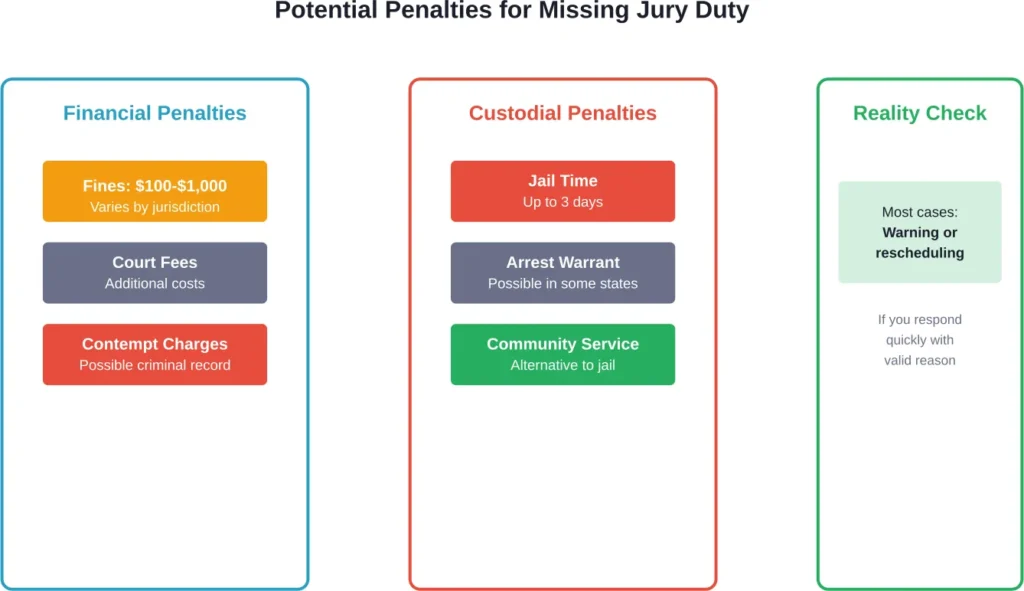
Under the Jury Selection Act, 28 U.S.C. § 1866(g), any person who fails to show good cause for noncompliance with a jury summons may face penalties that include:
- Fines ranging from $100 to $1,000
- Imprisonment for up to three days
- Community service requirements
- Any combination of these penalties
The U.S. District Court for Utah specifically notes that jurors who fail to report may be served with a show cause order by the U.S. Marshal. This requires them to appear in court and explain why they shouldn’t be held in contempt. Contempt penalties range from a fine of $1,000 to three days imprisonment, or both.
State courts operate similarly. In Texas, courts can charge individuals with contempt for failing to appear, with initial fines typically ranging from $100 to $1,000, depending on the judge’s discretion.
What Actually Happens in Practice
But here’s where theory meets reality. While the legal penalties are significant, enforcement varies considerably.
According to Charlotte Observer reporting on North Carolina law, actual practice often differs from statutory maximums. Attorney Jeremy Nagle noted that judges and courts in Forsyth County have never issued subpoenas for failure to appear for jury duty. “In actual practice, often nothing happens at all,” Nagle said.
That doesn’t mean missing jury duty is without risk. Courts handle non-compliance differently based on several factors:
First-Time Offenses vs. Repeat No-Shows
The first time someone misses jury duty, courts are generally more lenient. Many jurisdictions will simply send a follow-up notice or allow rescheduling without penalty—provided the person responds promptly.
Continued non-compliance tells a different story. When someone repeatedly ignores jury summons or fails to appear multiple times, courts escalate their response. This is when fines, contempt charges, and even arrest warrants become realistic possibilities.
The Show Cause Order Process
Here’s how enforcement typically unfolds:
- Initial summons goes out
- If someone fails to appear, the court may issue a show cause order
- The U.S. Marshal or local law enforcement serves this order
- The individual must appear in court to explain their absence
- The judge determines whether the excuse constitutes “good cause”
- Penalties are imposed if the excuse is deemed insufficient
The Alabama Northern District Court notes that any person summoned for jury service who fails to appear as directed may be ordered by the district court to appear forthwith and show cause for failure to comply with the summons. Anyone who fails to show good cause may be fined not more than $1,000, imprisoned not more than three days, ordered to perform community service, or any combination thereof.
Valid Excuses for Missing Jury Duty
Not every absence results in penalties. Courts recognize that legitimate conflicts arise. What qualifies as “good cause” varies by jurisdiction, but generally accepted excuses include:
- Serious illness or medical emergency
- Death in the immediate family
- Previously scheduled surgery or medical procedures
- Sole caregiver for someone unable to care for themselves
- Active military deployment
- Extreme financial hardship (though this has a high bar)
Many jurisdictions also allow postponements for work-related conflicts, educational commitments, or pre-planned vacations—but these typically require advance notice, not after-the-fact explanations.
| Excuse Type | Typically Accepted? | Documentation Required |
|---|---|---|
| Medical emergency | Yes | Doctor’s note or hospital records |
| Death in family | Yes | Death certificate or obituary |
| Work conflict | Sometimes | Employer letter (advance notice needed) |
| Pre-planned vacation | Sometimes | Travel receipts (advance notice needed) |
| Financial hardship | Rarely | Financial documentation |
| Forgot about summons | No | None—not considered valid excuse |
| Lost the summons | No | None—responsibility remains with recipient |
What to Do If You’ve Already Missed Jury Duty
So you missed the date. Now what?
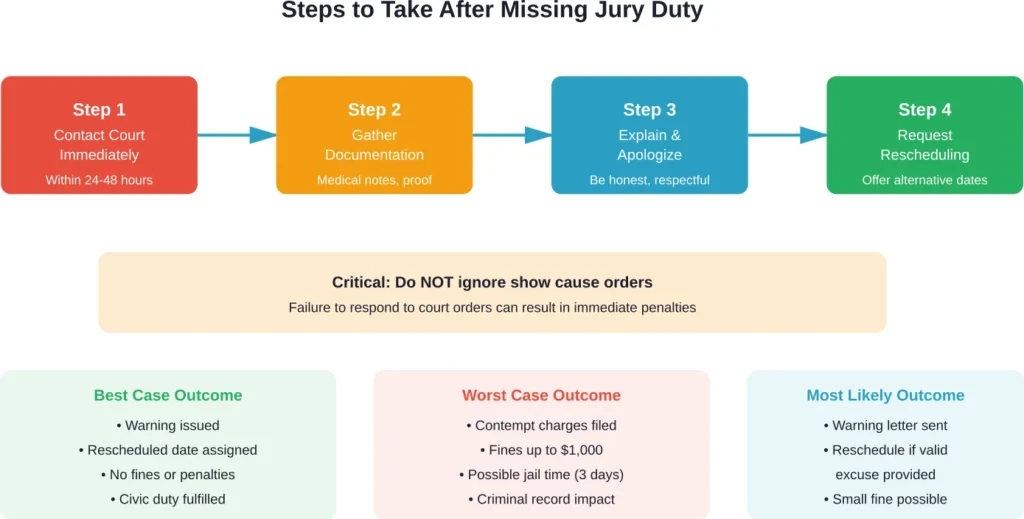
The best way to handle this situation is to act immediately. Speed matters. The longer someone waits to address a missed jury duty date, the more likely courts will view the absence as willful non-compliance rather than an honest mistake.
Step 1: Contact the Court Immediately
Find the contact information on the original summons. Most jury duty summons include a phone number for the jury clerk’s office. Call during business hours and explain the situation honestly.
Be prepared to provide:
- Your juror identification number
- The date you were supposed to appear
- The reason for your absence
- Documentation supporting your excuse (if applicable)
Step 2: Submit Documentation
If there’s a legitimate reason for the absence, gather supporting documentation quickly. Medical excuses need doctor’s notes. Family emergencies may require death certificates or other proof.
Courts are more receptive to documented excuses than verbal explanations alone.
Step 3: Request Rescheduling
Most courts will allow individuals to reschedule for a future date rather than imposing immediate penalties—especially for first-time offenses with reasonable explanations.
The key is demonstrating willingness to fulfill the civic duty, just at a different time.
Step 4: Respond to Any Court Orders
If the court has already issued a show cause order or other directive, responding is not optional. Ignoring these orders compounds the problem and virtually guarantees serious consequences.
Understanding Jury Duty Compensation and Employment Protection
One reason people consider skipping jury duty is financial concern. The daily compensation for jury service is modest compared to regular wages.
According to the North Carolina Judicial Branch, trial jurors receive $12 for the first day of service and $20 for each day thereafter. If you serve more than five days, you will receive $40 per day. According to Minnesota courts, jurors are paid $20.00 for each day that they report to the courthouse, plus roundtrip mileage from home to the courthouse at the rate of 54 cents per mile. According to Utah courts, you will be paid $18.50 for the first day of service and $49 for each subsequent day of service.
These rates barely cover basic expenses, let alone replace lost wages for most workers.
Employer Obligations
Federal law doesn’t require employers to pay employees during jury duty, though many companies offer paid jury leave as a benefit. State laws vary significantly on this point.
What employers cannot do is retaliate against employees for jury service. Firing, demoting, or otherwise penalizing an employee for fulfilling jury duty is illegal in all states. Employees facing such retaliation have legal recourse.
How Courts Select Jurors and Track Compliance
Every couple of years, a three-person commission from each county compiles a jury pool of licensed drivers and registered voters. Minnesota, for example, obtains names from lists of licensed drivers, state identification card holders, and registered voters residing in each county. Names of deceased persons are removed using Department of Health data.
From this master list, potential jurors are randomly selected by computer. This means most people will receive a jury summons at some point in their lives.
Courts maintain records of who responds, who appears, and who fails to comply. This tracking system ensures repeat offenders don’t slip through unnoticed.
Postponing or Getting Excused Before the Date
The smartest approach is handling conflicts proactively. Most jurisdictions allow requests for postponement or excusal before the scheduled date.
Process for requesting postponement:
- Check the summons for instructions (many now include website portals)
- Submit the request as soon as possible after receiving the summons
- Provide specific reasons and supporting documentation
- Suggest alternative dates when available
Many courts now offer online systems where potential jurors can request postponements, submit documentation, or even complete qualification questionnaires electronically. Taking advantage of these systems demonstrates good faith and typically results in accommodation.
Beware of Jury Duty Scams
The Northern District of Georgia issued a warning about jury duty scams. Residents continue to receive fraudulent phone calls claiming the victim failed to appear for jury duty in federal court and has an arrest warrant or similar adverse situation pending.
The scammer tells the victim they can avoid arrest or other negative consequences by making a payment, often through prepaid cards like Green Dot cards.
Real courts never demand immediate payment over the phone. They don’t request prepaid cards, wire transfers, or cryptocurrency. Official communication about missed jury duty comes through mail or in-person service by law enforcement—never through unsolicited phone calls demanding payment.
Frequently Asked Questions About Missing Jury Duty
Yes, though it’s uncommon. Federal law allows for up to three days imprisonment for contempt of court related to jury duty non-compliance. However, this typically only happens in cases of repeated failure to appear or willful disregard of show cause orders. First-time offenses with prompt response rarely result in jail time.
Fines range from $100 to $1,000 depending on jurisdiction and circumstances. Federal courts in multiple districts cite this range under the Jury Selection Act. State courts have similar penalty structures. The actual fine imposed depends on whether the absence was intentional, if there were prior offenses, and how the individual responded after missing the date.
First-time offenses typically result in a warning letter or opportunity to reschedule if the person contacts the court promptly. Many jurisdictions are lenient with individuals who have never missed jury duty before, especially if they provide a reasonable explanation and demonstrate willingness to serve at a rescheduled date. The key is responding quickly—within a few days of the missed date.
Possibly, but not immediately. Courts typically send follow-up notices or show cause orders before issuing warrants. According to North Carolina legal experts, while state law allows courts to issue arrest orders for non-compliance with subpoenas, it’s fairly uncommon. Warrants are more likely in cases of repeated non-compliance or failure to respond to show cause orders.
No. Employers cannot legally fire, demote, or retaliate against employees for serving jury duty. While federal law doesn’t require paid leave during jury service, many employers offer it as a benefit. State laws provide additional protections. Employees facing retaliation for jury service have legal recourse through employment law claims.
Contact the court immediately using the phone number or website listed on the original summons. Explain the situation honestly, provide any supporting documentation for the absence, and request a rescheduled date. Most courts will accommodate reasonable requests, especially from first-time offenders who respond promptly. Be prepared to offer specific alternative dates when available.
Contempt of court charges can result in a criminal record. However, simply missing a date and then rescheduling typically doesn’t create a permanent record. Courts maintain internal records of jury service compliance, but these are primarily used for tracking purposes within the judicial system. Only if contempt charges are formally filed and result in conviction would this potentially appear on background checks.
Taking Jury Duty Seriously
Jury duty represents a fundamental civic responsibility. The justice system depends on ordinary citizens participating in the legal process. While the daily compensation is modest and scheduling conflicts are real, the consequences of simply ignoring a jury summons can be severe.
The good news? Most courts recognize that life happens. They’re willing to work with people who communicate honestly and promptly. A medical emergency, family crisis, or legitimate work conflict can usually be accommodated—if handled correctly.
The worst approach is ignoring the summons and hoping it goes away. It won’t. Courts track compliance, and repeated failures to appear trigger escalating consequences.
If you’ve already missed jury duty, don’t panic. But don’t delay either. Contact the court today, explain the situation, and request an opportunity to fulfill the obligation at a rescheduled date. That simple step can mean the difference between a minor inconvenience and serious legal consequences.
Treat the summons with the seriousness it deserves, communicate proactively with the court, and remember that jury service—while sometimes inconvenient—plays a vital role in maintaining fair trials and justice for all.