

Quick Summary: If you miss your flight, contact the airline immediately—many will rebook you on the next available flight, though fees may apply depending on your ticket type. Airlines can cancel your entire itinerary including return flights per their contract of carriage. Acting quickly gives you the best chance of rebooking without additional charges, especially if you have flexible ticket types or elite status.
That sinking feeling when the gate doors close. The rush of panic as you realize the plane is already pushing back from the terminal. Missing a flight ranks among the most stressful travel experiences, and it happens more often than most people think.
Whether it’s a long TSA security line, traffic on the way to the airport, or simply cutting it too close, the aftermath doesn’t have to derail your entire trip. Airlines have policies for this exact scenario, though what happens next depends heavily on why you missed the flight, what type of ticket you purchased, and how quickly you act.
Here’s the reality: airlines aren’t legally required to accommodate passengers who miss flights due to their own delay. But many will—under certain conditions.
The Immediate Consequences of Missing Your Flight
When you miss a flight, the airline doesn’t just hold your seat for the next departure. According to airline contracts of carriage, missing your outbound flight can trigger automatic cancellation of your entire itinerary.
Delta’s Contract of Carriage explicitly states that if you miss your flight, your entire itinerary including return trip may be cancelled. This policy isn’t unique to Delta—most major carriers enforce similar rules to prevent passengers from cherry-picking segments.
The clock starts ticking the moment that aircraft door closes. Airlines operate on tight schedules, and your seat gets released almost immediately. Community discussions on travel forums consistently report that gate agents begin processing standby passengers within minutes of the scheduled departure time.
What Happens to Your Ticket
Your ticket type determines your options. Refundable tickets offer the most flexibility—these can typically be rebooked without penalties, though change fees may still apply depending on the fare class.
Non-refundable tickets get trickier. Most airlines will allow rebooking but charge change fees plus any difference in fare between your original flight and the next available one. Change fees and fare differences vary by airline and ticket type; contact your airline for specific amounts.
Basic economy fares? Those are the most restrictive. Many airlines don’t allow any changes to basic economy tickets, meaning you might need to purchase an entirely new ticket at current pricing.
The “Flat Tire Rule” and Airline Discretion
The unofficial “flat tire rule” represents one of the airline industry’s better-kept secrets. This discretionary policy allows agents to rebook passengers on the next available flight without fees when circumstances beyond their control cause them to miss their original departure.
But here’s the thing—it’s not actually a rule. It’s a courtesy that varies wildly between airlines and even between individual gate agents at the same airline.
The name comes from the classic excuse: you got a flat tire on the way to the airport. Whether that’s true or not matters less than how you present the situation and the agent’s willingness to help. Arriving flustered but polite at the counter immediately after missing your flight gives you the best shot at invoking this policy.
Airlines are more likely to extend this courtesy for:
- Elite status members and frequent flyers
- Passengers who arrived at the airport with reasonable time but faced security delays
- First-time offenders with clean travel records
- Situations involving airport or airline operational issues
According to traveler reports and discussion forums, success rates for obtaining fee waivers vary. Passengers report that rebooking outcomes vary depending on agent discretion and circumstances.
Your Step-by-Step Action Plan
The seconds after you realize you’ve missed your flight matter. Here’s exactly what to do, in order of priority.
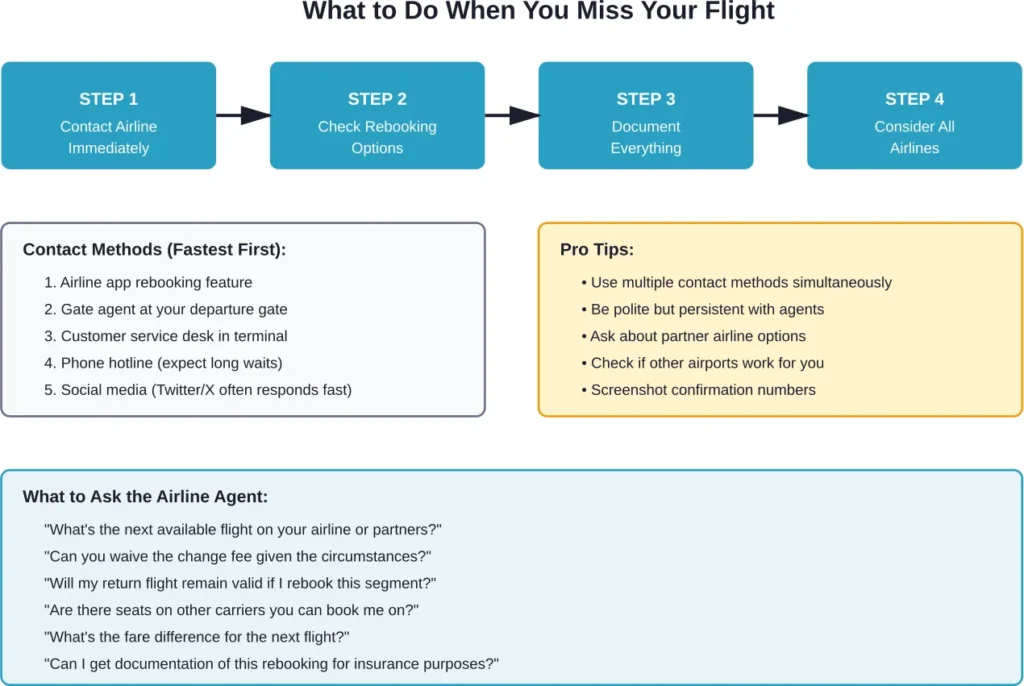
Contact the Airline Immediately
Don’t wait until you get home or even leave the airport. Call the airline or use their mobile app while you’re still at the gate. Many airline apps now include self-service rebooking features that let you see available flights and rebook yourself without waiting for an agent.
The gate agent at your original departure gate can often help faster than the main customer service desk. They’re already at their computer with access to your booking.
Understand Your Rebooking Options
Airlines typically offer three paths forward when you miss a flight:
Standby on the next flight: If seats are available and the agent applies the flat tire rule, you might get on the next departure at no charge. This works best on high-frequency routes with multiple daily flights.
Confirmed rebooking with fees: Pay the change fee plus any fare difference to secure a seat on a later flight. This guarantees you a spot rather than gambling on standby.
Alternative routing: Sometimes flying through a different hub or taking a connection gets you there faster than waiting for the next direct flight. Ask about all options.
Document Everything
Save every confirmation email, take screenshots of rebooking charges, and keep any receipts for expenses incurred due to the missed flight. If you have travel insurance or credit card trip protection, you’ll need this documentation for potential reimbursement claims.
According to the US Department of Transportation, airlines must provide refunds when they significantly change or cancel flights. A significant change means departure or arrival times that differ by more than 3 hours domestically or 6 hours internationally from the original schedule. But when you miss the flight yourself, these protections don’t apply—making documentation crucial for any insurance claims.
Airline-Specific Policies and What to Expect
Each airline handles missed flights differently. While the basic framework remains similar, the details matter.
| Airline | Same-Day Change | Typical Fee | Notable Policy |
|---|---|---|---|
| Southwest | Free on Anytime/Business | Fare difference only | No change fees on most tickets |
| Delta | Available for fee | $75-$200 | May cancel entire itinerary |
| United | Available for fee | $75-$200 | Same-day standby often free |
| American | Available for fee | $75-$200 | Elite members get fee waivers |
| Alaska | $50 same-day change | $125 standard change | 24-hour flexible booking |
Southwest stands out for passenger-friendly policies. Their tickets don’t have change fees—you only pay fare differences when rebooking. This flexibility makes Southwest tickets effectively more valuable than comparable fares on other carriers.
Legacy carriers like Delta, United, and American have moved away from change fees on most domestic tickets as of recent years, but restrictions still apply to basic economy fares. International flights often maintain traditional change fee structures.
When Travel Insurance and Credit Cards Can Help
Many travelers don’t realize their credit card might cover missed flights. Premium travel cards often include trip delay and cancellation coverage that reimburses costs associated with missing flights.
Check your card benefits for:
- Trip cancellation/interruption insurance (typically requires booking the trip with that card)
- Trip delay coverage (kicks in after 6-12 hour delays, varies by card)
- Reimbursement for change fees and fare differences
- Coverage for additional expenses like hotels if you’re stranded overnight
Standalone travel insurance policies vary dramatically in what they cover. Most don’t cover missed flights due to oversleeping or poor planning. They typically require a covered reason like illness, accident, or documented traffic incidents.
According to UCLA Travel guidelines during COVID-19 disruptions, travelers should exhaust refund options with vendors before seeking reimbursement from insurance or institutional funds. This principle applies broadly—insurance serves as backup, not the primary solution.
How to Prevent Missing Flights in the First Place
Prevention beats cure. Real talk: most missed flights are preventable with better planning.
TSA Security Line Strategies
Long TSA lines represent one of the top reasons passengers miss flights. During peak travel periods, security wait times can exceed an hour at major airports.
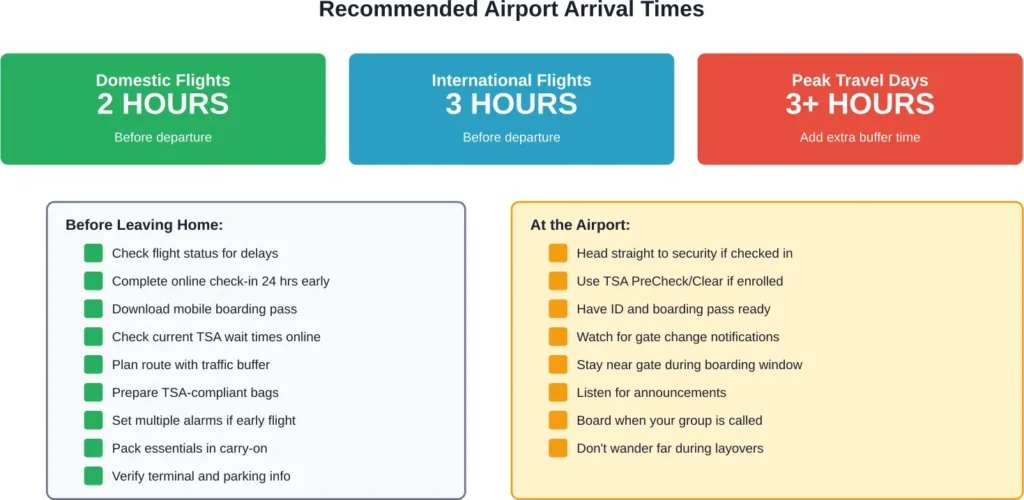
TSA PreCheck membership costs $78-$85 for five years (verify current pricing with TSA) and grants access to expedited screening lanes. Clear requires a membership fee (verify current pricing with Clear) but uses biometric verification to skip the ID check line entirely. For frequent travelers, these programs pay for themselves after just a few uses.
Check real-time security wait times before leaving for the airport. Many airports publish current wait times on their websites and apps. TSA also provides estimated wait times through their MyTSA app.
Build in Buffer Time
Arrive at the airport earlier than feels necessary. TSA recommends 2 hours for domestic flights and 3 hours for international departures. During holiday periods, add another hour.
The “I’ll just cut it close” mentality works until it doesn’t. Then it costs hundreds in rebooking fees plus the stress of scrambling for alternatives.
Your Rights When the Airline Causes the Problem
Different rules apply when you miss a connection due to airline delays rather than arriving late for your first flight.
If an airline delay causes you to miss a connecting flight, the carrier must rebook you on the next available flight at no additional charge. The US Department of Transportation’s Airline Customer Service Dashboard shows commitments major airlines have made regarding controllable delays and cancellations.
When delays or cancellations stem from circumstances within the airline’s control, most major carriers now provide:
- Rebooking on the next available flight
- Meal vouchers for significant delays
- Hotel accommodations for overnight delays
- Ground transportation to hotels
Weather delays and air traffic control issues don’t trigger these benefits since they’re outside airline control. But mechanical problems, crew scheduling issues, and other operational failures do.
Special Considerations for International Travel
International flights add complexity. Missing a flight to Europe or Asia can disrupt carefully planned itineraries, hotel reservations, and tour bookings.
European Union regulations provide stronger passenger protections than US rules. EU Regulation 261/2004 grants compensation for delays and cancellations, though these protections don’t apply when passengers miss flights due to their own late arrival.
Visa implications matter too. Some countries require proof of onward travel. If you miss your departing flight but still enter a country, immigration officials might question your compliance with entry requirements.
Time zone confusion causes missed connections. When booking international itineraries, verify whether listed times are local to each airport. A 7 AM departure means 7 AM in the departure city’s time zone, not your current location.
Frequently Asked Questions
Airlines don’t typically refund missed flights when the passenger fails to show up. Refundable tickets may be eligible for a refund minus fees, while non-refundable tickets generally only retain their value as credit toward future travel, subject to change fees and fare differences. Each airline’s contract of carriage specifies exact terms.
Most airlines will cancel your entire itinerary including return flights if you miss the outbound segment. This “no-show” policy prevents passengers from gaming fare structures. Contact the airline immediately if you miss an outbound flight to discuss options for preserving your return reservation.
Airlines typically close boarding 10-15 minutes before departure for domestic flights and 15-20 minutes for international flights. Once the gate door closes, the seat gets released. Arriving at the gate even 5 minutes before departure doesn’t guarantee boarding if the door has already closed.
Travel insurance coverage for missed flights depends on the policy and reason for missing the flight. Most policies cover missed departures due to covered reasons like documented illness, accidents, or severe traffic incidents. They typically exclude oversleeping, poor planning, or underestimating travel time to the airport.
TSA agents generally don’t allow passengers to skip security lines even when running late. Some airports have expedited lanes for passengers with imminent departures, but this varies by location and isn’t guaranteed. The best strategy involves arriving with sufficient time rather than counting on exceptions.
Airlines rarely rebook missed passengers onto competitor airlines, especially when the passenger caused the missed departure. They’ll typically offer rebooking on their own flights or partner airlines within the same alliance. Booking a ticket on a different carrier yourself remains an option if that gets you to your destination faster.
Checked baggage for missed flights typically gets pulled from the aircraft for security reasons. When you rebook, the airline should route your bag on your new flight. Retrieve baggage claim tags and provide them when rebooking to ensure bags follow your new itinerary. If bags get separated, file a delayed baggage report immediately.
The Bottom Line on Missed Flights
Missing a flight doesn’t have to ruin your trip, but it will complicate things. Airlines have policies to handle these situations, though generous application of those policies depends heavily on ticket type, airline discretion, and how you approach the situation.
Contact the airline immediately. Be polite with agents. Know your ticket’s terms and conditions. Ask about all available options including partner airlines and alternative routing.
Better yet, build enough buffer time into your airport arrival that missed flights remain a theoretical concern rather than a costly reality. Those extra 30 minutes of waiting at the gate beat the alternative of watching your plane taxi away without you.
Most importantly, understand that while airlines may help, they’re not obligated to when you miss a flight through your own delay. The responsibility for getting to the airport on time rests with passengers. Treat departure times as hard deadlines, plan accordingly, and you’ll avoid this entire stressful scenario.