

Quick Summary: Failing a class in college impacts your GPA, can jeopardize financial aid eligibility, and may delay graduation. Most institutions place students on academic probation if their GPA falls below required thresholds. However, you can typically retake the course to replace the grade, and schools offer resources like academic advisors and tutoring to help you recover and stay on track toward graduation.
Failing a college class feels devastating. The grade appears on your transcript, your confidence takes a hit, and suddenly you’re wondering if your entire academic career is derailed.
But here’s the reality: thousands of students fail classes each semester and still go on to graduate successfully. It’s not ideal, but it’s also not the end of the world.
What matters most is understanding the actual consequences and knowing exactly what steps to take next. Because while failing a class creates obstacles, those obstacles are manageable if you act quickly and strategically.
The Immediate Impact on Your Academic Record
When you fail a class, that F lands directly on your transcript. Unlike dropping a course before the withdrawal deadline (which typically shows as a W), a failure affects your academic standing immediately.
Your GPA takes the biggest hit. Since an F typically counts as 0.0 in grade point calculations, it drags down your cumulative average—sometimes dramatically, especially if you’re early in your college career or if the course carried significant credit hours.
The failed course also doesn’t count toward your degree requirements. If it’s a core requirement or a prerequisite for other classes, you’ll need to retake it before progressing in your major. That creates a domino effect that can delay your graduation timeline.
How GPA Calculations Work After Failure
Most institutions calculate GPA by dividing total quality points (credit hours multiplied by grade points) by total credit hours attempted. An F means zero quality points for those credit hours, but the hours still count as attempted.
So a 3-credit course that you fail adds three attempted hours with zero quality points. If you previously had a 3.0 GPA with 30 credits completed, that single failed class could drop you to approximately 2.77.
And that’s where things get serious.
Academic Probation and Standing Consequences
Colleges establish minimum GPA requirements for maintaining good academic standing. When your GPA falls below that threshold—often 2.0 for undergraduates—you’ll likely receive an academic warning or be placed on probation.
Academic probation isn’t just a label. It comes with real restrictions and requirements.
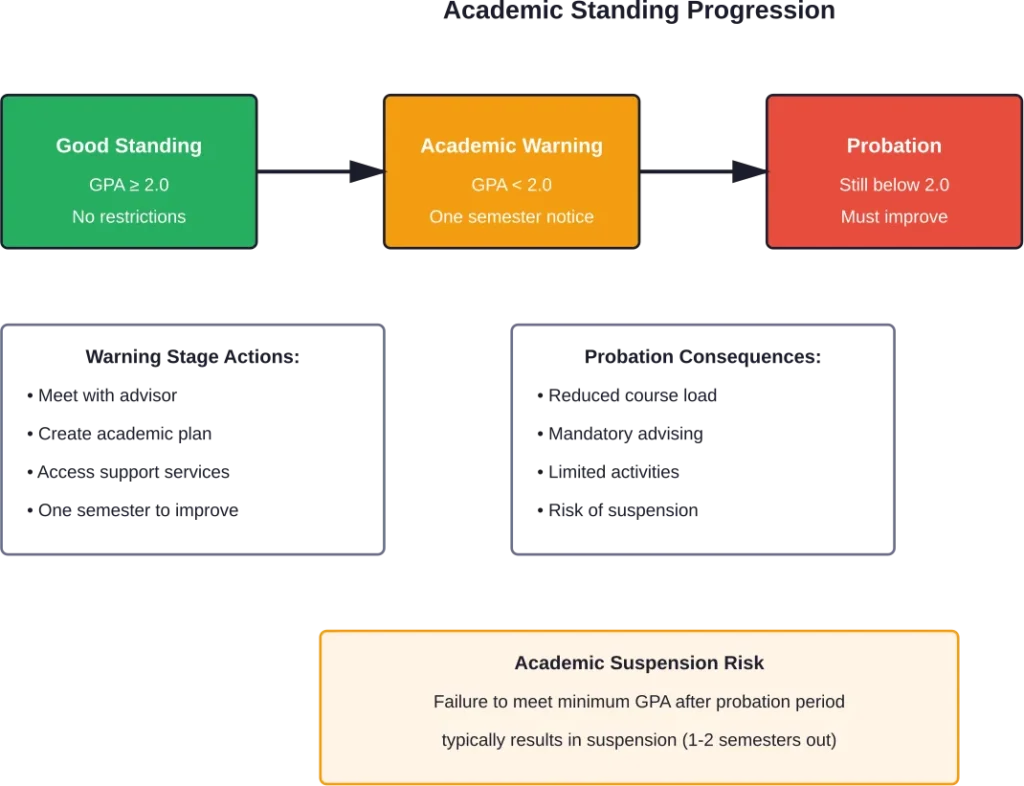
Students on probation typically face restrictions such as reduced maximum credit hours per semester, mandatory meetings with academic advisors, and limitations on participation in extracurricular activities or athletics. Some institutions require students to develop an academic improvement plan.
According to the University of Louisville’s academic policies, students who fail to meet minimum GPA requirements after probation face academic suspension—meaning you cannot enroll in classes for a specified period, typically one or two semesters.
That’s the escalation path: warning, probation, suspension, and potentially dismissal.
Financial Aid Complications
Here’s where failing a class gets financially serious. Federal financial aid requires students to maintain Satisfactory Academic Progress (SAP), which includes both qualitative and quantitative measures.
The qualitative component is your GPA—typically that 2.0 minimum. The quantitative component is your completion rate: you must successfully complete a certain percentage of attempted credits.
The 67% Rule and Maximum Timeframe
According to the U.S. Department of Education’s guidance on Satisfactory Academic Progress, institutions generally require students to complete at least 67% of attempted credit hours. When you fail a class, those credits count as attempted but not completed, dragging down your completion percentage.
Federal regulations also limit financial aid to 150% of your program’s published length. For a 120-credit bachelor’s degree, that’s 180 attempted credits maximum. Failed classes that you need to retake eat into that allowance quickly.
| SAP Component | Federal Requirement | Impact of Failed Class |
|---|---|---|
| Minimum GPA | Typically 2.0 for undergrad | F grade (0.0) lowers cumulative GPA |
| Completion Rate | 67% of attempted credits | Attempted credits increase, completed stays same |
| Maximum Timeframe | 150% of program length | Retaking course uses additional attempts |
| Progression | Measured each term | May trigger financial aid warning or probation |
Losing financial aid eligibility doesn’t happen instantly after one failed class, but it can happen faster than most students realize—especially if you’re already close to the thresholds or fail multiple courses.
Schools typically provide a financial aid warning for one semester, giving you a chance to get back on track. But if you don’t meet SAP standards by the end of that warning period, your aid gets suspended unless you successfully appeal.
The Appeal Process
Most institutions allow students to appeal financial aid suspension if extenuating circumstances contributed to academic failure—serious illness, family emergencies, mental health crises, or similar situations.
According to the Department of Education’s guidance, successful appeals typically require documentation of the circumstances and a clear academic plan demonstrating how you’ll meet SAP requirements going forward.
Graduation Timeline and Degree Requirements
Failed classes directly impact when you’ll graduate. If the course is required for your major or serves as a prerequisite for upper-level classes, you’re now behind schedule.
The ripple effect can be substantial. One failed prerequisite in your sophomore year might block three courses you planned for junior year, which then delays your senior capstone, which pushes graduation back a full semester or year.
And that delay costs money. Extra semesters mean additional tuition, fees, housing, and opportunity costs from delayed entry into the workforce.
What You Can Do About a Failed Class
Okay, so the consequences are real. But they’re not insurmountable. Here’s what to do.
Retake the Course Strategically
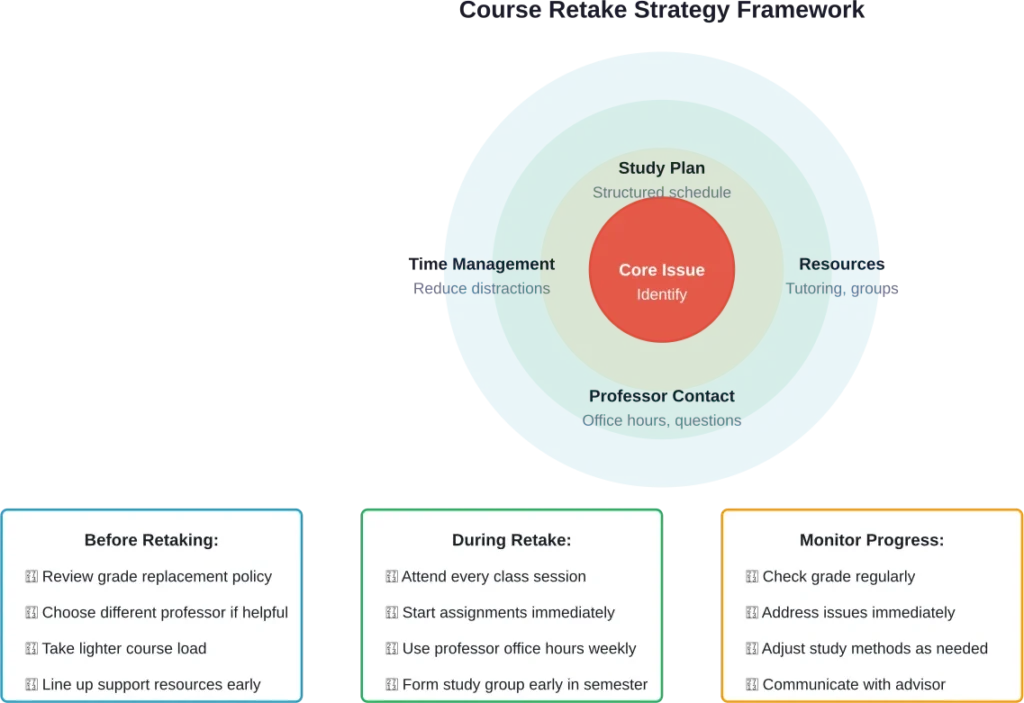
Most colleges allow grade replacement—when you retake a failed class, the new grade replaces the F in your GPA calculation. The original F still appears on your transcript, but it no longer drags down your average.
Check your school’s grade replacement policy carefully. Some institutions limit how many courses you can retake, and policies vary on whether retakes replace or average with the original grade.
When retaking a course, approach it differently than the first time. Identify exactly what went wrong—poor attendance, insufficient study habits, lack of prerequisite knowledge, external circumstances. Then address those specific issues.
Meet With Your Academic Advisor Immediately
Academic advisors can help students navigate situations like this, offering practical solutions and support for academic recovery. Advisors have seen it all and can help you understand how the failed class affects your degree progress, explore alternative courses that might fulfill the same requirement, and develop a realistic plan for getting back on track.
Use Campus Academic Support Resources
Most colleges offer tutoring centers, writing labs, study skills workshops, and supplemental instruction programs. These resources exist because institutions recognize that students need academic support to succeed.
If you failed due to difficulty with the material, get tutoring help before retaking the course. If time management or study skills were the issue, attend workshops on those topics. If mental health or personal issues contributed, connect with counseling services.
Consider Course Load Reduction
If you failed because you were overwhelmed with too many credits or a particularly difficult course combination, adjust your approach. Taking 12 credits and earning solid grades beats taking 18 credits and failing classes.
Sure, a reduced course load might delay graduation slightly. But graduating a semester late with a decent GPA beats failing multiple classes and potentially losing financial aid or facing suspension.
Prevention: What to Do When You’re Struggling
The best time to address a failing grade is before it becomes official. If you’re currently in a class where you’re struggling badly, you have options.
Withdrawal vs. Failing
Most colleges have a withdrawal deadline—typically around mid-semester—after which you can drop a class and receive a W on your transcript instead of an F.
A W doesn’t affect your GPA. It shows as attempted hours for financial aid purposes, but it’s infinitely better than an F. If you’re genuinely failing and cannot reasonably recover, withdrawing is often the smarter choice.
But check the financial implications first. Dropping below full-time status (usually 12 credits) can affect financial aid, scholarships, and insurance coverage. Talk to financial aid before withdrawing.
Incomplete Grades
If extenuating circumstances prevent you from completing coursework, professors can assign incomplete grades—typically marked as I. Some institutions allow incomplete grades to give students extra time to finish work when circumstances like serious illness or family emergencies interfere with completion.
Incompletes aren’t available just because you’re behind or struggling with the material. They’re specifically for situations where external factors beyond your control prevented completion despite good-faith effort throughout most of the semester.
Long-Term Academic Recovery
One failed class doesn’t define your college career. Many successful professionals failed classes during their undergraduate years.
What matters is the trajectory afterward. Admission committees for graduate programs and employers care more about your overall pattern and how you responded to setbacks than they do about individual grades from years ago.
If you fail early in your college career and then earn consistently strong grades afterward, that narrative actually demonstrates resilience and growth. A 3.4 GPA with one early F followed by three years of solid performance can be more impressive than a straight 3.4 with no setbacks.
| Recovery Timeline | Immediate (This Semester) | Short-Term (Next Semester) | Long-Term (Following Years) |
|---|---|---|---|
| Academic Actions | Meet advisor, plan retake, access support services | Retake course, lighter load, strong grades | Consistent performance, upward trajectory |
| Financial Aid | Check SAP status, understand probation terms | Meet SAP requirements, maintain completion rate | Restore full eligibility, maximize timeframe |
| GPA Impact | Calculate new GPA, understand standing | Replace failed grade, raise cumulative GPA | Demonstrate consistent improvement |
| Degree Progress | Revise graduation timeline, adjust course sequence | Complete prerequisites, stay on revised track | Graduate with solid record overall |
When to Consider Bigger Changes
Sometimes a failed class signals a deeper issue. If you failed because the subject fundamentally doesn’t align with your strengths or interests, that’s worth examining.
Students sometimes discover partway through college that their chosen major isn’t the right fit. That’s okay. Changing majors after recognizing a mismatch is smarter than forcing yourself through a program where you consistently struggle and hate the material.
Similarly, if mental health issues, learning differences, or personal circumstances significantly impacted your performance, addressing those underlying issues matters more than just retaking classes.
Frequently Asked Questions
No. Most colleges allow grade replacement when you retake a failed course. The new grade replaces the F in your GPA calculation, though the original F typically remains on your transcript. Your GPA can recover with consistent strong performance in subsequent courses.
It depends on the specific course and your degree requirements. If the failed class was an elective or easily substituted, you might stay on track by taking an extra course another semester. But if it’s a prerequisite for multiple other courses, graduation will likely be delayed by at least one semester.
One failed class alone typically won’t immediately disqualify you from financial aid, but it counts against your Satisfactory Academic Progress requirements. If your GPA falls below 2.0 or your completion rate drops below the required percentage (typically 67%), you may lose aid eligibility after a warning period.
Most institutions limit course retakes to one or two attempts beyond the original enrollment. Policies vary significantly by school, so check your institution’s specific grade replacement and course repeat policies. Some schools limit the total number of courses you can retake during your entire college career.
Withdrawing is almost always better than failing if you’re still within the withdrawal deadline. A W doesn’t affect your GPA and looks better on transcripts than an F. However, withdrawing can affect financial aid if it drops you below full-time status, so consult with financial aid before making that decision.
Employers who request official transcripts will see all grades, including failures. However, many employers only verify degree completion and graduation date rather than reviewing detailed transcripts. Graduate programs typically review full transcripts more carefully than most employers do.
Yes, most colleges have formal grade appeal processes, but successful appeals are rare. You typically need evidence of grading errors, discrimination, or failure to follow published grading policies. Simply disagreeing with the grade or feeling it’s too harsh generally isn’t grounds for a successful appeal.
Moving Forward After Academic Setback
Failing a class in college creates real consequences—lower GPA, potential financial aid complications, delayed graduation, and academic probation risk. Those consequences aren’t trivial.
But they’re also not insurmountable. Thousands of students fail classes each year and still go on to complete degrees successfully. The difference between those who recover and those who don’t comes down to taking immediate, strategic action.
Meet with your advisor. Understand your institution’s grade replacement policy. Retake the course with a better strategy. Use campus support resources. Address any underlying issues that contributed to failure.
And remember that one failed class doesn’t define your academic career. What defines your career is how you respond to that setback and what you do next.
The path back to academic success exists. Take the first step today.