
Quick Summary: Drinking bleach causes immediate and potentially severe chemical burns to the mouth, throat, esophagus, and stomach. Household bleach contains 3-6% sodium hypochlorite, a caustic substance that damages tissue on contact. Even small amounts can cause vomiting, throat pain, and stomach irritation, while larger quantities may lead to life-threatening complications including esophageal perforation, respiratory distress, and internal bleeding.
Household bleach sits under countless kitchen sinks and in laundry rooms across the country. Most people know it’s dangerous to drink, but understanding exactly what happens when bleach enters the body helps explain why accidental poisonings require immediate medical attention.
Household bleach is used for cleaning and disinfecting and contains sodium hypochlorite as its active ingredient. The severity of poisoning depends on concentration, amount ingested, and how quickly treatment begins.
What’s Actually in Household Bleach
Household bleach products typically contain 3-6% sodium hypochlorite solution. That might sound low, but it’s enough to cause significant tissue damage.
Some newer concentrated formulations contain higher percentages. Industrial-strength bleach solutions can contain around 20% hypochlorite, making them considerably more dangerous.
Sodium hypochlorite is a caustic chemical. When it contacts living tissue, it doesn’t just irritate—it actively destroys cells and causes chemical burns.
Immediate Physical Effects of Drinking Bleach
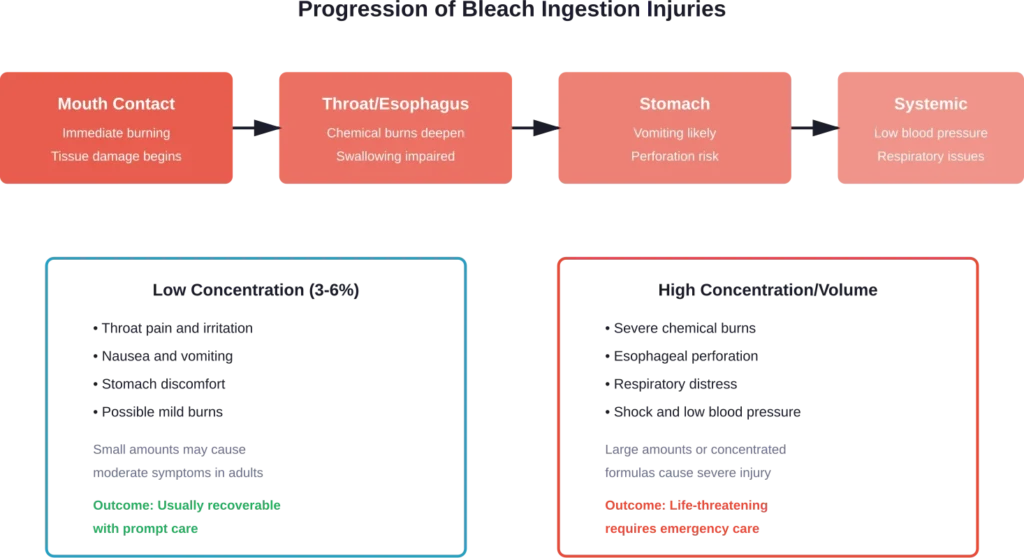
The moment bleach enters the mouth, the damage begins. The caustic liquid burns tissue on contact, creating injuries that progress through multiple body systems.
Mouth and Throat Damage
Burning sensations start immediately in the mouth and throat. The mucous membranes lining these areas are particularly vulnerable to chemical burns.
Drooling often occurs because swallowing becomes painful and difficult. The gagging reflex typically activates as the body attempts to expel the toxic substance.
Esophageal and Stomach Injury
As bleach moves down the esophagus, it continues burning tissue. According to medical research published in peer-reviewed journals, alkaline substances like bleach often cause deeper and more severe injuries than acidic substances.
The stomach lining faces similar damage. Chemical burns in the gastrointestinal tract can lead to perforation in severe cases—a life-threatening emergency where holes develop in the organ walls.
Complete Symptom Overview
Symptoms of sodium hypochlorite poisoning extend beyond the digestive system. The body’s response to this toxic exposure involves multiple organ systems.
| Body System | Symptoms | Severity Level |
|---|---|---|
| Mouth/Throat | Burning sensation, pain, drooling, difficulty swallowing | Immediate, moderate to severe |
| Gastrointestinal | Nausea, vomiting, abdominal pain, esophageal burns | Severe |
| Respiratory | Coughing, chest tightness, breathing difficulty | Moderate to severe |
| Eyes | Burning, tearing, redness (if splashed) | Moderate |
| Cardiovascular | Low blood pressure, rapid heart rate, shock | Severe (large ingestions) |
| Neurological | Confusion, delirium, loss of consciousness | Severe (systemic poisoning) |
According to the CDC’s medical management guidelines, symptoms vary based on concentration and amount ingested. Lower concentrations typically cause irritation and discomfort, while higher concentrations lead to severe corrosive injuries.
How Much Bleach Is Dangerous
There’s no safe amount of bleach to drink. But severity correlates with volume and concentration.
Small accidental sips of diluted household bleach may cause mild symptoms in adults. One case reported by the South Texas Poison Center involved children exposed to a diluted solution (a quarter cup of bleach per gallon of water). According to poison control experts, this dilution was “nowhere near the dose that would cause a serious adverse health effect.”
But that’s an extremely diluted concentration—far below typical household bleach strength.
Drinking bleach straight from the bottle, even a small amount, causes significantly more damage. Medical case reports describe severe corrosive injuries from ingesting household-strength bleach, with some requiring intensive medical intervention.
Concentrated bleach formulations pose even greater risks. Some products contain concentrations high enough to cause life-threatening injuries from relatively small volumes.
What to Do If Someone Drinks Bleach
Immediate action saves lives. The response depends on the person’s condition and symptoms.
Critical First Steps
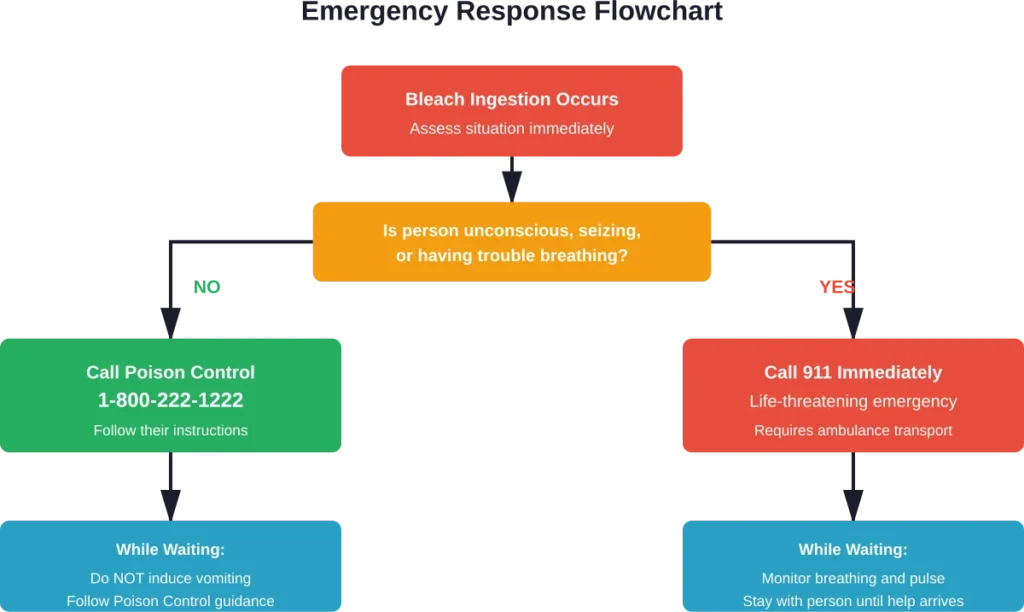
If someone collapses, has a seizure, has trouble breathing, or can’t be awakened: Call 911 immediately. These are medical emergencies requiring ambulance transport.
For conscious individuals who’ve ingested bleach: Call Poison Control at 1-800-222-1222 right away. This service is free, confidential, and available 24 hours a day.
Trained specialists at Poison Control can assess the situation and provide specific guidance based on the exact product, amount ingested, and symptoms present.
What NOT to Do
Don’t induce vomiting. Bringing bleach back up through the esophagus causes additional chemical burns to already damaged tissue.
Don’t give activated charcoal. It doesn’t neutralize bleach and may complicate medical treatment.
Don’t try to neutralize the bleach with other household chemicals. Mixing bleach with acids creates toxic chlorine gas, making the situation significantly worse.
Home Care While Waiting for Help
If the person can swallow safely and isn’t vomiting, small sips of water or milk may help dilute the bleach. But only do this if Poison Control or emergency services advise it.
For bleach splashed in eyes, rinse immediately with lukewarm water for at least 10-15 minutes. Don’t use eye drops.
For skin exposure, rinse the affected area thoroughly with water. Remove contaminated clothing without pulling it over the head (cut it off if necessary).
Medical Treatment for Bleach Poisoning
Hospital treatment focuses on managing symptoms and preventing complications. There’s no specific antidote for sodium hypochlorite poisoning.
Medical teams typically begin with airway assessment. Severe throat swelling can compromise breathing, requiring intubation in critical cases.
Endoscopy often follows for patients who’ve ingested significant amounts. This procedure allows doctors to visualize the extent of esophageal and stomach damage. According to medical research, 70-90% of patients can be managed non-operatively after initial assessment.
For patients unstable or at high risk, contrast-enhanced CT scans provide rapid, non-invasive evaluation. This imaging detects early signs of perforation—a complication requiring immediate surgical intervention.
Supportive care includes IV fluids to maintain blood pressure, pain management, and monitoring for complications. Patients with severe injuries may require extended hospitalization.
Long-Term Complications and Recovery
Most people who ingest small amounts of diluted bleach recover fully within days. Mild irritation and discomfort typically resolve without lasting effects.
But severe ingestions can cause permanent damage. Chemical burns to the esophagus may lead to strictures—narrowing of the passage that makes swallowing difficult. Some patients require repeated procedures to dilate the esophagus.
According to medical case reports, elderly patients face higher risks of serious complications. Age-related factors affect tissue resilience and healing capacity.
Why People Drink Bleach
Most bleach ingestions are accidental. Children mistake it for water or juice, especially when bleach is stored in unmarked containers.
Countless poisonings occur when someone pours bleach into a cup for cleaning, then leaves it on a counter. Someone else picks it up thinking it’s water and drinks it.
Intentional ingestions happen during suicide attempts or due to confusion in elderly individuals with cognitive impairment.
During the COVID-19 pandemic, dangerous misinformation spread suggesting bleach could treat or prevent coronavirus infection. Medical authorities and poison control centers explicitly warned that drinking or injecting bleach is extremely dangerous and provides no health benefits.
Preventing Bleach Poisoning
Storage practices prevent most accidental exposures. Keep bleach in its original container with the label intact. Never transfer it to drinking cups, bottles, or unlabeled containers.
Store cleaning products out of reach of children—high cabinets or locked storage areas work best. Child-resistant caps provide some protection but aren’t foolproof.
Never mix bleach with other household chemicals. Combining bleach with acids (like vinegar or toilet bowl cleaners) produces toxic chlorine gas. Mixing bleach with ammonia creates chloramine gas. Both can cause severe respiratory injury.
Use bleach only as directed on product labels. Wear protective gear including rubber gloves and eye protection when handling concentrated formulations.
Frequently Asked Questions
Yes, drinking bleach can be fatal, particularly in large amounts or with concentrated formulations. Severe corrosive injuries can lead to esophageal perforation, shock, respiratory failure, and death. Even smaller amounts cause serious medical problems requiring immediate treatment.
Call Poison Control immediately at 1-800-222-1222. If the child is unconscious, having seizures, or having trouble breathing, call 911 instead. Don’t induce vomiting or give anything by mouth unless instructed by poison control or emergency services.
Symptoms begin immediately upon contact. Burning sensations in the mouth and throat start within seconds. Vomiting, abdominal pain, and other symptoms typically develop within minutes. Some complications like esophageal strictures may not become apparent for days or weeks.
Small sips of water or milk may help dilute the bleach, but only if the person can swallow safely and isn’t vomiting. Always call Poison Control first for guidance—they’ll provide specific instructions based on the situation. Drinking large amounts of liquid can cause vomiting, which causes additional damage.
No. Drinking or injecting bleach does not treat, cure, or prevent COVID-19 or any other disease. This dangerous misinformation has led to serious poisonings and deaths. Bleach is effective for disinfecting surfaces when properly diluted, but it should never be consumed or injected.
Household bleach typically contains 3-6% sodium hypochlorite, though some concentrated formulas contain higher percentages. Industrial-strength bleach contains around 20% hypochlorite and causes more severe injuries. Both are dangerous to ingest, but industrial products pose greater risks from smaller volumes.
Recovery depends on the amount ingested and concentration. Small accidental sips of diluted bleach often result in full recovery with mild, temporary symptoms. Larger ingestions or concentrated formulations can cause permanent damage including esophageal strictures, requiring long-term medical management. Severe cases may result in death despite treatment.
Final Thoughts
Bleach poisoning represents a serious medical emergency requiring immediate professional intervention. The caustic nature of sodium hypochlorite causes tissue damage on contact, leading to chemical burns throughout the digestive system.
Severity depends on concentration and volume, but no amount is safe to drink. Small accidental exposures may cause mild symptoms, while larger ingestions can be life-threatening.
Prevention through proper storage and handling eliminates most risks. Keep bleach in original containers, store it out of reach of children, and never mix it with other chemicals.
If bleach ingestion occurs, call Poison Control at 1-800-222-1222 immediately for conscious individuals with mild symptoms. Call 911 for anyone who’s unconscious, having seizures, or experiencing respiratory distress. Don’t induce vomiting or attempt home remedies—professional medical guidance is essential.
The bottom line: bleach belongs on surfaces, not in bodies. When used properly for its intended purpose, it’s a safe and effective cleaning product. But ingestion causes serious harm that requires immediate medical attention.