
Quick Summary: Taking Jardiance (empagliflozin) at night is generally safe and effective, though morning dosing is typically recommended to minimize nighttime urination. Research shows that evening administration increases the time to peak concentration by 35% but results in slightly higher 24-hour glucose excretion. The medication works continuously regardless of timing, so either schedule can provide effective blood sugar control for type 2 diabetes.
Jardiance (empagliflozin) has become a cornerstone medication for managing type 2 diabetes, but confusion about optimal dosing timing persists. Most prescribing information recommends morning administration, yet many patients wonder whether evening dosing might better suit their lifestyle.
The short answer? Timing matters less than you might think for effectiveness, but it significantly impacts side effects and quality of life.
Understanding what happens when Jardiance is taken at different times requires examining how this SGLT2 inhibitor works in the body and what research reveals about circadian timing effects.
How Jardiance Works in Your Body
Jardiance belongs to a class of medications called sodium-glucose cotransporter 2 (SGLT2) inhibitors. These drugs revolutionized diabetes management by targeting the kidneys rather than insulin production.
According to the National Institutes of Health, approximately 90% of renal glucose reabsorption occurs in the first segment of the proximal tubule and is mediated by SGLT2, a low-affinity high-capacity transporter. Jardiance blocks this transporter, forcing excess glucose to exit through urine instead of being reabsorbed into the bloodstream.
This mechanism provides glucose-lowering efficacy together with cardiovascular and renal protection. The Canagliflozin Cardiovascular Assessment Study (CANVAS) Program demonstrated a 14% relative risk reduction in the composite outcome of cardiovascular death, nonfatal myocardial infarction, or nonfatal stroke.
But here’s the thing—this process happens continuously. Once Jardiance is in your system, it works around the clock regardless of when the dose was taken.
The Research on Morning vs. Evening Dosing
A groundbreaking study published in F1000Research examined exactly what happens when empagliflozin timing changes. Researchers gave 16 participants a 10-milligram dose of Jardiance at 7:00 p.m., then monitored them for 24 hours while testing their urine and blood.
The results revealed some interesting pharmacokinetic differences.
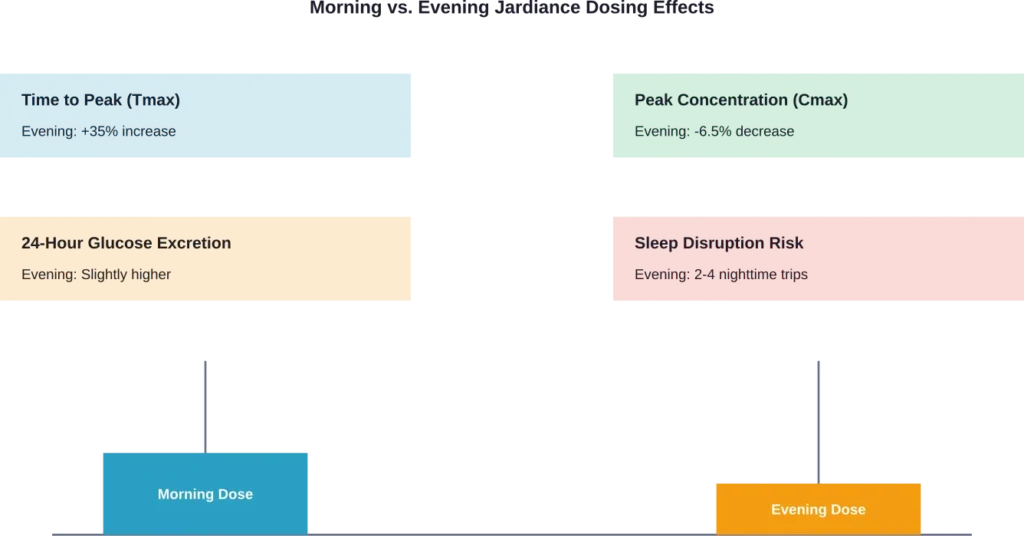
The time to reach maximum concentration (Tmax) increased by 35% in the evening phase compared to morning dosing. Meanwhile, the maximum concentration (Cmax) decreased by 6.5% with the evening dose.
Surprisingly though, the study found that more blood sugar was excreted after taking Jardiance in the evening. The 24-hour urinary glucose excretion (UGE) actually increased slightly with evening administration.
What does this mean practically? The body processes the medication differently depending on the time it’s given, but overall effectiveness remains comparable.
The Circadian Rhythm Connection
These timing differences aren’t random—they’re tied to the body’s internal clock. Circadian rhythms affect how medications are absorbed, distributed, metabolized, and eliminated.
Kidney function fluctuates throughout the day, with glomerular filtration rate typically higher during waking hours. This explains why SGLT2 inhibitors like Jardiance may produce different pharmacokinetic profiles based on dosing time.
Research on SGLT2 inhibitor pharmacodynamics has explored these chronotherapeutic effects. According to physiologically based pharmacokinetic modeling studies, the 24-hour urinary glucose excretion patterns can vary between different SGLT2 inhibitors (dapagliflozin, canagliflozin, empagliflozin, and ipragliflozin) when simulated in patients with type 2 diabetes and renal insufficiency.
But the effectiveness for blood sugar control? That remains consistent regardless of timing.
Side Effects and Quality of Life Considerations
Here’s where timing truly matters. Jardiance works by forcing glucose out through urine, which means increased urination is inevitable.
Taking Jardiance at night leads to a predictable problem: nighttime bathroom trips. Some patients report experiencing nighttime urination when taking Jardiance in the evening.
Morning dosing minimizes sleep disruption. The medication’s diuretic effect occurs primarily during waking hours, when bathroom access is convenient and sleep quality isn’t compromised.
| Factor | Morning Dosing | Evening Dosing |
|---|---|---|
| Sleep Quality | Minimal disruption | 2-4 nighttime bathroom trips |
| Glucose Control | Effective 24-hour coverage | Effective 24-hour coverage |
| Convenience | Fits routine, easier to remember | May suit shift workers |
| Urination Frequency | Daytime increase | Nighttime increase |
| Consistency | Recommended by prescribers | Off-label timing |
Other side effects remain consistent regardless of timing. Clinical trials showed that fasting plasma glucose levels decreased by 17.2–25.8% with empagliflozin across different dosing schedules.
The frequency of adverse events in multiple rising dose studies ranged from 33.3–66.7% with empagliflozin compared to 41.7% with placebo—timing didn’t significantly alter this profile.
Official Prescribing Recommendations
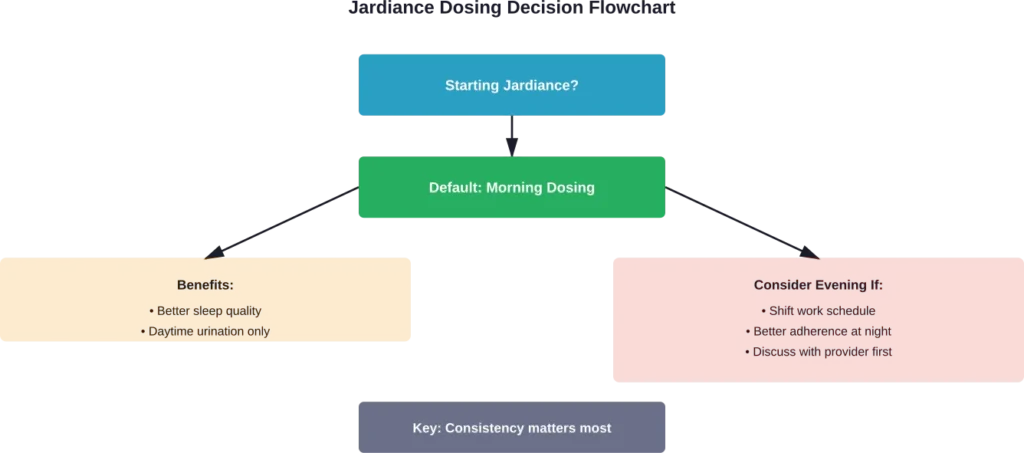
Healthcare professionals and official prescribing information consistently recommend morning administration. The recommended Jardiance dosage is one tablet per day, taken in the morning with or without food.
MedlinePlus drug information emphasizes once-daily dosing without specific rationale for optimal timing, but the pattern in clinical practice strongly favors morning dosing to prevent nighttime urination.
According to the American Diabetes Association, oral medications for type 2 diabetes work in different ways to regulate blood glucose levels. Managing type 2 diabetes involves a comprehensive approach that includes meal planning, physical activity, and medication timing that supports adherence.
The key is consistency. Taking Jardiance at the same time each day maintains steady blood levels and maximizes effectiveness.
When Evening Dosing Might Make Sense
Real talk: some situations might warrant evening dosing despite the general morning recommendation.
Shift workers with non-traditional schedules may find evening dosing aligns better with their “morning” wake time. The goal is to take the medication at a consistent time relative to the daily routine, not strictly based on clock time.
Patients who consistently forget morning medications but reliably take evening pills might achieve better adherence with nighttime dosing. Medication effectiveness requires actually taking it—a perfectly timed dose that’s forgotten is worthless.
That said, any timing change should be discussed with a healthcare provider first. Don’t adjust dosing schedules without medical guidance.
What About Missing a Dose or Double Dosing?
Taking Jardiance twice per day is not recommended. Doing so may increase the risk of certain side effects, particularly dehydration, urinary tract infections, and genital yeast infections.
If a dose is missed, the standard recommendation is to take it as soon as remembered—unless it’s close to the next scheduled dose. In that case, skip the missed dose and resume the regular schedule. Never double up to make up for a missed dose.
Jardiance doesn’t lower blood sugar immediately. SGLT2 inhibitors work gradually over several days to weeks as they build up in the system and consistently remove glucose through the kidneys.
Stopping Jardiance suddenly isn’t dangerous in the way it might be with insulin, but blood sugar control will gradually worsen. Any medication discontinuation should involve medical consultation.
Practical Tips for Taking Jardiance
Regardless of timing chosen, these practices optimize Jardiance effectiveness:
- Stay hydrated: SGLT2 inhibitors increase urination, so adequate fluid intake prevents dehydration
- Monitor for infections: Increased glucose in urine raises urinary tract and genital infection risk
- Maintain foot hygiene: Jardiance doesn’t directly cause foot problems, but diabetes complications require vigilance
- Check ketone levels if ill: SGLT2 inhibitors carry a small risk of euglycemic diabetic ketoacidosis, particularly during illness or fasting
- Don’t skip doses: Consistency maintains steady blood sugar control
Set a daily alarm or use a pill organizer to maintain the schedule. Many patients link Jardiance to a daily habit like brushing teeth or making morning coffee.
Special Populations and Timing Considerations
Patients with renal insufficiency require special attention. Physiologically based pharmacokinetic models have been developed to predict optimal dosage regimens for patients with type 2 diabetes and kidney problems.
According to research examining SGLT2 inhibitor effects across different stages of renal function, dosing adjustments may be necessary as kidney function declines. Timing becomes less critical than dosage in these populations.
Cardiovascular disease patients benefit from SGLT2 inhibitors beyond glucose control. These medications reduce hospitalizations for heart failure and lower cardiovascular mortality in patients with or without diabetes. Timing doesn’t affect these protective benefits.
Frequently Asked Questions
No, evening dosing doesn’t significantly reduce Jardiance’s effectiveness for blood sugar control. Research shows that while the body processes the medication differently at night (35% longer time to peak concentration), 24-hour glucose excretion actually increases slightly with evening doses. The medication works continuously regardless of timing.
Jardiance won’t keep patients awake through direct stimulation, but it will increase nighttime urination. Some patients report experiencing 2-4 bathroom trips per night with evening dosing, which disrupts sleep quality. This is why morning dosing is generally recommended—not for effectiveness, but for quality of life.
Take the missed dose as soon as remembered, unless it’s close to the next scheduled dose. If it’s nearly time for the next dose, skip the missed one and resume the regular schedule. Never take two doses at once to make up for a missed dose, as this increases side effect risk without improving effectiveness.
While Jardiance can be taken at any time of day, timing changes should be discussed with a healthcare provider first. The transition itself is straightforward—simply take the next dose at the new preferred time—but medical guidance ensures the change aligns with the overall treatment plan and other medications.
Jardiance can be taken with or without food, and meals don’t significantly affect absorption. However, linking medication to a daily meal helps with adherence. Many patients take it with breakfast, which combines the morning timing recommendation with a consistent daily routine.
Jardiance doesn’t have significant timing-dependent drug interactions, but it does interact with certain medications regardless of when it’s taken. Diuretics, insulin, and medications that cause dehydration require careful management. Discuss all medications with a healthcare provider to optimize the overall timing strategy.
Jardiance begins excreting glucose through urine within hours of the first dose, but meaningful blood sugar improvements typically appear within several days to weeks. This gradual effect means missing one dose won’t cause immediate blood sugar spikes, but consistent daily dosing is essential for sustained control.
The Bottom Line on Jardiance Timing
Taking Jardiance at night is safe and won’t dramatically reduce effectiveness, but morning dosing offers clear quality-of-life advantages. Clinical research confirms that evening administration changes how the body processes empagliflozin—peak concentration occurs later and reaches slightly lower levels—but 24-hour glucose control remains effective.
The real difference isn’t effectiveness; it’s sleep quality. Nighttime bathroom trips add up quickly when SGLT2 inhibitors are taken in the evening.
For most patients, morning dosing represents the sweet spot: effective blood sugar control without sleep disruption. But individual circumstances matter. Shift workers, patients with better evening adherence, or those with specific lifestyle needs may benefit from personalized timing.
The most important factor? Consistency. Taking Jardiance at the same time daily—whether morning or evening—maintains steady blood levels and maximizes therapeutic benefits.
Talk with a healthcare provider before adjusting dosing schedules. Jardiance has transformed type 2 diabetes management by providing glucose control alongside cardiovascular and renal protection. Optimizing timing ensures those benefits fit seamlessly into daily life.