

Quick Summary: Getting a DUI triggers immediate legal consequences including arrest, license suspension, fines ranging from $200-$5,000, potential jail time, mandatory alcohol education programs, and ignition interlock requirements. According to the National Institute on Alcohol Abuse and Alcoholism, alcohol contributes to about 31% of motor vehicle traffic fatalities. Beyond legal penalties, a DUI conviction can impact employment, insurance rates, professional licenses, and future opportunities for years.
A DUI arrest changes everything in an instant. One moment there’s a traffic stop, the next there’s handcuffs, a towed vehicle, and a future that feels uncertain.
The consequences extend far beyond that initial encounter with law enforcement. Understanding what happens after a DUI arrest helps prepare for the legal process ahead and the decisions that will shape the outcome.
According to the National Institute on Alcohol Abuse and Alcoholism, alcohol increases the risk for injuries and deaths from violence, falls, fires, and motor vehicle crashes. In 2022, alcohol contributed to more than 4.2 million emergency department visits in the United States.
The immediate and long-term repercussions of a DUI conviction touch nearly every aspect of life. Here’s what actually happens.
The Immediate Aftermath of a DUI Arrest
The arrest itself marks just the beginning. Law enforcement conducts field sobriety tests and chemical testing at the scene or station. Refusing chemical testing carries its own penalties in most jurisdictions, often including automatic license suspension.
After the arrest, the vehicle typically gets impounded. Towing fees, impound lot charges, and storage costs start accumulating immediately. These expenses can reach several hundred dollars within the first few days.
Most people are released on bond within hours or by the next morning. Release conditions often include restrictions on alcohol consumption, driving privileges, and requirements to appear at scheduled court dates. Violating these conditions creates additional legal problems.
The arresting officer confiscates the driver’s license and issues a temporary driving permit. This permit usually expires within 7 days, depending on state law.
Understanding DUI Charges and Classifications
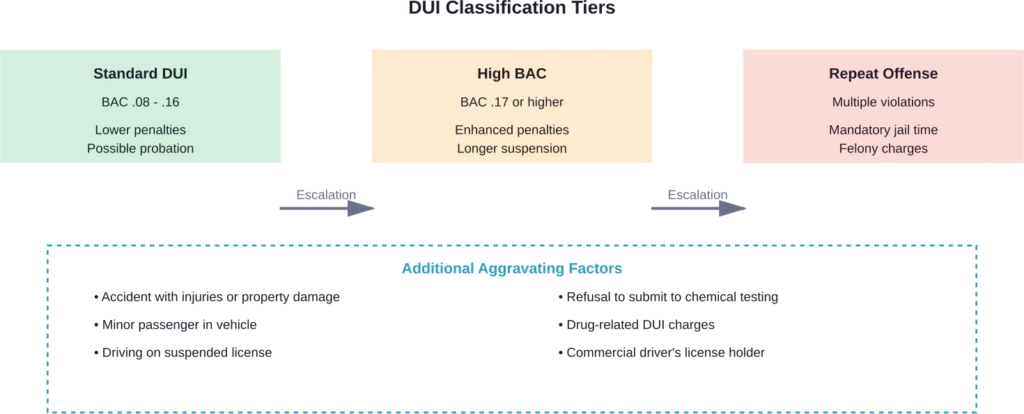
Not all DUI charges are identical. The specific charge depends on blood alcohol content (BAC), prior offenses, and circumstances surrounding the arrest.
Standard DUI charges typically apply when BAC measures between .08 and .16. Some states classify these as Operating While Intoxicated (OWI) or Driving While Intoxicated (DWI).
High BAC offenses involve blood alcohol levels of .17 or higher. Pennsylvania law, for example, creates tiered penalties based on BAC ranges: .08 to .099%, .10 to .159%, and .16% and above. Each tier carries progressively harsher penalties.
Other substances beyond alcohol also trigger DUI charges. Illegal drugs, prescription medications, over-the-counter drugs, and inhalants like glue or gasoline can all impair driving ability and result in charges.
First Offense DUI Penalties
First-time offenders often wonder whether jail time is inevitable. The answer varies by state and circumstances.
Most courts order probation for first offenses rather than incarceration. However, jail time remains possible, particularly for high BAC cases or when aggravating factors exist.
Financial Penalties for First DUI
The financial impact hits hard and fast. Fines alone range from $300 to $500 for a first offense, depending on jurisdiction and BAC level.
Court costs add another $200 to $1,000. Additional fees include probation oversight charges, reimbursement to law enforcement for testing, and mandatory program enrollment fees.
Pennsylvania’s tiered system for high BAC offenses (.10 to .159% BAC) imposes fines between $500 and $5,000 for first offense with no prior violations.
Kentucky requires completion of a 90-day alcohol or substance abuse program for first offenses, adding program costs to the financial burden.
License Suspension Periods
License suspension begins quickly. First offense suspensions typically last six months to one year.
Kentucky law imposes a six-month license suspension for first DUI offenses. The driver may become eligible for restricted driving privileges after a portion of the suspension period.
High BAC cases face longer suspensions. A conviction with BAC of 0.17 or higher results in a total loss of driving privileges for 45 days, followed by eligibility for an interlock-restricted license for the next 320 days.
Some states allow restricted licenses that permit driving to work, school, or medical appointments. These restricted licenses often require installation of an ignition interlock device.
Mandatory Programs and Community Service
Alcohol education programs are standard requirements. These programs examine drinking patterns, consequences of impaired driving, and strategies for avoiding future offenses.
Community service requirements can reach up to 360 hours for first offenses. The hours must be completed within specified timeframes set by the court.
Treatment programs may be ordered when alcohol dependency is suspected. These programs range from outpatient counseling to residential treatment, depending on assessment results.
Second and Subsequent Offense Consequences
Repeat offenses trigger substantially harsher penalties. The legal system treats multiple DUI convictions as evidence of ongoing dangerous behavior.
Virginia law mandates a minimum $500 fine and confinement in jail for not less than one month with 20 days mandatory minimum for second offenses committed within five to ten years of a prior offense.
License suspension extends to one year or longer for second offenses. Ignition interlock devices become mandatory equipment for any driving privileges.
Third offenses often elevate charges to felony level. Felony DUI convictions carry prison sentences measured in years rather than months, along with permanent criminal records.
| Offense | Typical Jail Time | Fine Range | License Suspension | Additional Requirements |
|---|---|---|---|---|
| First DUI | Probation to 6 months | $300 – $1,000 | 6 months – 1 year | Alcohol education, community service |
| Second DUI | 5 days – 1 year | $500 – $5,000 | 1 year – 2 years | Ignition interlock, treatment programs |
| Third DUI | 1 – 5 years prison | $1,000 – $10,000 | 1 – 10 years | Felony record, vehicle forfeiture possible |
The Court Process After DUI Arrest
Understanding the legal timeline helps manage expectations. The process moves through several distinct stages.
Arraignment and Formal Charges
Arraignment typically occurs within days or weeks of arrest. The court formally presents charges and the defendant enters a plea: guilty, not guilty, or no contest.
This hearing establishes bail conditions if the defendant wasn’t released immediately after arrest. The judge may impose additional restrictions on driving, alcohol consumption, or travel.
Legal representation matters significantly at this stage. Challenging the legality of the traffic stop, questioning the accuracy of breath or blood tests, and presenting evidence of improper police conduct can all impact case outcomes.
Pretrial Negotiations and Plea Bargains
Many DUI cases resolve through pretrial negotiations rather than trials. Prosecutors may offer plea bargains that reduce charges or penalties in exchange for a guilty plea.
Common plea bargain outcomes include reduced charges from DUI to reckless driving, shortened suspension periods, or elimination of jail time in favor of extended probation.
Accepting a plea bargain requires weighing the certainty of known penalties against the risk of harsher consequences if convicted at trial.
Trial and Evidence Presentation
Cases that proceed to trial require the prosecution to prove guilt beyond reasonable doubt. Defense attorneys challenge the evidence, question witness credibility, and identify procedural errors.
Blood alcohol test results can be contested based on calibration records for breathalyzer devices, proper administration of tests, and chain of custody for blood samples.
Field sobriety test performance may be challenged by showing medical conditions, uneven road surfaces, or improper test administration that affected results.

Administrative License Suspension
License consequences operate on two separate tracks: administrative and criminal.
Administrative suspension begins immediately after arrest, separate from any criminal court proceedings. This suspension stems from implied consent laws that require drivers to submit to chemical testing.
Refusal to take a breath or blood test triggers automatic administrative suspension. These refusal suspensions often last longer than suspensions resulting from failed tests.
Administrative hearings provide an opportunity to contest the suspension. Common grounds for challenge include lack of probable cause for the stop, improper testing procedures, or equipment malfunction.
The administrative suspension continues unless successfully challenged, regardless of the outcome in criminal court.
Long-Term Consequences Beyond Legal Penalties
The ripple effects extend far beyond courtrooms and license bureaus.
Employment Impact
Professional licenses face jeopardy. Healthcare workers, attorneys, teachers, real estate agents, and commercial drivers may lose professional licensing or face disciplinary action.
Commercial driver’s license holders face particularly harsh consequences. A DUI conviction often means permanent disqualification from operating commercial vehicles, ending careers in trucking, bus driving, or delivery services.
Background checks reveal DUI convictions. Employers in transportation, education, healthcare, and positions involving company vehicles frequently reject applicants with impaired driving records.
Insurance Rate Increases
Auto insurance rates increase significantly after DUI convictions. Some insurers drop coverage, potentially forcing drivers into high-risk insurance pools with substantially higher premiums.
SR-22 certificates become mandatory in most states. These certificates prove financial responsibility and require higher coverage limits, adding to insurance costs.
Elevated insurance rates typically persist for three to five years following conviction.
Personal and Social Consequences
Housing applications may be denied when criminal background checks reveal DUI convictions. Landlords and property management companies often reject applicants with recent criminal records.
Educational opportunities can be affected. College admissions, financial aid eligibility, and participation in study abroad programs may all be impacted by criminal convictions.
Travel restrictions apply in some countries. Canada, for example, considers DUI a serious criminal offense and may deny entry to individuals with impaired driving convictions.
The Role of Ignition Interlock Devices
Ignition interlock devices have become standard requirements in DUI cases nationwide.
These devices connect to the vehicle’s ignition system and require a breath sample before the engine will start. Random rolling retests occur while driving to ensure continued sobriety.
Installation costs typically range from $70 to $150. Monthly monitoring and calibration fees add another $60 to $90. The driver bears all costs.
Attempts to circumvent the device trigger violations recorded in the device’s memory. These violations must be explained to monitoring authorities and can result in extended interlock requirements or additional penalties.
Interlock periods vary by offense level. First offenses may require six months to one year of interlock use. Repeat offenses extend requirements to multiple years.
Health Consequences of Alcohol-Related Incidents
The National Institute on Alcohol Abuse and Alcoholism reports sobering statistics about alcohol’s broader impact beyond traffic incidents.
Alcohol is a factor in about 25% of suicides, about 40% of fatal burn injuries, about 50% of fatal drownings and homicides, and about 65% of fatal falls. Around 31% of all motor vehicle traffic fatalities involve alcohol.
Half of liver disease deaths in the United States are caused by alcohol. Alcohol-associated liver disease is increasing, particularly among women and young people.
Research has shown an important association between alcohol consumption and breast cancer. Even one drink per day can increase a woman’s risk.
These health statistics underscore why DUI enforcement remains a public safety priority.
Defending Against DUI Charges
Legal defenses can significantly impact case outcomes. Not every arrest leads to conviction.
Challenging the traffic stop examines whether law enforcement had reasonable suspicion or probable cause. Traffic stops without valid justification can result in case dismissal.
Questioning test accuracy involves examining breathalyzer calibration records, blood sample handling procedures, and testing protocol compliance. Technical errors and equipment malfunctions create reasonable doubt.
Medical conditions can affect test results. Diabetes, acid reflux, dental work, and certain medications may produce false positive results on breath tests.
Officer testimony faces scrutiny during cross-examination. Inconsistencies in police reports, dash camera footage contradicting officer statements, and improper field sobriety test administration all weaken prosecution cases.
Mounting an effective defense requires expertise in challenging evidence, questioning test accuracy, and identifying procedural errors.
Steps to Take Immediately After DUI Arrest
Actions taken in the hours and days following arrest matter significantly.
Document everything. Write down details about the stop, what was said, tests administered, and any unusual circumstances while memory remains fresh.
Request administrative hearing quickly. Deadlines for challenging administrative license suspension are typically very short, often just 7-10 days from arrest.
Avoid discussing the case on social media or with anyone except legal counsel. Statements made to friends, family, or online can be used as evidence.
Secure copies of all documentation including police reports, chemical test results, and video footage from the arrest.
Begin researching legal representation immediately. Consultations with multiple attorneys help identify the best fit for the specific case.
Frequently Asked Questions About DUI Consequences
Jail time isn’t guaranteed for first offenses. Most courts order probation, alcohol programs, fines, and license sanctions rather than incarceration for first-time offenders. However, high BAC levels, accidents, injuries, or aggravating circumstances increase the likelihood of jail time even on first offenses.
Total costs for a first offense typically range from $2,000 to $7,000 when accounting for all expenses. This includes fines ($300-$500), court costs ($200-$1,000), attorney fees ($1,500-$5,000), increased insurance premiums, ignition interlock costs, alcohol program fees, towing and impound charges, and lost wages from court appearances and jail time.
Expungement availability varies significantly by state. Some states allow first-time offenders to petition for expungement after completing all sentence requirements and waiting a specified period (often 5-10 years). Other states prohibit DUI expungement entirely. The specific laws in the jurisdiction where the conviction occurred determine eligibility.
Refusing chemical testing triggers automatic administrative license suspension under implied consent laws. Refusal suspensions often last longer than suspensions for failed tests. Additionally, refusal can be used as evidence of consciousness of guilt in criminal proceedings. Some states impose additional penalties specifically for test refusal beyond standard DUI consequences.
DUI convictions typically impact insurance rates for three to five years. During this period, premiums often increase by 80% to 300% compared to standard rates. Some insurers refuse coverage altogether, forcing drivers into high-risk pools with even higher premiums. The exact duration and amount of increase depend on the insurance company, state regulations, and individual driving history.
Many states offer restricted licenses that permit driving for specific purposes like work, school, medical appointments, or alcohol treatment programs. Eligibility typically requires serving a portion of the suspension period first. Restricted licenses usually require ignition interlock device installation. Some suspensions prohibit all driving, offering no restricted license option.
Yes, DUI is a criminal offense. First and second offenses typically qualify as misdemeanors, while third and subsequent offenses often elevate to felonies. Criminal convictions appear on background checks, can affect employment and housing opportunities, and may restrict gun ownership rights. The conviction remains on criminal records permanently unless successfully expunged.
Moving Forward After a DUI
A DUI conviction reshapes multiple aspects of life, but it doesn’t define the future permanently.
Compliance with all court-ordered requirements demonstrates responsibility and prevents additional legal complications. Missing court dates, failing to complete programs, or violating probation terms compounds existing problems.
Addressing underlying alcohol issues prevents future offenses. Whether through court-ordered treatment or voluntary programs, examining drinking patterns and making changes protects both legal standing and personal wellbeing.
Rebuilding after conviction takes time. Professional opportunities, insurance rates, and driving privileges gradually normalize as years pass and requirements are fulfilled.
The immediate aftermath feels overwhelming. The process extends over months or years. But understanding what happens after a DUI arrest provides the foundation for navigating the system effectively.
Legal representation makes a measurable difference in outcomes. Experienced attorneys challenge evidence, negotiate favorable plea agreements, and protect rights throughout the process.
The consequences are serious. The statistics are sobering. But informed decisions and appropriate legal help can mitigate the worst impacts and preserve future opportunities.