

Quick Summary: Taking sea moss daily can support thyroid function, improve gut health, and boost immunity due to its rich mineral content. However, daily consumption carries risks including excessive iodine intake that may trigger thyroid dysfunction, potential heavy metal exposure, and digestive upset. Most experts recommend cycling sea moss rather than continuous daily use, and consulting a healthcare provider before starting any supplementation regimen.
Sea moss has exploded across social media feeds and supplement shelves, celebrated as a nutrient-dense superfood that promises everything from glowing skin to boundless energy. The reddish seaweed, also called Irish moss or Chondrus crispus, is showing up in smoothies, gels, capsules, and even ice cream.
But here’s the thing—daily consumption isn’t as straightforward as wellness influencers make it seem.
The question isn’t just whether sea moss offers benefits. It’s what happens to the body when consuming it every single day, and whether those daily doses cross from helpful into harmful territory.
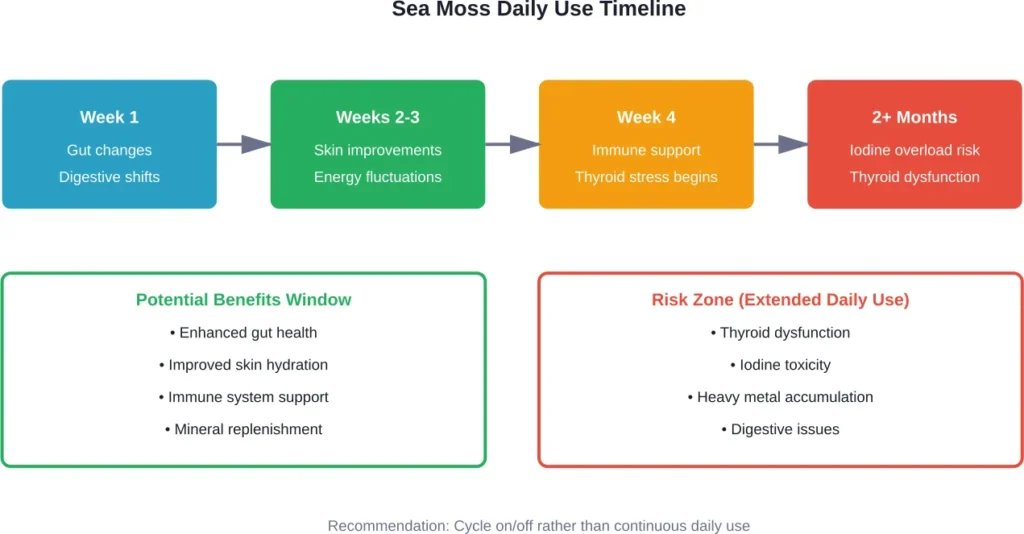
The Timeline: What Happens Week by Week
Understanding the effects of daily sea moss requires looking at how the body responds over time. The changes don’t all happen at once.
Week 1: Initial Gut and Digestive Changes
During the first week, the most noticeable changes happen in the digestive system. Sea moss contains carrageenan, a type of fiber that acts as a prebiotic, feeding beneficial gut bacteria.
Some people report improved regularity and less bloating. Others experience the opposite—digestive discomfort, loose stools, or mild cramping as the gut microbiome adjusts to the new fiber source.
The body also starts absorbing the mineral content, particularly iodine, which accumulates in the thyroid gland.
Weeks 2-3: Skin and Energy Shifts
Around the second week, many users notice changes in skin hydration and texture. Sea moss contains sulfur compounds and minerals that support collagen production and skin barrier function.
Energy levels may shift during this period. Some report feeling more energized, while others—particularly those with underlying thyroid conditions—may experience fatigue or jitteriness as thyroid hormone levels fluctuate in response to increased iodine intake.
This is where individual variation becomes significant.
Week 4 and Beyond: Thyroid Function Under Pressure
After a month of daily consumption, iodine accumulation becomes a concern. According to research published by the National Institutes of Health, seaweeds can contain extremely high iodine levels, and excessive intake can damage thyroid function.
The European Journal of Nutrition published a 2026 study showing that habitual seaweed consumption significantly increased urinary iodine concentrations, with estimated median iodine intake reaching 260 µg/day from diet alone—before adding concentrated seaweed products.
Long-term daily use without cycling off can lead to thyroid dysfunction, even in people with healthy thyroid function at baseline.
The Iodine Problem: Too Much of a Good Thing
Iodine is essential for thyroid hormone production. The thyroid needs it to function. But there’s a narrow window between deficiency and excess.
Sea moss contains highly variable iodine content depending on where it’s harvested, the species, and processing methods. Some samples contain enough iodine in a single serving to exceed the safe upper limit.
According to MedlinePlus, a government health resource, iodine poisoning can occur with large doses, and children are especially sensitive to its effects. Symptoms include abdominal pain, coughing, delirium, diarrhea (sometimes bloody), fever, gum and tooth soreness, loss of appetite, and metallic taste.
Jod-Basedow Phenomenon: When Iodine Triggers Thyroid Crisis
Medical literature documents cases of thyroid crisis triggered by sea moss. A case report published in the Journal of the Endocrine Society (2021) described a patient with Grave’s disease who developed Jod-Basedow phenomenon—a rare form of thyrotoxicosis—after consuming Irish sea moss supplements.
The phenomenon occurs when excessive iodine intake triggers uncontrolled thyroid hormone production in people with underlying thyroid conditions. But it can also affect those with previously normal thyroid function after prolonged high-dose iodine exposure.
This isn’t a theoretical risk. It’s documented in medical literature and represents a serious concern for daily users.
Quality Control and Contamination Risks
Sea moss absorbs compounds from the water where it grows. That includes beneficial minerals, but also heavy metals, pollutants, and toxins if harvested from contaminated waters.
The FDA issued multiple warnings and recalls related to sea moss products. On January 9, 2026, Diva Fam Inc. announced a voluntary recall of all lots and flavors of Sea Moss Gel Superfood due to lack of required regulatory authorization and temperature monitoring records for pH-controlled food products, with FDA publishing the notice on January 12, 2026, creating potential botulism risk.
The FDA also maintains Import Alert 99-39, which allows detention without physical examination of certain imported food products that appear misbranded, including some sea moss products.
Sourcing matters significantly. According to Jennifer Smith, a professor of marine biology at UC San Diego’s Scripps Institution of Oceanography, if seaweed is harvested from polluted harbors, the products will contain heavy metals and potentially other toxins.
Documented Benefits: What the Research Actually Shows
Despite the risks, sea moss does contain beneficial compounds. But the evidence is more limited than social media suggests.
Mineral Content and Nutritional Profile
Sea moss contains various minerals including calcium, magnesium, potassium, and sulfur. However, the claim that it contains “92 out of 102 minerals the body needs” lacks scientific support.
The actual mineral content varies widely by species, harvest location, and processing. Lab testing is the only way to know what’s actually in a specific product.
Prebiotic Fiber and Gut Health
The carrageenan in sea moss acts as a prebiotic fiber that can support beneficial gut bacteria. Research published in Marine Drugs discusses the health benefits of seaweed consumption, noting that compounds like fucoidans and laminarans may provide biological activity, with content varying from 20% to higher levels depending on species.
But these same compounds can cause digestive upset, especially when starting supplementation or consuming high doses daily.
Immune System Support
Generally speaking, polysaccharides found in seaweeds may have immune-modulating properties. However, clinical trials specifically testing sea moss in humans remain limited.
Most of the immune-related claims stem from in vitro studies or research on isolated compounds rather than whole sea moss consumed in typical supplement forms.
| Claimed Benefit | Evidence Level | Notes |
|---|---|---|
| Thyroid support | Moderate | Contains iodine but excess causes dysfunction |
| Gut health | Moderate | Prebiotic fiber supports microbiome |
| Skin health | Limited | Anecdotal reports, minimal clinical trials |
| Immune function | Limited | Based on compound studies, not whole food trials |
| Energy boost | Minimal | Mostly anecdotal, likely related to correcting deficiencies |
| Weight loss | Minimal | No direct evidence for sea moss specifically |
Who Should Avoid Daily Sea Moss
Certain populations face higher risks from daily sea moss consumption:
- People with thyroid conditions: Grave’s disease, Hashimoto’s thyroiditis, hypothyroidism, or hyperthyroidism can all be worsened by excessive iodine intake
- Pregnant and breastfeeding women: While iodine is essential during pregnancy, the unpredictable content in sea moss products makes dosing unreliable and potentially dangerous
- People taking thyroid medications: Sea moss can interfere with thyroid hormone replacement and other medications
- Those with kidney disease: The potassium content may be problematic for those with impaired kidney function
- People on blood thinners: Sea moss may affect blood clotting
According to Children’s Hospital of Philadelphia, the benefits of sea moss are supposedly related to thyroid support, gut health, and immunity, but the evidence remains limited and potential harms may outweigh benefits for many people.
Safe Usage Guidelines: How to Minimize Risks
For those who choose to use sea moss despite the risks, certain precautions can help minimize harm.
Cycling Instead of Daily Use
The safest approach involves cycling—taking sea moss for 2-3 weeks, then taking 1-2 weeks off. This prevents iodine accumulation and gives the thyroid time to regulate.
Continuous daily use for months increases risk significantly compared to intermittent use.
Dosage Considerations
There’s no established safe daily dose because iodine content varies so dramatically between products. Generally speaking, keeping intake to 1-2 tablespoons of gel or 500-1000mg of capsules may be reasonable for most adults without thyroid conditions.
But without third-party lab testing of the specific product showing iodine content and contaminant screening, dosing remains guesswork.
Quality Verification
Look for products that provide:
- Third-party testing results showing iodine content
- Heavy metal screening results
- Harvest location information
- Processing and storage details
- Proper pH control documentation for gel products
Products priced anywhere from $30 to $90 a jar may or may not be higher quality—price doesn’t guarantee safety or efficacy.
What Medical Experts Say About Daily Use
Healthcare professionals remain cautious about sea moss supplementation. Claire Edgemon, senior registered dietitian at Baylor College of Medicine, noted in a 2025 article that sea moss has been promoted as a “super supplement,” but states that if you’re eating a healthy diet with lean proteins, vegetables and fruits, you will still get the vitamins and minerals that sea moss provides.
Children’s Hospital of Philadelphia (via Dr. Katie K. Lockwood, MD, MEd) published guidance on September 3, 2025, stating that sea moss extract is turning up across social media and in supplements, smoothies, and skin care, but clinical evidence proving health benefits remains limited.
The European Thyroid Journal published research emphasizing that even minor iodine deficiency can result in adverse thyroid health consequences, while excess iodine intake can also result in thyroid function disorders.
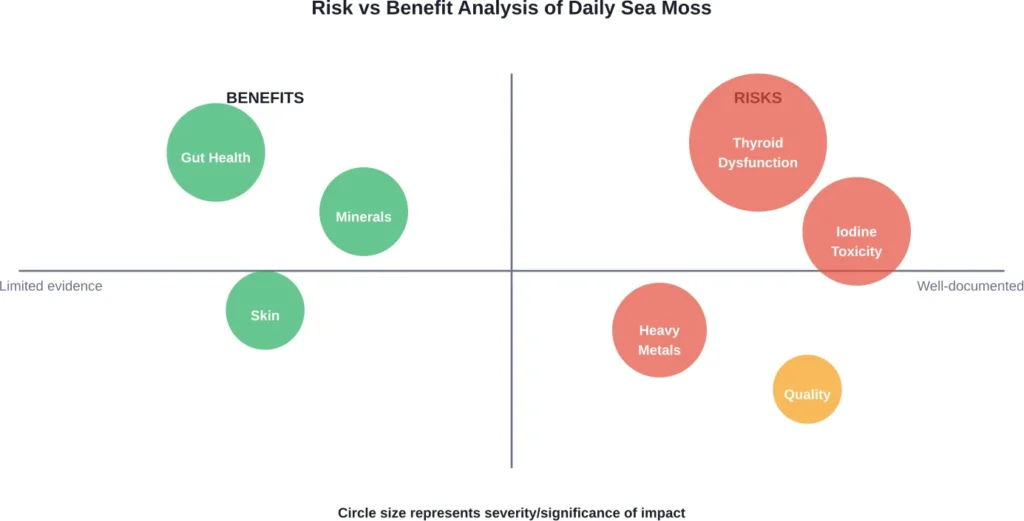
Real talk: The medical community isn’t convinced that daily sea moss offers benefits that justify the thyroid and contamination risks.
Frequently Asked Questions
There’s no established safe daily dose because iodine content varies dramatically between products. Most experts suggest 1-2 tablespoons of gel or 500-1000mg in capsule form, but cycling on and off is safer than continuous daily use. Anyone considering sea moss should consult a healthcare provider first, especially those with thyroid conditions.
Yes. Medical literature documents cases of thyroid dysfunction triggered by sea moss, including Jod-Basedow phenomenon—a rare thyroid crisis caused by excessive iodine. Even people with normal thyroid function can develop problems after prolonged high-dose iodine exposure. Those with existing thyroid conditions face significantly higher risks.
No. According to the FDA, dietary supplements are not authorized for approval for safety and effectiveness before they’re marketed. Under the Dietary Supplement Health and Education Act, firms can lawfully introduce supplements to market without even notifying the FDA. The FDA has issued recalls and import alerts for specific contaminated sea moss products.
Symptoms of excessive iodine from sea moss include metallic taste, burning mouth or throat, increased salivation, stomach pain, nausea, vomiting, diarrhea, fever, weak pulse, and thyroid dysfunction symptoms like fatigue, rapid heartbeat, anxiety, tremors, or neck swelling. Digestive issues like cramping and loose stools are also common.
This claim lacks scientific support. While sea moss does contain various minerals like calcium, magnesium, potassium, and sulfur, the actual mineral content varies widely by species, harvest location, and processing. Lab testing is the only way to determine what’s actually in a specific product. The human body also doesn’t require 102 minerals—this number has no basis in nutritional science.
Pregnant women should avoid sea moss supplements. While iodine is essential during pregnancy, the unpredictable and often excessive iodine content in sea moss products makes dosing unreliable and potentially dangerous. The WHO recommends iodine supplementation for pregnant women in countries with inadequate salt iodization programs, but through controlled supplementation with known dosing—not through sea moss.
Community discussions suggest some people notice digestive changes within days, while skin and energy effects may appear in 2-3 weeks. However, these reports are anecdotal. Clinical trials specifically testing sea moss in humans remain limited, so scientifically validated timelines for specific benefits don’t exist. Individual responses vary significantly based on baseline nutritional status and health conditions.
The Bottom Line on Daily Sea Moss
Taking sea moss every day creates a risk-benefit calculation that doesn’t favor most people.
The potential benefits—improved gut health, mineral supplementation, immune support—remain inadequately proven by clinical research. The risks—thyroid dysfunction, iodine toxicity, heavy metal exposure, contamination—are well-documented in medical literature and FDA warnings.
For those determined to use sea moss, cycling on and off provides a safer approach than continuous daily consumption. Choosing products with third-party testing, proper documentation, and known iodine content reduces but doesn’t eliminate risk.
But here’s what matters most: sea moss isn’t a magic solution. It won’t transform health, cure diseases, or deliver the dramatic benefits promoted on social media. At best, it provides supplemental minerals that most people can obtain more safely from varied whole foods. At worst, it causes serious thyroid problems that require medical intervention.
Before taking sea moss daily—or at all—consult a healthcare provider who can assess thyroid function, review medications, and determine whether supplementation makes sense for individual health status and needs. That’s not just cautious advice. It’s essential protection against documented risks that social media conveniently ignores.