

Quick Summary: If you miss a Mounjaro dose, take it as soon as you remember—but only if 4 days or fewer have passed since your scheduled injection day. After 4 days, skip the missed dose entirely and resume your normal weekly schedule. Never double up on doses or take two injections close together to avoid serious side effects.
Missing a dose of medication happens. Life gets busy, travel disrupts routines, and weekly injections don’t come with the daily reminder that pills do.
But Mounjaro (tirzepatide) isn’t like most medications. As a dual GIP/GLP-1 receptor agonist approved by the FDA for type 2 diabetes and chronic weight management, it works by changing how your body regulates appetite and blood sugar. According to the FDA approval announcement from November 8, 2023, tirzepatide addresses a significant medical need in a country where approximately 70% of American adults have obesity or overweight.
So what actually happens when you miss that weekly injection? And more importantly, what should you do about it?
Understanding the 4-Day Rule
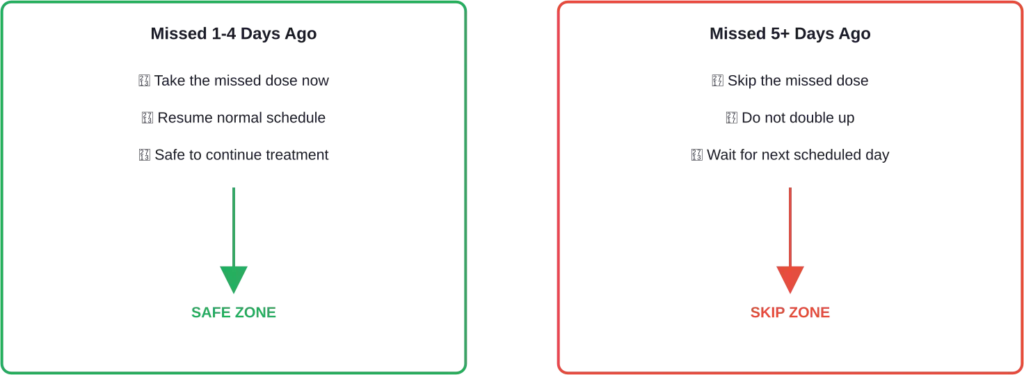
The most important thing to know about missing a Mounjaro dose is the 4-day rule. This guideline determines whether you should take the missed dose or skip it entirely.
Here’s how it works: If 4 days or fewer have passed since your scheduled injection day, take the missed dose as soon as you remember. Then return to your regular weekly schedule.
If more than 4 days have passed, skip the missed dose completely. Wait until your next regularly scheduled injection day and resume from there.
Why 4 Days?
The 4-day cutoff exists because of how tirzepatide works in your body. Mounjaro has a relatively long half-life, meaning it stays active in your system for several days after injection.
Taking a dose too close to your next scheduled injection could lead to overlapping medication levels. That raises the risk of side effects without providing additional benefit.
Never double up on doses to make up for a missed injection. Taking two doses close together significantly increases the risk of gastrointestinal side effects and other complications.
Step-by-Step: What to Do When You Miss a Dose
Let’s break down exactly what to do based on when you remember the missed injection.
Scenario 1: You Remember Within 4 Days
Say your regular injection day is Wednesday, but you realize on Friday that you forgot.
That’s only 2 days past your scheduled dose. Take the injection as soon as you remember on Friday. Then continue with your next dose on the following Wednesday as originally planned.
The calendar simply shifts forward by those 2 days for this one cycle, then returns to normal.
Scenario 2: You Remember After 4 Days
Using the same Wednesday schedule, imagine you don’t realize you missed your dose until Monday—that’s 5 days later.
In this case, skip the missed dose entirely. Don’t inject on Monday. Wait until the next Wednesday (which would be 7 days from Monday) and resume your regular schedule.
This means you’ll have a gap of about 12 days between injections, but that’s safer than taking doses too close together.
| Day You Remember | Days Since Missed Dose | Action to Take | Next Scheduled Dose |
|---|---|---|---|
| Thursday | 1 day | Take it now | Next Wednesday |
| Friday | 2 days | Take it now | Next Wednesday |
| Saturday | 3 days | Take it now | Next Wednesday |
| Sunday | 4 days | Take it now | Next Wednesday |
| Monday or later | 5+ days | Skip this dose | Following Wednesday |
What Happens to Your Body When You Miss a Dose
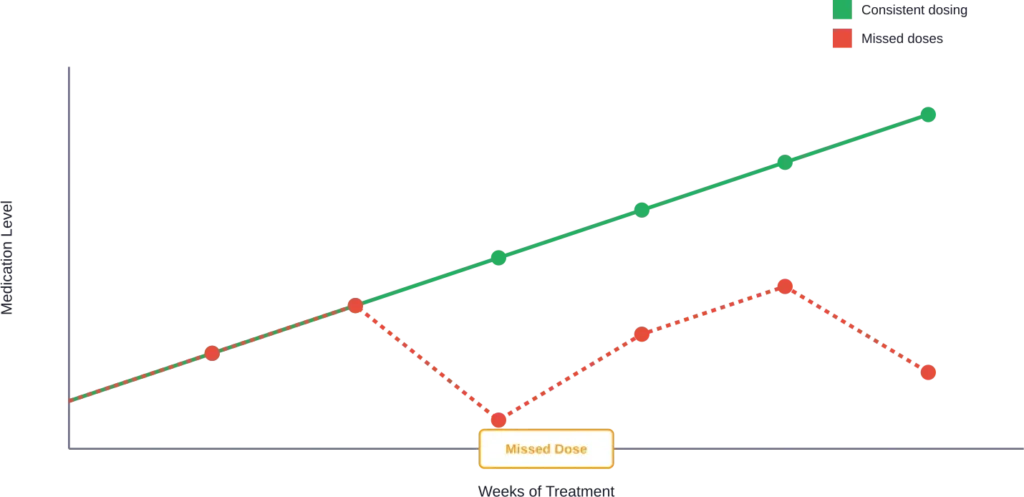
When you miss a Mounjaro injection, the medication levels in your system gradually decline. But the effects don’t vanish overnight.
Tirzepatide works by activating GLP-1 and GIP receptors, which slow gastric emptying, reduce appetite, and improve insulin secretion. These effects diminish as the medication clears from your system over several days.
Short-Term Effects (Days 1-7)
During the first week after a missed dose, many patients notice increased appetite. The appetite suppression that Mounjaro provides begins to wear off as medication levels drop.
Blood sugar control may also become less stable for those using tirzepatide for type 2 diabetes management. This doesn’t mean glucose levels will spike immediately, but the tight control achieved with regular dosing may loosen.
Longer Gaps and Treatment Interruption
Research on GLP-1 receptor agonists shows that treatment interruptions can have measurable impacts. A study published in Hospital Pharmacy in 2025 documented cases where missed doses of GLP-1 medications led to complications requiring readmission.
According to NIH research analyzing real-world tirzepatide safety data from 2022-2025, incorrect dose administration was the top adverse event reported, increasing 8-fold from 1,248 reports in 2022 to 9,800 in 2024. While this includes both missed doses and dosing errors, it highlights how common adherence challenges are.
The same research analyzing FAERS data noted that common side effects include nausea, vomiting, dyspepsia, and diarrhea—all related to delayed gastric emptying. When treatment is interrupted and then restarted, these gastrointestinal effects may return as the body readjusts to the medication.
Missing Multiple Doses: When to Contact Your Doctor
Missing one dose is manageable with the 4-day rule. But what if you’ve missed multiple weeks?
If you’ve gone more than 2 weeks without a Mounjaro injection, contact your healthcare provider before resuming treatment. Don’t just restart at your current dose level.
Here’s why: tirzepatide dosing follows a careful titration schedule. According to clinical trial protocols and manufacturer guidelines, treatment begins at a 2.5 mg introductory dose for four weeks, followed by a move to 5 mg. Subsequent increases occur in 2.5 mg increments (7.5 mg, 10 mg, 12.5 mg, and 15 mg) every four weeks, provided the medication is tolerated.
This gradual escalation minimizes gastrointestinal side effects while finding the lowest effective dose. Extended treatment gaps may require restarting at a lower dose to avoid severe nausea, vomiting, or other adverse reactions.
A 2025 case report documented severe adverse effects requiring intensive care unit admission after a tirzepatide overdose. While this involved intentional overdosing rather than resuming after a gap, it illustrates why proper dosing protocols matter.
Signs You Should Call Your Doctor
Contact your healthcare provider if you experience any of these situations:
- You’ve missed more than 2 consecutive doses
- You’re experiencing severe gastrointestinal symptoms after resuming treatment
- Your blood sugar levels are unstable (for diabetes patients)
- You’re unsure whether to take a missed dose based on timing
- You accidentally took two doses close together
Why Missing Doses Matters for Weight Loss
For those using Mounjaro for weight management, consistency is critical. Research from Weill Cornell Medicine found that anti-obesity drugs may require long-term use to maintain weight loss—similar to how diabetes or high blood pressure requires ongoing treatment.
A 2025 study analyzing real-world adherence in a UK digital obesity service found that the 12-month adherence rate was 27%. That’s one of the lowest adherence rates for any chronic medication.
The study identified several predictors of adherence, including demographic and clinical factors, but the weekly injection schedule itself presents challenges. There’s no daily trigger, and by the time injection day arrives, it’s easy to forget.
Clinical data shows tirzepatide can produce weight loss of up to 20.9% in trials like SURMOUNT-1, which represented the highest percentage of weight loss at the maximum doses. But these results depend on consistent dosing. Irregular use compromises both efficacy and the metabolic adaptations that support sustained weight reduction.
Practical Tips to Avoid Missing Future Doses
Prevention is always better than dealing with a missed dose. Here are strategies that work in real-world practice.
Set Multiple Reminders
Don’t rely on memory alone. Set up redundant reminders:
- Phone calendar alert 24 hours before injection day
- Second reminder on injection day morning
- Evening reminder if you typically inject later in the day
- Physical calendar or planner notation
Some patients find success pairing their injection with a weekly routine that already exists—Sunday meal prep, Wednesday evening yoga class, whatever provides a consistent anchor.
Use a Medication Tracking App
Medication reminder apps offer features including dose logging, refill reminders, and the ability to track side effects or other health metrics.
Keep Backup Supplies Accessible
Travel disrupts routines. Keep an extra pen in your travel bag if you frequently go out of town. Once you start using a pen, it can be kept at room temperature (up to 86 degrees F / 30 degrees C) for up to 21 days. Store unopened pens in the refrigerator (36 to 46 degrees F / 2 to 8 degrees C).
For longer trips, use a medication cooler or ask your hotel to provide refrigerator access.
Address Cost Barriers Proactively
Financial constraints are a major reason for treatment interruption. If cost is preventing consistent dosing, explore options before you run out:
- Manufacturer savings programs or patient assistance
- Insurance appeals for coverage denials
- Compounding pharmacies (discuss with your doctor)
- Alternative GLP-1 medications with better coverage
The research on adherence challenges emphasizes that addressing cost barriers is critical for sustained treatment success.
Comparing Missed Dose Guidelines Across GLP-1 Medications
Different GLP-1 and dual GLP-1/GIP medications have different missed dose protocols. Understanding these differences helps avoid confusion if switching treatments.
| Medication | Dosing Frequency | Missed Dose Rule | Maximum Time to Take Late |
|---|---|---|---|
| Mounjaro (tirzepatide) | Once weekly | Take if ≤4 days late; skip if >4 days | 4 days |
| Ozempic (semaglutide) | Once weekly | Take if ≤5 days late; skip if >5 days | 5 days |
| Wegovy (semaglutide) | Once weekly | Take if ≤5 days late; skip if >5 days | 5 days |
| Dulaglutide | Once weekly | Take if ≥3 days until next dose; skip if <3 days | Varies |
Notice that Mounjaro has a slightly shorter window than semaglutide products. This reflects differences in pharmacokinetics and half-life between tirzepatide and semaglutide.
When Missing a Dose Might Indicate a Bigger Issue
Sometimes a missed dose isn’t just about forgetting. It can signal underlying concerns about the medication itself.
Some patients may intentionally skip doses due to side effects—particularly severe nausea or gastrointestinal distress. Others may pause treatment before specific events or circumstances to manage gastrointestinal effects.
If you’re tempted to skip doses because of side effects, that’s a conversation to have with your healthcare provider. Adjusting the dose, changing the injection timing relative to meals, or adding supportive medications might resolve the issue without interrupting treatment.
Psychological factors also play a role. The commitment to weekly injections for potentially years raises questions about long-term sustainability and whether this approach aligns with personal health goals.
The Bottom Line on Missed Mounjaro Doses
Missing a Mounjaro dose doesn’t have to derail your treatment. The 4-day rule provides clear guidance: take the missed dose if you’re within that window, skip it if you’re beyond.
What matters most is getting back on schedule safely and preventing future gaps. Tirzepatide works best with consistent dosing—whether being used for type 2 diabetes management or chronic weight loss.
According to StatPearls, tirzepatide is a novel medication and dual agonist for the glucagon-like peptide-1 (GLP-1) and glucose-dependent insulinotropic polypeptide (GIP) receptors. Clinical data demonstrates meaningful improvements in glycemic control and weight reduction, with effects comparable to or exceeding single-agonist GLP-1 medications like semaglutide.
But those benefits require adherence. Real-world data shows that only about one-quarter of patients maintain consistent use at one year. Setting up systems to prevent missed doses—reminders, routines, addressing cost barriers—makes a measurable difference in treatment outcomes.
And if you do miss a dose? Don’t panic. Follow the 4-day rule, never double up, and contact your doctor if you’ve missed multiple weeks or have questions about restarting safely.
Frequently Asked Questions
Taking your dose one day early occasionally is generally acceptable, but it’s better to stick to your regular schedule whenever possible. If you need to shift your injection day permanently, talk to your doctor about the best way to transition. Don’t make early dosing a regular habit, as it can compress the time between injections and increase side effect risk.
Contact your healthcare provider immediately if you’ve taken two doses within a short timeframe. Tirzepatide overdose can cause severe gastrointestinal symptoms including intractable nausea, vomiting, and dehydration. A 2025 case report documented a patient requiring ICU admission after overdose. Monitor for symptoms and seek medical attention if you develop severe side effects.
Missing a single dose is unlikely to cause immediate weight regain, but you may notice increased appetite as medication levels decline. The bigger concern is that inconsistent dosing undermines the long-term metabolic changes that support sustained weight loss. Research from Weill Cornell Medicine emphasizes that obesity treatment with tirzepatide requires ongoing use—similar to medications for diabetes or hypertension.
No. Mounjaro must be administered as prescribed—one injection per week at the specified dose. The medication is formulated for once-weekly dosing based on its pharmacokinetic profile. Splitting doses would alter how the drug works in your body and could reduce effectiveness while increasing side effects. Never modify your dosing regimen without explicit direction from your healthcare provider.
Generally, if you’ve gone more than 2 weeks without an injection, contact your doctor before resuming. Extended gaps may require restarting at a lower dose to minimize gastrointestinal side effects. The exact protocol depends on how long you were on treatment, what dose you were taking, and why you stopped. Never restart tirzepatide after a prolonged gap without medical guidance.
Yes. The 4-day rule applies regardless of whether tirzepatide is prescribed for type 2 diabetes management (Mounjaro) or chronic weight management (marketed as Zepbound at higher doses). Both are the same medication—tirzepatide—and follow the same pharmacokinetic principles. The missed dose protocol is determined by how the drug works in the body, not the indication for use.
Potentially, yes. When restarting tirzepatide after an extended gap, the gastrointestinal side effects common during initial titration—nausea, vomiting, dyspepsia, diarrhea—may return as your body readjusts to the medication. This is why healthcare providers often recommend restarting at a lower dose after prolonged interruptions. The severity varies by individual, but many patients report that side effects are milder the second time around.