

Quick Summary: Cutting off a skin tag yourself can lead to serious complications including infection, excessive bleeding, scarring, and misdiagnosis of potentially dangerous skin conditions. Medical professionals use sterile techniques and proper anesthesia to safely remove skin tags in quick office procedures, minimizing risks that DIY methods cannot avoid.
Skin tags are those small, soft pieces of skin that seem to appear out of nowhere, often hanging from a thin stalk. They’re incredibly common—studies show approximately 50% to 60% of adults develop at least one during their lifetime, with occurrence increasing after age 40.
When these harmless growths start rubbing against clothing or jewelry, the temptation to simply cut them off can be strong. But what actually happens if someone takes scissors or a razor to a skin tag at home?
The answer isn’t pretty. And the risks go far beyond a simple nick.
Why Cutting Off Skin Tags Yourself Is Dangerous
The American Academy of Dermatology warns against removing skin tags at home, and the U.S. Food and Drug Administration has flagged online removal products as potentially causing harmful side effects and serious risks.
Here’s what can go wrong when attempting DIY skin tag removal.
Infection Risk Is Substantial
Skin tags contain blood vessels, nerve cells, collagen fibers, and fat tissue. Cutting into this tissue creates an open wound that becomes a gateway for bacteria.
Without proper sterilization techniques, infection rates climb significantly. Research on postoperative wound infections shows that superficial incisional infections constitute over 50% of all surgical site infections, even in controlled medical environments. At home, where sterile conditions are nearly impossible to achieve, the risk multiplies.
Signs of infection include redness spreading from the removal site, increasing pain, warmth, swelling, and pus discharge. Severe infections can spread beyond the initial wound, requiring antibiotics or more intensive medical treatment.
Uncontrolled Bleeding Can Occur
Skin tags attach to the body through a blood supply. Cutting them off severs these vessels, which can bleed more than expected.
For individuals taking blood-thinning medications—common among those with heart conditions or stroke risk—bleeding becomes even more problematic. Studies demonstrate the overwhelming safety of procedures performed by dermatologic surgeons; however, when complications do arise, there is a strong probability it will be related to bleeding.
At home, without proper hemostatic tools or training, bleeding that seems minor can become difficult to stop. And applying direct pressure with non-sterile materials introduces that infection risk all over again.
Scarring and Poor Cosmetic Outcomes
Cutting off a skin tag without proper technique often results in noticeable scarring. The healing process for wounds created by non-surgical cutting tends to produce more prominent scar tissue than professional removal methods.
Skin tags that appear on visible areas like the neck, face, or eyelids pose particular cosmetic concerns. A scar from improper removal can be more noticeable and bothersome than the original growth.
Dermatologists use specific techniques—including varying the depth and angle of removal—to minimize scarring. These skills aren’t replicable with bathroom scissors.
Incomplete Removal and Regrowth
Without medical training, it’s difficult to remove a skin tag completely. Leaving tissue behind often leads to regrowth, sometimes creating an even larger or more irregular growth.
Professional removal ensures the entire growth is excised at the base, reducing recurrence rates significantly.
The Misdiagnosis Problem
Here’s where things get genuinely concerning: not every growth is actually a skin tag.
Several skin conditions can mimic the appearance of skin tags, including warts, moles, seborrheic keratoses, and in rare cases, skin cancer. According to the American Academy of Dermatology, distinguishing between these growths requires trained evaluation.
Cutting off what appears to be a skin tag—but is actually a different type of growth—can have serious consequences. If the growth is cancerous, removing it improperly can allow cancer cells to spread before proper diagnosis and treatment occur.
Dermatologists can usually identify skin tags visually, but when there’s any question about diagnosis, they can perform a biopsy. The removed tissue gets examined under a microscope to confirm what it actually is.
That level of certainty isn’t available in the bathroom mirror.
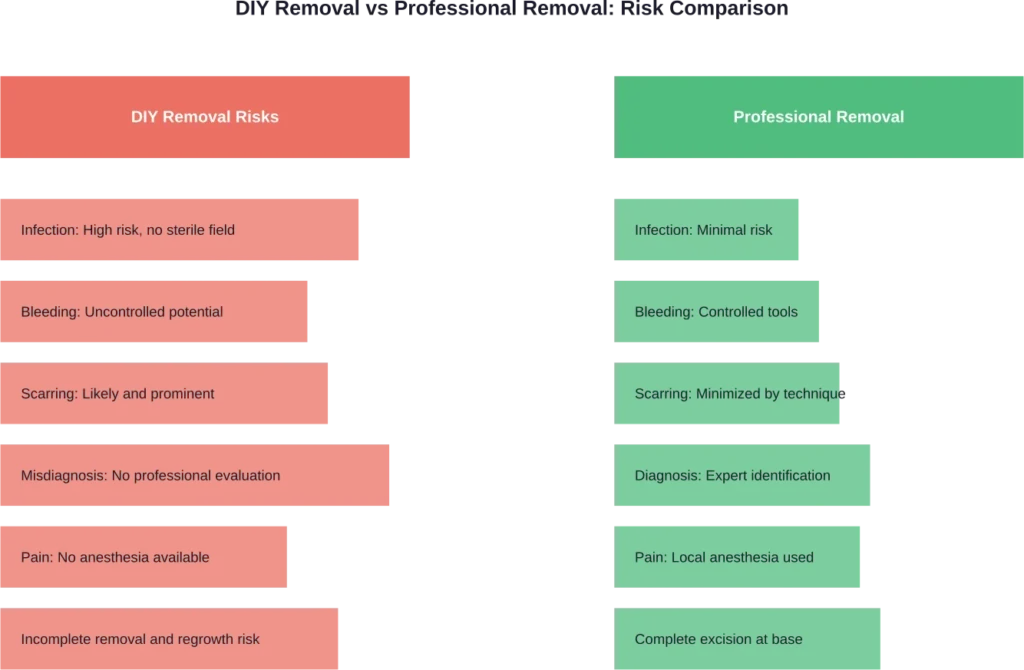
How Dermatologists Actually Remove Skin Tags
Professional skin tag removal is quick, safe, and typically requires just one office visit. The procedure usually takes about 15 minutes from start to finish.
Dermatologists use several methods depending on the size and location of the growth.
Surgical Excision
For larger skin tags, excisional biopsy involves numbing the area with local anesthetic, then using a sterile scalpel to cut the growth at its base. The dermatologist can control bleeding immediately and may place a small stitch if needed.
This method ensures complete removal and allows the tissue to be sent for pathological examination if there’s any diagnostic uncertainty.
Cryotherapy
Freezing the skin tag with liquid nitrogen causes the tissue to die and fall off within days. This method works well for smaller growths and leaves minimal scarring.
Cauterization
Using heat to burn off the skin tag simultaneously removes the growth and seals blood vessels, preventing bleeding. The controlled burning process requires specialized equipment not available for home use.
Ligation
For pedunculated skin tags (those on a stalk), tying off the base with surgical thread cuts off blood supply. The tag withers and falls off naturally within days.
| Removal Method | Best For | Anesthesia | Typical Healing Time |
|---|---|---|---|
| Surgical Excision | Large or irregular tags | Local injection | 1-2 weeks |
| Cryotherapy | Small to medium tags | Usually none needed | 1-2 weeks |
| Cauterization | Medium tags with bleeding risk | Local injection | 1-2 weeks |
| Ligation | Pedunculated (stalked) tags | Usually none needed | 5-10 days |
What About Over-the-Counter Removal Products?
Pharmacies and online retailers sell various products marketed for skin tag removal, including freezing kits, topical solutions, and ligation bands.
The FDA has issued warnings about these products. They can cause skin irritation, chemical burns, and the same infection and scarring risks as cutting. Additionally, they don’t solve the misdiagnosis problem—applying a removal product to what turns out to be a mole or other growth can mask symptoms that should be evaluated.
Wart removers specifically don’t work on skin tags. These products contain salicylic acid designed to break down the thick, hardened skin of warts. Skin tags have different tissue composition and won’t respond to these formulations.
When Skin Tags Need Medical Attention
Most skin tags are harmless and don’t require removal unless they’re bothersome. But certain situations warrant seeing a dermatologist.
Skin tags that repeatedly get irritated by clothing, jewelry, or shaving should be evaluated for removal. The constant friction can cause pain and inflammation.
Any growth that changes color, bleeds spontaneously, grows rapidly, or becomes painful needs professional evaluation to rule out other conditions.
Skin tags appearing suddenly in large numbers can sometimes indicate metabolic syndrome or diabetes. While skin tags themselves aren’t dangerous, their presence can signal underlying health issues worth investigating.
The Cost Reality
Many people avoid professional removal because of cost concerns. Insurance coverage varies—cosmetic removal typically isn’t covered, but removal for medical reasons (irritation, bleeding, diagnostic uncertainty) often is.
For those paying out of pocket, pricing varies by provider and location. Calling ahead to ask about costs for the specific procedure helps avoid surprises.
When weighing the expense of professional removal against DIY methods, factor in the potential costs of treating complications—infected wounds, scarring revision, or delayed diagnosis of serious conditions.
Prevention and Risk Factors
While there’s no guaranteed way to prevent skin tags, understanding risk factors helps explain why they develop.
Skin tags occur more commonly in individuals with obesity, diabetes mellitus, or metabolic syndrome. Family history also plays a role—if parents had skin tags, their children face higher likelihood of developing them.
Friction appears to be a significant factor. Areas where skin rubs against skin or clothing—neck, armpits, groin, under breasts—develop tags more frequently.
Maintaining healthy weight, managing blood sugar if diabetic, and reducing friction in prone areas may help minimize new skin tag formation, though some people develop them regardless of preventive measures.
Frequently Asked Questions
Yes, skin tags contain blood vessels and will bleed when cut. The amount of bleeding varies by size and location, but can be difficult to control without proper medical tools, especially for people taking blood-thinning medications.
Absolutely. Cutting creates an open wound that’s vulnerable to bacterial infection. Without sterile instruments and proper antiseptic technique, infection risk is substantial and can lead to complications requiring medical treatment.
Most professional skin tag removals take about 15 minutes for the entire office visit. The actual removal procedure often takes just a few minutes, with additional time for anesthesia application and post-procedure care instructions.
When completely removed by a medical professional, individual skin tags typically don’t grow back in the exact same spot. However, people prone to developing skin tags may develop new ones in nearby areas or other locations on the body.
Skin tags themselves are benign and not cancerous. However, some skin cancers or other concerning growths can look similar to skin tags, which is why professional evaluation is important before any removal attempt.
The FDA warns that over-the-counter skin tag removal products can cause harmful side effects and serious risks. These products don’t address the misdiagnosis concern and can cause chemical burns, scarring, and infection.
Professional removal involves local anesthetic that numbs the area, making the procedure virtually painless. Some methods like cryotherapy may not require anesthesia for smaller tags. DIY removal without anesthetic would be painful and is not recommended.
The Bottom Line on Skin Tag Removal
Cutting off a skin tag at home carries risks that far outweigh any perceived convenience or cost savings. Infection, uncontrolled bleeding, scarring, incomplete removal, and potential misdiagnosis of serious conditions make DIY removal a genuinely bad idea.
Professional dermatologic removal is quick, safe, and designed to minimize complications. Dermatologists can properly diagnose the growth, select the appropriate removal method, use sterile technique and anesthesia, and ensure complete excision with optimal cosmetic results.
For anyone bothered by a skin tag—whether due to irritation, appearance, or concern about what it might be—scheduling a dermatology consultation is the smart move. The peace of mind that comes with professional diagnosis and safe removal is worth it.
Don’t risk your health trying to solve a minor cosmetic issue with scissors. See a dermatologist and get it done right.