
Quick Summary: Smoking moldy weed can cause respiratory infections, allergic reactions, and serious lung problems, especially in people with weakened immune systems. The CDC warns that Aspergillus mold, commonly found on cannabis, can lead to aspergillosis—a potentially life-threatening fungal infection. Moldy cannabis typically shows a grayish-white powdery coating and smells musty or mildewy, and should never be smoked regardless of the amount.
Finding mold on cannabis is more common than most people think. Maybe the stash sat too long in a humid bathroom, or perhaps that eighth came contaminated from the start. Either way, the question becomes urgent: what actually happens if that moldy weed gets smoked?
The short answer? It’s genuinely dangerous. Not in a “maybe you’ll feel weird” way, but in a “potential hospitalization” way for certain people.
According to the CDC, aspergillosis is a fungal infection caused by breathing in Aspergillus mold spores. And guess what thrives on improperly stored cannabis? That exact same mold.
The Real Health Risks of Smoking Moldy Cannabis
When moldy weed burns, those mold spores become airborne and head straight into the lungs. The most common culprit on cannabis is Aspergillus, a fungus that causes aspergillosis.
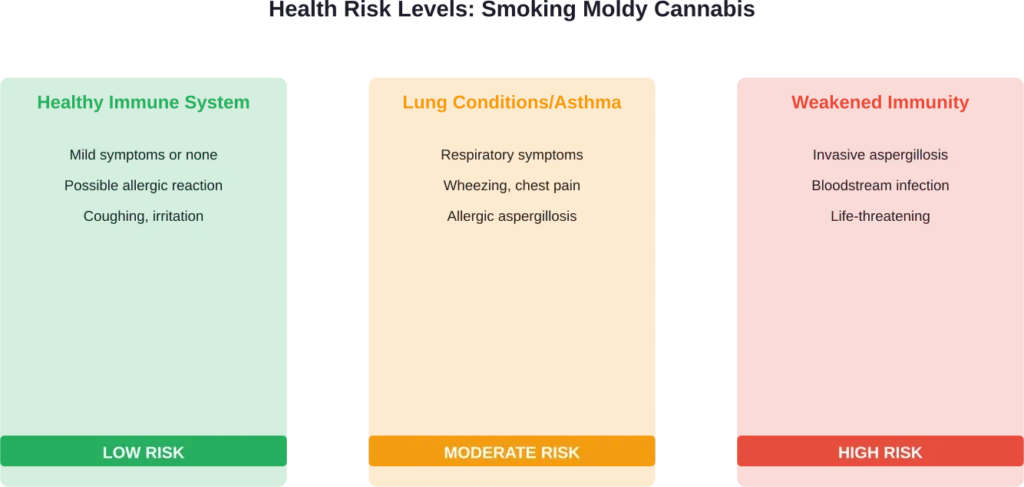
Here’s the thing though—not everyone reacts the same way. People with healthy immune systems might experience mild symptoms or none at all. But for anyone with compromised immunity, the risks escalate dramatically.
The CDC identifies several types of aspergillosis, ranging from allergic reactions to invasive infections that spread through the bloodstream. The invasive form can be life-threatening, particularly for individuals undergoing chemotherapy, organ transplant recipients, or those with HIV/AIDS.
Common Symptoms After Smoking Moldy Weed
Symptoms vary based on the type of infection and individual health status:
- Persistent coughing and wheezing
- Shortness of breath or difficulty breathing
- Fever and chills
- Chest pain or tightness
- Allergic reactions including sneezing, runny nose, and skin rashes
- Nausea and vomiting (in severe cases)
- Coughing up blood (with invasive aspergillosis)
According to the CDC, invasive aspergillosis occurs when the infection spreads beyond the lungs into the blood system. This represents the most severe form and requires immediate medical attention.
Beyond Aspergillosis: Other Mold Dangers
Aspergillus isn’t the only problem. Cannabis can harbor multiple mold species, some of which produce mycotoxins—toxic compounds that cause additional health problems.
According to research published by the National Institutes of Health, aflatoxin B1 and AFM1 have been classified as Group 1 and Group 2B human carcinogens, respectively, by the International Agency for Research on Cancer. Research estimates that between 60-80% of the world’s food crops are contaminated by mycotoxins.
When inhaled, these mycotoxins can cause acute respiratory distress, chronic inflammation, and potentially long-term damage to lung tissue.
How Much Moldy Weed Does It Take to Cause Problems?
Here’s where it gets tricky: there’s no safe threshold.
Even a single inhalation of mold spores can trigger reactions in sensitive individuals. The CDC notes that most people breathe in Aspergillus spores daily without issue, but concentrated exposure—like directly smoking contaminated material—presents significantly higher risk.
Community discussions reveal varied experiences. Some users report immediate symptoms after one contaminated session, while others with stronger immune systems notice nothing. But that variability makes moldy weed dangerous—there’s no way to predict individual response.
The medical consensus? Don’t test those limits. Any visible mold contamination means the entire batch should be discarded.
How to Identify Moldy Cannabis
Spotting mold before smoking is crucial. Moldy cannabis typically displays several telltale signs:
| Indicator | What to Look For | Notes |
|---|---|---|
| Visual appearance | Grayish-white powdery coating, fuzzy spots, or weblike growth | Don’t confuse with trichomes (shiny crystals) |
| Smell | Musty, mildewy odor similar to damp basement | Fresh cannabis smells earthy or piney, never musty |
| Texture | Slimy or unusually moist to touch | Properly cured cannabis feels dry and slightly sticky |
| Color changes | Dark spots, yellowing, or uneven discoloration | Mold often appears as patches rather than uniform color |
The trickiest part? Distinguishing mold from trichomes. Trichomes are those crystalline, mushroom-shaped glands that contain cannabinoids—they’re desirable. Mold is powdery, lacks the sparkle of trichomes, and typically appears in irregular patches rather than uniform coverage.
When in doubt, the smell test rarely lies. That musty odor is a dead giveaway.
Why Cannabis Gets Moldy
Understanding mold growth helps prevent future contamination. Mold thrives in specific conditions:
Moisture is enemy number one. Cannabis stored above 65% relative humidity creates ideal conditions for mold proliferation. The CDC notes that active mold growth requires moisture, and cannabis is particularly susceptible during curing or in humid storage environments.
Temperature fluctuations accelerate the problem. Warm environments (above 77°F) combined with humidity essentially guarantee mold development within days.
Poor air circulation also contributes. Sealed containers without proper curing or containers that trap condensation provide perfect breeding grounds.

How to Prevent Mold on Cannabis
Prevention beats dealing with contaminated product every time. Proper storage requires attention to three factors: humidity control, temperature management, and container selection.
Humidity control is non-negotiable. Cannabis is best kept at a relative humidity range that prevents mold growth, typically below 65%. Humidity control packs designed for cannabis maintain this range automatically. These two-way humidity regulators absorb excess moisture or release it as needed.
Storage containers matter significantly. Airtight glass jars work best—mason jars are perfectly adequate. Avoid plastic bags, which don’t prevent moisture fluctuation and can create static that damages trichomes.
Location is equally important. Keep containers in cool, dark places away from bathrooms, kitchens, or anywhere steam and temperature swings occur. Closets, drawers, or dedicated storage boxes work well.
Never store cannabis in direct sunlight. UV light degrades cannabinoids and can create heat buildup that promotes condensation inside containers.
Storage Best Practices
- Use airtight glass containers with humidity packs
- Store in cool locations (60-70°F optimal)
- Keep away from light sources
- Avoid high-humidity areas like bathrooms
- Check stored cannabis monthly for signs of mold
- Don’t overfill containers—allow some air space
- Cure properly before long-term storage
Can Moldy Weed Be Salvaged?
Real talk: no.
Some people suggest cutting away moldy sections or trying to “cure” contaminated cannabis through heating or additional drying. These methods don’t work and create false security.
Here’s why salvaging fails: mold spreads through invisible networks called mycelia that permeate the entire plant material. What’s visible represents only a fraction of the contamination. Additionally, mycotoxins remain even if mold is killed, and these toxins don’t break down through heating.
The only safe approach is complete disposal of any batch showing mold contamination.
What About Concentrates and Vapes?
Sound familiar? Many assume processed cannabis products like vapes and concentrates eliminate mold risks. Unfortunately, that’s not entirely accurate.
While extraction processes may remove some contaminants, mold spores and mycotoxins can survive into final products if source material was contaminated. Some extraction methods actually concentrate these toxins rather than eliminating them.
Testing requirements vary by jurisdiction, but not all markets mandate comprehensive mold and mycotoxin testing for concentrates. Community discussions reveal occasional reports of contaminated cartridges causing respiratory issues.
Purchasing from licensed, regulated sources with testing requirements provides the best protection. Black market products carry unknown risks.
When to Seek Medical Attention
Anyone experiencing persistent symptoms after smoking potentially moldy cannabis should consult healthcare providers. Watch for:
- Coughing that lasts more than a few days
- Difficulty breathing or chest tightness
- Fever developing after consumption
- Coughing up blood or discolored mucus
- Worsening asthma symptoms
According to the CDC, people with weakened immune systems face the highest risk for serious complications and should seek immediate medical evaluation if they suspect mold exposure.
Healthcare providers can perform lung imaging and cultures to diagnose aspergillosis. Treatment typically involves antifungal medications, though the CDC warns that antimicrobial resistance is emerging in Aspergillus fumigatus, potentially complicating treatment.
Frequently Asked Questions
While rare, invasive aspergillosis from inhaled mold spores can be life-threatening, particularly for immunocompromised individuals. The CDC identifies invasive aspergillosis as a severe infection that spreads through the bloodstream and requires immediate medical intervention. Healthy individuals face lower risk but can still develop serious respiratory infections.
Moldy cannabis typically produces a harsh, unpleasant smoke with musty or earthy flavors distinctly different from normal cannabis taste. Many describe it as tasting “off” or dirty, often accompanied by excessive coughing or throat irritation. If cannabis tastes unusually harsh or musty, stop smoking immediately and inspect for mold.
Cannabis can develop mold within 24-48 hours under ideal conditions for mold growth, particularly with high humidity and warmth. The CDC notes that mold growth requires moisture, and improperly stored or insufficiently dried cannabis provides perfect conditions. Properly stored cannabis in controlled humidity can last months or even years without mold development.
Yes, mold can absolutely grow in sealed containers if moisture is trapped inside. Sealing cannabis before it’s properly cured or dried, or storing it at excessive humidity levels, creates condensation inside jars that promotes mold growth. This is why humidity control packs are essential—they regulate moisture levels inside sealed containers.
Not necessarily. Trichomes—the resinous glands containing cannabinoids—appear as shiny, crystalline structures that can look white or frosted. Mold appears more powdery or fuzzy without the sparkle of trichomes. Mold typically occurs in patches rather than uniform coverage, smells musty, and wipes off easily. When uncertain, the smell test helps—musty odors indicate mold.
Freezing may slow mold growth but doesn’t kill all mold or eliminate mycotoxins already produced. Additionally, freezing cannabis damages trichomes and degrades quality. The only safe approach for moldy cannabis is complete disposal—no salvage method reliably eliminates health risks from contaminated material.
Yes, even single exposures can trigger aspergillosis in susceptible individuals. According to the CDC, people with weakened immune systems are at highest risk, and concentrated exposure from smoking contaminated material presents significantly more danger than environmental exposure. The unpredictability of individual reactions makes any consumption of moldy cannabis risky.
The Bottom Line
Smoking moldy weed isn’t worth the gamble. The health risks—ranging from allergic reactions to potentially life-threatening infections—far outweigh any perceived benefit of using contaminated cannabis.
Recognition is the first line of defense. Check cannabis for grayish-white powdery coating, musty odors, or slimy texture before consumption. When doubt exists, disposal is the only safe option.
Prevention through proper storage eliminates most mold problems entirely. Humidity-controlled containers in cool, dark locations keep cannabis fresh and safe for extended periods.
For anyone who’s smoked potentially moldy cannabis and experiences persistent respiratory symptoms, medical consultation provides peace of mind and necessary treatment if infection has developed. The CDC emphasizes that aspergillosis is treatable when caught early, making prompt attention important.
Take storage seriously, inspect purchases carefully, and never compromise on quality. A fresh, mold-free stash is always worth the small effort required to maintain it properly.