

Quick Summary: Amazon offers two selling plans: Individual ($0.99 per sale, no monthly fee) for sellers moving fewer than 40 items monthly (the break-even point where Professional becomes cost-competitive), and Professional ($39.99/month flat rate) for higher-volume sellers needing advanced tools. The break-even point is approximately 40 sales monthly—below that, Individual costs less; above it, Professional becomes cheaper. Professional unlocks bulk uploads, advertising, restricted categories, and premium reporting that Individual accounts lack.
Starting an Amazon business means making one critical choice before listing a single product: which selling plan fits your operation.
The platform offers two paths—Individual and Professional—and picking the wrong one costs money every month. Pick Individual when Professional makes sense, and advanced tools stay locked. Pick Professional when sales don’t justify it, and subscription fees eat your margins.
Here’s the thing though—most guides oversimplify this decision into “sell more than 40 items? Go Pro.” Real talk: the calculation runs deeper than unit count. Features matter. Category restrictions matter. Growth trajectory matters.
This breakdown covers the actual cost structures, feature differences, and strategic implications Amazon doesn’t advertise upfront. No fluff, no outdated 2024 data—just the 2026 reality of choosing between these two plans.
The Core Difference: Pay-Per-Sale vs Monthly Subscription
Amazon structures its two selling plans around fundamentally different payment models.
The Individual selling plan operates on a pay-as-you-go basis. Sellers pay $0.99 for every item that sells, plus standard referral fees and fulfillment costs. No monthly commitment, no upfront investment. Sell nothing this month? Pay nothing in subscription fees.
The Professional selling plan charges a flat $39.99 monthly subscription fee. That fee applies whether sellers move one unit or ten thousand. Referral fees and fulfillment costs still apply on top—the monthly fee simply replaces the per-item charge.
The math creates a clear inflection point. At exactly 40 sales per month, both plans cost the same in subscription/per-item fees: 40 sales × $0.99 = $39.60, essentially matching the $39.99 Professional fee. (Note: Official sources indicate the break-even is below 40 items; sellers should monitor their actual volume.)
Below 40 monthly sales, Individual costs less. Above 40, Professional becomes cheaper. But wait—that calculation ignores the feature differences that often matter more than the fee structure itself.

Maximize Profit with Advanced Analytics

Choosing between a Professional and an Individual plan is only the first step toward Amazon success. To truly scale, sellers need clear visibility into their advertising efficiency and sales data. WisePPC provides an advanced analytics platform designed to bridge the data gaps and simplify complex marketplace management.
- Long-term Data Retention: While Amazon stores data for 60-90 days, WisePPC keeps historical performance insights for years to help track long-term trends and seasonality.
- Unified Dashboard: Sellers can view advertising results, organic performance, and total profit in one centralized interface.
- Bulk Optimization: The platform allows for editing thousands of campaigns and targets in a few clicks to save time on manual updates.
- Real-time Metrics: Users can monitor TACOS, ROAS, and conversion rates as they happen to make immediate, data-driven decisions.
To optimize marketplace performance and access exclusive beta benefits, visit WisePPC to complete the registration.
Individual Selling Plan: What It Actually Offers
The Individual plan serves as Amazon’s entry-level option. Registration costs nothing upfront, making it accessible to anyone testing the marketplace without financial commitment.
Cost Structure Breakdown
Individual sellers pay $0.99 per item sold. That per-item fee adds to referral fees, which vary by product category. Clothing and accessories carry a 17% referral fee. Footwear carries 15%. Most other categories fall within this range.
A seller moving 25 items monthly pays $24.75 in per-item fees (25 × $0.99). A seller moving 10 items pays $9.90. The structure scales linearly with volume, which sounds fair until sales cross into higher volumes where Professional becomes cheaper.
Feature Access and Limitations
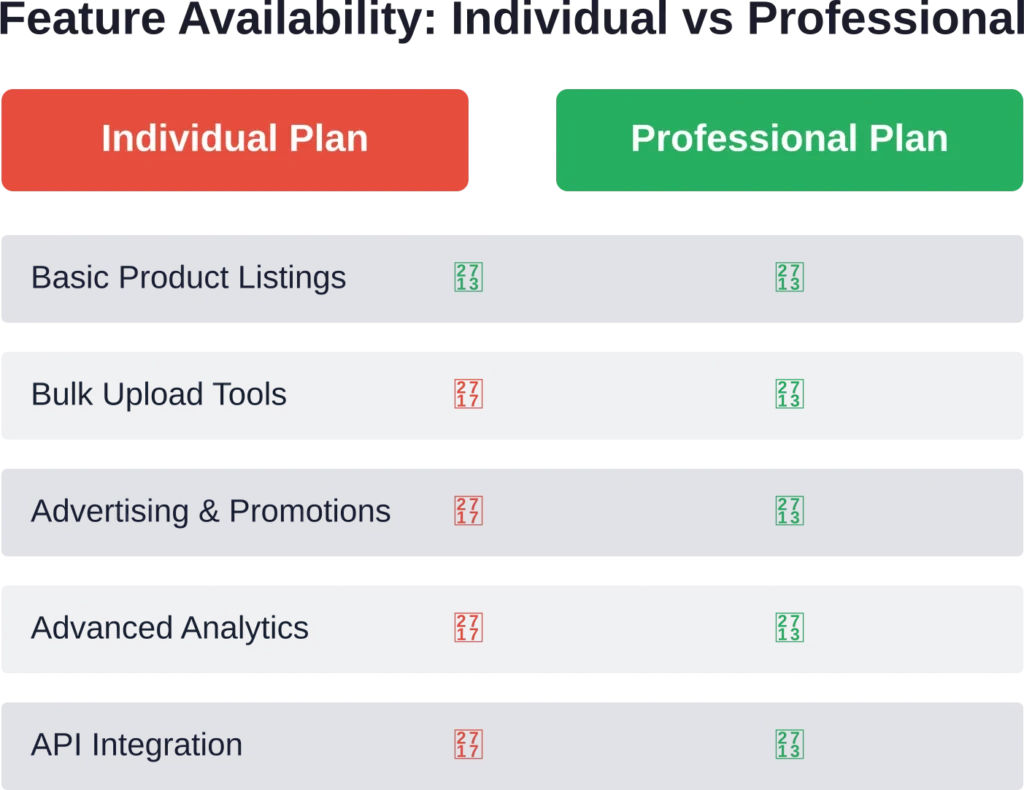
Individual accounts get basic listing capabilities. Sellers can add products to Amazon’s catalog one at a time, either matching existing product pages or creating new ones. That works fine for small catalogs but becomes tedious past a dozen SKUs.
What Individual sellers cannot access:
- Bulk listing tools and inventory management spreadsheets
- Order reports and advanced sales analytics
- Advertising tools (Sponsored Products, Sponsored Brands, Sponsored Display)
- Promotional tools like lightning deals and coupons
- API access for third-party inventory software integration
- Restricted category approvals (most gated categories require Professional)
- Buy Box eligibility on certain competitive listings
- Gift messaging options for customers
These limitations matter more for some sellers than others. A casual seller clearing out household items doesn’t need API access. A growing business launching 50 SKUs absolutely does.
When Individual Makes Strategic Sense
The Individual plan works best in specific scenarios. Testing Amazon as a sales channel before committing represents one valid use case. Sell a few items, learn the platform mechanics, evaluate customer response—all without monthly overhead.
Seasonal sellers benefit too. Someone selling handmade ornaments exclusively during November and December doesn’t need year-round Professional fees. Pay $0.99 per sale for two months, pause activity the other ten.
Low-volume niche products fit Individual accounts well. Rare collectibles, vintage items, or specialized equipment that moves 5-15 units monthly costs less under Individual pricing. The per-item fee stays manageable, and feature restrictions rarely impact these business models.
Based on Amazon Seller Central community discussions, some sellers continue using Individual accounts even when moving higher volumes. One seller shared experience selling around 150 items monthly—illustrating how some sellers delay upgrading despite it being less cost-effective at higher volumes.
Professional Selling Plan: Advanced Tools and Higher Volume
The Professional plan unlocks Amazon’s full seller toolkit. The $39.99 monthly subscription removes per-item fees and opens access to features that Individual accounts cannot touch.
The $39.99 Monthly Investment
That flat monthly fee applies regardless of sales volume. Sell 41 units, pay $39.99. Sell 1,000 units, still pay $39.99. The per-unit cost decreases as volume increases—at 100 units monthly, the subscription effectively costs $0.40 per item. At 500 units, it drops to $0.08 per item.
Professional sellers still pay referral fees and fulfillment costs identical to Individual sellers. The monthly subscription only replaces the $0.99 per-item charge, not the category-specific referral percentages.
Features That Justify the Subscription
Professional accounts gain access to tools that fundamentally change how sellers operate on Amazon.
Bulk Operations: Upload hundreds of products via spreadsheet. Update pricing across the entire catalog with one file. Adjust inventory quantities in bulk rather than editing each SKU manually. For sellers managing 50+ products, this alone justifies the monthly fee through time savings.
Advertising Platform: Sponsored Products ads drive visibility on competitive search terms. Sponsored Brands create custom header ads showcasing multiple products. Sponsored Display retargets shoppers who viewed competitor listings. Individual accounts cannot access any Amazon advertising tools—a massive disadvantage in crowded categories.
Advanced Reporting: Professional sellers access detailed sales reports, inventory performance metrics, and customer behavior analytics. Track which products generate the highest margins. Identify slow-moving inventory before it becomes a storage fee problem. Individual sellers get basic order information and little else.
Promotional Tools: Create coupon codes, lightning deals, and percentage-off promotions. These drive conversion rates and help win the Buy Box on competitive listings. Individual sellers cannot offer any promotional discounts through Amazon’s native tools.
API Integration: Connect third-party inventory management systems, repricing software, and analytics platforms. Professional sellers can automate pricing adjustments, sync inventory across multiple channels, and integrate Amazon data into business intelligence dashboards. Individual accounts lack API access entirely.
Restricted Categories: Many product categories require Professional accounts for approval. Grocery and gourmet food, collectible books, fine jewelry, automotive parts—Amazon gates these categories behind Professional subscriptions to ensure seller quality and expertise.
Who Should Choose Professional from Day One
Certain seller profiles benefit from Professional accounts regardless of initial sales volume.
Private label brands launching product lines need Professional features immediately. Building a brand on Amazon requires advertising, promotions, and analytics—all locked behind the Professional subscription. Starting with Individual delays critical brand-building activities.
Sellers with inventory management systems must have API access. Companies running multi-channel operations (Amazon plus Shopify, eBay, Walmart) need inventory sync tools that only work with Professional accounts.
Anyone entering restricted categories has no choice. Grocery sellers, supplement brands, automotive parts dealers—these businesses require Professional accounts for category approval before listing a single product.
High-margin, low-volume sellers sometimes choose Professional for advertising access. Selling $200+ items with 50% margins? Running Sponsored Products ads might generate more profit than saving $30 monthly on subscription fees.
Fee Comparison: Beyond the Subscription Cost
Both plans share most Amazon fees. Understanding the complete cost structure prevents surprises when the first payment arrives.
Referral Fees Apply to Both Plans
Amazon charges referral fees as a percentage of each sale, regardless of selling plan. These percentages vary by category and represent Amazon’s commission for facilitating the transaction.
Common referral fee rates:
- Clothing and accessories: 17%
- Footwear: 15%
- Backpacks, handbags, luggage: 15%
- Home and kitchen: typically 15%
- Electronics: typically 8%
- Automotive and powersports: 12%
These fees apply identically to Individual and Professional sellers. A $50 shirt generates an $8.50 referral fee (17%) whether the seller pays $0.99 per item or $39.99 monthly.
Fulfillment Options and Costs
Both plans can use Fulfillment by Amazon (FBA) or Fulfillment by Merchant (FBM). The selling plan does not restrict fulfillment choices.
FBA charges pick-and-pack fees, weight-handling fees, and monthly storage fees. These costs depend on product dimensions, weight, and storage duration—not on selling plan. A Professional seller and Individual seller pay identical FBA fees for the same product.
FBM sellers handle shipping themselves and pay no Amazon fulfillment fees. But FBM requires managing inventory, packing orders, and maintaining shipping performance metrics. Individual sellers often choose FBM to avoid FBA fees when moving low volumes.
The Real Cost Calculation
Comparing total costs requires adding subscription fees, per-item fees, referral fees, and fulfillment costs together.
Example: selling 30 units monthly of a $40 product in the clothing category (17% referral fee) using FBA (assuming $5 average fulfillment cost per unit as an illustration).
Individual Plan:
- Per-item fees: 30 × $0.99 = $29.70
- Referral fees: 30 × ($40 × 0.17) = $204
- FBA fees: 30 × $5 = $150
- Total monthly fees: $383.70
Professional Plan:
- Subscription fee: $39.99
- Referral fees: 30 × ($40 × 0.17) = $204
- FBA fees: 30 × $5 = $150
- Total monthly fees: $393.99
At 30 units monthly, Individual costs $10.29 less. At 50 units monthly, Professional costs $9.51 less. The crossover happens right around that 40-unit mark.
But this calculation still ignores advertising. Professional sellers running Sponsored Products campaigns might spend $200 monthly on ads but generate $800 in additional revenue. Individual sellers cannot access advertising regardless of budget.
| Fee Type | Individual Plan | Professional Plan |
|---|---|---|
| Monthly Subscription | $0 | $39.99 |
| Per-Item Fee | $0.99 per sale | $0 |
| Referral Fees | 8-17% by category | 8-17% by category |
| FBA Fulfillment | Based on size/weight | Based on size/weight |
| Storage Fees | Based on cubic feet | Based on cubic feet |
| Advertising Access | Not available | Sponsored Products, Brands, Display |
Account Performance Standards: Same Rules, Different Tools
Amazon holds Individual and Professional sellers to identical performance standards. Order defect rate, late shipment rate, and cancellation rate apply equally regardless of selling plan.
Performance Metrics That Matter
Amazon measures three core performance metrics:
- Order Defect Rate (ODR): Target below 1%. Includes negative feedback, A-to-Z guarantee claims, and credit card chargebacks.
- Late Shipment Rate: Target below 4%. Measures orders shipped after the promised ship date.
- Cancellation Rate: Target below 2.5%. Tracks seller-initiated cancellations after customers place orders.
Poor metrics lead to account suspension regardless of selling plan. Amazon does not give Professional sellers more leeway on performance standards. An Individual seller with 0.5% ODR outperforms a Professional seller with 2% ODR, full stop.
Tools for Maintaining Performance
Here’s where selling plans diverge. Both face the same standards, but Professional sellers get better tools for meeting them.
Professional accounts access detailed performance reports showing exactly which orders generated defects, which shipments arrived late, and which cancellations hurt the metric. Individual sellers see basic performance numbers but lack the granular reporting to diagnose issues.
Inventory management tools help Professional sellers avoid cancellations. Automated inventory tracking prevents overselling. Low-stock alerts trigger reorders before stockouts force cancellations. Individual sellers manually track inventory and often discover stockouts only after orders arrive.
Order management feeds allow Professional sellers to automate shipping confirmations and tracking uploads. Individual sellers manually confirm each shipment, increasing the risk of missing shipment deadlines through human error.
Switching Between Plans: Easier Than Expected
Amazon allows sellers to switch plans at any time through Seller Central settings. The process takes minutes, and changes apply immediately.
Upgrading from Individual to Professional
Individual sellers outgrowing the basic plan can upgrade without losing listing history, feedback ratings, or seller metrics. Navigate to Settings > Account Info > Selling Plan, select Professional, confirm the change. Amazon charges the $39.99 subscription fee immediately and on the same date each subsequent month.
Upgrades make sense when:
- Monthly sales consistently exceed 40 units
- Product catalog grows beyond 20-30 SKUs and manual updates become tedious
- Advertising could drive significant additional revenue
- Category gating requires Professional status for approval
- Third-party tools require API access for inventory management
One seller in Amazon Seller Central forums noted starting with an Individual plan in 2008, selling 500 items monthly. Even after sales dropped to 150 monthly units, they maintained Professional status for the advertising and reporting tools—choosing to pay $39.99 for features rather than saving $109.51 monthly by downgrading.
Downgrading from Professional to Individual
Professional sellers can downgrade to Individual through the same settings menu. Amazon prorates the current month’s subscription fee. The downgrade takes effect immediately.
Downgrading makes sense for:
- Seasonal sellers pausing activity for several months
- Sellers whose volume dropped below 40 units monthly with no recovery expected
- Businesses exiting Amazon but keeping the account active for occasional sales
Downgrading removes access to advertising campaigns, bulk tools, and API integrations immediately. Active Sponsored Products campaigns stop running. Bulk inventory updates revert to manual one-by-one edits. Third-party software disconnects. Plan the timing carefully to avoid disrupting active operations.
Temporary Account Suspension Option
Both Individual and Professional sellers can temporarily suspend accounts during extended absences. Vacation mode pauses listing visibility without closing the account entirely. This prevents orders from arriving while sellers cannot fulfill them due to family emergencies, vacations, or inventory shortages.
Professional sellers still pay the monthly subscription during suspension periods unless they downgrade to Individual first. Individual sellers pay nothing during suspension since no sales occur.
Category Restrictions and Approval Requirements
Amazon gates certain product categories behind approval processes. Many gated categories require Professional accounts before Amazon even reviews approval applications.
Categories Requiring Professional Status
These categories typically demand Professional accounts for approval consideration:
- Grocery and gourmet food
- Collectible books
- Fine jewelry (items over $5,000)
- Automotive and powersports parts
- Industrial and scientific equipment
- Video, DVD, and Blu-ray (media categories)
- Watches (luxury brands)
The restriction exists to ensure sellers in sensitive categories have the operational infrastructure that Professional features provide. Amazon wants grocery sellers using inventory management tools to prevent expired products. Automotive parts sellers need bulk upload capabilities to maintain accurate fitment data across thousands of SKUs.
Approval Process Considerations
Category approval requires documentation regardless of selling plan. Invoices from authorized distributors, product authenticity certificates, safety compliance documentation—Amazon demands proof of legitimate sourcing and product quality.
Professional status satisfies the account-level requirement but does not guarantee approval. Sellers still need to meet category-specific criteria. But Individual sellers cannot even submit applications for most restricted categories, making Professional subscription a prerequisite rather than a guarantee.
Strategic Considerations Beyond the Math
The 40-unit break-even calculation provides a starting point, not a final answer. Strategic factors often outweigh pure cost optimization.
Growth Trajectory and Business Planning
Sellers expecting rapid growth should consider Professional accounts before hitting 40 monthly units. Building advertising campaigns, optimizing listings with A/B testing tools, and establishing brand presence takes months. Starting these initiatives at 25 units monthly positions the business for scalable growth. Waiting until hitting 45 units delays growth initiatives by weeks or months.
According to a guide on how to sell on Amazon in 2026, independent sellers in the US averaged more than $290,000 in annual sales in 2024. Sellers targeting that level of revenue cannot operate on Individual accounts—the feature limitations become impossible constraints long before hitting six-figure sales.
Competitive Positioning in Saturated Categories
Highly competitive categories demand advertising to achieve visibility. Launching in saturated markets like supplements, pet supplies, or phone accessories without advertising access means accepting page-three search placements and minimal organic traffic.
Professional sellers running targeted Sponsored Products campaigns appear in top-of-search placements immediately, even with zero sales history. Individual sellers wait months building organic ranking through sales velocity they struggle to generate without visibility. The $39.99 monthly fee becomes insignificant compared to the opportunity cost of invisible listings.
Multi-Channel Operations
Sellers operating across multiple platforms (Shopify, eBay, Walmart, their own website) need centralized inventory management. Professional accounts provide API access enabling third-party software to sync inventory levels across channels in real-time. Individual sellers manually update inventory on each platform—a recipe for overselling and cancellations.
The Professional subscription essentially becomes the cost of multi-channel infrastructure rather than an Amazon-specific expense. Businesses already paying for inventory management software gain little cost savings from Individual accounts that cannot integrate with those systems anyway.
Brand Building vs Product Arbitrage
Private label sellers building branded product lines need Professional features for brand registry, advertising, and enhanced brand content. These sellers invest in product development, packaging design, and brand identity—investments that fail without the visibility and trust that Professional tools enable.
Retail arbitrage sellers flipping discounted retail products operate differently. Catalog constantly changes, profit margins stay thin, and brand building does not apply. These sellers often succeed on Individual plans, especially when moving 20-35 units monthly across constantly rotating inventory.
Common Mistakes Sellers Make Choosing Plans
Several patterns consistently lead sellers to choose suboptimal plans.
Underestimating the Value of Advertising Access
Many new sellers focus exclusively on subscription cost, ignoring that advertising access can generate more profit than the monthly fee costs. A $50 monthly advertising budget driving $400 in additional revenue at 30% margins produces $120 profit. Subtract the $39.99 subscription and advertising spend—still $30.01 ahead versus Individual accounts with no advertising capability.
The calculation flips when sellers view Professional subscriptions only as cost rather than as access to revenue-generating tools.
Staying on Individual Plans Too Long
Sellers often delay upgrading past the 40-unit threshold to avoid commitment or because current operations feel manageable. But manageable and optimal differ significantly. Manually updating 50 SKUs might take only 30 minutes weekly—until a pricing error costs hundreds in margin loss because bulk updates would have caught the mistake across the entire catalog instantly.
The time cost of Individual account limitations adds up. At 60 units monthly, the $20.01 monthly savings versus Professional translates to roughly $0.33 per unit. Most sellers value their time well above $0.33 per unit when accounting for manual listing updates, individual order confirmations, and lack of analytical insights.
Choosing Professional for the Wrong Reasons
Some sellers upgrade to Professional simply because guides recommend it, even when sales volumes do not justify the expense. Selling 8 units monthly at $100 each generates $800 revenue. After referral fees (typically 15% = $120), FBA fees (perhaps $40), and cost of goods (perhaps $300), profit might reach $340. Spending $39.99 monthly on subscription fees takes nearly 12% of profit when sales volume does not require Professional features.
Perception that Professional status signals legitimacy to customers also drives unnecessary upgrades. Customers see product listings, pricing, and reviews—not seller account type. Professional status provides no customer-facing badge or credibility marker. The legitimacy argument does not hold.
Account Setup and Registration Process
Both plans require the same registration information and verification steps. Account type choice occurs during initial setup but changes easily afterward.
Information Required for Both Plans
Amazon requires:
- Business name and address
- Contact phone number
- Credit card for fees and subscription charges
- Bank account for sales payouts
- Tax identification number (SSN for individuals, EIN for businesses)
- Government-issued photo ID
Professional accounts do not require additional business licenses or documentation at registration. The verification process runs identically for both plans. Some sellers assume Professional accounts demand business entity formation (LLC, corporation), but sole proprietors can register for Professional accounts using personal Social Security numbers.
Timeline and Approval Process
Account approval typically completes within 24-48 hours. Amazon verifies identity documents and confirms bank account ownership. Both plan types follow the same approval timeline.
Some accounts enter additional review, particularly when address verification fails or identity documents appear unclear. Extended review affects Individual and Professional applications equally—plan type does not influence approval likelihood or speed.
Tax Reporting and Compliance
Tax obligations apply identically to both selling plans. Amazon reports seller earnings to the IRS regardless of account type.
Form 1099-K Reporting
Amazon issues Form 1099-K to sellers meeting reporting thresholds: more than $20,000 in gross sales and more than 200 transactions in a calendar year. Both thresholds must be met for 1099-K issuance under current federal law (state thresholds vary and many states require reporting at much lower levels).
Professional and Individual sellers receive identical tax reporting. The 1099-K reports gross sales, not profit. Sellers must track expenses, cost of goods sold, and Amazon fees separately to calculate taxable income accurately.
Sales Tax Collection
Amazon automatically calculates and collects sales tax in states with marketplace facilitator laws. This automation applies to both Individual and Professional sellers. Sellers do not need to manage sales tax calculations or remittance in most states—Amazon handles it through the marketplace facilitator framework.
Some states still require sellers to manage their own sales tax collection and remittance. Professional and Individual accounts both access the same tax settings to configure collection in these jurisdictions.
Customer Service and Seller Support
Amazon provides seller support to both plan types, but service levels differ in subtle ways.
Support Access Channels
Both Individual and Professional sellers can contact Seller Support through email and chat. Phone support availability varies—Professional sellers generally receive faster phone support access, while Individual sellers sometimes face longer wait times or limited phone support hours.
That said, seller support quality varies significantly based on representative knowledge rather than account type. Professional status does not guarantee better support outcomes, just somewhat better access.
Account Health and Reinstatement
Account suspension processes work identically for both plans. Amazon evaluates appeals based on corrective actions and compliance improvements, not subscription tier. Individual sellers with strong appeals and documented improvements get reinstated. Professional sellers with weak appeals and repeated violations stay suspended.
The difference: Professional sellers have better tools to prevent suspensions in the first place. Inventory management prevents cancellations. Automated shipping confirmations reduce late shipment rates. Analytics identify product quality issues before defect rates spike. Individual sellers lack these preventive tools and often detect problems only after metrics deteriorate.
Real-World Seller Experiences
Community discussions on Amazon Seller Central forums reveal patterns in how sellers actually use both plans.
Individual Plan Success Stories
One seller described using an Individual account for rare collectibles, moving 8-12 items monthly at $200+ per item. The per-item fee cost roughly $10 monthly versus $39.99 for Professional. Without need for bulk tools or advertising in a niche category with minimal competition, Individual status saved money without sacrificing functionality they would not use anyway.
Another seller operates seasonally, listing handmade crafts during holiday months only. Individual account costs stay minimal during active months, and zero fees apply during inactive periods. Professional subscription would have cost $479.88 annually despite generating sales only 4-5 months per year.
Professional Plan Transformations
Multiple sellers reported upgrading to Professional after struggling with Individual limitations. One common pattern: starting with 15-20 units monthly, growing to 35-40 units, then hitting a ceiling. Upgrading to Professional and launching Sponsored Products campaigns typically drove 40-60% sales increases within 60 days.
The advertising access proved transformative not just for volume, but for data. Sellers discovered which keywords drove conversions, which products had highest click-through rates, and which listings needed optimization. That data does not exist for Individual sellers, leaving them guessing about market demand and customer behavior.
Plan Switching Patterns
Sellers commonly start Individual, upgrade to Professional after 3-6 months, and never look back. The reverse pattern—downgrading from Professional to Individual—occurs mainly in two scenarios: winding down Amazon operations entirely, or seasonal sellers entering off-season periods.
Frequent switching between plans appears rare. The operational disruption of losing API access, advertising campaigns, and bulk tools outweighs the potential monthly savings for most sellers once they have built workflows around Professional features.
Making the Decision: A Practical Framework
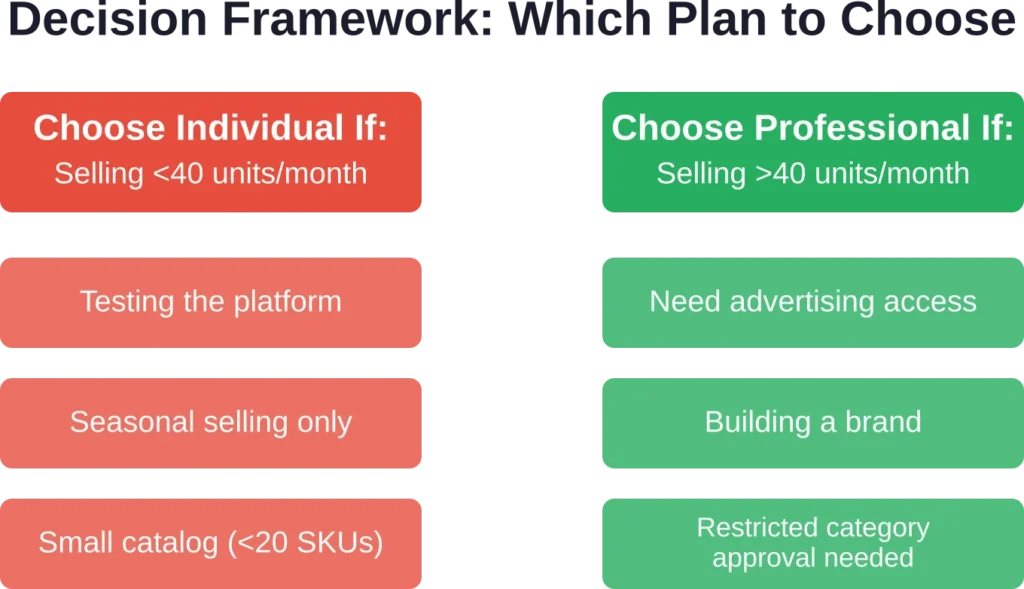
Choose the selling plan based on these questions rather than sales volume alone.
Do you have more than 20 SKUs or expect to grow beyond 20 soon? Professional bulk tools become essential past 20 products. Manual listing management scales poorly.
Will you sell more than 40 units monthly consistently? Professional becomes cheaper on pure subscription cost at this threshold.
Do you need advertising to compete in your category? Saturated markets demand Sponsored Products access. Individual accounts cannot advertise regardless of budget.
Are you entering a restricted category? Many gated categories require Professional status before Amazon reviews approval applications.
Do you operate across multiple sales channels? Multi-channel sellers need API access for inventory sync. Individual accounts lack API entirely.
Is this a test or a committed business? Testing Amazon with minimal commitment suits Individual plans. Building a long-term business requires Professional infrastructure.
Are you seasonal or year-round? Year-round sellers justify Professional subscriptions. Seasonal sellers selling only 2-4 months annually save money with Individual accounts.
Answer these honestly, and the optimal plan becomes clear regardless of what general recommendations suggest.
Frequently Asked Questions
Yes, Amazon allows unlimited plan switches through Seller Central settings. Changes take effect immediately, though Professional subscriptions bill monthly on the same date each month. Downgrading mid-cycle does not refund the prorated portion of that month’s subscription. Frequent switching makes sense for seasonal sellers, though year-round operations rarely benefit from constant plan changes due to operational disruption from losing access to Professional features.
No. Product listings, detail pages, and seller profiles look identical to customers regardless of plan type. Amazon does not display badges, markers, or indicators showing account type. Customers see product title, images, description, price, reviews, and seller feedback rating—nothing about Individual versus Professional status. The plan choice affects seller capabilities and costs, not customer perception or trust.
Yes, both Individual and Professional sellers can use FBA. Fulfillment method choice stays independent of selling plan. Individual sellers pay the same FBA pick-and-pack fees, weight-handling fees, and storage fees as Professional sellers for identical products. FBA provides the same Prime badge, shipping speed, and customer service regardless of seller account type. The selling plan limitation affects advertising and bulk tools, not fulfillment options.
Upgrades process instantly through Seller Central. Navigate to Settings > Account Info > Selling Plan, select Professional, and confirm. Amazon charges the $39.99 subscription immediately and grants access to all Professional features within minutes. Listings do not need republishing, and seller history, feedback ratings, and performance metrics carry over unchanged. The transition causes no operational downtime or customer-facing disruption.
Not directly. Amazon’s search algorithm ranks listings based on relevance, sales velocity, conversion rate, customer satisfaction, and price competitiveness—not seller account type. Professional and Individual sellers compete equally in organic search rankings. However, Professional sellers gain indirect advantages through advertising access. Sponsored Products placements boost visibility, drive sales velocity, and improve organic ranking over time. Individual sellers cannot advertise, losing this growth mechanism despite equivalent organic ranking treatment.
Advertising campaigns stop immediately upon downgrading. Sponsored Products, Sponsored Brands, and Sponsored Display ads pause and stop spending budget. Accumulated campaign data remains accessible if you upgrade back to Professional, but active delivery ceases the moment the account switches to Individual status. Plan downgrades carefully if advertising drives significant sales—the revenue loss from stopped campaigns often exceeds the $39.99 monthly subscription savings.
Amazon generally prohibits operating multiple seller accounts without explicit approval. The restriction applies regardless of selling plans. Sellers with legitimate business reasons for multiple accounts (separate brands, different business entities, acquired companies) can apply for approval through Seller Support. If approved, each account can use different selling plans based on that account’s sales volume and needs. One account could operate on Individual while another maintains Professional status, but both must have pre-approved justification for existing.
Conclusion: The Plan That Fits Your Business Model Wins
The Individual versus Professional decision hinges on operational needs more than pure cost optimization.
Individual plans serve low-volume sellers, seasonal operations, and marketplace testing perfectly. The $0.99 per-item fee costs less than Professional subscriptions under 40 monthly units. Sellers who do not need advertising, bulk uploads, or advanced analytics save money without sacrificing functionality they would not use anyway.
Professional plans enable serious Amazon businesses to scale efficiently. The $39.99 monthly subscription becomes negligible at higher volumes while unlocking advertising, API integration, promotional tools, and restricted category access. Sellers building brands, managing large catalogs, or competing in saturated markets cannot operate effectively on Individual accounts regardless of sales volume.
Sound familiar? That moment when manual listing updates consume hours, or when competitors’ Sponsored Products ads dominate search results while Individual status locks you out of advertising? Those pain points signal Professional plans make sense even before hitting the 40-unit mathematical threshold.
The right plan aligns with business trajectory rather than current state. Sellers planning serious growth invest in Professional infrastructure early. Hobbyists clearing closets stick with Individual and avoid unnecessary overhead.
Review your business model honestly against the decision framework above. The optimal plan becomes obvious once you stop focusing only on subscription cost and start evaluating operational capabilities and growth potential.
Ready to set up your Amazon seller account? Visit Amazon Seller Central to register, choose your initial plan, and remember—switching later takes minutes if your business needs change.